Specter vs. Spectre: What’s the Difference? Meaning, Spelling, and Examples
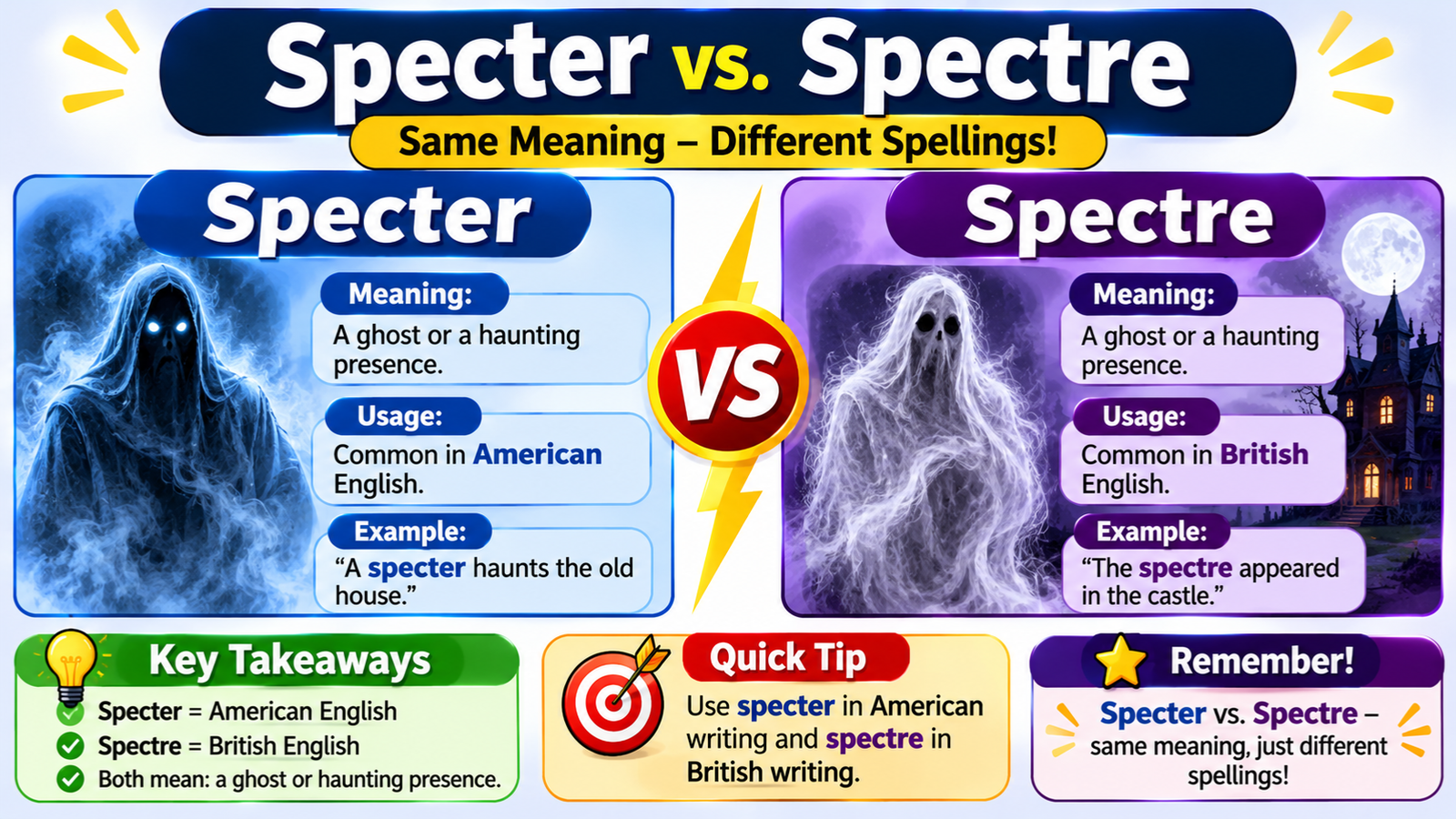
Have you ever wondered whether to write specter or spectre? Both spellings are correct, and they have the same meaning. The main difference is regional preference: specter is the standard American English spelling, while spectre is the traditional British English spelling.
Both words refer to a ghostly apparition, a phantom, or something frightening that creates a sense of fear or uncertainty. They can also describe an unpleasant possibility that seems to threaten the future, such as the specter of war or the spectre of economic collapse.
Although American and British writers generally prefer different spellings, neither version is inherently incorrect. You may even encounter specter in British publications, particularly those following Oxford spelling conventions.
In this guide, you’ll learn what specter and spectre mean, how they are pronounced, where they originated, how they differ across English-speaking countries, and when to use each spelling. You’ll also find practical sentence examples, common expressions, synonyms, and answers to frequently asked questions.
Quick Answer: Specter vs. Spectre
The difference between specter and spectre is primarily a matter of regional spelling, not meaning.
- Specter: The preferred spelling in American English.
- Spectre: The traditional and more common spelling in British English.
- Meaning: Both describe a ghost, apparition, phantom, or frightening possibility.
- Pronunciation: They have the same basic pronunciation, although accents affect the final vowel and the pronunciation of R.
- Part of speech: Both are nouns.
- Plural forms: Specters (American) and spectres (British).
| Feature | Specter | Spectre |
| Preferred variety | American English | British English |
| Meaning | Ghost or threatening possibility | Ghost or threatening possibility |
| Pronunciation | /ˈspek.tɚ/ (US) | /ˈspek.tə/ (UK) |
| Part of speech | Noun | Noun |
| Plural | Specters | Spectres |
| Typical use | US publications | UK publications |
Easy rule: Use specter when writing primarily for American readers. Choose spectre when following traditional British spelling conventions. For either spelling, consistency matters.
What Does Specter Mean?
Specter is a noun that describes a ghost, phantom, or supernatural apparition. It often refers to the visible or imagined appearance of a dead person or another mysterious figure.
The word also has a figurative meaning. It can describe an unpleasant possibility, potential danger, or frightening situation that causes people to feel anxious about the future.
For example, someone might refer to the specter of unemployment when discussing the possibility of losing a job. In this context, the word does not describe an actual ghost. Instead, it represents a threatening possibility.
Specter is the standard American English spelling.
Examples of Specter in Sentences
- A mysterious specter appeared near the entrance of the abandoned house.
- The children believed that a specter haunted the old cemetery.
- The specter of war continued to worry families across the country.
- Rising prices have raised the specter of another economic crisis.
- A pale specter appeared in the window before disappearing into the darkness.
- The possibility of unemployment became a constant specter in his mind.
- The village legend described a specter that wandered through the forest at night.
- The specter of political instability discouraged foreign investors.
- She could not escape the specter of failure after her previous experience.
- The abandoned hospital was surrounded by stories of a terrifying specter.
Common Contexts for Specter
The word appears in several types of writing:
- Supernatural stories: A ghostly figure that appears unexpectedly.
- Literature: A mysterious presence that represents fear, guilt, or an unresolved past.
- News and journalism: A possible threat, such as war, inflation, or financial instability.
- Everyday language: An unpleasant possibility that causes worry or anxiety.
What Does Spectre Mean?
Spectre is a noun with the same meaning as specter. It can describe a ghostly apparition, phantom, or frightening presence.
It can also refer to an imagined or possible danger that creates fear. This figurative meaning is especially common in political, economic, and journalistic writing.
For example, the phrase the spectre of recession describes the possibility of an economic downturn and the anxiety surrounding it.
Spectre is the traditional British English spelling and is commonly used in British publications.
Examples of Spectre in Sentences
- A ghostly spectre appeared in the ruins of the ancient castle.
- The spectre of civil war continued to haunt the country.
- An eerie spectre was reportedly seen near the abandoned church.
- The spectre of poverty remains a serious concern for policymakers.
- The villagers told stories about a spectre that appeared during winter.
- The possibility of another financial crisis raised the spectre of unemployment.
- A mysterious spectre moved silently through the dark corridor.
- The spectre of inflation worried consumers and business owners.
- The old mansion was believed to be haunted by a wandering spectre.
- The spectre of failure prevented him from pursuing his ambitions.
Common Contexts for Spectre
- Ghost stories: A supernatural figure or mysterious apparition.
- Political writing: A possible conflict, crisis, or threat.
- Economic reporting: The possibility of inflation, recession, or financial collapse.
- Literary writing: A haunting memory, fear, or troubling presence.
Specter vs. Spectre: Key Differences Explained
When comparing these two words, the most important point is that their definitions do not change with their spelling.
A writer in the United States may use specter, while a British writer may prefer spectre. Both communicate the same idea.
However, the regional spelling distinction is not an absolute rule. British English includes publications that use the -er form, particularly those following Oxford-style spelling.
1. Spelling
The visible difference is the final two letters:
- Specter ends in -er.
- Spectre ends in -re.
This pattern is similar to other regional spelling differences, including:
| American English | British English |
| Center | Centre |
| Theater | Theatre |
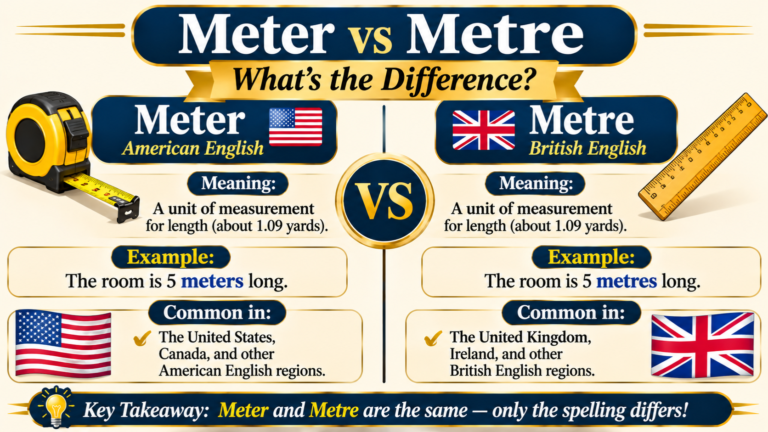
| Meter | Metre |
| Fiber | Fibre |
| Specter | Spectre |
For more examples, see our guide to American and British spelling differences.
2. Meaning
There is no meaningful difference between the definitions.
Both words can refer to:
- A ghost or apparition.
- A supernatural or mysterious figure.
- An imagined threat.
- An unpleasant possibility that causes fear.
For example:
- American: The specter of war frightened the population.
- British: The spectre of war frightened the population.
The meaning remains exactly the same.
3. Pronunciation
The spelling does not create a separate pronunciation. Both words have the same basic sound pattern.
However, American and British accents pronounce the final R differently. American English is generally rhotic, meaning the R is pronounced, while many standard British accents are non-rhotic, meaning the final R is not pronounced unless followed by a vowel sound.
4. Grammatical Function
Both words function as nouns.
They can appear as subjects, direct objects, or objects of prepositions.
Examples:
- The specter frightened the children. (Subject)
- She saw a spectre in the hallway. (Direct object)
- They feared the specter of war. (Object of a preposition)
Is Specter American or British?
Specter is primarily the American English spelling.
American dictionaries and publications generally prefer the -er ending. The spelling follows the broader American tendency to use forms such as center, theater, and meter rather than their traditional British alternatives.
Examples in American English:
- The specter of inflation continues to concern voters.
- A mysterious specter appeared inside the building.
- The possibility of another recession raised the specter of financial hardship.
Although specter is the standard American choice, it is not exclusively used in the United States. British writers and publishers may also use it, particularly when following Oxford spelling conventions or a specific editorial style.
Is Spectre American or British?
Spectre is the traditional British English spelling.
It is widely used in the United Kingdom and in other English-speaking regions influenced by British spelling conventions.
Examples in British English:
- The spectre of economic collapse worried investors.
- A mysterious spectre appeared in the ancient ruins.
- The spectre of another conflict dominated political discussions.
The spelling is also familiar to readers in Australia, New Zealand, and Ireland.
However, British English is not completely uniform. Some British publishers prefer -ize and -er forms where other publishers use -ise and -re. Always check the relevant style guide.
Specter vs. Spectre: Which Spelling Do Different Countries Use?
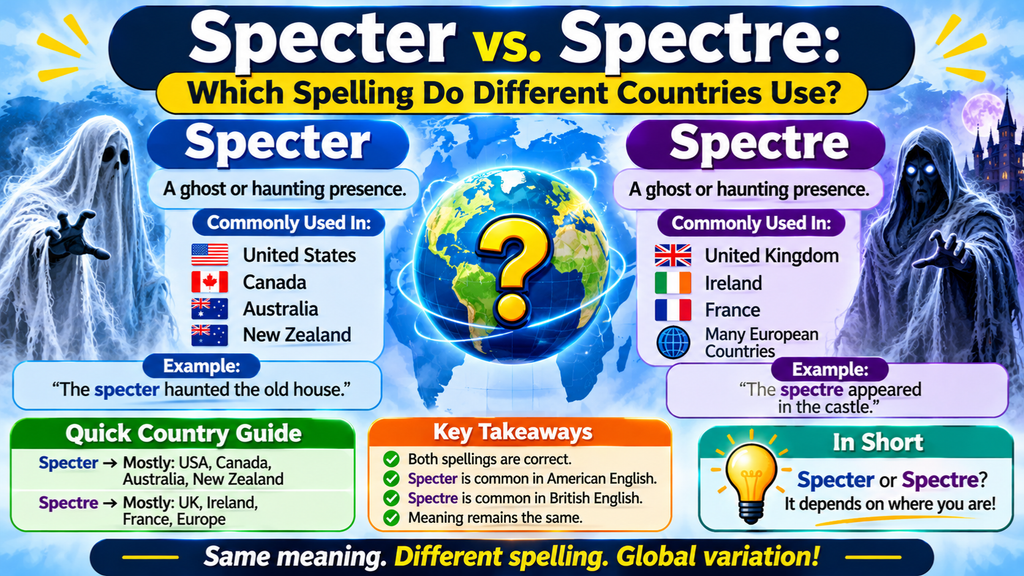
Regional spelling preferences are useful when deciding which version to choose for a particular audience.
| Country or region | Commonly preferred spelling | Important note |
| United States | Specter | Standard American spelling |
| United Kingdom | Spectre | Traditional British spelling |
| Canada | Spectre or Specter | Follow the publication’s style |
| Australia | Spectre | British-style spelling convention |
| New Zealand | Spectre | British-style spelling convention |
| Ireland | Spectre | British-style spelling convention |
These are practical regional preferences, not exclusive rules. The presence of one spelling does not automatically make the other incorrect.
What About Canada?
Canadian English combines features of American and British spelling. As a result, writers should avoid assuming that every -re word follows one universal Canadian rule.
Both forms may be encountered, although spectre is consistent with traditional British-style spelling.
For Canadian publications, the safest approach is to follow the publisher’s house style.
What About Australia and New Zealand?
Australian and New Zealand English generally retain many traditional British spelling conventions. Therefore, spectre is the natural choice for writers following those conventions.
How to Pronounce Specter and Spectre
Both words share the same basic pronunciation.
| Variety | IPA pronunciation |
| American English | /ˈspek.tɚ/ |
| British English | /ˈspek.tə/ |
The first syllable receives the main stress.
You can break the word into two syllables:
SPEC-ter
The main pronunciation differences come from regional accents rather than the spelling itself.
For example, American speakers generally pronounce the final R, whereas speakers of many British accents do not pronounce it in the same way.
Importantly, writing specter instead of spectre does not change the intended word or its pronunciation.
Origin and Etymology of Specter and Spectre
The history of these words helps explain why English has two spellings.
Both forms are connected to the French word spectre and the Latin word spectrum, which referred to an appearance, image, or apparition.
The Latin word is associated with the verb specere, meaning to look at or observe.
The word entered English around the beginning of the seventeenth century. It originally referred to a frightening ghost or apparition.
Over time, its meaning expanded beyond supernatural appearances.
How Did the Word Develop Its Figurative Meaning?
The figurative sense developed as writers began using the image of a ghost to describe something that continued to trouble or frighten people.
By the eighteenth century, the word was being used to represent an object of dread or an unpleasant possibility.
For example:
- The specter of war.
- The spectre of poverty.
- The specter of political instability.
These expressions describe threats rather than actual supernatural beings.
Why Did American English Adopt Specter?
American English developed several spelling preferences that differed from traditional British forms.
One recognizable pattern is the use of -er instead of -re in words such as:
- Center instead of centre.
- Theater instead of theatre.
- Meter instead of metre.
- Specter instead of spectre.
The spelling reforms associated with American lexicographer Noah Webster helped popularize several American spelling conventions.
However, the history of each word is different, and it would be inaccurate to assume that every -er spelling originated from a single reform.
For more information about spelling history, see the Etymonline entry for specter.
Specter vs. Spectre in Literal and Figurative Language
One of the most interesting features of these words is that they can describe both supernatural appearances and abstract threats.
Understanding the difference between literal and figurative usage makes it easier to interpret them correctly.
Literal Meaning: A Ghost or Apparition
When used literally, a specter or spectre refers to a ghostly figure or supernatural appearance.
Examples:
- A specter appeared at the end of the hallway.
- The villagers claimed that a spectre haunted the old bridge.
- The writer described a pale specter standing beside the window.
- A strange specter appeared in the moonlight.
- The children believed that a spectre lived inside the abandoned house.
In these sentences, the words describe an actual or imagined ghostly figure.
Figurative Meaning: A Threat or Fear
In figurative writing, the words represent something unpleasant that may happen.
Examples:
- The specter of recession worried small-business owners.
- The spectre of war threatened regional stability.
- The specter of unemployment affected consumer confidence.
- The spectre of poverty remained a major political concern.
- The spectre of failure discouraged the young entrepreneur.
In these examples, no ghost is involved. The words communicate fear, uncertainty, and possible danger.
Common Expressions Using Specter and Spectre
Both spellings appear in several established expressions.
| Expression | Meaning | Example |
| The specter of war | The possibility of war | The specter of war affected diplomatic negotiations. |
| The spectre of poverty | The threat of poverty | The spectre of poverty worried the community. |
| The specter of failure | Fear of failing | The specter of failure held him back. |
| The spectre of inflation | The possibility of rising prices | The spectre of inflation concerned investors. |
| The specter of death | The fear or presence of death | The specter of death haunted the novel’s main character. |
| A ghostly spectre | A supernatural apparition | A ghostly spectre appeared near the tower. |
The expression raise the specter/spectre of something is particularly common in formal writing.
It means to introduce or create the possibility of something unpleasant.
For example:
“The announcement raised the specter of another financial crisis.”
Singular and Plural Forms: Specter, Specters, Spectre, and Spectres

Both words are countable nouns. Their plural forms follow the normal English rule of adding -s.
| Singular | Plural | English variety |
| Specter | Specters | American English |
| Spectre | Spectres | British English |
Examples:
- A specter appeared near the cemetery.
- Several specters appeared in the old mansion.
- A spectre haunted the ancient castle.
- The villagers reported seeing multiple spectres.
Remember to maintain the same spelling throughout your article.
For example, if you begin with specter, use specters rather than switching to spectres later.
Synonyms and Related Words
Specter and spectre have several synonyms. However, not every synonym works in exactly the same context.
Some refer specifically to supernatural beings, while others describe fear or danger.
| Synonym | Meaning | Example |
| Ghost | The spirit of a dead person | A ghost appeared in the hallway. |
| Phantom | An imaginary or ghostly figure | A phantom disappeared into the mist. |
| Apparition | A supernatural or unexpected appearance | An apparition frightened the visitors. |
| Wraith | A ghostly figure, often associated with death | A wraith wandered through the forest. |
| Spirit | A supernatural or nonphysical being | The spirit appeared in the old house. |
| Haunting presence | Something that remains disturbing or mysterious | A haunting presence filled the room. |
| Menace | A possible source of danger | The growing menace worried residents. |
| Threat | Something that may cause harm | The threat of war affected the region. |
Specter vs. Ghost
A ghost usually refers directly to the spirit of a dead person.
A specter can also describe a ghost, but it is particularly useful when the writer wants to create a mysterious, frightening, or literary atmosphere.
Specter vs. Phantom
A phantom is generally an imaginary or ghostlike figure. A specter often carries a stronger association with fear or something disturbing.
Specter vs. Apparition
An apparition emphasizes the appearance of a supernatural figure. A specter can describe that figure or a figurative source of fear.
Common Mistakes When Using Specter and Spectre
Although the difference is simple, writers sometimes misunderstand how these words work.
1. Assuming One Spelling Is Incorrect
A common mistake is believing that spectre is wrong because American dictionaries prefer specter, or that specter is incorrect because British dictionaries prefer spectre.
Both are established English spellings.
2. Thinking They Have Different Meanings
The two forms do not describe different types of ghosts or threats. Their meanings are essentially identical.
3. Confusing Spelling With Pronunciation
The spelling difference does not create a separate word or a fundamentally different pronunciation.
Regional accents may affect the final R sound, but that is an accent difference.
4. Mixing Regional Spellings
Using specter in one paragraph and spectres in another can make a document inconsistent.
Choose one regional spelling system and follow it.
5. Using Specter Only for Actual Ghosts
Both words have important figurative meanings.
For example, “the specter of inflation” describes a possible economic threat, not a supernatural event.
6. Confusing Specter With Spectrum
Although the words share a historical connection, they have different modern meanings.
- Specter: A ghost or frightening possibility.
- Spectrum: A range of related values, qualities, or frequencies.
For example, the electromagnetic spectrum refers to a range of electromagnetic radiation, not a ghost.
When Should You Use Specter or Spectre?
The best spelling depends on your audience, publication, and preferred style guide.
Use this simple decision guide:
- Writing for the United States? Choose specter.
- Writing for the United Kingdom? Choose spectre as the traditional preference.
- Writing for Australia or New Zealand? Choose spectre when following British-style conventions.
- Writing for Canada? Check the publisher’s preferred spelling.
- Writing for an international audience? Select one spelling system and apply it consistently.
- Following a university or company style guide? Follow its spelling requirements.
If you manage an English-learning or educational website, it is especially important to establish a consistent spelling policy.
Since American readers are your primary audience, specter is the appropriate default for American-targeted content.
For a broader explanation of regional spelling patterns, explore our guides to Splendor vs. Splendour and Standardize vs. Standardise.
Frequently Asked Questions About Specter vs. Spectre
1. What is the difference between specter and spectre?
Specter is the preferred American English spelling, while spectre is the traditional British English spelling. Both have the same meaning: a ghost, apparition, or frightening possibility.
2. Is specter American or British?
Specter is primarily the American English spelling. However, it also appears in British English, especially in publications that follow Oxford-style spelling.
3. Is spectre American or British?
Spectre is the traditional British English spelling. It is also commonly used in Australia, New Zealand, and Ireland.
4. Do specter and spectre have the same meaning?
Yes. Both words refer to a ghostly apparition or an unpleasant possibility that causes fear or concern.
5. Are specter and spectre pronounced the same?
They share the same basic pronunciation. The final R sound may differ between American and British accents, but the spelling itself does not create a pronunciation distinction.
6. Can Americans use spectre?
Yes. Americans can understand and use spectre, but specter is the standard spelling for most American writing.
7. Can British writers use specter?
Yes. British writers can use specter, particularly when following Oxford spelling or a publisher’s preferred style. However, spectre remains the traditional British choice.
8. What is the plural of specter and spectre?
The plural of specter is specters, while the plural of spectre is spectres. Both follow the regular English plural rule.
9. What is the origin of specter and spectre?
Both spellings trace their history to the French spectre and Latin spectrum, meaning an appearance, image, or apparition. The word entered English around the beginning of the seventeenth century.
10. What does the phrase “the specter of war” mean?
It refers to the possibility or threat of war. It is a figurative expression that describes fear and uncertainty rather than an actual ghost.
Final Thoughts
The difference between specter and spectre comes down to regional spelling preferences. Both words are correct, have the same meaning, and can describe either a supernatural apparition or an unpleasant possibility.
Remember these simple rules:
- Specter: Preferred American English spelling.
- Spectre: Traditional British English spelling.
- Meaning: Identical in both forms.
- Pronunciation: The same basic word, with accent-related differences.
- Plural: Specters (US) and spectres (UK).
If you’re writing for an American audience, choose specter. If you’re following traditional British English conventions, use spectre.
Ultimately, the most important thing is to understand your audience and maintain consistent spelling throughout your writing.