
Sell vs Sale in English: Difference, Meaning, Pronunciation and Examples
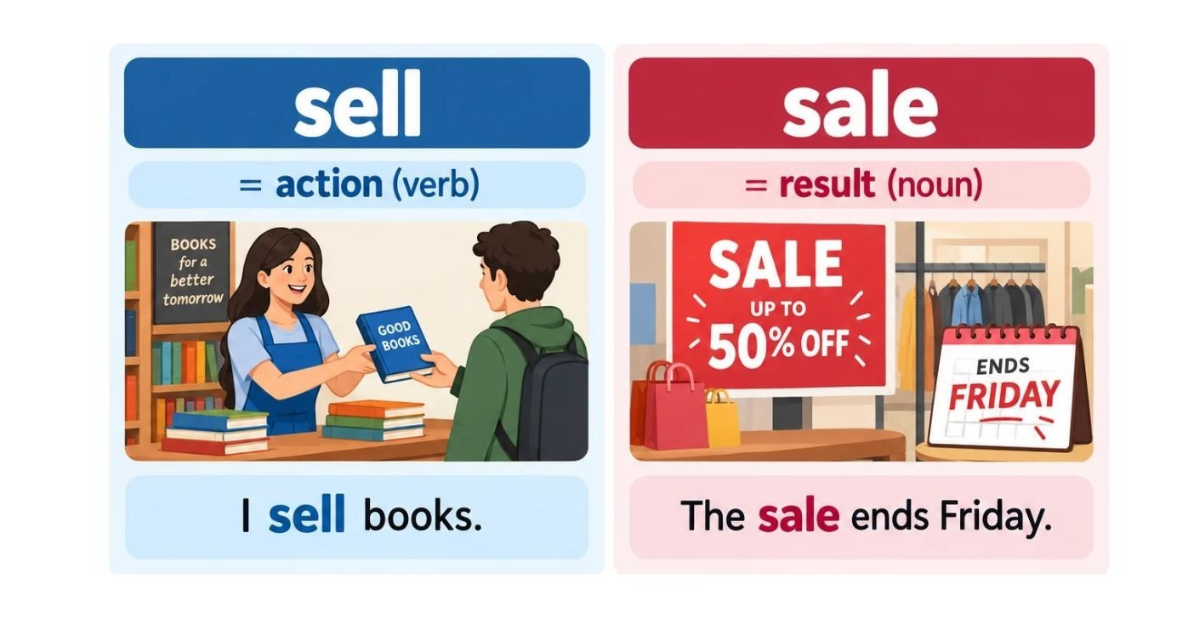
Sell vs sale in English is really a question about parts of speech. Sell is a verb: it’s something you do (I sell books). Sale is a noun: it names the act, one deal, or a time when prices drop (the sale ends Friday). If you can put it in front, you want to sell. If you can put them in front, you want to sell them. This page covers what each word means, how they sound, what the signs in shop windows say, and where the two words came from.Sell or Sale? The Quick Answer
| Sell | Sale | |
| Part of speech | Verb | Noun |
| Core meaning | To give something and receive money for it | The act of selling, one deal, or a discount event |
| Example | I sell books. | The sale ends Friday. |
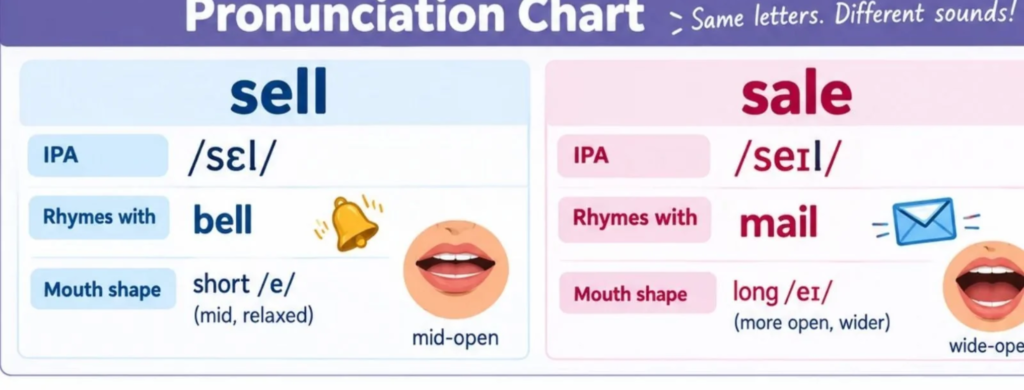
| Rhymes with | bell, tell, well | mail, tail, fail |
What Does “Sell” Mean? (Verb Meanings and Uses)
The core meaning is to give something to someone for money. The same verb also covers a few other situations:
- To be bought. The thing sold becomes the subject: These sandwiches sell fast at lunchtime. The book sold well.
- To persuade. She sold the idea to the board. No goods change hands. You are winning someone over.
- To betray for gain. He sold his friends out for a promotion.
- As a noun, inside set phrases. The pay freeze was a hard sell. Dictionaries treat sell as a verb, and this noun turns up mainly in phrases like hard sell, soft sell and easy sell.
What Does “Sale” Mean? (Noun Meanings and Uses)
- The act or one transaction. It was our first sale of the day.
- A reduced-price event. The shop’s winter sale starts on Monday.
- An event where goods are sold, especially an auction or a bake sale.
The plural sales has two meanings of its own: the amount sold (Sales rose by ten percent) and the department that does the selling (She works in sales).
For Sale vs On Sale (and Sold, Sold Out)
Signs are where most readers meet these words, and each one says something different.
| Sign | What it tells you |
| For sale | The owner is offering it to buyers. It says nothing about the price. |
| Sale or on sale | Prices are reduced. In Oxford’s labelling, this sense of on sale is especially North American. |
| Tickets go on sale Friday | They become available to buy. On sale in this sense carries no discount. |
| Sold | A buyer already has it. |
| Sold out | None are left. |
British shoppers also say in the sale or in the sales for reduced prices (I got these shoes in the sale). Another British phrase, sale or return, describes goods a shop can send back to the supplier if they don’t sell.
How to Pronounce Sell and Sale (IPA and Simple Phonetics)
| Word | Simple phonetics | IPA | Rhymes with |
| sell | “sel” | /sɛl/ (some dictionaries write /sel/) | bell, tell, well |
| sale | “sayl” | /seɪl/ | mail, tail, fail |
Sell has a short vowel, like the e in bed. Sale glides: start at “eh” and slide towards “ee” before the l. They also have homophones: sell sounds like cell, and sale sounds like sail. Try We sell sails at the sale slowly, then at speed.
Sell vs Sale Grammar: Verb, Noun, Forms and Prepositions
Sell as a Verb: Forms, Objects and Prepositions
| Form | Word | Example |
| Base | sell | I sell vegetables. |
| Third person | sells | She sells vegetables. |
| Present participle | selling | They are selling their house. |
| Past simple and participle | sold | He sold his car. The tickets have been sold. |
The past form is sold, never selled. Sell works with or without an object: She sold her bicycle (transitive), This model sells well (intransitive).
Common prepositions: sell to a person, sell for or sell at a price, sell by a method (sell by auction).
Sale as a Noun: Singular, Plural and Prepositions
Sale is countable (two sales this morning), but in for sale and on sale it appears without an article. It takes off (the sale of the building) and by a method (sale by tender).
British and American usage differ in more than spelling here, and the same split shows up in pairs like prioritize vs prioritise.
“Sale of” or “Selling of”?
Both are correct, and they tend to feel different. The sale of the house treats it as one event: The sale of the house was finalised in May. The selling of the house treats it as a process: The selling of the house took months because of the paperwork. If you could say “the deal,” use sale. If you mean “all the work involved,” use selling.
Sell and Sale in a Sentence: Casual, Business and Formal Examples
- “I’m going to sell my old bike online. It’s just collecting dust.”
- “Everything in the shoe shop is half price in the sale this weekend.”
- “We sold just over three hundred units in the first week.”
- “The sale of the subsidiary is expected to close in March.”
- “Tickets for the concert sold out in under ten minutes.”
- “The selling of the house dragged on for months, but the sale itself took an afternoon.”
Synonyms and Opposites of Sell and Sale
- Vend: formal; used for traders, vending machines and legal wording.
- Retail: to sell directly to the public.
- Market: to promote and sell. The focus is on advertising, not the handover.
- Peddle: to sell by going from place to place. It is also used for dubious goods or ideas, as in peddling nonsense.
- Transaction and deal: words for the sale itself. Transaction is neutral and formal, deal is informal.
- Clearance and markdown: a clearance is a sale to empty the shelves, while a markdown is the price cut itself.
Opposites: buy (everyday) and purchase (formal) are the opposite of sell. Keep and retain are the opposite when you hold on to something.
Where Do Sell and Sale Come From?
Old English sellan, the ancestor of sell, did not mainly mean “sell.” According to Etymonline, it meant “to give, furnish, supply, lend,” and even “surrender.” The commercial sense of giving something up for money was already present by late Old English. The older meaning lingered for centuries: Chaucer’s selle can still mean “give.” The usual Old English verb for selling was a different word, bebycgan, built on bycgan, “to buy.”
Sale comes from late Old English sala, “act of selling.” The OED considers a Scandinavian source such as Old Norse sala probable. Both words trace back to a Proto-Germanic root and, further back, to a root meaning “to take, grasp.” Unlike most verb-and-noun pairs, sale isn’t built from sell with a suffix. It’s an old noun in its own right, which is part of why the pair looks odd.
The phrases are old too. Etymonline dates on sale to the 1540s and for sale to the 1610s, and the reduced-price shop sale to 1866.
Idioms and Set Phrases with Sell and Sale
- Sell like hot cakes: to be bought quickly or in great numbers. The new trainers are selling like hot cakes.
- Sell yourself short: to value yourself too little. Don’t sell yourself short in the interview.
- Be sold on something: to be very enthusiastic about it (informal). I’m not sold on the idea.
- Point of sale: the place or moment a purchase is made. Point-of-sale displays sit next to the till.
Common Mistakes with Sell vs Sale
| Mistake | Fix | Note |
| They sell houses. | They sell houses. | You need a verb here. |
| The car is for sale. | The car is for sale. | For sale is a fixed phrase with a noun. |
| The sale starts Friday. | The sale starts Friday. | Noun sell appears only in phrases like hard sell. |
| I selled my laptop. | I sold my laptop. | Sales are irregular. |
| A sale on shoes. | A sale on shoes. | Sales means revenue or the department. |
| The boat’s shell was torn. | The boat’s sail was torn. | Homophone. |
| My cell phone is broken. | My cell phone is broken. | Homophone. |
Past-tense slips happen in other words too, such as happened versus happend. So do singular and plural slips, for example experience vs experiences. Quick test: if to or will fit in front (to sell, will sell), use the verb. If you need a or the (a sale), use the noun.
FAQs
What is the difference between sell and sale?
Sell is a verb meaning to give something in exchange for money, as in I sell shoes. Sale is a noun meaning the act of selling, one deal, or a time when prices are lowered, as in the shoe sale. Sell is the action; sale is what happens. Sell rhymes with bell, and sale rhymes with mail.
Is it “for sale” or “for sale”?
The correct phrase is “for sale”. The phrase needs a noun, and sale is a noun while sell is a verb. You see it on signs and listings, such as House for sale or Not for sale. “For sell” is not standard English.
What is the difference between “for sale” and “on sale”?
“For sale” means an item is available to buy and says nothing about the price. “On sale” usually means the item is discounted, especially in American English. In both American and British English, “go on sale” can also mean to become available, as in tickets go on sale Friday.
Can sell be a noun?
Rarely. Dictionaries list sell as a verb, and the noun appears mainly inside set phrases such as hard sell, soft sell and easy sell, where it means an act of persuading. It never means a transaction or a discount event. For those, use sales. When in doubt, sale is the noun and sell is the verb.
What is the past tense of sell?
The past tense and past participle of sell are sold. Sell is an irregular verb, so selled is not standard. Use sold in sentences like She sold her car last week and The house has been sold. For the present participle, use selling, as in They are selling tickets.
Conclusion
The difference between Sell vs Sale comes down to what the word is doing. Sell is a verb, the action of giving something for money (I sell books). Sale is a noun, the thing that happens: one deal, the act of selling, or a time when prices drop (the sale ends Friday). A quick test settles most cases. If it fits in front, use sell. If the or fits, use sales.
Watch the few spots where people slip. The past tense is sold, never selled. The sign is for sale, not for sale. On sale usually means discounted, especially in American English, while for sale only says something is available. And sell and sale sound close but not identical: sell rhymes with bell, sale with mail.



One Comment