
Criteria vs. Criterion: Meaning, Difference, Plural Rules and Examples
Should you write “the main criteria is price” or “the main criterion is price”? If you have ever stopped mid-sentence to wonder, you are in good company. The criteria vs. criterion question trips up students, job applicants, managers, and even experienced editors, because the two words look almost identical and both show up in formal writing about standards, requirements, and judgments.
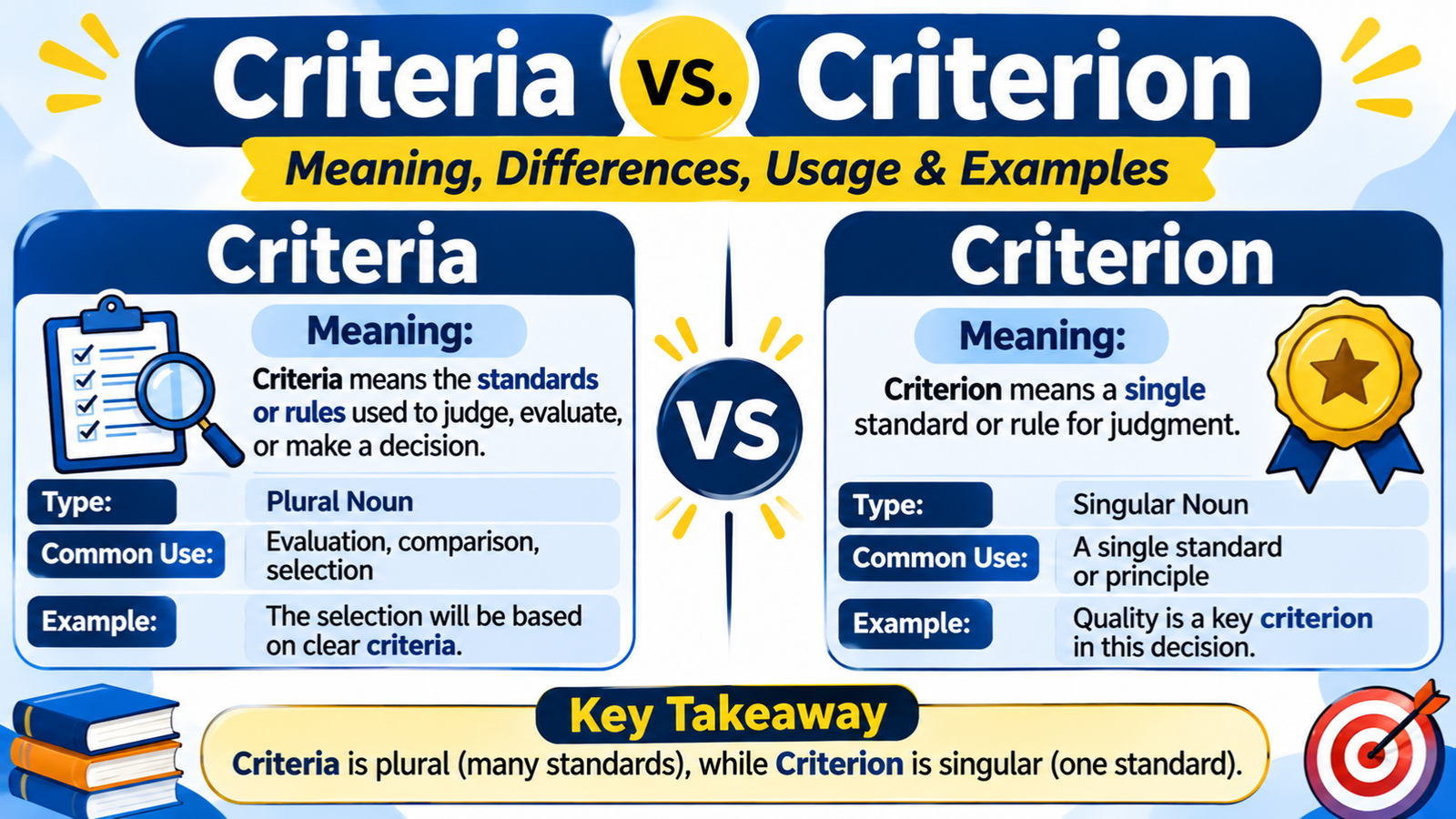
Here is the short version: criterion is singular (one standard) and criteria is plural (two or more standards). The rest of this guide explains the meaning of each word, where they come from, how to match them with the right verb, and how to avoid the mistakes that make otherwise strong writing look careless. You will also find more than 40 example sentences, a comparison table, a short practice quiz, and a FAQ.
If you enjoy quick, plain-language grammar guides, browse our full collection of Vs guides for more commonly confused words.
Quick Answer: Criteria vs. Criterion
Keep this rule in mind and you will be right almost every time:
- Criterion = one standard, rule, test, or requirement used to judge something.
- Criteria = more than one standard, rule, test, or requirement.
Both words are nouns. Criterion is the singular noun, and criteria is its plural noun form. That is the entire grammar difference. Importance, formality, and meaning do not change between them. Only the number changes.
Fast check: Count the standards you are talking about. One means criterion. Two or more means criteria.
Criteria vs. Criterion Comparison Table
| Feature | Criterion | Criteria |
| Number | Singular | Plural |
| Meaning | One standard or requirement | Two or more standards or requirements |
| Pronunciation | kry-TEER-ee-on | kry-TEER-ee-a |
| Matching verb | is, was, has | are, were, have |
| Matching determiner | a, one, this, the single | these, those, several, all, many |
| Example | Cost is the key criterion. | Cost and quality are the key criteria. |
| Common error | Replacing it with “criteria” | Adding an extra s (“criterias”) |
What Does “Criterion” Mean?
A criterion is a single standard by which something is judged, measured, or decided. When you evaluate a job candidate, a product, a poem, or a loan application against one test, that test is a criterion.
Dictionaries such as Merriam-Webster, Oxford, and Cambridge define it in very similar terms: a principle or standard on which a judgment or decision may be based.
Examples of “criterion”:
- Price is the most important criterion when buying a used car.
- Accuracy was the only criterion the judges applied.
- Safety is a non-negotiable criterion for this design.
- One criterion for the scholarship is a minimum GPA of 3.5.
- What single criterion would you use to rank these candidates?
- Relevance is the first criterion we check when reviewing sources.
- Her sole criterion for choosing an apartment was a short commute.
- Originality served as the main grading criterion for the essay.
Notice that every sentence is about exactly one standard. If you can swap in “one requirement” or “one standard” and the sentence still makes sense, criterion is the right word.
What Does “Criteria” Mean?
Criteria is the plural of criterion. It refers to a set of two or more standards used together to evaluate, select, compare, or measure something.
Examples of “criteria”:
- The hiring criteria include experience, education, and communication skills.
- Our review criteria are performance, durability, and value for money.
- The committee published the selection criteria last week.
- Applicants must meet all the eligibility criteria.
- The judging criteria have been simplified this year.
- What criteria do universities use to decide admissions?
- These criteria apply to every department.
- Several criteria were considered before the final decision.
Whenever more than one factor is involved, whether they are listed or only implied, criteria is the correct choice.
Where These Words Come From
Understanding the origin makes the pattern easier to remember. Both words come from Greek. Criterion traces back to the Greek word kritērion, meaning a means for judging or a standard, which in turn relates to krinein, “to judge” or “to decide.” The same root gives us words like critic, critique, critical, and crisis.
English borrowed criterion with its original Greek plural, criteria. That is why the plural does not follow the usual rule of adding -s or -es. Many other Greek and Latin loanwords keep their original plurals, as shown in the table later in this guide.
Criteria vs. Criterion in American English
If you are writing for a US audience, here is the good news: there is no American versus British spelling difference for these words. Unlike color and colour or organize and organise, both varieties spell and pluralize criterion and criteria the same way.
What does vary is how strictly editors and readers in the United States enforce the singular-plural rule in formal settings. Major American style references, including the AP Stylebook, the Chicago Manual of Style, and the APA and MLA guidelines, generally expect criteria to be treated as plural and criterion as singular. Always check the current edition of the guide your school, employer, or publisher requires.
| Writing situation (US) | What readers expect |
| News and journalism (AP style) | criterion = singular, criteria = plural |
| Books and academic publishing (Chicago) | criteria takes a plural verb |
| College papers (APA or MLA) | criteria takes a plural verb |
| Business emails and policies | correct agreement signals professionalism |
| Casual texting and speech | “criteria is” is common but not formal |
Since you may also be sorting out other US-versus-UK differences while you edit, see our guides on Prioritize vs Prioritise, Colonize vs Colonise, and Marveled or Marvelled.
Subject-Verb Agreement: Is or Are?
The fastest way to catch a mistake is to check the verb. Subject-verb agreement means a singular subject takes a singular verb and a plural subject takes a plural verb.
| Subject | Correct verb form | Example |
| Criterion (singular) | is / was / has | The main criterion is clear. |
| Criteria (plural) | are / were / have | The main criteria are clear. |
More examples:
- ✅ The only criterion that matters is accuracy.
- ✅ The criteria that matter are accuracy and speed.
- ❌ These criteria is difficult to meet.
- ✅ These criteria are difficult to meet.
- ❌ This criteria was never explained.
- ✅ This criterion was never explained.
If your verb ends in -s (matters, remains, depends) and the noun is “criteria,” you probably have a mismatch.
Tricky Agreement Cases (Sets, Numbers and Pairs)
The basic rule is easy. A few sentence patterns, however, cause hesitation even for confident writers.
1. “A set of criteria” The subject is set, which is singular, so the verb is singular.
- ✅ A set of criteria is posted on the website.
- ✅ The criteria in that set are clearly written.
2. “A number of criteria” vs. “The number of criteria”
- ✅ A number of criteria are still under review. (plural meaning)
- ✅ The number of criteria is limited to five. (the subject is number)
3. “Each of the criteria” and “all of the criteria”
- ✅ Each of the criteria is explained below.
- ✅ All of the criteria are explained below.
4. “Either” and “neither”
- ✅ Neither criterion is negotiable.
- ✅ Either criterion is acceptable.
5. Two standards joined by “and”
- ✅ Cost and quality are the two main criteria.
6. After “the following”
- ✅ The following criteria apply: age, residency, and income.
Whenever you are unsure, find the true subject of the sentence, decide if it is singular or plural, and match the verb to it.
Correct Prepositions and Word Combinations
Writers often wonder which verbs and prepositions pair naturally with these words. These collocations appear constantly in reports, applications, and policies.
| Pattern | Example |
| meet the criteria | Applicants must meet all the criteria. |
| satisfy a criterion | The proposal satisfies each criterion. |
| fulfill the criteria | She fulfilled the criteria for promotion. |
| set / establish criteria | The board established new criteria. |
| apply a criterion | We apply one criterion to every submission. |
| criteria for | The criteria for admission are posted online. |
| criterion for | Experience is a key criterion for this role. |
| criteria by which | These are the criteria by which we judge entries. |
| based on / according to criteria | Candidates are ranked according to clear criteria. |
| fail to meet the criteria | The application failed to meet the criteria. |
What About the Possessive?
Possessive forms of these words can look awkward, so many writers avoid them.
- Singular possessive: the criterion’s importance
- Plural possessive: the criteria’s weight (grammatical but clumsy)
A smoother option is to use “of” instead: the importance of the criterion or the weight of the criteria.
Why So Many People Say “Criteria Is”
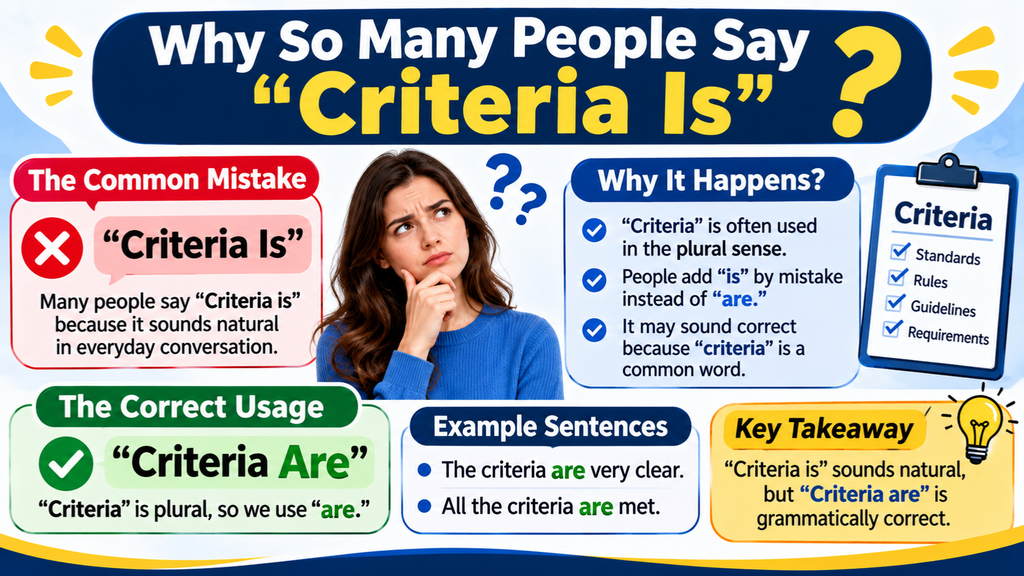
If the criteria vs. criterion rule is this simple, why does the mistake appear everywhere, from emails to news articles to job postings? There are a few reasons.
1. The plural is far more common. Most of the time, we judge things by several standards, so we meet “criteria” far more often than “criterion.” The singular starts to feel unusual and overly formal.
2. The ending looks singular. Words ending in -a, like “idea,” “area,” and “formula,” are normally singular. Our brains treat “criteria” the same way.
3. Casual speech tolerates it. In everyday conversation, saying “the criteria is simple” rarely causes confusion, so people stop correcting it.
4. Singular use is documented. Some dictionaries and usage guides acknowledge that “criteria” is sometimes used as a singular in informal English. However, usage guides and style authorities continue to recommend the traditional distinction in formal writing, and many editors and professors will mark the error.
The takeaway: a mistake being common does not make it correct in formal contexts. If you want your writing to read as polished, keep the distinction.
Common Mistakes and How to Fix Them
Most errors in the criteria vs. criterion choice fall into the same few patterns, shown below.
| Mistake | Why it’s wrong | Correct version |
| “The criteria is price.” | Criteria is plural, so it needs are | “The criterion is price.” or “The criteria are price and quality.” |
| “My only criteria is comfort.” | “Only” signals one standard | “My only criterion is comfort.” |
| “We reviewed all the criterias.” | Criteria is already plural | “We reviewed all the criteria.” |
| “One criteria is enough.” | “One” requires the singular | “One criterion is enough.” |
| “These criterion are strict.” | Plural noun needed after these | “These criteria are strict.” |
| “Each criteria must be met.” | “Each” takes a singular noun | “Each criterion must be met.” |
A note on “criterions”
You may see criterions as an alternate plural in some dictionaries. It exists, but it is rare and sounds unnatural to most readers. In everyday and professional writing, use criteria as the plural.
Before-and-After: Fix These Sentences
Learning by editing is one of the fastest ways to build the habit. Study each row, then cover the right-hand column and try to fix the sentence yourself.
| Before (incorrect) | After (correct) | Reason |
| The criteria is cost. | The criterion is cost. | One standard, singular verb |
| Our only criteria was speed. | Our only criterion was speed. | “Only” signals one |
| All the criterion are listed. | All the criteria are listed. | “All” signals plural |
| Each criteria must be met. | Each criterion must be met. | “Each” takes singular |
| Three criterion were used. | Three criteria were used. | Plural number needs plural noun |
| We updated the criterias. | We updated the criteria. | No extra s |
| This criteria needs review. | This criterion needs review. | “This” signals singular |
| Those criterion are strict. | Those criteria are strict. | “Those” signals plural |
| The hiring criteria is unclear. | The hiring criteria are unclear. | Plural subject |
| One criteria is enough. | One criterion is enough. | “One” signals singular |
Real-Life Examples by Context
The criteria vs. criterion rule works the same in every field. These pairs show it in action.
Seeing the words in real situations makes the rule stick. Each pair below shows singular and plural usage.
Job Interviews and Hiring
- Criterion: The most important criterion for this role is relevant experience.
- Criteria: Our hiring criteria include experience, teamwork, and problem-solving skills.
School and College Admissions
- Criterion: Academic performance is one admission criterion.
- Criteria: Admission criteria vary between universities.
Buying a Home or Car
- Criterion: Location was our primary criterion.
- Criteria: Our criteria were price, size, and neighborhood safety.
Competitions and Judging
- Criterion: Creativity was the deciding criterion.
- Criteria: The judging criteria were announced before the contest.
Product Reviews
- Criterion: Battery life is the first criterion we test.
- Criteria: We rate every phone on five criteria: display, camera, performance, battery, and price.
Scholarships and Grants
- Criterion: Financial need is the sole criterion for this grant.
- Criteria: Applicants must satisfy the following eligibility criteria.
Research and Science
In research, you will often see the terms inclusion criteria and exclusion criteria, which describe who can or cannot take part in a study. Single conditions within those lists are individual criteria, and any one of them is a criterion.
- Criterion: Age over 18 is an inclusion criterion.
- Criteria: Participants were screened against strict inclusion and exclusion criteria.
Software and Project Management
Teams that use agile methods write acceptance criteria to describe when a task counts as done.
- Criterion: Each user story needs at least one acceptance criterion.
- Criteria: The acceptance criteria were reviewed in sprint planning.
Healthcare
Clinicians refer to diagnostic criteria when deciding whether a patient meets the definition of a condition.
- Criterion: Persistent symptoms for six months is one diagnostic criterion.
- Criteria: The patient met the diagnostic criteria.
Criteria vs. Criterion in Everyday US Situations
Because you are writing for an American audience, here are scenarios that readers in the United States meet all the time. Each shows how the singular and plural forms work in practice.
College Admissions
Admissions offices look at several factors, such as grades, essays, activities, and recommendations. When talking about the group, use the plural. When singling out one factor, use the singular.
- Criteria: Many colleges publish their admission criteria online.
- Criterion: For this scholarship, community service is the primary criterion.
Scholarships and Financial Aid
Aid programs set rules that applicants must follow, including federal programs such as the FAFSA.
- Criteria: Applicants must meet the eligibility criteria to receive aid.
- Criterion: Financial need is the only criterion for this grant.
Job Postings and Resumes
Recruiters screen applicants against requirements, and employers often use applicant tracking software to sort resumes. Matching the language of a posting is smart, as long as your grammar is correct.
- Criteria: I meet all the criteria listed in your job description.
- Criterion: Five years of management experience is one criterion I exceed.
Mortgages and Real Estate
Lenders weigh credit score, income, and debt-to-income ratio together.
- Criteria: Lenders use underwriting criteria to approve loans.
- Criterion: Credit score is one criterion buyers should check early.
Health Insurance
Insurers publish rules about what they will cover.
- Criteria: Plans use medical necessity criteria to decide on coverage.
- Criterion: Prior authorization is a criterion for some procedures.
Government Grants and Contracts
Requests for proposals usually explain how responses will be scored.
- Criteria: Proposals are scored against the evaluation criteria in the solicitation.
- Criterion: Past performance is a weighted criterion.
Schools and Classrooms
Teachers share rubrics so students know how work will be graded.
- Criteria: The rubric lists four scoring criteria.
- Criterion: Clarity is the first criterion on the rubric.
Other Words That Follow the Same Pattern
The criteria vs. criterion pattern is not unique. It belongs to a larger family of borrowed nouns.
Criterion and criteria belong to a group of English nouns borrowed from Greek or Latin that keep their original plural endings. Recognizing the pattern helps you handle other tricky words.
| Singular | Plural | Origin |
| Criterion | Criteria | Greek |
| Phenomenon | Phenomena | Greek |
| Datum | Data | Latin |
| Medium | Media | Latin |
| Bacterium | Bacteria | Latin |
| Stimulus | Stimuli | Latin |
| Analysis | Analyses | Greek |
| Thesis | Theses | Greek |
| Hypothesis | Hypotheses | Greek |
| Curriculum | Curricula | Latin |
Just like “criteria is,” the phrase “the data is” is widely used in casual English. Style guides differ on that one, which is a good reminder to check your style guide for formal documents.
If you want another example of how English handles singular and plural forms, see our guide on Die vs Dice, where the same kind of number question appears with a very different word.
Criteria vs. Criterion in Academic and Professional Writing
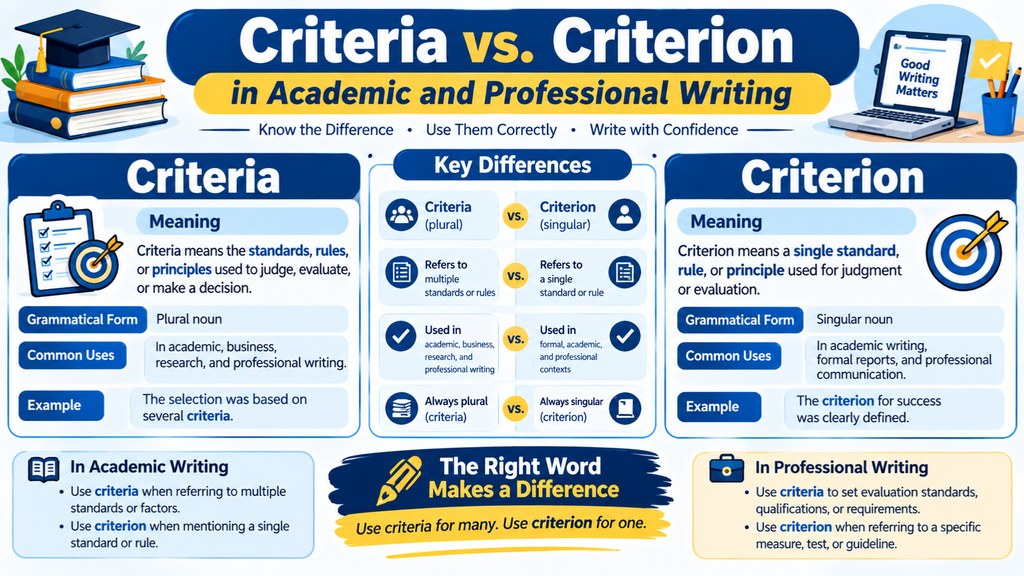
Formal writing is where the criteria vs criterion distinction matters most. A single wrong word can quietly lower a reader’s trust, especially in documents that will be reviewed, graded, or published.
Academic Writing
Professors, journal editors, and thesis committees expect precise grammar. Style references such as the APA, MLA, and Chicago guidelines treat criteria as plural in formal prose.
- ✅ One assessment criterion is the originality of the argument.
- ✅ The assessment criteria are published in the course syllabus.
Business Reports and Policies
Policies, contracts, and job descriptions often list standards. Writing them correctly signals care and professionalism.
- ✅ The selection criteria were agreed upon during the meeting.
- ✅ The primary criterion for vendor approval is compliance with safety regulations.
Research Papers
Methods sections regularly describe the criteria used to include sources, measure outcomes, or classify data. Because these sections are scrutinized closely, correct grammar supports your credibility.
- ✅ Studies were selected according to predefined inclusion criteria.
- ✅ The sole criterion for classification was response time.
Resumes and Cover Letters
Applicants often write that they “meet all the criteria” in a job posting. That is correct. If you want to say you meet one requirement, write “I meet this criterion.”
When your writing aims to confirm or explain precisely what a standard requires, our comparison of Clarify vs Verify can help you choose the right verb for the job.
Criteria vs. Criterion: Quick Reference Cheat Sheet
Save this short list for the next time you are editing a document.
- One standard? Write criterion and use is.
- Two or more standards? Write criteria and use are.
- See “one,” “each,” “single,” or “only”? Expect criterion.
- See “these,” “all,” “several,” or “following”? Expect criteria.
- See “criterias”? Delete the final s.
- Still unsure? Replace the word with “requirement(s)” and read the sentence aloud.
Bookmark this checklist, and the criteria vs criterion question will rarely slow you down again.
Easy Memory Tricks
Pick whichever trick feels most natural.
Trick 1: The ending trick. Criterion ends in -on, like one. Criteria ends in -a, like all. One standard is criterion, and all standards are criteria.
Trick 2: The pattern trick. Link it to a word you already know. Phenomenon becomes phenomena, so criterion becomes criteria.
Trick 3: The verb trick. Say the verb out loud. “Criterion is” and “criteria are” both sound correct. “Criteria is” sounds slightly off once you listen for it.
Trick 4: The swap trick. Replace the word with “requirement” or “requirements.” If “requirement” fits, use criterion. If “requirements” fits, use criteria.
Ready-to-Use Sentences for Resumes, Emails and Reports
Copy and adapt these lines. Each uses the correct form.
Cover letter
- “I meet every criterion listed in the job description.”
- “My background aligns with the criteria you outlined for this position.”
Email to a team
- “Please review the attached criteria before Friday.”
- “The key criterion for approval is budget alignment.”
Project proposal
- “We evaluated each vendor against five criteria.”
- “Cost was the deciding criterion.”
Report or essay
- “The study used two inclusion criteria.”
- “One limitation is that the criterion was subjective.”
Grading comments
- “Your essay meets the criteria for clarity and structure.”
- “The criterion for evidence needs more development.”
Simpler Alternatives When You Are Unsure
If the criteria vs. criterion choice still feels risky in a high-stakes document, use a plain synonym.
Sometimes the best option is to avoid the problem. These synonyms work in most sentences.
| Instead of… | Try… |
| Criterion | standard, requirement, test, benchmark, factor, measure |
| Criteria | standards, requirements, benchmarks, guidelines, factors, measures |
Example:
- Original: The admission criteria are strict.
- Alternative: The admission requirements are strict.
Both are correct. If you are weighing the value of one standard against another, you may also enjoy our guide on Reckon vs Value.
Practice Quiz
Test yourself on criteria vs. criterion before you move on.
Choose the correct word. Answers are at the end.
- The only ______ for entry is a valid ID. (criterion / criteria)
- The following ______ must be met before approval. (criterion / criteria)
- Which ______ do you think matters most? (criterion / criteria)
- These ______ are published on our website. (criterion / criteria)
- Cost is not the sole ______ to consider. (criterion / criteria)
- All the ______ were clearly explained. (criterion / criteria)
- One ______ for success is consistency. (criterion / criteria)
- The ______ was changed after the review. (criterion / criteria)
Answers:
- criterion
- criteria
- criterion
- criteria
- criterion
- criteria
- criterion
- criterion (the verb “was” is singular)
Advanced Practice: Choose the Correct Verb
Pick the right word in each sentence.
- A set of criteria (is / are) attached to the email.
- The number of criteria (is / are) limited.
- Each criterion (has / have) a point value.
- Neither criterion (is / are) flexible.
- The criteria (was / were) approved by the board.
- Cost and quality (is / are) the two main criteria.
- One of the criteria (is / are) missing.
- The following criteria (applies / apply).
Answers: 1. is, 2. is, 3. has, 4. is, 5. were, 6. are, 7. is (the subject is “one”), 8. apply
Key Takeaways
Here is everything you need to remember about criteria vs. criterion.
- Criterion is singular and means one standard.
- Criteria is plural and means two or more standards.
- Pair criterion with is/was/has and criteria with are/were/have.
- Never write criterias, and avoid “one criteria.”
- The words are spelled the same in American and British English.
- Major American style guides expect the singular-plural distinction in formal writing.
- With phrases like “a set of,” find the real subject before choosing the verb.
- When unsure, swap in “requirement” or “requirements” and read the sentence aloud.
FAQ
Is “criteria” singular or plural?
Criteria is plural. The singular form is criterion.
Can I say “one criteria”?
No. Use “one criterion.” The word “one” needs the singular noun.
Is “the criteria is” ever correct?
In formal writing, no. Use “the criterion is” for one standard or “the criteria are” for several. The singular use of “criteria” appears in casual speech, but formal writing expects the traditional distinction.
Is “criterias” a real word?
No. Criteria is already plural, so adding an s is an error.
What is the plural of criterion?
The standard plural is criteria. Some dictionaries list criterions as a rare variant, but it is not recommended for everyday writing.
How do you pronounce criterion and criteria?
Criterion is pronounced “kry-TEER-ee-on,” and criteria is “kry-TEER-ee-a.” The stress falls on the second syllable in both words.
What is the difference between criteria and standards?
They are very close in meaning. Criteria usually refers to the specific tests or conditions used to judge something, while standards often implies a broader level of quality. In many sentences, you can use them interchangeably.
Should I use “criterion” in professional writing?
Yes, when you mean one standard. Using it correctly signals attention to detail, especially in policies, reports, academic work, and applications.
Is there a difference between American and British English for criteria and criterion?
No. Both varieties use the same spelling and the same singular-plural forms.
What does AP style say about criteria and criterion?
The AP Stylebook treats criteria as plural and criterion as singular. For anything you are publishing under AP rules, check the current edition.
Is “a set of criteria is” or “a set of criteria are” correct?
Use “is.” The subject of the sentence is the singular word set.
Is it “criteria for” or “criteria of”?
Both appear, but criteria for is the most natural choice when you mean standards used to select or approve something, as in “criteria for admission.”
How do I make criterion possessive?
Add an apostrophe and s: the criterion’s weight. For the plural, many writers prefer “of the criteria” to the clumsy criteria’s.
Can I use “criteria” as a singular in a business email?
It is better to avoid it. Although you will see it in casual writing, using “criterion” for one standard is safer and looks more professional in a US business setting.
Final Thoughts
For American readers and writers, the criteria vs. criterion debate comes down to one simple idea: number. Use criterion when you mean one standard and criteria when you mean more than one. Match the verb (“is” with criterion, “are” with criteria), avoid “criterias,” and remember that “criteria is” may sound fine in conversation but can undermine formal writing.
When in doubt, count the standards, use the -on = one and -a = all trick, or swap in “requirement” to test your sentence. With a little practice, the right choice becomes automatic.
Want to keep sharpening your writing? Explore more grammar and spelling guides, and see how plural forms can also affect spelling in Penality vs Penalty.




One Comment