
Marveled or Marvelled: Which Spelling Is Correct?
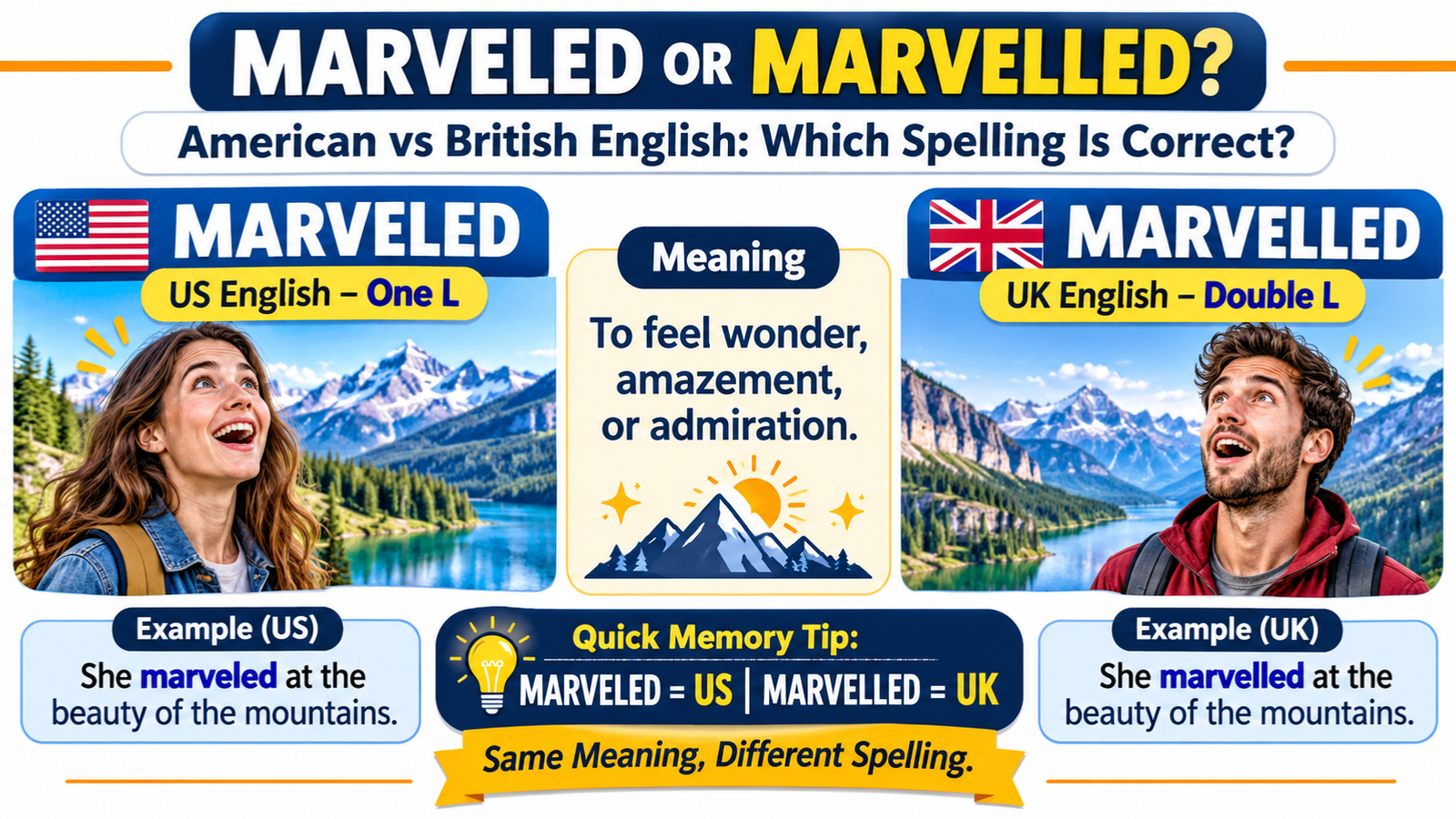
Quick answer: Both spellings are correct. Marveled (one “l”) is standard in American English, and marvelled (two “l”s) is standard in British English, Australian English, and most Commonwealth countries. They mean the same thing and sound the same. Choose the one that matches your audience, then stay consistent.
What Does “Marvel” Mean?
The verb marvel means to feel or express great wonder, surprise, or admiration. It comes from the Old French merveille (“wonder”), which traces back to the Latin mirabilia and the verb mirari (“to wonder”). It entered Middle English centuries ago and has kept almost the same meaning ever since.
Marvel also works as a noun, meaning something that causes wonder, as in “the marvels of modern medicine.” But the spelling question only affects the verb forms, because that is where a suffix such as -ed or -ing gets added.
Marveled or Marvelled: The Core Difference
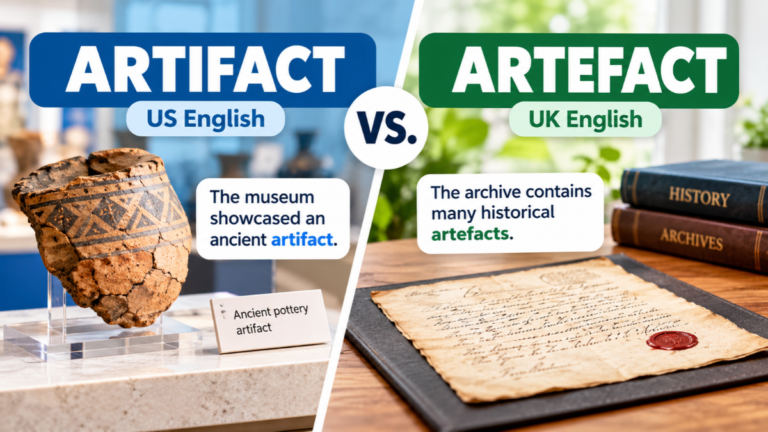
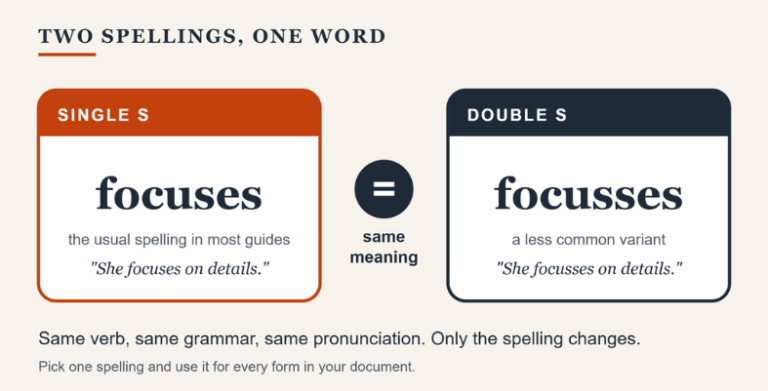
The difference between marveled or marvelled is purely regional.
| Marveled | Marvelled | |
| Variety | American English | British English |
| Number of “l”s | One | Two |
| Meaning | Felt or expressed wonder | Felt or expressed wonder |
| Pronunciation | /ˈmɑːrvəld/ | /ˈmɑːrvəld/ (same) |
| Grammar role | Past tense and past participle | Past tense and past participle |
The extra “l” in marvelled is silent in practice. It changes the spelling only, not the sound, the syllable count, or the definition. Neither form is a typo.
The Grammar Rule: Why Two Spellings Exist
When you add a suffix beginning with a vowel (-ed, -ing, -er) to a short verb, English sometimes doubles the final consonant: stop → stopped, plan → planned. The two major varieties of English handle verbs ending in “-l” differently.
The British English rule
British English doubles a final “-l” after a single vowel, no matter where the stress falls. That is why British spelling gives you:
- marvel → marvelled, marvelling
- travel → travelled, travelling
- cancel → cancelled, cancelling
- label → labelled, labelling
- model → modelled, modelling
The American English rule
American English doubles the final consonant only when the stress falls on the last syllable. In marvel, the stress is on the first syllable (MAR-vel), so the “l” stays single before the suffix:
- MAR-vel → marveled
- TRAV-el → traveled
- CAN-cel → canceled
- LA-bel → labeled
Now compare words where the stress lands on the final syllable:
- com-PEL → compelled (double “l” in both US and UK)
- re-BEL → rebelled
- ex-CEL → excelled
- con-TROL → controlled
- pro-PEL → propelled
This is why an American writer types marveled but also compelled. It is a stress-based rule, not a random choice. Remember that the doubling rule exists to protect the pronunciation of the stressed vowel, and unstressed final syllables do not need that protection.
A common exception
Some words follow neither pattern perfectly. Parallel becomes paralleled in both varieties, because the word already contains a double “l” earlier in it. Words with two vowels before the final “l,” such as reveal or conceal, do not double at all (revealed, concealed) in either variety.
A Short History: Noah Webster and the Spelling Split
English spelling was not standardized for most of its history. Printers and writers used different forms, and doubling was fairly common. In 1755, Samuel Johnson’s A Dictionary of the English Language helped fix many spellings in Britain, and British practice kept the doubled “-ll-” in verbs like travelled and marvelled.
Across the Atlantic, the American lexicographer Noah Webster argued that American English should be simpler and more logical. In his 1806 Compendious Dictionary and especially his 1828 An American Dictionary of the English Language, he promoted forms such as color (instead of colour), center (instead of centre), and traveled (instead of travelled). His dictionaries became hugely influential, and later American references, including the Merriam-Webster line of dictionaries, continued the single-“l” tradition.
Over time, American spelling settled on the stress-based doubling rule, while British English retained the older pattern. The pair marveled / marvelled is one small result of that divergence.
Related Forms: Marveling, Marvelling, Marvelous, Marvellous
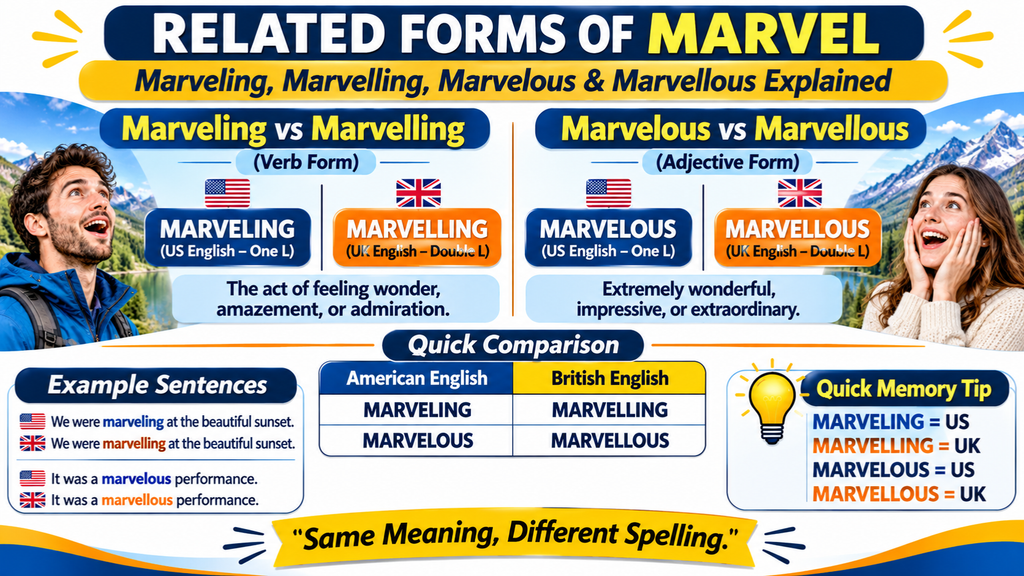
The same split affects every inflected form of the word:
| Form | American English | British English |
| Past tense / past participle | marveled | marvelled |
| Present participle | marveling | marvelling |
| Person who marvels (noun) | marveler | marveller |
| Adjective | marvelous | marvellous |
| Adverb | marvelously | marvellously |
If you write marvelled, you should also write marvelling and marvellous. Mixing them in one document looks inconsistent.
Example Sentences
Marveled (American English)
- The tourists marveled at the size of the Grand Canyon.
- She marveled at how quickly her daughter had learned to read.
- We marveled over the chef’s careful plating.
- The engineers marveled at the strength of the new bridge.
- He marveled that anyone could finish the marathon in such heat.
Marvelled (British English)
- The visitors marvelled at the grandeur of Buckingham Palace.
- She marvelled at her grandmother’s endless patience.
- The crowd marvelled at the fireworks above the Thames.
- He marvelled that the old castle had survived so many centuries.
- We marvelled at the skill of the street musicians in Edinburgh.
Marveling vs. Marvelling
- American: The students are marveling at the telescope’s images.
- British: The students are marvelling at the telescope’s images.
Which Spelling Should You Use? (By Country)
The right choice of marveled or marvelled depends on who will read your writing.
| Country / Region | Recommended spelling | Notes |
| United States | marveled | Standard in US newspapers, schools, and publishers. The AP Stylebook and Chicago Manual of Style follow American conventions. |
| United Kingdom | marvelled | Standard in British publications, universities, and government writing. |
| Canada | marvelled (usually) | Canadian English mixes both systems, but it generally follows the British double-“l” pattern for verbs like this. Check your publisher’s style guide. |
| Australia | marvelled | Follows British convention; the Macquarie Dictionary is the main reference. |
| New Zealand | marvelled | Follows British convention. |
| India | marvelled | Indian English follows British spelling in most formal writing. |
| Pakistan | marvelled | Pakistani English follows British spelling, and it is used in schools, exams, and newspapers. |
| South Africa and other Commonwealth countries | marvelled | British-based conventions apply. |
| Global or mixed audience | Either, but consistent | Pick one variety and apply it across the whole page. |
Practical tip: If most of your readers are in the US, use marveled. If most are in the UK, Pakistan, India, Australia, or other Commonwealth countries, use marvelled.
How to Use “Marvel” Correctly
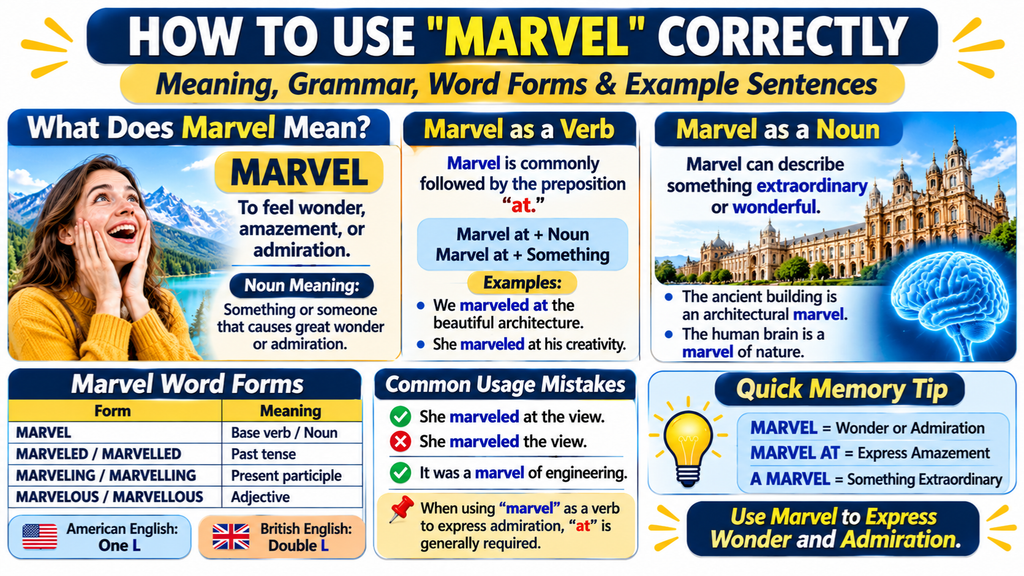
The verb marvel usually appears in one of two patterns.
1. Marvel + at + noun
- She marveled at the view. / She marvelled at the view.
2. Marvel + that / how + clause
- He marveled that the tiny team had won. / He marvelled how quickly the work was done.
Use at, not to, after marvel. “She marveled to the view” is incorrect.
Marveled and marvelled are both the simple past and the past participle:
- Simple past: They marveled at the sunset.
- Present perfect: They have marveled at it many times.
Common Mistakes
1. Treating one spelling as a typo. Americans sometimes “correct” marvelled to marveled, and British editors do the reverse. Both forms are accepted in their own varieties.
2. Mixing spelling systems. Writing “The traveler marvelled at the colourful market” combines American traveler with British marvelled and colourful. Pick one system for the whole text.
3. Expecting a pronunciation change. The double “l” does not add a syllable. Both forms are said as MAR-vuld.
4. Applying the American stress rule to British English. In British English, the doubling happens regardless of stress.
5. Forgetting the related words. If you use marveled, also use marveling and marvelous. If you use marvelled, also use marvelling and marvellous.
6. Ignoring your spell-checker’s language setting. Grammarly, Microsoft Word, and Google Docs all let you choose English (US), English (UK), English (Canada), or English (Australia). A wrong setting will flag the right spelling as an error.
Easy Ways to Remember the Difference
- “Two l’s for the UK.” Marvelled has two “l”s, and UK and Commonwealth writers use it.
- “American English trims the extra letter.” Webster’s goal was to simplify, so US spellings tend to be shorter (color, center, marveled).
- Check your other words. If you write traveled and canceled, use marveled. If you write travelled and cancelled, use marvelled.
- Stress test for Americans. If you are unsure whether to double an “l,” say the word aloud. If the stress is on the last syllable (com-PEL), double it. If not (MAR-vel), keep it single.
Mini Quiz: Test Yourself
Choose the correct spelling for the audience shown in brackets.
- The audience ______ at the magician’s trick. (US)
- They stood ______ at the Taj Mahal. (UK, marvel + -ing)
- She ______ at how well the plan worked. (Pakistan)
- The senator was ______ to vote against the bill. (US, compel)
- It was a ______ performance. (Australia)
Answers:
- marveled
- marvelling
- marvelled
- compelled (stress on the last syllable, so it doubles even in American English)
- marvellous
Frequently Asked Questions
Is it marveled or marvelled?
Both are correct. Marveled is the standard American spelling, and marvelled is the standard British spelling.
Is marveled American or British?
Marveled is the American English spelling. British English uses marvelled.
Is marvelled a misspelling?
No. Marvelled is the correct, standard spelling in British English and in countries that follow British conventions, including Pakistan, India, Australia, and New Zealand.
What is the past tense of marvel?
The past tense is marveled in American English and marvelled in British English. The past participle uses the same form.
Is it marveling or marvelling?
It follows the same split. Marveling is American, and marvelling is British.
Is marvelous or marvellous correct?
Both are correct. Marvelous is the American spelling, and marvellous is the British spelling.
Why does British English double the “l”?
British English keeps the older practice of doubling a final “-l” after a single vowel before adding a suffix, whether or not the last syllable is stressed.
Why does American English use a single “l” in marveled?
American English doubles a final consonant only when the stress falls on the last syllable. Because marvel is stressed on the first syllable, the “l” stays single. This simplification was encouraged by Noah Webster’s dictionaries.
Do marveled and marvelled sound different?
No. The extra “l” is a spelling difference only. Both are pronounced the same way.
Which spelling is correct in Canadian English?
Canadian English blends both systems, but marvelled is the form usually used. Follow your publication’s style guide if it specifies otherwise.
Can I use both spellings in one article?
You should not. Mixing them looks inconsistent. Choose one variety of English and apply it throughout.
Final Thoughts
So, marveled or marvelled? The answer depends on your readers. Use marveled (and marveling, marvelous) for American audiences, and use marvelled (and marvelling, marvellous) for readers in the UK, Pakistan, India, Australia, New Zealand, and most other Commonwealth countries. Canadian writers usually lean toward marvelled.
The reason behind the split is simple. British English doubles the final “l,” while American English doubles it only when the last syllable is stressed, a pattern shaped by Noah Webster’s influential dictionaries. Whichever spelling you choose, the key to polished writing is consistency, so match your spelling to your audience, set your spell-checker to the right English, and keep the same style from the first sentence to the last.
5 Comments