
Colonize vs Colonise: Which Spelling Is Correct?
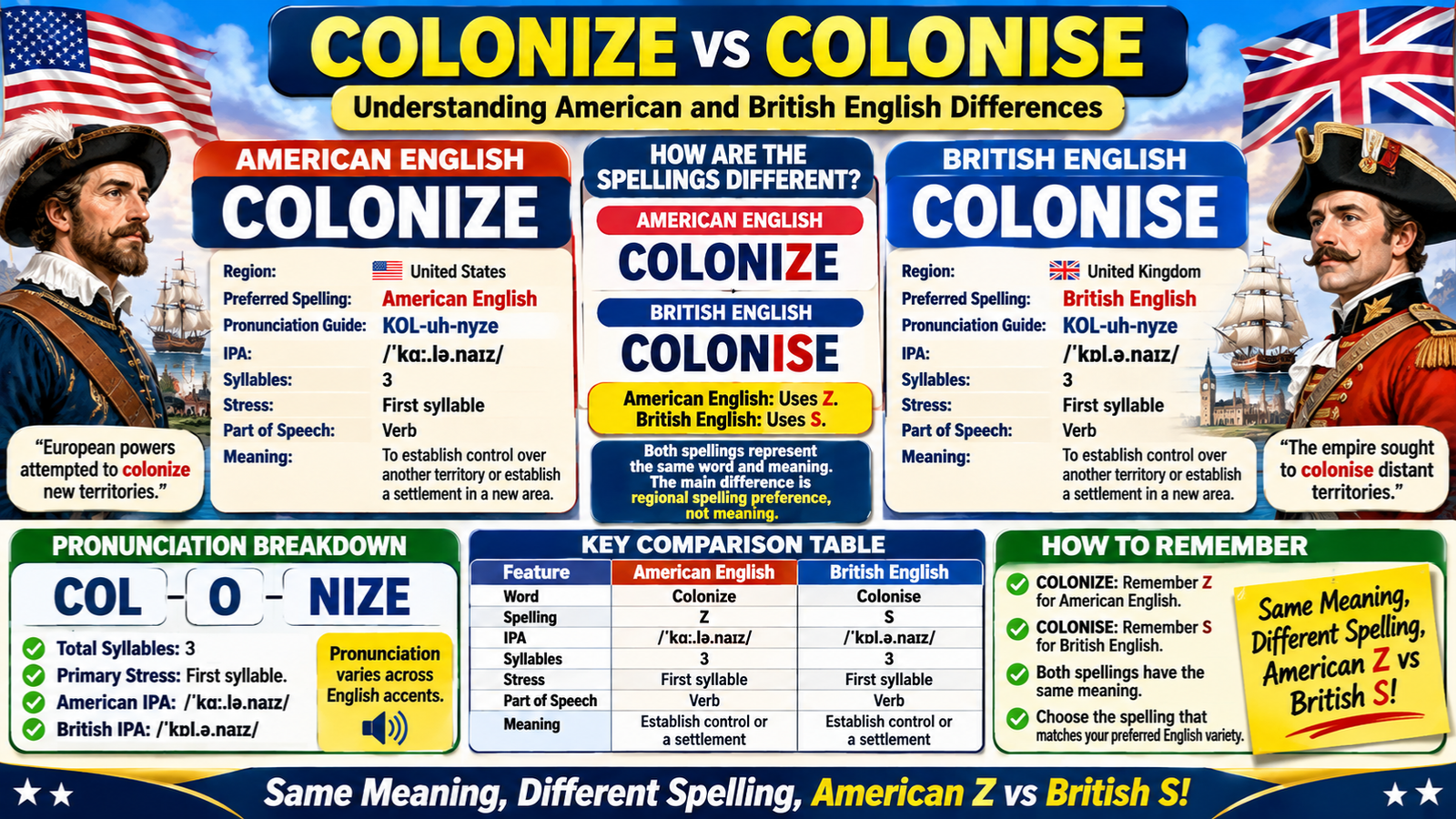
Colonize vs colonise: both spellings are correct. Colonize is the American spelling, and it is also the one Oxford-style British publishers use. Colonise is the common British and Commonwealth spelling. The meaning is identical, so pick the spelling that matches your readers and keep it the same from start to finish.
In this guide you’ll get the full colonize vs colonise rule, both meanings, every word form, the Oxford spelling story, biology and everyday uses, examples, common mistakes, a short quiz and answers to the questions people search most.
Colonize vs Colonise: The Quick Answer
Nobody has made a mistake here. Dictionary.com lists colonise as the form used especially in British English. Oxford Learner’s Dictionaries gives colonize as the headword and notes colonise as the British variant, and the Britannica Learner’s Dictionary does the same. Wiktionary adds a useful wrinkle: it calls colonize the American and Oxford British spelling, and colonise the non-Oxford British one. Grammarist says the American spellings are also considered correct and are gaining ground around the world.
So if your spellchecker draws a red line under one of them, check the language setting before you change the word. It is probably set to the other region.
The only real rule is consistency. One document should not say “colonize” in paragraph two and “colonise” in paragraph six.
What Does Colonize Mean?
The colonize vs colonise question is about spelling only, so the meaning is the same either way. Colonize is a verb, and dictionaries describe a few closely related senses.
The first is the historical and political one. Oxford Learner’s Dictionaries defines it as taking control of an area or country that is not your own, often by force, and sending people from your own country to live there. The Learner’s Dictionary keeps it simpler: to create a colony in or on a place. That simpler sense also covers fiction and science writing about settling other planets.
The second is biological. Oxford Learner’s describes animals or plants living or growing in large numbers in a particular area. Merriam-Webster extends this to microorganisms that multiply in or on a host or a surface, and Dictionary.com gives the example of bacteria in a probiotic colonizing the intestines.
Grammatically, colonize works with an object (“Moss began to colonize the bare rock”) and without one (“Some species colonize quickly; others take decades”). Grammarist and Dictionary.com both list the two uses.
What Does Colonise Mean?
Colonise means exactly what colonize means. Oxford Learner’s Dictionaries lists it as the British English form and gives the same two senses: taking control of an area, and animals or plants living or growing in large numbers in a place. Merriam-Webster treats colonise and colonisation as the British spellings of colonize and colonization, and Dictionary.com marks colonise as the form used especially in British English.
So every definition in the section above applies word for word. Compare the pair: “Moss can colonize bare rock” in American English and “Moss can colonise bare rock” in British English. The colonise meaning in a history essay, a biology paper or a science fiction novel is the same as the colonize meaning. Only the spelling follows a different convention.
One point trips people up: colonise is not a different verb, a rarer sense, or a softer or harsher version of the word. If a sentence works with colonize, it works with colonise.
Colonize or Colonise: Which Region Uses Which?

Here is the regional pattern from Sapling’s usage data. The scores are out of 100 for each spelling.
| Region | colonize | colonise | Usual lean |
| United States | 98 | 2 | colonize |
| Canada | 91 | 9 | colonize |
| Philippines | 96 | 4 | colonize |
| Ireland | 56 | 44 | colonize (slightly) |
| India | 49 | 51 | almost even |
| New Zealand | 49 | 51 | almost even |
| United Kingdom | 42 | 58 | colonise |
| Australia | 32 | 68 | colonise |
Treat these numbers as a rough direction, not a precise statistic, because they come from Sapling’s own sampling. Still, the table makes one thing clear: outside the US, Canada and the Philippines, habits are mixed. Even in the UK, more than four in ten of the sampled uses were spelled with a z.
Wikipedia’s Manual of Style gives the broader picture. Commonwealth countries follow British English, except Canada, which follows American spellings more closely. For most readers outside the US, then, a style guide will settle the question faster than a country name will.
Is -ize Really American? The Oxford Spelling Story
Many people believe -ize is an American invention and -ise is the “real” British spelling. It is a tidy story. It is also wrong.
Wikipedia’s article on Oxford spelling calls that belief incorrect and notes that the -ize suffix has been used in the UK since the 15th century. Oxford spelling is a standard that combines British spelling with -ize in words like realize and organization. Oxford University Press uses it, and so do the Nature journals and the United Nations and its agencies. The Oxford English Dictionary even lists the -ise form separately, as a frequent spelling of -ize.
Meanwhile, British newspapers and magazines normally use -ise. The Times recommended -ize until 1992 and then switched. The University of Oxford’s own style guide, as of its 2016 update, recommended -ise for internal use. Honestly, that surprises people more than anything else in this article.
Wikipedia’s Manual of Style sorts these words into three columns: en-GB (-ise), en-GB-oxendict (-ize) and en-US (-ize). Colonize sits in the second and third. So when you meet colonize in a British book, it may be a house-style choice, not an American import.
All the Forms in One Table
Most searches don’t stop at the base verb, and a document is only consistent if every form matches. Here is the full set, based on Oxford Learner’s Dictionaries, Merriam-Webster and Grammarist.
| Form | US / Oxford spelling | British -ise spelling |
| Base verb | colonize | colonise |
| Third person singular | colonizes | colonises |
| Past tense and participle | colonized | colonised |
| -ing form | colonizing | colonising |
| Noun | colonization | colonisation |
| Person or thing that colonizes | colonizer | coloniser |
| Adjective | colonizable | colonisable |
Swap the z for an s and you have the other column. Nothing else in the word changes, so “colonyse” and “colonnize” are just misspellings.
The agent noun is the form people hesitate over most. Merriam-Webster lists coloniser as a British variant of colonizer, and Oxford Learner’s Dictionaries notes the same. Sapling’s country data for the two spellings point the same way as the verb: of the 12 countries it lists, 6 lean toward colonizers and 3 toward colonisers, so treat that as a loose guide too.
The colonize vs colonise split repeats in every form, so here is each one with a matched pair of examples.
Colonized vs Colonised
Both are the past tense and the past participle. Oxford Learner’s Dictionaries lists colonized as the past simple and past participle, with colonise as the British form of the verb. Sapling’s usage data show colonized as the predominant spelling in American English and colonised as the predominant one in British English, including the UK, Australia and New Zealand.
US: The algae colonized the new pond within weeks.
UK: The algae colonised the new pond within weeks.
Colonizing vs Colonising
The -ing form follows the verb. Use colonizing with colonize and colonising with colonise, whether the word works as a participle or as a gerund.
US: Colonizing a new habitat takes time for any species.
UK: Colonising a new habitat takes time for any species.
Colonization vs Colonisation
The noun names the act of colonizing. Merriam-Webster lists establishing a colony as its first sense and covers biological establishment too, and Oxford Learner’s Dictionaries uses “plant colonization” as a biological example. Colonisation is the British spelling.
US: Plant colonization was fastest on the sunniest slope.
UK: Plant colonisation was fastest on the sunniest slope.
Colonizer vs Coloniser
The agent noun names the one doing the colonizing. Merriam-Webster lists coloniser as a British variant of colonizer, and Oxford Learner’s Dictionaries notes the same. In biology, it can also mean an organism that establishes a population in a new area.
US: Seaweed is often an early colonizer of a bare shoreline.
UK: Seaweed is often an early coloniser of a bare shoreline.
Which Spelling Should You Use?
Settling colonize vs colonise for your own writing takes four quick checks.
Start with your audience. Readers in the United States, Canada and the Philippines will expect colonize. Readers in the UK and Australia more often expect colonise.
Next, look for a style guide. Journals, schools, publishers and companies usually have a house rule, and it beats personal taste. An Oxford-style house wants the z. Many British newspapers want the s.
Then match your tools. Set English (US) or English (UK) in Word, Google Docs or whatever editor you use, and the spellchecker will agree with you instead of arguing.
Finally, stay consistent. That matters more than the choice itself. If you truly have no audience and no guide, take the spelling your spellchecker already likes and move on. Nobody will think less of you for either one.
Colonize in History, Science and Everyday Writing
The spelling stays neutral, but the word is used in very different settings, and it helps to know which sense you mean.
In history and social studies, writers use it for settling and taking control of territory. Dictionaries differ slightly in emphasis. The Learner’s Dictionary stops at creating a colony, while Oxford Learner’s adds control and, often, force. Merriam-Webster also adds a usage note: colonizer is used especially where the exploitative nature of colonialism is being discussed, while colonist is the more common and usually more neutral term. If you are writing an essay, choose the word your definition and your sources support. The z or s won’t change the tone. The word choice might.
In biology, it is about living things establishing themselves somewhere new. Merriam-Webster notes that seaweeds are often the first colonizers on shorelines, and the medical sense covers microorganisms that multiply in or on a host.
In space and science fiction, it usually means creating a colony on another world. An American writer would say “colonize Mars” and a British one “colonise Mars”. Same sentence, same sense, one letter apart.
Colonize in Biology: Colonization vs Infection
Biology is where colonize gets its most precise use, so it deserves its own section. Oxford Learner’s Dictionaries defines the biological meaning as animals or plants living or growing in large numbers in a particular area, with examples such as bats in ruins and flowering plants on slopes. Merriam-Webster adds a medical sense: a microorganism that multiplies in or on a host or a surface.
That medical sense is easy to misread. In medical writing, colonization usually means microbes are living on or in a host without causing damage, while infection means they invade tissue and make the host ill. Medical references draw the line in much the same way. The word describes presence, not disease.
A sentence like “The bacterium can colonize the nose without causing symptoms” is therefore a statement about where the microbe lives. The spelling rule stays the same as anywhere else: colonize and colonization in American and Oxford spelling, colonise and colonisation in standard British spelling. This is a note about language, not medical advice.
A Practical Example: Fixing a Mixed Paragraph
Here is the kind of paragraph an editor catches in seconds.
Before: The team studied how algae colonise a new pond. The colonization process was recorded, and the results were organised into a table.
It mixes two systems. The verb colonise and the participle organised follow British -ise, but the noun colonization has a z. Nothing is hard to understand, yet the paragraph looks unedited.
After (US): The team studied how algae colonize a new pond. The colonization process was recorded, and the results were organized into a table.
After (UK): The team studied how algae colonise a new pond. The colonisation process was recorded, and the results were organised into a table.
The fix takes under a minute. Pick the variety first, then check the verb, the noun and every other -ize or -ise word in a single pass.
Colonize vs Colonise in Academic Writing
Academic writing rewards consistency more than most formats. Follow the spelling your institution, journal or publisher specifies, because that rule beats personal preference. A UK university may ask for -ise, while some UK-based journals, such as Nature, use Oxford spelling, which keeps -ize. The University of Oxford’s own style guide, as of its 2016 update, recommended -ise for internal use, which shows how mixed the picture is even inside Britain.
Spelling is the smaller part of the job, though. Because the word can cover settlement, administration or control, a clear essay says which sense it means and takes that sense from its sources. Dictionaries already show the range: the Learner’s Dictionary defines colonize as creating a colony in a place, while Oxford Learner’s Dictionaries adds control and, often, force. Use the definition your evidence supports, and let the evidence carry the argument.
A safe habit for any paper: define the sense once, spell it one way throughout, and run a final search for the other spelling before you submit.
Where Colonize Comes From and Related Words
Colonize is built from colony plus -ize, according to Dictionary.com, which dates the verb to 1615-25. Grammarist traces the family back to the Latin colonus, meaning a tiller of the soil or farmer. Merriam-Webster gives later first-use dates for some relatives: colonist 1701, colonial 1764 and colonialism 1791.
Here is how standard dictionaries define the main relatives:
- Colonist: a person who lives in a colony or takes part in founding one. Merriam-Webster calls it the more common and usually more neutral term next to colonizer.
- Colonial: relating to or characteristic of a colony, or having the status of a colony.
- Colonialism: control by one nation over a dependent area or people.
- Colonizer: one that colonizes, meaning a nation or state that takes control of a people or area, a person who settles in a foreign area as part of a colony, or, in biology, an organism that establishes a population in a new area.
- Colonization: the act of colonizing, including the biological sense of organisms establishing themselves in a place.
The verb family is the only one with a z/s split, and that includes the opposite. Oxford Learner’s Dictionaries lists decolonize, with decolonise as the British spelling, and Vocabulary.com gives decolonize as the antonym of colonize. Nouns and adjectives such as colony, colonist and colonial are spelled the same everywhere, so the colonize vs colonise choice only touches the verb and the words built from it.
Other Words That Follow the Same Pattern
Colonize belongs to a large group of verbs that end in -ize in American English and -ise in standard British writing: organize / organise, realize / realise, prioritize / prioritise, apologize / apologise and memorize / memorise. For more pairs, see our guides to prioritize vs prioritise, apologize vs apologise and memorize vs memorise.
Don’t stretch the rule too far. Wikipedia’s Manual of Style lists words that end in -ize in every variety of English, including size, seize, prize, capsize and maize. And verbs like advise and surprise end in -ise everywhere. “Advize” is wrong in American English too.
How to Pronounce Colonize
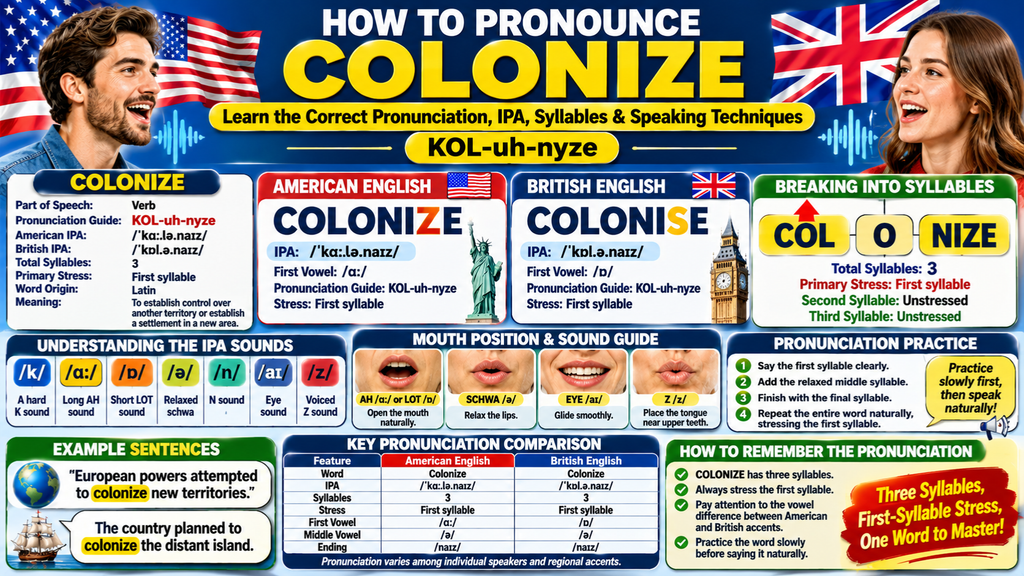
The stress falls on the first syllable: KOL-uh-nyz. Oxford Learner’s Dictionaries gives the British pronunciation as /ˈkɒlənaɪz/ and the American one as /ˈkɑːlənaɪz/. The difference is the first vowel, which is about accent, not spelling. The ending sounds like “size” whether you write it with a z or an s, so nobody can hear which spelling you chose.
The spelling does not change the ending sound. In colonise the last consonant is a z, as in rise, not an s as in rice. Oxford Learner’s Dictionaries transcribes the ending as /naɪz/, and Dictionary.com respells the word as kol-uh-nahyz. That is why the colonize vs colonise confusion exists at all: the two forms look different on the page but sound the same.
Example Sentences
With colonize (American and Oxford spelling):
- Moss is usually among the first plants to colonize bare rock.
- The novel follows a crew trying to colonize a distant planet.
- Researchers tested whether the bacteria could colonize the gut.
- Weeds colonize empty lots surprisingly fast.
- The students compared how three dictionaries define colonize.
- Algae began to colonize the newly built pond.
- Colonizing a new habitat takes time for any species.
- The board game asks players to colonize islands and manage resources.
With colonise (British spelling):
- Seaweed is often among the first things to colonise a bare shoreline.
- The board game lets players colonise a chain of islands.
- Scientists want to know how bacteria colonise a surface.
- Wild grasses will quickly colonise the cleared ground.
- The essay compares how two dictionaries define colonise.
- Invasive plants can colonise a garden bed in a single summer.
- In the story, humans colonise a distant planet.
- Lichen began colonising the old stone wall.
Common Mistakes
Most colonize vs colonise slips are about consistency, not correctness.
The most common one is mixing both spellings in a single document. Pick one, then search the page for the other before you publish.
A close second is calling one spelling wrong. Colonize is not an error in British English, and colonise is not an error in American English. Oxford Learner’s Dictionaries, Dictionary.com and Merriam-Webster all record both.
Writers also match the verb but forget the noun, writing “colonise” in one sentence and “colonization” in the next. If the verb has an s, the noun has an s: colonisation.
Some people over-correct and push the pattern onto words it doesn’t fit, like advise or size. And plenty of “errors” come from a spellchecker set to the wrong language, so fix the setting first.
Another slip is treating colonise as an American spelling. It isn’t. US writers use colonize, and colonise is the British form.
Don’t read the -ise ending as an s sound either. Colonise ends in the same z sound as colonize, so the spelling changes nothing when you say it aloud.
Finally, don’t let the spelling debate hide the real question in a history or science essay, which is what you mean by the word. Pick the spelling by audience, and pick the sense by your sources.
How to Remember It
Here is the whole colonize vs colonise rule in one line: z for the US, s for the rest, and pick one per document. The one exception to keep in your pocket is Oxford spelling, where the z comes back in British writing.
Colonize vs Colonise: Quick Comparison
- Meaning: the same. Both can mean to settle and take control of an area or, in biology, to live or grow in large numbers in an area.
- Spelling: colonize is US and Oxford, colonise is standard British.
- Pronunciation: the same ending sound, a z.
- Past tense: colonized or colonised.
- -ing form: colonizing or colonising.
- Noun: colonization or colonisation.
- Agent noun: colonizer or coloniser.
- Opposite: decolonize or decolonise.
- Rule to keep: one spelling per document.
Quick Practice
Choose the correct spelling for each situation. Answers follow.
- You are writing a US college essay. Which is standard? (colonize / colonise)
- A British newspaper uses -ise. Which fits? (colonize / colonise)
- A British publisher follows Oxford spelling. Which do they use? (colonize / colonise)
- Which noun matches “colonise”? (colonization / colonisation)
- Which past form matches “colonize”? (colonized / colonised)
- Which agent noun is the British spelling? (colonizer / coloniser)
- Which spelling is wrong in every variety? (colonyse / colonise)
- Which word ends in -ise even in American English? (advise / realize)
Answers: 1. colonize. 2. colonise. 3. colonize. 4. colonisation. 5. colonized. 6. coloniser. 7. colonyse. 8. advise.
Frequently Asked Questions About Colonize vs Colonise
Is it colonize or colonise? Both are correct. Colonize is the US and Oxford-style spelling, and colonise is the common British and Commonwealth one. Meaning, grammar and pronunciation are the same. Choose the spelling that suits your readers or style guide, and use it consistently throughout the document.
Is colonise a word? Yes. Dictionary.com, Oxford Learner’s Dictionaries and Merriam-Webster all list colonise as the British spelling of colonize. It is a standard variant, not an error, although in a US-focused document it will look like a regional spelling.
Is colonise British or American? British. Merriam-Webster labels colonise and colonisation as British spellings, and the American forms are colonize and colonization. Oxford-style British publishers also use the z, so colonize is not strictly American.
Is “colonize” correct in UK English? Yes. Oxford spelling uses -ize with British conventions, and Wiktionary lists colonize as American and Oxford British spelling. Most UK newspapers and magazines use -ise, though, so check your publisher’s house style before you choose.
What is the difference between colonize and colonise? Only the spelling. Both mean to create a colony in a place or, in biology, to live or grow in large numbers in an area. Colonize is the US and Oxford spelling, and colonise is the British one. Grammar and pronunciation don’t change.
What does colonize mean? It means to settle in and take control of an area outside your own borders, often by sending people from your own country there. In biology, it means to live or grow in large numbers in a particular area. The Learner’s Dictionary defines it simply as creating a colony.
Is it colonization or colonisation? Both. Colonization goes with colonize in American and Oxford spelling, and colonisation goes with colonise in British writing. Match the noun to the verb you chose, so one document never mixes a verb ending in -ise with a noun ending in -ization.
Is it colonized or colonised? Both, by the same rule. Colonized is the past tense in American and Oxford spelling, and colonised is the British -ise form. Sapling’s data show colonized leading in the US and colonised leading in the UK, Australia and New Zealand.
Is it colonizer or coloniser? Both. Merriam-Webster lists coloniser as the British variant of colonizer, and Oxford Learner’s Dictionaries agrees. Sapling’s country data lean toward colonizer in about half of the 12 countries it lists and toward coloniser in a few others.
Which spelling should I use in Pakistan or India? Sapling’s data show India almost evenly split, with colonise slightly ahead at 51 to 49. We found no usage figure for Pakistan. Follow your institution’s style guide, your publisher or your readers’ expectations, and keep the spelling consistent.
What is the past tense of colonize? Colonized in American and Oxford spelling, and colonised in standard British spelling. Oxford Learner’s Dictionaries lists it as both the past simple and the past participle. For example: “The algae colonized the pond” or “The algae colonised the pond.”
What is the British spelling of colonized? Colonised. The same pattern gives colonising, colonisation and coloniser. Merriam-Webster treats colonise and colonisation as British spellings of colonize and colonization, so all four follow one rule: swap the z for an s.
Do colonize and colonise mean the same thing? Yes. Both can mean to settle and take control of an area, or, in biology, for animals or plants to live or grow in large numbers somewhere. Only the spelling convention differs, so any definition of colonize also defines colonise.
Are colonize and colonise pronounced the same? The ending sounds the same in both, a z, as in rise. British and American speakers do pronounce the first vowel differently, as Oxford Learner’s Dictionaries shows, but that comes from accent, not from the z or s in the spelling.
Which spelling should I use in American English? Colonize, with colonized, colonizing, colonization and colonizer. These are the forms American dictionaries list first, and they are the ones Sapling’s data show as overwhelmingly standard in the US.
Which spelling should I use in British English? Colonise, with colonised, colonising, colonisation and coloniser, unless your publisher follows Oxford spelling, which keeps the z. Check the style guide you write for, then use one form from start to finish.
What is the difference between colonization and colonisation? There is no difference in meaning. Colonization is the American and Oxford spelling of the noun, and colonisation is the standard British one. Match the noun to the verb you chose, so that colonize goes with colonization.
Does colonization mean infection? No. In medical writing, colonization usually means microbes living on or in a host without causing damage, while infection means they invade tissue and cause illness. The two words describe different things, and this is a language note, not medical advice.
Is colonizable a word? Yes. Grammarist lists colonizable as the North American adjective and colonisable as the British one. If you want a plainer option, “capable of being colonized” says the same thing.
Final Thoughts
Both are correct. Colonize is the American and Oxford spelling, colonise is the standard British one, and the meaning never changes. Look at your audience, pick one, and keep it the same across the whole document.


4 Comments