
Mustache vs Moustache: Which Spelling Is Correct?
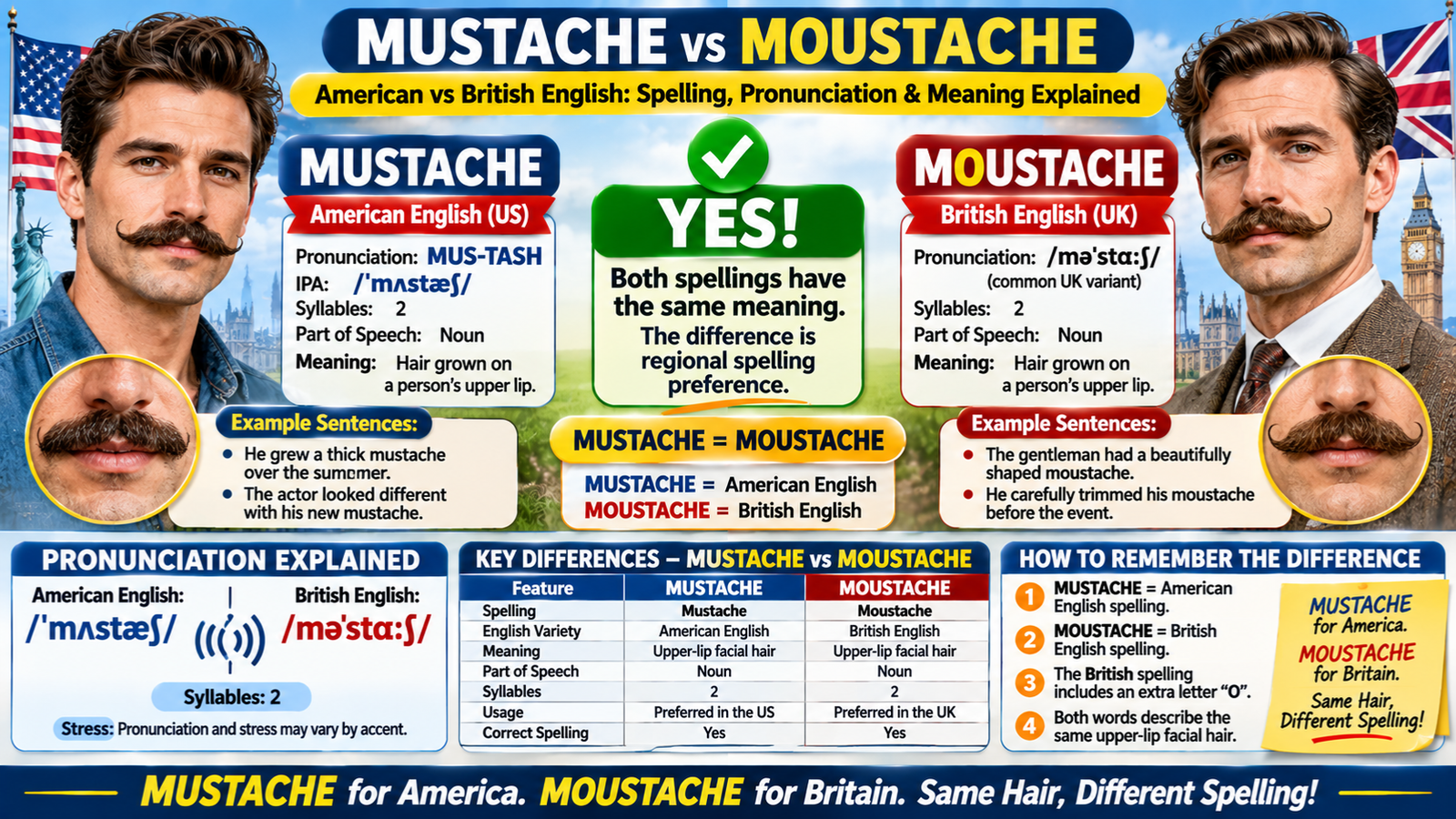
Both are correct. “Mustache” is the usual American spelling, and “moustache” is the usual British one. They mean the same thing: hair growing on the upper lip. Choose the spelling that suits your readers, then use it consistently throughout the document.
Mustache vs Moustache: The Quick Answer
Same word, two spellings. Nobody is wrong.
Mustache, without the o, is the American form. Moustache, with the o, is the British form. Writing Explained puts it this way: mustache is commonly used in American English, whereas moustache is the accepted variant in British English. YourDictionary agrees, and adds that some Americans still write moustache, so the key is to stay consistent.
The meaning is identical, and so is the sound. Both are usually pronounced the same way. What differs is the reader you are writing for, and the extra o.
So if your spellchecker flagged one of them, it is probably set to the other region. Switch the language setting, or switch the spelling, and keep going. The one rule that really matters is this: don’t write “mustache” in the first paragraph and “moustache” in the fifth.
What Does Mustache Mean?
Mustache is a noun. Dictionary.com defines it as hair that grows on the upper lip, usually on men, often left unshaven and trimmed into different shapes.
It has a few other uses too. According to the same entry, mustache can describe:
- bristles or hairs near the mouth of an animal
- a coloured stripe or elongated feathers on a bird’s head
- something that looks like a mustache, such as milk or foam on a person’s upper lip
That last one is the “milk mustache” you see after a glass of milk. In every case, the picture is the same: something that sits above the mouth and looks like hair.
Mustache Styles and Slang
The word covers a lot of shapes. One of the best known is the handlebar, a big curly style. Live Bearded notes that it needs the outer hairs to grow long, and that wax helps train the hair to grow “out and up” and gives the ends their curl. Other style names (pencil, walrus and so on) are common in barber talk, but I could not verify their definitions from the pages I could open, so I won’t define them here.
Slang is easier. YourDictionary lists stache, tache and tash as shortened forms. And Grammarly notes that in Australia a moustache is called a “mo,” which is the source of the word Movember.
The spelling question follows you into all of these. If you write “handlebar mustache” in a US magazine, it stays “handlebar moustache” in a British one.
Mustache or Moustache: Which Region Uses Which?
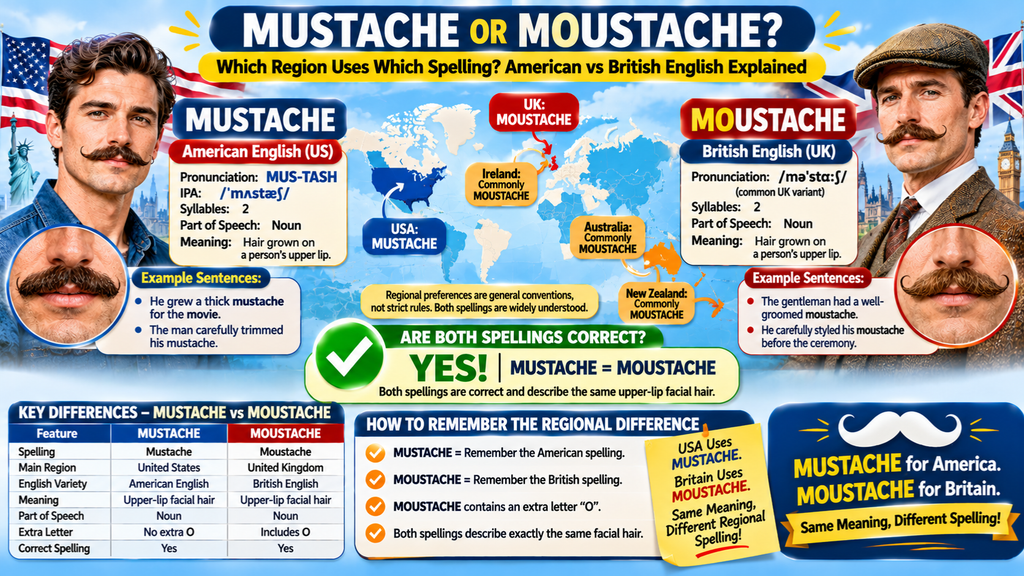
The Mustache vs Moustache split follows geography more than any rule of grammar.
Here is how usage divides, based on Sapling’s regional data.
| Region | More common spelling | Sapling’s score (mustache / moustache) |
| United States | mustache | 87 / 13 |
| Philippines | mustache | 79 / 21 |
| Canada | mustache | 52 / 48 |
| India | moustache | 47 / 53 |
| Ireland | moustache | 46 / 54 |
| United Kingdom | moustache | 36 / 64 |
| Australia | moustache | 33 / 67 |
| New Zealand | moustache | 28 / 72 |
Treat those numbers as a rough direction, not exact statistics. I can’t tell you how Sapling measures them.
Two things stand out. First, Canada is almost a coin toss, 52 to 48. If you write for Canadian readers, the data won’t settle it for you. Second, India leans slightly toward moustache, 53 to 47, so don’t assume that an Indian audience follows the American spelling.
About Pakistan: none of the sources I checked list it. India’s numbers are not Pakistan’s. If you write for Pakistani readers, the “Which Spelling Should You Use?” section below is the better guide.
Why Do the Two Spellings Differ?
Both spellings come from the same French word. English borrowed it in the 1500s, according to Grammarphobia, and Dictionary.com dates it to about 1575 to 1585, from Middle French moustache. French took the word from Italian mostaccio, and the root goes back to the Greek mystax, meaning “upper lip.”
So moustache is the form closer to French, and mustache is the simplified English form that became standard in the United States.
YourDictionary makes a helpful comparison. Like British words such as colour and omelette, moustache keeps an extra letter from its French roots. That is a handy way to think about it, though the pattern isn’t the same as the -or/-our split. The difference here is “mou-” against “mu-“, not a changed ending.
There is one surprise in the history. Grammarphobia notes that dictionaries on both sides of the Atlantic once preferred mustache, and quotes the OED: “most American dictionaries prefer the semi-anglicized form mustache.” And Merriam-Webster’s article says its Unabridged Dictionary still preferred moustache for American English as late as 1961. So the American spelling was not always the shorter one. It settled that way over time.
Writing Explained adds that moustache has been the preferred British variant since the mid-nineteenth century.
All the Forms in One Table
Here are the forms people look for, drawn from YourDictionary, Merriam-Webster and Grammarphobia.
| Form | US spelling | UK spelling |
| Singular noun | mustache | moustache |
| Plural | mustaches | moustaches |
| Adjective (has one) | mustached | moustached |
| Adjective (large or groomed) | mustachioed | mustachioed |
The first three rows swap the o in and out. The last row stays the same in both varieties.
The plural is simple: add an s. YourDictionary lists moustaches and mustaches. Grammarphobia adds a twist, noting that the plural has long been used for one man’s upper-lip growth, perhaps because people thought of the two halves. Today, mustache is treated as singular, and you would normally say “a mustache,” not “mustaches,” for one person.
Which Spelling Should You Use?
Settling Mustache vs Moustache for your own writing takes five quick checks.
Think about your audience. American readers expect mustache. British, Australian and New Zealand readers lean toward moustache, according to Sapling’s figures.
Follow the style guide. If a publisher, school or client gives you a style sheet, that settles it.
Match the rest of your text. If you write colour and favourite, moustache belongs with them. If you write color and favorite, use mustache.
Set your spellchecker first. Choose English (US) or English (UK) before you start, and the red lines will agree with you.
Be consistent. Honestly, this matters more than the choice itself. A reader will forgive either spelling, but a mix looks careless.
With no audience and no style guide, pick the one that matches the rest of your spelling and stick with it.
How to Pronounce Mustache and Moustache
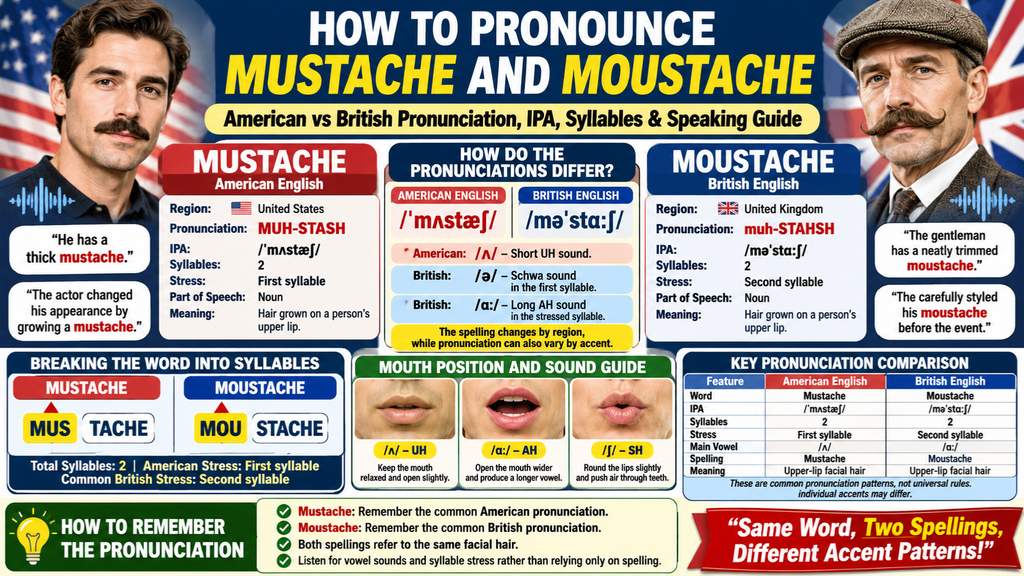
Both spellings are usually pronounced “muh-stash,” according to YourDictionary. Some people say “moo-stosh,” which is closer to the French pronunciation.
So the spelling doesn’t change the sound. You can’t hear whether someone means mustache or moustache. You can only see it. YourDictionary is the only source I could open that covers pronunciation, so I haven’t printed a full phonetic transcription for the UK and the US. If you need one for a dictionary-style entry, check a current dictionary.
Mustachioed and Related Words
The family has a few more members worth knowing.
Mustached or moustached describes someone who has a mustache. Dictionary.com lists mustached as the related adjective. YourDictionary says mustachioed is for someone with a particularly large, bushy mustache.
Mustachioed is the more dramatic choice. Merriam-Webster’s article says it is the choice for writers who want to emphasize size or grooming, the same emphasis that mustachios conveys.
Mustachio is an older form. Grammarphobia says English got it from Italian and Spanish, and it appeared a few decades before mustache. Writing Explained says mustachio is sometimes used for a conspicuously large mustache, and may sound pretentious or ornate. You’ll mostly meet it in literature, or when someone is being playful.
Mustachios is the plural form of mustachio. Grammarly says it is commonly written as a plural in the UK, and that it is common in the United States to drop the s when referring to a large or elaborate mustache. It is a small detail, but it explains why you see both “his mustachio” and “his mustachios” in print.
Short forms exist too. YourDictionary lists stache, tache and tash as shortened forms, mostly informal.
In practice, “a mustached man” is neutral, and “a mustachioed gentleman” paints a picture of waxed ends and a lot of pride.
Mustache vs Beard
A mustache is not a beard. Dictionary.com defines a mustache as hair that grows on the upper lip, so it is only one part of a person’s facial hair. A beard covers other parts of the face.
That means a man can have:
- a mustache without a beard
- a beard without a mustache
- both a mustache and a beard
- neither
“He shaved his beard but kept his mustache” makes the contrast clear. In British spelling the same sentence reads “He shaved his beard but kept his moustache.”
Example Sentences
With mustache:
- The old sailor’s mustache was white with sea salt.
- He shaved his beard but kept his mustache.
- She wiped the milk mustache off her son’s face.
- His grey mustache twitched when he laughed.
- The mustached man had spent all morning grooming his facial hair.
- My grandfather has worn the same mustache for forty years.
- The actor grew a thick mustache for the role.
- The detective stroked his mustache and frowned.
- He carefully waxed the ends of his mustache.
- The child drew a funny mustache on the photograph.
With moustache:
- The old sailor’s moustache was white with sea salt.
- He shaved his beard but kept his moustache.
- She wiped the milk moustache off her son’s face.
- His grey moustache twitched when he laughed.
- The moustached man had spent all morning grooming his facial hair.
- My grandfather has worn the same moustache for forty years.
- The actor grew a thick moustache for the role.
- The detective stroked his moustache and frowned.
- He carefully waxed the ends of his moustache.
- The child drew a funny moustache on the photograph.
A Practical Case Study
A small scenario shows why the Mustache vs Moustache choice matters in real writing.
Picture three writers describing the same actor.
The first writes for an American magazine: “The actor grew a mustache for his latest role.”
The second writes for a British newspaper: “The actor grew a moustache for his latest role.”
Neither made a mistake. Each followed the spelling of their readers.
The third writer is writing American English throughout, but slips: “The actor grew a mustache for his latest role. His moustache became part of the character’s look.” The meaning is clear, but the page now looks unedited. That is the real cost of getting Mustache vs Moustache wrong: not a wrong word, just a careless impression. The fix is one letter: use mustache in both places, or moustache in both.
Common Mistakes
The Mustache vs Moustache choice rarely causes errors. The slips below do.
Mixing both spellings in one document. The most frequent slip. Pick a spelling and search the page before you publish.
Calling one spelling wrong. Mustache is not a mistake in British writing, and moustache is not a mistake in American writing. Merriam-Webster, Dictionary.com and YourDictionary all treat both as correct.
Writing “mustash,” “moustach” or “mustachy”. Neither is a standard spelling. The word ends in -ache.
Treating mustachioed as a plain synonym. Mustachioed suggests something large or carefully groomed. “A mustached man” and “a mustachioed man” are not quite the same picture.
Switching mid-sentence. “He trimmed his mustache, then waxed his moustache” has no reason to change spelling. Unless you are quoting a source, choose one.
Thinking the extra o changes the meaning. It doesn’t. Mustache and moustache name the same facial hair.
Assuming moustache is more formal. The spelling doesn’t change the tone. “He has a mustache” and “He has a moustache” sound equally formal. Only the region differs.
Using the plural for one person. Grammarphobia explains that the plural has a long history, but today a single person has a mustache, not mustaches.
Applying the -our rule. The pattern here is “mou-” versus “mu-“, so it doesn’t work like colour and color, where the ending changes.
Forgetting the spellchecker’s language. A document set to US English will flag moustache even if you meant it. Fix the setting before you change the word.
How to Remember It
One memory trick is enough.
Writing Explained offers a neat trick: moustache and London are both spelled with an O.
That’s a good hook if you write for a British audience. Britain, London, moustache: keep the o. For American readers, drop it.
If you want another picture, think of the o in moustache as a small extra letter that came over from French, and which American English decided to leave behind.
Quick Practice
Choose the spelling that fits the situation. Answers follow.
- You are writing for a US lifestyle magazine. (mustache / moustache)
- You are writing for a British newspaper. (mustache / moustache)
- The plural for an American audience is ___. (mustaches / moustaches)
- The plural for a British audience is ___. (mustaches / moustaches)
- Which word describes a large, bushy or carefully groomed mustache? (mustached / mustachioed)
- Which spelling is the same in both varieties? (mustachioed / moustache)
- Which is not a standard spelling? (moustach / moustache)
- Which spelling is the British one? (mustache / moustache)
Answers: 1. mustache. 2. moustache. 3. mustaches. 4. moustaches. 5. mustachioed. 6. mustachioed. 7. moustach. 8. moustache.
FAQs
These are the questions people ask most about this topic.
Is it mustache or moustache? Both are correct. Mustache is the American spelling, and moustache is the British one. Choose by your audience and keep the same spelling throughout.
Is moustache British or American? British. The American spelling is mustache, though some Americans still write moustache.
What is the difference between mustache and moustache? Only the spelling. The meaning is the same, and both are usually pronounced “muh-stash.”
Are mustache and moustache the same? Yes. They are the same word, from the same French and Italian roots. The difference is the extra o in the British form.
What is the plural of mustache? Mustaches, or moustaches in British English. Add an s to either spelling.
Is it mustaches or moustaches? Both, following the same rule as the singular. Use mustaches with mustache and moustaches with moustache.
What does mustachioed mean? It describes someone with a particularly large, bushy or carefully groomed mustache. It is the more dramatic choice compared with mustached.
How do you pronounce moustache? Usually “muh-stash.” Some people say “moo-stosh,” which is closer to French. The spelling doesn’t change the usual sound.
Is a mustache the same as a beard? No. Dictionary.com defines a mustache as hair on the upper lip, so it is only one part of a person’s facial hair. A man can have a mustache without a beard.
Which spelling should I use in Pakistan or India? No source I checked lists Pakistan. Sapling shows India leaning slightly to moustache, 53 to 47, but that isn’t a rule. Follow your audience or your employer’s style and stay consistent.
Is moustache wrong in American English? No. Mustache is the usual US spelling, but YourDictionary notes that some Americans still write moustache. It is a less common variant, not an error.
Is mustache wrong in British English? No. Mustache is recognised as the American spelling. It will look odd in a British publication, but it is not a mistake in itself.
Is mustachio the same as mustache? Not exactly. Writing Explained says mustachio is sometimes used for a conspicuously large mustache, and it may sound ornate. It isn’t just another regional spelling of the standard word.
What does “mo” mean in Australia? It is a short form of moustache. Grammarly says it is the source of the word Movember.
Key Facts to Remember
Here is the whole topic in one place.
- Mustache and moustache are the same word. Mustache is the usual American spelling, moustache the usual British one.
- Both mean hair on the upper lip. Dictionary.com also records animal bristles, bird markings and “milk mustaches.”
- English borrowed the word from French in the 1500s. French took it from Italian mostaccio, and the root goes back to Greek mystax.
- The plural adds an s: mustaches or moustaches.
- Mustached or moustached describes someone who has one. Mustachioed suggests something large or groomed.
- Sound doesn’t change with the spelling.
- Consistency matters more than which spelling you pick.
Final Thoughts
Both are correct. Mustache is American, moustache is British, and the meaning is the same. Look at your audience, pick one spelling, and keep it from the first paragraph to the last.
If you remember one thing from this Mustache vs Moustache guide, make it the London trick: moustache and London both have an O.
One Comment