Bourbon vs Whiskey: What’s the Difference? Rules, Taste and Types
You are reading a menu at a restaurant in Kentucky, Texas, or New York, and it lists “bourbon” in one column and “whiskey” in another. Or a friend says, “I don’t drink whiskey, I only drink bourbon.” Are they talking about two different drinks? Is bourbon sweeter, stronger, or better? Or is it the same thing with a fancier name?
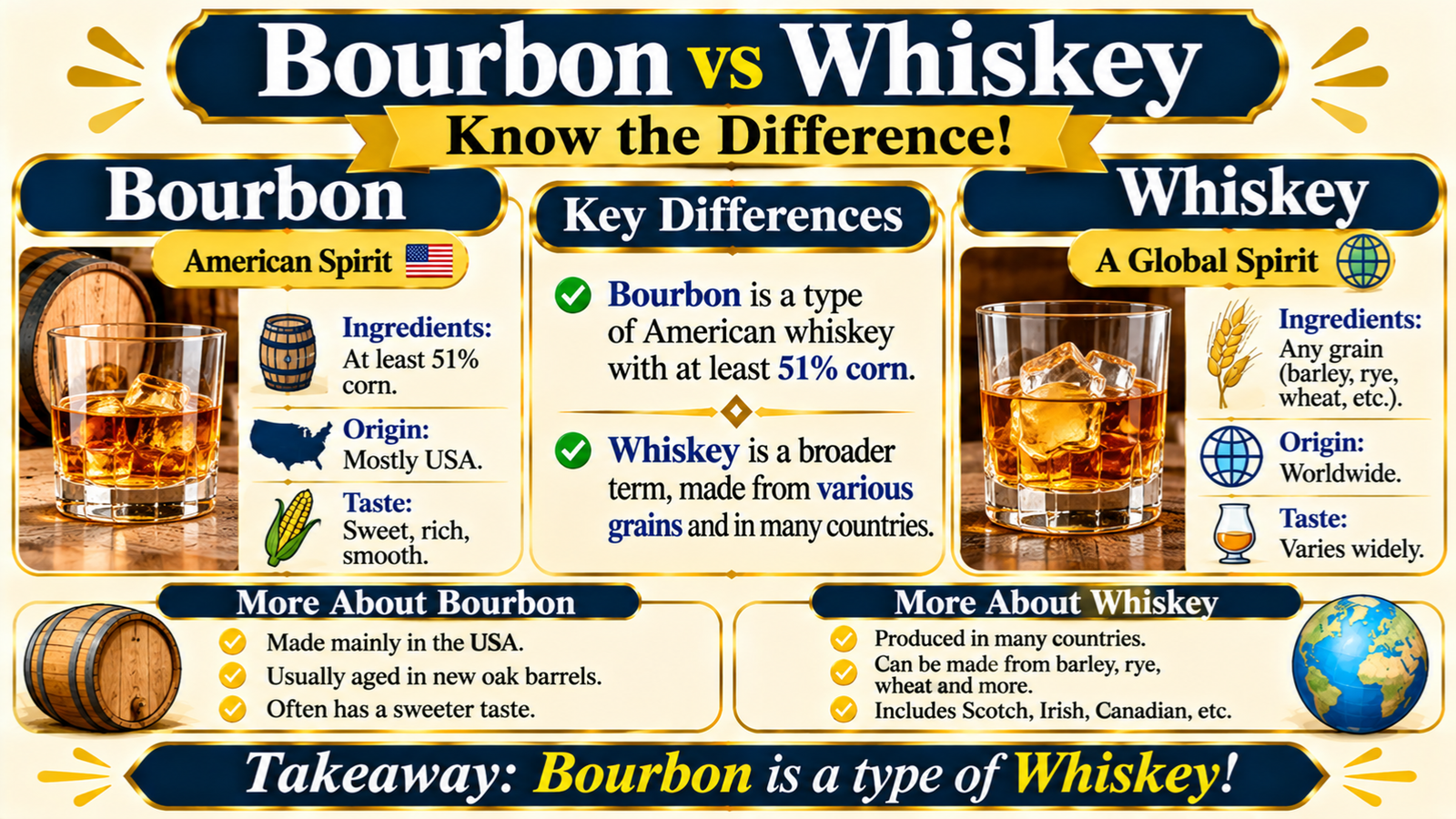
The Bourbon vs Whiskey question has a short answer: all bourbon is whiskey, but not all whiskey is bourbon. Whiskey is the broad family of spirits distilled from fermented grain. Bourbon is one specific member of that family, with strict federal rules about where it is made, what grain goes into it, and what kind of barrel it ages in.
In this Bourbon vs Whiskey guide, you will learn those rules in plain English, how bourbon compares with rye, Tennessee, Scotch, Irish, and other whiskeys, what “straight,” “bottled in bond,” and “barrel proof” mean on a label, why some bottles say “whisky” without the “e,” and which myths to ignore. Every point is explained simply, so you can order, shop, or write about the subject with confidence.
This article is educational. In the United States, you must be 21 to buy alcohol, laws vary by state and country, and alcohol is not suitable for everyone. If you drink, please do so responsibly.
Bourbon vs Whiskey: Quick Answer
Bourbon is a type of American whiskey. Under U.S. federal rules, it must be made in the United States from a grain mixture of at least 51% corn, distilled at no more than 160 proof, aged in new charred oak containers, and bottled at no less than 80 proof, with no added coloring or flavoring. Whiskey is the broad category of spirits distilled from fermented grain. So all bourbon is whiskey, but not all whiskey is bourbon.
| Term | What it means | Example |
| whiskey | the broad family of grain spirits | Scotch, Irish, rye, Tennessee, and bourbon are all whiskey. |
| bourbon | a specific American whiskey with legal rules | Bourbon must use at least 51% corn. |
Think of it like squares and rectangles: every square is a rectangle, but not every rectangle is a square. Every bourbon is a whiskey, but not every whiskey is a bourbon.
Bourbon vs Whiskey at a Glance
Here is the whole Bourbon vs Whiskey story on one screen. Details follow in the sections below.
| Feature | Bourbon | Whiskey (general) |
| What it is | A specific, legally defined style of American whiskey | The broad category of grain spirits |
| Where it is made | The United States (distilled and aged there) | Anywhere in the world, depending on the style |
| Main grain | At least 51% corn | Corn, rye, barley, wheat, or a mix |
| Distillation limit | 160 proof (80% ABV) or less | Under 190 proof (95% ABV) for the broad class |
| Barrel | Charred new oak, entered at 125 proof (62.5% ABV) or less | Depends on the style (new, used, or other oak) |
| Additives | No coloring, flavoring, or blending materials; no neutral spirits | Depends on the style and country |
| Minimum age | None for plain bourbon; 2 years for “straight” | Depends on the style (3 years for Scotch and Irish) |
| Minimum bottling strength | 80 proof (40% ABV) | Usually 80 proof or more |
| Typical flavor | Often sweeter: caramel, vanilla, oak | Wide range: smoky, spicy, fruity, malty, or light |
What Is Whiskey?
Whiskey (or whisky) is a distilled spirit made from a fermented mash of grain. The grain can be corn, rye, barley, or wheat, and in most traditions the spirit is aged in oak barrels.
The federal definition in the United States (27 CFR 5.143, published by the Alcohol and Tobacco Tax and Trade Bureau, or TTB) describes the general “whisky” class like this:
- It is an alcoholic distillate from a fermented mash of grain.
- It is distilled at less than 95% alcohol by volume (190 proof).
- It has the taste, aroma, and characteristics generally attributed to whisky.
- It is stored in oak barrels (corn whisky is the exception).
- It is bottled at not less than 40% alcohol by volume (80 proof).
The same rule says the word may be spelled either “whisky” or “whiskey” on a label.
Because the category is broad, “whiskey” covers many styles from many countries: bourbon, rye, Tennessee whiskey, Scotch, Irish whiskey, Canadian whisky, Japanese whisky, and more. Each has its own rules, grains, and flavors.
What Is Bourbon?
Bourbon is a specific style of American whiskey, defined by law rather than marketing. To be called bourbon, a whiskey has to meet a list of rules about its origin, grain, barrel, proof, and ingredients.
The name’s origin is debated. The most common explanation links it to Bourbon County, Kentucky, which was named for the French royal House of Bourbon. Others point to Bourbon Street in New Orleans. Historians have not settled the question, so treat any single story with caution.
Examples of “bourbon” in sentences:
- He ordered a bourbon on the rocks.
- The distillery makes a straight bourbon aged for four years.
- This bourbon has notes of caramel, vanilla, and toasted oak.
- Many Americans associate bourbon with Kentucky, but it can be made in any state.
In everyday speech, people often say “bourbon whiskey” to make the relationship clear: bourbon is the type, and whiskey is the category. On a label, the standard wording is “Bourbon Whisky” or “Bourbon Whiskey,” since both spellings are allowed.
The Legal Rules for Bourbon
The legal side of Bourbon vs Whiskey lives in the U.S. federal standard of identity, 27 CFR 5.143. Here are the requirements in plain English:
| Rule | What the standard says |
| Made in the U.S. | The word “bourbon” may not be used to describe a whisky that was not distilled and aged in the United States. |
| Grain | The fermented mash must be at least 51% corn. |
| Distillation | Distilled at 160 proof (80% alcohol by volume) or less. |
| Barrels | Stored in charred new oak barrels, entered at 125 proof (62.5% alcohol by volume) or less. |
| Neutral spirits | None allowed. |
| Additives | No coloring, flavoring, or blending materials. |
| Bottling strength | Bottled at not less than 80 proof (40% alcohol by volume). |
| Minimum age | None for plain bourbon. “Straight” bourbon must be stored at least 2 years. |
Three points surprise many readers:
- Bourbon does not have to be made in Kentucky. The federal rule requires the United States, not a specific state.
- Bourbon does not need a minimum age. Only “straight” bourbon must be aged at least two years.
- Bourbon cannot contain added coloring or flavoring. The brown color comes from the barrel, not from a bottle of dye.
That last rule is a big reason people trust the word. When a whiskey says “bourbon,” the flavor and color are supposed to come from the grain, the yeast, and the wood.
U.S. labels also have to be approved. The TTB reviews and approves alcohol labels through a Certificate of Label Approval (COLA), which is why you see consistent wording across bottles.
Bourbon vs Whiskey: The Core Difference Explained
The simplest way to see the Bourbon vs Whiskey difference is to separate the category from the style.
- Whiskey is the category: a grain-based spirit, usually aged in oak.
- Bourbon is a style inside that category: an American whiskey that follows a strict recipe.
The relationship looks like this:
Whiskey → American whiskey → Bourbon → Straight bourbon
Each step to the right adds more rules. That is why asking “bourbon or whiskey?” is a bit like asking “poodle or dog?” A poodle is a dog, but “dog” covers many more breeds.
| If you mean… | Use |
| any grain-based spirit aged in wood | whiskey |
| an American whiskey with at least 51% corn in new charred oak | bourbon |
| a bourbon aged at least two years | straight bourbon |
| a Scottish spirit made under Scotch regulations | Scotch whisky |
| an Irish spirit aged at least three years | Irish whiskey |
Does Bourbon Have to Be Made in Kentucky?
No. This is one of the most common myths in the Bourbon vs Whiskey debate.
Kentucky is the heart of bourbon culture, and many famous distilleries are there. But the federal rule asks only that bourbon be distilled and aged in the United States. A bourbon can be made in Indiana, Texas, New York, Colorado, or any other state.
The label rules reinforce this. If a label names a state, such as “Kentucky Straight Bourbon Whiskey” or “New York Bourbon Whisky,” the whisky must have been distilled and aged there. If the label just says “bourbon,” it can come from any U.S. state.
You may also hear that “95% of the world’s bourbon is made in Kentucky.” The Kentucky Distillers’ Association has used that figure for years, and many news stories repeat it. Some industry voices have questioned it as the number of craft distilleries grows in other states. A safer statement is: Kentucky is the center of bourbon production, but bourbon is not legally limited to Kentucky.
Why Kentucky Became the Home of Bourbon
Kentucky’s role is historical and practical, not legal. Distillers there found corn easy to grow, limestone-filtered water widely available, and a climate with hot summers and cold winters that pushes whiskey in and out of the wood. Over generations, a network of distilleries, cooperages (barrel makers), warehouses, and skilled workers grew up around the industry.
Congress recognized bourbon’s importance on May 4, 1964, when it declared bourbon a “distinctive product of the United States.” That is where the nickname “America’s Native Spirit” comes from. September is also celebrated as National Bourbon Heritage Month, and the Kentucky Bourbon Trail draws visitors from around the world. Kentucky officials often point out that there are more barrels of bourbon aging in the state than people living in it. That history is why the Bourbon vs Whiskey debate so often turns into a Kentucky debate.
Bourbon vs Other Types of Whiskey
Here is how bourbon compares with other well-known styles. The U.S. details come from 27 CFR 5.143. The Scotch and Irish details come from the Scotch Whisky Regulations 2009 and the Irish Whiskey technical file, linked at the end of this article.
| Style | Where it is made | Key rules |
| Bourbon | United States | At least 51% corn, charred new oak, no coloring or flavoring |
| Rye whiskey (U.S.) | United States | At least 51% rye, charred new oak barrels |
| Wheat whiskey (U.S.) | United States | At least 51% wheat, charred new oak barrels |
| Malt whiskey (U.S.) | United States | At least 51% malted barley, charred new oak barrels |
| Corn whiskey (U.S.) | United States | At least 80% corn; if stored in oak, it must be used or uncharred new oak |
| Straight whiskey | United States | Stored at least 2 years in charred new oak |
| American single malt | United States | 100% malted barley, one U.S. distillery, a federal standard added in 2025 |
| Tennessee whiskey | Tennessee | State law: made in Tennessee, at least 51% corn, charcoal filtered, new charred oak |
| Scotch whisky | Scotland | Aged at least 3 years in oak casks of no more than 700 liters; only water and plain caramel coloring added |
| Irish whiskey | Island of Ireland | Aged at least 3 years in wooden casks of no more than 700 liters; only water and plain caramel coloring added |
| Canadian whisky | Canada | Made under Canada’s own rules; often blended and lighter |
Bourbon vs Rye Whiskey
American rye whiskey is made with at least 51% rye in the mash, where bourbon uses at least 51% corn. That one grain switch changes the flavor. Rye is often described as spicier, drier, and more peppery. Bourbon is often described as sweeter and rounder.
Rye is traditional in a Manhattan. Bourbon is a favorite in an Old Fashioned. But plenty of bartenders swap one for the other.
Bourbon vs Wheated Bourbon
Some bourbons replace the rye in the recipe with wheat. These “wheated bourbons” are often described as softer and gentler, because wheat lacks rye’s peppery bite. They are still bourbon, since the mash still contains at least 51% corn.
Bourbon vs Tennessee Whiskey
Tennessee whiskey is its own well-known American style. Under Tennessee Code § 57-2-106, a product labeled “Tennessee Whiskey” must be made in Tennessee, from a mash of at least 51% corn, distilled to no more than 160 proof, filtered through maple charcoal before aging, aged in new charred oak barrels in Tennessee, and entered into the barrel at no more than 125 proof. The charcoal step is called the Lincoln County Process. The law includes one named exception for a single distillery that does not use it.
So Tennessee whiskey follows nearly the same recipe as bourbon, with extra state-level requirements. Some Tennessee whiskeys could technically meet the federal definition of bourbon, but many producers choose to market themselves as Tennessee whiskey.
Bourbon vs Scotch Whisky
Scotch must be made in Scotland under the Scotch Whisky Regulations 2009. It is traditionally made from malted barley, aged at least three years in oak casks of no more than 700 liters, and allowed only water and plain caramel coloring as additions. Many Scotches are matured in used casks, which often held bourbon or sherry before. Bourbon, by contrast, must use new charred oak.
The popular idea that “Scotch is smoky” is only partly true. Smoke comes from peat used to dry malt in some Scotches. Many others are fruity, floral, or honeyed.
Bourbon vs Irish Whiskey
Irish whiskey must be made on the island of Ireland and matured at least three years in wooden casks of no more than 700 liters. Many Irish whiskeys taste lighter, fruitier, and smoother than bourbon, although the category includes rich styles too. Bourbon’s new charred oak requirement usually gives it a more pronounced vanilla and caramel character.
Canadian, Japanese, and American Single Malt
Canadian whisky is a distinctive product of Canada and is often lighter and blended. Japanese whisky traditions were strongly shaped by Scotch. And since 2025, the TTB has had a federal standard for American single malt whisky: made from 100% malted barley at a single U.S. distillery and matured in oak casks of no more than 700 liters.
Key takeaway: the big differences are the country, the grain, and the barrel. Bourbon uses mostly corn and new charred oak, and it must be American.
Bourbon vs Whiskey: Taste and Flavor
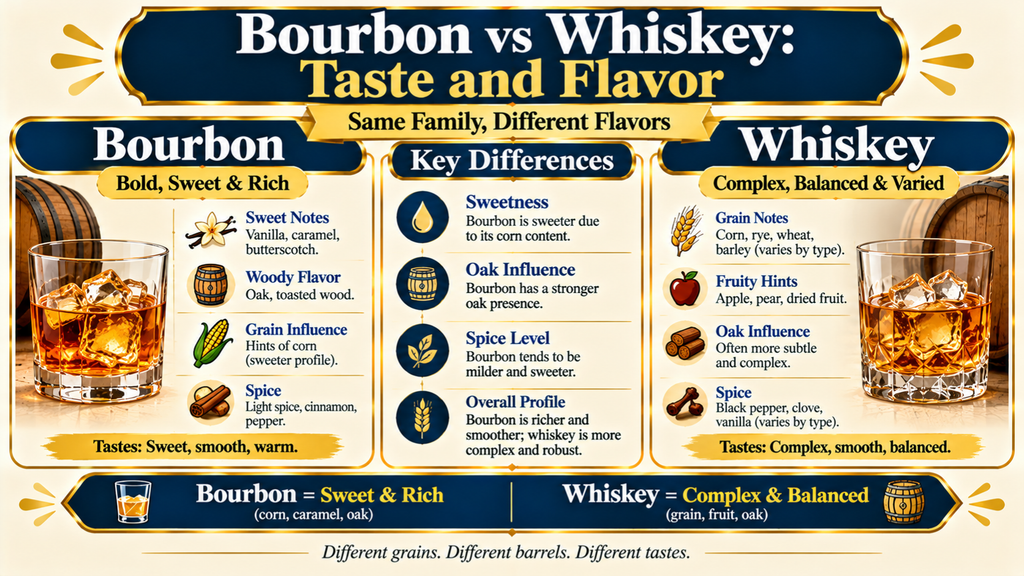
Taste is personal, and every brand is different. Still, some general patterns help explain Bourbon vs Whiskey in the glass.
Bourbon is often described as sweeter and rounder. Two reasons are commonly given:
- Corn: At least 51% of the mash is corn, which many drinkers associate with sweetness. Many bourbons use well above the 51% minimum.
- New charred oak: Fresh barrels with a charred inside tend to add vanilla, caramel, and toasted notes.
Typical bourbon tasting notes include caramel, vanilla, brown sugar, toasted oak, baking spices, cherry, dried fruit, and sometimes chocolate or nuts.
Other whiskeys vary widely:
- Rye is often spicier and drier, with pepper and herbal notes.
- Scotch ranges from light and floral to heavily smoky, depending on the region and the method.
- Irish whiskey is often described as light, fruity, and smooth.
- Canadian whisky is often described as light and gentle.
Bourbon can taste sweet without being sugary. There is no added sugar in the bottle. The “sweet” impression comes from the grain, the char, and the compounds the wood releases during aging.
These are general descriptions, not rules. A single bottle can break the pattern, so always trust your own palate.
How Bourbon Is Made
To see Bourbon vs Whiskey in practice, follow the process step by step:
- Mash. Grain is ground and cooked with water. For bourbon, at least 51% of the grain is corn. Rye, wheat, or malted barley usually make up the rest. The grain recipe is called the mash bill.
- Ferment. Yeast turns the sugars in the mash into alcohol. Many distillers use a sour mash method, adding a portion of leftover liquid from a previous run to help control acidity.
- Distill. The fermented liquid is heated and the alcohol vapor is collected. Many Kentucky distilleries use a column still followed by a “doubler” or “thumper.” For bourbon, the spirit must come off the still at 160 proof or less.
- Barrel. The new spirit goes into new, charred oak barrels at no more than 125 proof. The barrels are made by a cooperage, and the inside is toasted and charred.
- Age. The barrels rest in warehouses, sometimes called rickhouses. Temperature swings push the whiskey in and out of the wood, adding color and flavor. Some liquid evaporates each year. This loss is poetically called the “angels’ share.” Plain bourbon has no minimum age, and straight bourbon needs at least two years.
- Bottle. Water may be added to reach the bottling strength, which must be at least 80 proof. No coloring or flavoring may be added.
That process is the practical side of Bourbon vs Whiskey: some steps are required by law, and the rest are left to the distiller.
Why New Charred Oak Matters So Much
Bourbon’s barrel rule is one of the biggest reasons it tastes the way it does.
When a barrel is charred, the heat breaks down wood sugars and other compounds in the oak. During aging, the spirit soaks into the charred layer and pulls out flavor compounds. These are commonly linked to vanilla, caramel, toast, spice, and coconut-like notes. The char also acts like a filter and helps shape the color.
Because the rule requires new barrels, the wood has not been used before. That means a fresh dose of flavor for every batch. It also explains why used bourbon barrels are in demand around the world. Scotch, Irish, and other producers often buy them to age their own whiskey.
The warehouse matters too. Hot Kentucky summers push the liquid into the wood, and cold winters pull it out. That is part of why age alone does not tell you everything about quality, and it is one of the biggest drivers of the Bourbon vs Whiskey difference in flavor.
Straight Bourbon, Bottled in Bond and Other Label Terms
The word “bourbon” is only the start. Other terms on the label tell you more about what is in the bottle.
What Does “Straight Bourbon” Mean?
Straight bourbon is bourbon that has been stored in charred new oak barrels for at least two years, with no coloring, flavoring, or blending materials added. The word “straight” is optional, but if it appears, the rules apply.
That gives a useful hierarchy:
Whiskey → Bourbon → Straight Bourbon
“Straight” is not a quality grade. It tells you about the minimum age and purity, not whether you will like the taste.
What Does “Bottled in Bond” Mean?
Bottled in Bond is a separate designation created by the Bottled-in-Bond Act of 1897. To use it, a whiskey must be:
- The product of one distillation season (January to June, or July to December),
- Made by one distiller at one distillery,
- Aged at least four years in a federally bonded warehouse, and
- Bottled at exactly 100 proof (50% alcohol by volume).
Some drinkers see “bonded” as a sign of quality, while some producers consider it old-fashioned and skip it. Either way, it gives you more verified information than words like “premium” or “handcrafted.”
Age Statements
Plain bourbon has no required minimum age, but federal labeling rules require a whiskey aged less than four years to state its age. An age statement always reflects the youngest whiskey in the bottle. A bottle that says “6 years” can contain older whiskey, but nothing younger.
Small Batch, Single Barrel, and Barrel Proof
- Small batch: Sounds precise, but there is no single federal definition of how many barrels may be blended. Do not assume it means better.
- Single barrel: Bottled from one barrel rather than a blend. Two single-barrel bottles from the same brand can taste noticeably different.
- Barrel proof (or cask strength): Bottled at or near the strength it came out of the barrel, instead of being diluted down. These can be much stronger than 80 proof, so sip carefully.
Finish
A finish is extra time in a second cask, such as a wine or port cask, after the main aging. Because the bourbon already spent time in new charred oak, a finish adds another layer rather than replacing the first one. Note that a whiskey with a secondary finish may no longer meet every requirement for the straight designation, so read the label.
Proof vs ABV: Reading Alcohol Strength
In the United States, proof is twice the alcohol by volume (ABV). So:
| Proof | ABV |
| 80 proof | 40% |
| 90 proof | 45% |
| 100 proof | 50% |
| 120 proof | 60% |
The federal rules set the minimum bottling strength for bourbon at 80 proof. Many bourbons are bottled at 90 to 100 proof, and barrel-proof releases can be higher.
For context, a standard drink in the United States contains about 0.6 fluid ounces (14 grams) of pure alcohol. That equals about 1.5 fluid ounces of 80-proof spirits. A 100-proof bourbon is stronger, so a standard serving of it is smaller. Always check the strength before you pour.
Whiskey vs Whisky: The Spelling Difference
A second confusion sits right next to Bourbon vs Whiskey: why do some labels say “whisky” without an “e”?
According to Merriam-Webster, whiskey (with an “e”) is the usual spelling in the United States and Ireland, and whisky (without the “e”) is the usual spelling elsewhere. Bottle labels generally follow the spelling of the country where the spirit is made. Federal U.S. rules allow either spelling, which is why a few American brands, including Maker’s Mark and George Dickel, use “whisky.”
| Country or region | Usual spelling |
| United States | whiskey |
| Ireland | whiskey |
| Scotland | whisky |
| Canada | whisky |
| Japan | whisky |
Plurals: The plural of whiskey is whiskeys, and the plural of whisky is whiskies. Both are used.
Word origin: The word goes back to the Gaelic phrase for “water of life,” written uisce beatha in Irish and uisge beatha in Scottish Gaelic. That phrase translates the Medieval Latin aqua vitae, which was used for distilled spirits. Over time, the old forms shortened into the modern word.
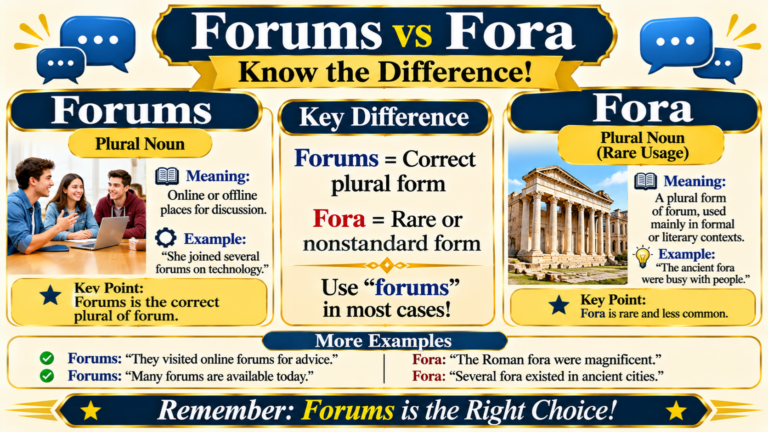
Spelling pairs like this appear in many English words. If you enjoy them, see our guides on mustache vs moustache, colonize vs colonise, and marveled or marvelled. For unusual plurals in general, read forums vs fora.
Which should you use? Match the spelling to the place the drink comes from. Write “bourbon whiskey” and “Irish whiskey,” but “Scotch whisky” and “Japanese whisky.” If you are unsure, follow your style guide and stay consistent.
How to Read a Bourbon Label
Reading a label is the fastest way to put your Bourbon vs Whiskey knowledge to work in a store. Labels use specific words, and each one carries meaning.
| Label term | What it tells you |
| Bourbon Whiskey | It meets the federal standard for bourbon. |
| Straight Bourbon Whiskey | It is bourbon stored at least 2 years in charred new oak. |
| Kentucky Straight Bourbon | It is straight bourbon distilled and aged in Kentucky. |
| Bottled in Bond | It meets the Bottled-in-Bond Act rules: 100 proof, 4+ years, one distillery, one season. |
| Proof / ABV | Strength. In the U.S., proof is twice the ABV. |
| Age statement | The age of the youngest whiskey in the bottle. |
| Small batch / Single barrel | Marketing or bottling terms; check the producer’s own explanation. |
Quick checks before you buy:
- A bottle with a flavor such as honey, apple, or cinnamon is usually a flavored whiskey, not a plain bourbon. Read the front label carefully.
- If the label says “Bourbon,” the product should be distilled and aged in the United States.
- “Whiskey” alone tells you only that it is a grain spirit aged in oak. It could be bourbon, rye, or something else.
A label is a claim, and claims are worth checking. When you want to be sure, verify the details on the distillery’s website or in the official regulation. The same care applies to words like “genuine” or “original” on a bottle, which our guide on real vs authentic explains. And if you want to know what a designation actually entails, the rules in 27 CFR 5.143 spell it out.
How to Taste Bourbon and Whiskey
Tasting is the fun half of Bourbon vs Whiskey, and you do not need fancy glassware or an expensive bottle. Start small.
- Look. Hold the glass to the light. Color depends on barrel contact, but color alone does not prove age.
- Smell. Bring the glass near your nose and breathe gently with your mouth slightly open. Look for vanilla, caramel, fruit, spice, or oak.
- Sip. Take a small sip and let it move across your tongue. Notice sweetness, spice, and heat.
- Add a few drops of water. A little water can soften the alcohol and open up aromas, especially in higher-proof bottles.
- Try it over ice. Ice chills and slowly dilutes the whiskey. It can soften heat, though it can also mute some aromas.
There is no wrong way to enjoy it. If you like it neat, drink it neat.
Bourbon vs Whiskey in Cocktails and Cooking
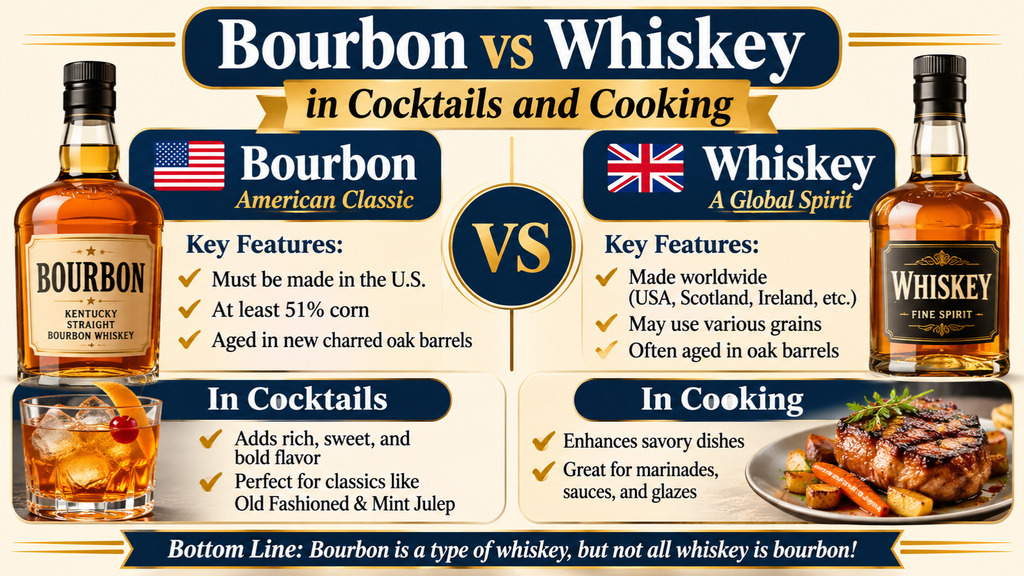
In cocktails, Bourbon vs Whiskey is often a matter of taste. Many classic American drinks use whiskey, and bourbon is a popular choice in several.
- Old Fashioned: Traditionally whiskey, bitters, sugar, and a twist of citrus. Bourbon gives a richer, sweeter version, and rye gives a spicier one.
- Manhattan: Whiskey, sweet vermouth, and bitters. Rye is traditional, but bourbon makes a softer drink.
- Mint Julep: A bourbon drink closely linked to the Kentucky Derby.
- Whiskey Sour: Whiskey, lemon juice, and sugar. Bourbon’s sweetness and oak pair well with citrus.
Choosing between bourbon and another whiskey changes the flavor: bourbon usually gives a sweeter drink, while rye gives a spicier one.
In cooking, bourbon shows up in glazes, barbecue sauces, pecan pie, and bread pudding. Cooking does not remove all of the alcohol, so keep that in mind if you are cooking for children or for people who avoid alcohol.
Which Should You Choose: Bourbon or Whiskey?
In the Bourbon vs Whiskey choice, the answer depends on your palate. Here is a simple starting guide.
Choose bourbon if you like: vanilla, caramel, brown sugar, toasted oak, and a rich, warm, fuller-bodied spirit. Bourbon is often an approachable first step for new whiskey drinkers.
Try rye if you like: pepper, cinnamon, herbal notes, and a drier, livelier taste.
Try Scotch if you like: malt, dried fruit, earthy flavors, or smoke. If you are unsure about smoky flavors, start with an unpeated Scotch.
Try Irish whiskey if you like: light fruit, honey, gentle spice, and a smooth texture.
Try Tennessee whiskey if you like: a bourbon-like profile with a slightly mellow, charcoal-filtered character.
When you shop, remember that price and age do not guarantee that you will like a bottle. If you are curious about how people reckon the value of a bottle, the age, proof, and rarity all play a role, but your own taste is the best guide.
Common Myths About Bourbon vs Whiskey
These myths cause most Bourbon vs Whiskey arguments:
| Myth | The truth |
| Bourbon is not whiskey. | Bourbon is a type of whiskey. |
| Bourbon must be made in Kentucky. | It must be made in the United States, not only in Kentucky. |
| Bourbon must be aged for years. | Plain bourbon has no minimum age. Only straight bourbon needs at least 2 years. |
| Every bourbon is aged at least two years. | Two years is the minimum for the straight designation, not for all bourbon. |
| Bourbon is flavored with added sugar or caramel. | Federal rules do not allow coloring, flavoring, or blending materials in bourbon. |
| Older bourbon is always better. | Age adds complexity, but too much oak can overwhelm other flavors. |
| Darker bourbon is always older. | Color is not a reliable way to judge age. |
| Whiskey always tastes smoky. | Some Scotch is smoky. Most American whiskey is not. |
| “Small batch” guarantees quality. | There is no single legal definition, so it is not a quality guarantee. |
| Bourbon is stronger than other whiskey. | Strength depends on the bottle, not the style. |
Common Mistakes With Bourbon vs Whiskey
Here are six Bourbon vs Whiskey errors to avoid in conversation and writing:
| Incorrect | Correct | Why |
| Bourbon and whiskey are two different drinks. | Bourbon is a type of whiskey. | Bourbon sits inside the whiskey category. |
| This Scotch bourbon is smooth. | This Scotch is smooth. | Bourbon is American, and Scotch is Scottish. They cannot be the same drink. |
| All bourbon comes from Kentucky. | Bourbon can come from any U.S. state. | The federal rule requires the United States, not Kentucky. |
| The label says “bourbon,” but it is made in Ireland. | A bourbon must be made in the United States. | The word is tied to U.S. production. |
| I ordered a Scotch whiskey. | I ordered a Scotch whisky. | Scotch uses the “whisky” spelling. |
| Straight bourbon means high quality. | Straight bourbon means at least two years of aging and no additives. | It describes the rules, not the taste. |
Memory Trick and Quick Self-Test
Memory trick: Think of squares and rectangles. Every square is a rectangle, but not every rectangle is a square. Likewise, every bourbon is a whiskey, but not every whiskey is a bourbon.
Second trick: Remember the three C’s of bourbon: Corn (at least 51%), Charred new oak, and Completely natural (no added coloring or flavoring).
Self-test:
- Is a Scotch a whiskey? (Yes, spelled “whisky” in Scotland, and it is not bourbon.)
- Does bourbon have to be made in Kentucky? (No. It has to be made in the United States.)
- What is the minimum corn content in bourbon? (51%.)
- How long must straight bourbon be aged? (At least 2 years.)
- What does 100 proof equal in ABV? (50% alcohol by volume.)
- Which spelling do the United States and Ireland usually use: whiskey or whisky? (Whiskey.)
Bourbon vs Whiskey: Key Takeaways
If you remember only a handful of points from this Bourbon vs Whiskey guide, make them these:
- Bourbon is a type of whiskey, and whiskey is the broader category.
- Bourbon must be made in the United States, but not necessarily in Kentucky.
- Bourbon must contain at least 51% corn in its mash.
- It must be distilled at 160 proof or less and enter new charred oak at 125 proof or less.
- It must be bottled at 80 proof (40% ABV) or higher, with no added coloring or flavoring.
- Plain bourbon has no minimum age, and straight bourbon must be aged at least two years.
- Bottled in Bond means 100 proof, at least four years, one distillery, and one distilling season.
- Rye, Tennessee, Scotch, Irish, and other styles are also whiskey.
- Spelling follows the country: “whiskey” in the U.S. and Ireland, “whisky” in Scotland, Canada, and Japan.
- Flavor depends on much more than age. Grain, barrel, proof, and warehouse all matter.
Keep Learning: More Word Guides
If you enjoy clear explanations of confusing word pairs, browse all of our Vs comparison guides, explore the Spelling category, or read the latest posts on the ClearPenPress blog.
Frequently Asked Questions About Bourbon vs Whiskey
Is bourbon a whiskey?
Yes. Bourbon is a type of American whiskey. All bourbon is whiskey, but not all whiskey is bourbon.
What is the main difference between bourbon and whiskey?
Whiskey is the broad category of grain spirits. Bourbon is a specific style with legal rules: made in the United States, at least 51% corn, aged in charred new oak, and no added coloring or flavoring. That is the whole Bourbon vs Whiskey answer in one line.
Does bourbon have to be made in Kentucky?
No. Bourbon must be made in the United States, but it can come from any state. Kentucky is the best-known home of bourbon.
What makes a whiskey a bourbon?
It must be distilled and aged in the U.S., made from a mash of at least 51% corn, distilled at 160 proof or less, stored in charred new oak barrels entered at 125 proof or less, and bottled at no less than 80 proof, with no added coloring, flavoring, or neutral spirits.
How long does bourbon have to be aged?
Plain bourbon has no required minimum age. Straight bourbon must be aged at least two years. If a whiskey is aged less than four years, the label must state its age.
Is bourbon sweeter than other whiskeys?
Bourbon is often described as sweeter because of its corn-based mash and new charred oak barrels. Taste varies by brand, so this is a general pattern, not a rule.
Is bourbon stronger than whiskey?
Not necessarily. Strength depends on the bottle. Bourbon must be bottled at 80 proof or higher, but other whiskeys can be the same strength or stronger.
What is the difference between whiskey and whisky?
It is mainly a spelling difference. “Whiskey” is the usual spelling in the United States and Ireland, and “whisky” is the usual spelling in Scotland, Canada, Japan, and most other places. U.S. federal rules allow either spelling.
What is the difference between bourbon and Scotch?
Bourbon is American, made with at least 51% corn, and aged in charred new oak. Scotch is made in Scotland, traditionally from malted barley, aged at least three years in oak casks, and spelled “whisky.”
What is the difference between bourbon and rye?
The main difference is the grain. Bourbon requires at least 51% corn, while U.S. rye whiskey requires at least 51% rye. Bourbon is often sweeter, and rye is often spicier.
Is Tennessee whiskey bourbon?
Tennessee whiskey is its own style. By state law, it must be made in Tennessee and filtered through maple charcoal before aging. Some Tennessee whiskeys could legally be labeled bourbon under the federal definition, but they usually are not.
What does straight bourbon mean?
Straight bourbon is bourbon stored in charred new oak for at least two years with no added coloring, flavoring, or blending materials.
What does bottled in bond mean?
It means the whiskey is the product of one distillation season at one distillery, was aged at least four years in a federally bonded warehouse, and is bottled at 100 proof.
What does “proof” mean on a bottle?
In the United States, proof is twice the alcohol-by-volume percentage. For example, 80 proof equals 40% alcohol by volume.
Why is bourbon brown?
Bourbon gets its color from time in charred new oak barrels, not from added dye. Federal rules do not allow added coloring in bourbon.
Does older bourbon always taste better?
No. Age can add complexity, but too much time in oak can make a whiskey taste overly woody. The best age depends on the bourbon and your own taste.
Is bourbon gluten-free?
Bourbon is distilled, and some sources say distillation removes gluten proteins, but opinions differ for people with celiac disease. If you have a medical concern, check with your doctor.
What is the plural of whiskey?
The plural of whiskey is whiskeys. For the “whisky” spelling, the plural is whiskies.
Final Thoughts
The Bourbon vs Whiskey question becomes easy once you separate the category from the style. Whiskey is the broad family of grain spirits. Bourbon is a specific American whiskey made in the United States from at least 51% corn, aged in charred new oak, with no added coloring or flavoring. It does not have to come from Kentucky, and plain bourbon does not need a minimum age, though straight bourbon must be aged at least two years. Remember too that the spelling follows the place: whiskey for the United States and Ireland, whisky for Scotland and most other countries.
Bourbon vs Whiskey is really a family tree, not a rivalry. Next time you see “bourbon” or “whiskey” on a menu or a label, you will know exactly what it promises.
Memory tip: Every bourbon is a whiskey, but not every whiskey is a bourbon.