
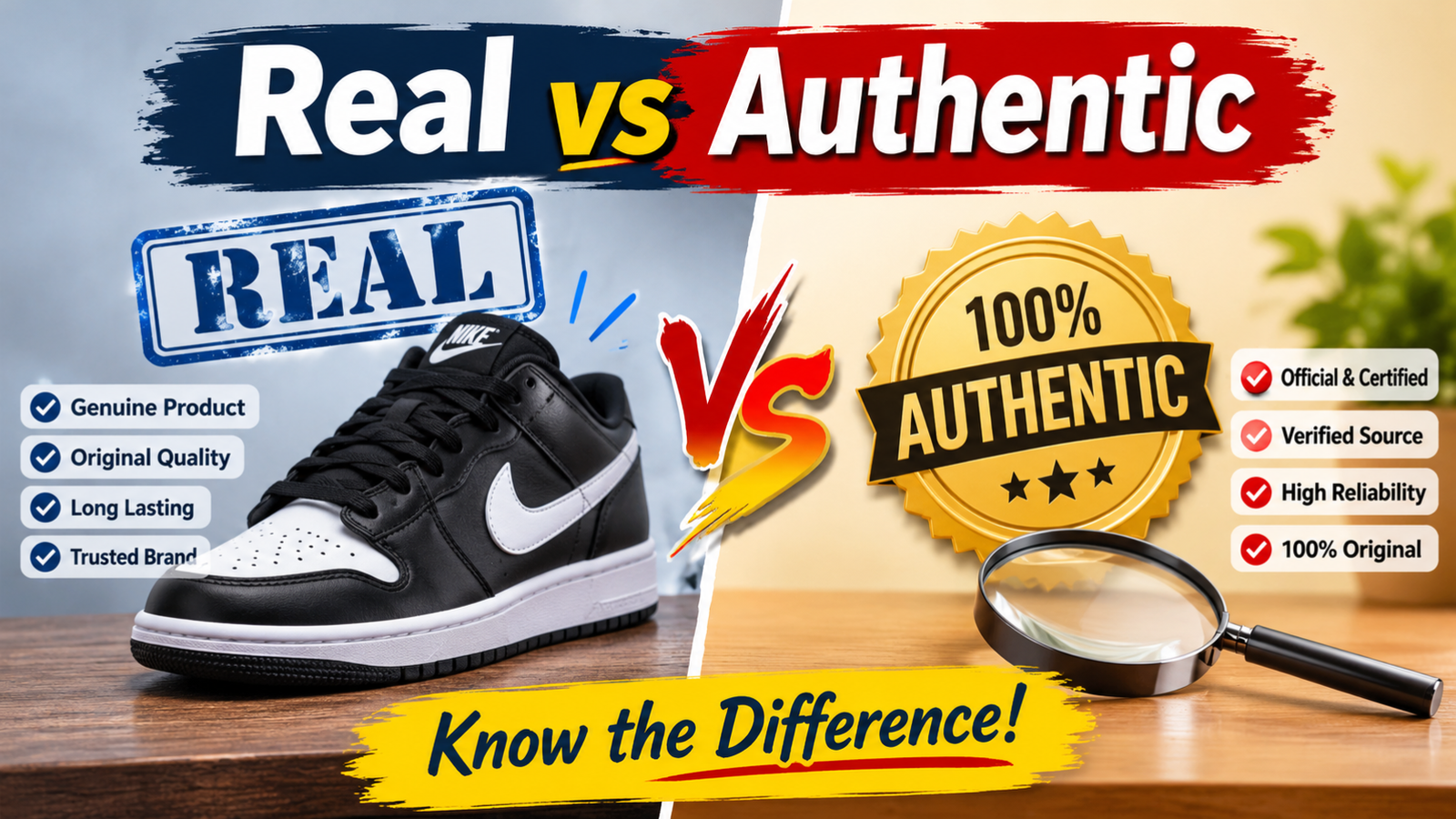
Real vs. Authentic: What’s the Difference? Meaning, Examples and Uses
You are shopping for a leather jacket, and the label says “100% real leather.” The next shop says “authentic leather.” Are they saying the same thing? Or is one claim stronger than the other?
The Real vs. Authentic question trips up students, writers, and shoppers alike, because the two words overlap a lot. Both can mean “not fake.” But they answer two different questions. Real asks: does it exist, and is it true? Authentic asks: is it the genuine original, made by the source it claims to come from?
In this guide, you will learn the exact meaning of each word, where they come from, how they differ in shopping, food, art, technology, and personality, and which mistakes to avoid. Every section has clear examples, and there is a short self-test at the end, so you can pick the right word every time.
Real vs. Authentic: Quick Answer
Real means something actually exists and is not imaginary or fake. Authentic means something is genuine and true to its origin, source, or claimed identity. A real object can still be a copy, but an authentic one is the genuine original. Example: a real handbag may be a knockoff, while an authentic handbag comes from the brand itself.
| Word | Core question | Example |
| real | Does it exist? Is it true? | The pain was real. |
| authentic | Is it the genuine original? | This is an authentic Persian rug. |
In short, authentic things are always real, but real things are not always authentic.
What Does “Real” Mean?
Real is an adjective with several closely related meanings:
- Actually existing, not imagined or invented.
- Not artificial or fake, made of the true material.
- Genuine or sincere, as in real feelings.
- Actual or true, as in the real reason.
- Not imaginary, in mathematics. The real numbers are the ones on the number line, as opposed to imaginary numbers.
Think of “real” as the broad, everyday word. It answers a simple question: is this thing truly there, or truly the way it seems?
Examples of “real”:
- Dragons are not real, but the stories about them are old.
- The fear in his voice was real.
- She is wearing a real diamond, not a glass one.
- What is the real reason you were late?
- The danger is very real.
- These flowers look so good, I thought they were real.
- Is that a real person on the phone, or a recording?
Notice that “real” can be used for nearly anything: feelings, objects, reasons, people, dangers. It is flexible, and that is why it appears in so many everyday phrases such as real life, real estate, and the real deal.
“Real” also works as an adverb in casual American speech (“That was real good”), and as a noun in a few fixed phrases (“for real,” “the real”). We come back to that in the grammar note below.
What Does “Authentic” Mean?
Authentic is an adjective that is narrower and more precise. It has two main uses:
- Genuine and original, made or done by the claimed source, or true to its stated origin.
- True to one’s own personality, values, or character, as in an authentic person.
Where “real” says it exists, “authentic” says it is exactly what it claims to be, and often it comes from where it claims to come from.
Examples of “authentic”:
- The museum confirmed the letter is an authentic Einstein manuscript.
- We ate at a small restaurant serving authentic Lebanese food.
- The shop sells authentic handwoven carpets from Kashmir.
- The expert checked the signature and said it was authentic.
- It was an authentic medieval sword, not a modern copy.
- He is at his best when he is being his authentic self.
- The film is praised for its authentic portrayal of village life.
- The auction house provided a certificate proving the watch is authentic.
Notice how many of these examples involve origin, source, or identity: Einstein, Lebanon, Kashmir, the medieval period. That is the heart of the word.
The Core Difference: Real vs. Authentic Explained
Here is the simplest way to see the Real vs. Authentic difference.
- Real is about existence and truth. Is it actually there? Is it not imaginary?
- Authentic is about origin and identity. Is it the genuine original? Is it what it says it is?
A few examples make this clearer.
Real but Not Authentic
- A forged painting. The painting is a real, physical object. You can touch it and hang it. But it is not an authentic Van Gogh, because Van Gogh did not paint it.
- A copied designer bag. The bag is real leather and real stitching. But it is not an authentic product of the brand.
- A restaurant meal. The food is real, fresh, and tasty. But it may not be authentic Thai cuisine if it uses none of the traditional methods.
- A bot account. The account really exists, and it really posts. But it is not an authentic user, because no real person is behind it.
- A deepfake video. The video file is real. But it is not an authentic recording of the person it shows.
Real and Authentic
- A museum piece. The vase really exists, and it was made in the period and place it claims.
- A signed letter. The letter is real, and the signature is genuinely the writer’s.
- A family recipe. The dish is real food, and it follows the traditional method of its culture.
Authentic but Not Real?
This almost never happens, because authentic things must exist. The nearest case is figurative: a film can be “authentic” in its portrayal of history even with fictional characters, because “authentic” then describes how faithful it is.
Rule of thumb: If you want to say something exists or is true, use real. If you want to say something is the genuine original or true to its source, use authentic.
Real vs. Authentic Comparison Table
This quick table sums up the Real vs. Authentic difference:
| Feature | Real | Authentic |
| Main idea | Actually exists; not imaginary or fake | Genuine; true to its origin or identity |
| Key question | Is it there? Is it true? | Is it the genuine original? |
| Focus | Existence, truth, material | Source, origin, faithfulness |
| Part of speech | Adjective (also noun and adverb in other uses) | Adjective |
| Common opposites | fake, unreal, imaginary, artificial | fake, counterfeit, forged, inauthentic |
| Typical nouns | feelings, danger, reason, money, life | cuisine, signature, artifact, voice, self |
| Formality | Everyday | Slightly more formal or technical |
| Proof needed | Usually none; you can see or touch it | Often provenance, certificates, or expert checks |
| Example | The risk is real. | The signature is authentic. |
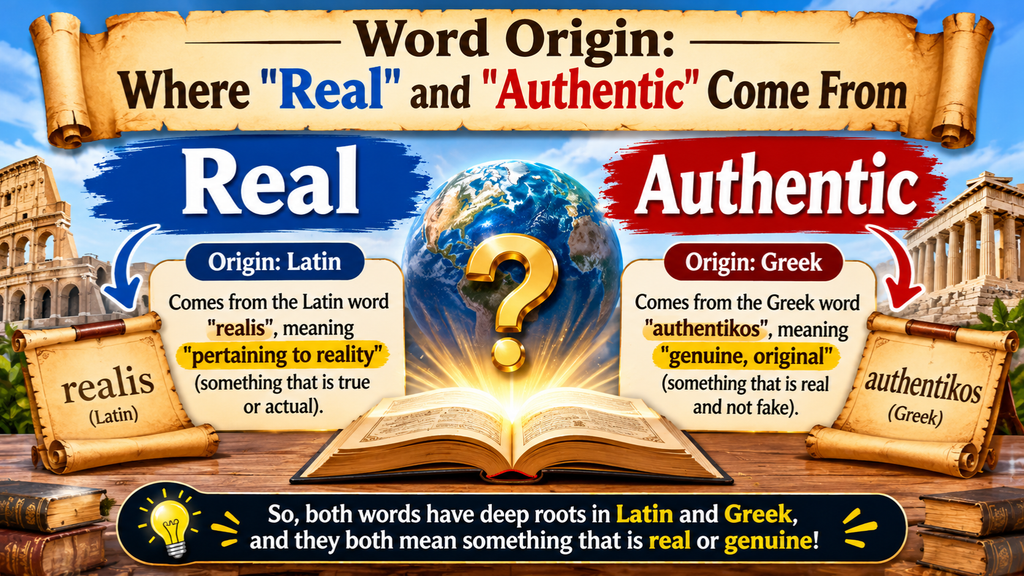
Word Origin: Where “Real” and “Authentic” Come From
The history of each word explains why their meanings differ.
Real comes from the Latin word res, meaning “thing.” From that root came the Late Latin realis, meaning “relating to things.” That is why “real” is tied to the idea of a thing that actually exists, as opposed to an idea or a pretense. The same root appears in words like reality, realize, and realistic.
Authentic has a more interesting past. It comes from the Greek authentikos, linked to authentes, meaning a person who acts on their own authority, an original doer or master. The word then passed through Late Latin and Old French before entering English. The older meaning is “of original or undisputed authority,” and that is why “authentic” still points to a source: the maker, the origin, the one with the right to claim the thing.
One caution: authentic looks like author, and that makes a handy memory aid, but the two words do not share the same root. Author comes from Latin auctor. Use the link as a memory trick, not as etymology.
(Dictionaries such as Merriam-Webster, the Oxford English Dictionary, and Cambridge Dictionary give fuller histories if you want to explore the details.)
Opposites: Fake, Counterfeit, Unreal and Inauthentic
Because Real vs. Authentic answers two different questions, the two words have different opposites.
| Opposite | Best paired with | Example |
| unreal | real (in the sense of existing) | The scene felt unreal. |
| imaginary | real (not existing) | He has an imaginary friend. |
| artificial | real (material) | The flowers are artificial, not real. |
| fake | both | That is a fake watch. |
| counterfeit | authentic (money, goods) | The police seized counterfeit banknotes. |
| forged | authentic (documents, art) | The signature was forged. |
| imitation | authentic (products) | The jacket is imitation leather. |
| replica | authentic (objects) | The museum sells a replica of the crown. |
| knockoff | authentic (brands) | She bought a knockoff of the designer bag. |
| inauthentic | authentic | The review felt inauthentic. |
Three useful notes:
- “Unreal” is the opposite of real, not of authentic. We say “the scene felt unreal,” not “unauthentic.”
- “Inauthentic” is the usual opposite of authentic. The form “unauthentic” exists but is rare. Choose inauthentic.
- A replica is not always a bad thing. A replica sold openly as a replica is honest. It only becomes a problem when someone passes it off as authentic.
Related Word Forms
Each word has its own small family.
The “real” family:
| Word | Part of speech | Example |
| real | adjective | This is a real photograph. |
| really | adverb | I really enjoyed the book. |
| reality | noun | Reality is sometimes stranger than fiction. |
| realistic | adjective | Set a realistic goal. |
| realize | verb | I realized I had left my keys at home. |
| unreal | adjective | The view was unreal. |
The “authentic” family:
| Word | Part of speech | Example |
| authentic | adjective | An authentic antique. |
| authentically | adverb | She spoke authentically about her fears. |
| authenticity | noun | Experts questioned the painting’s authenticity. |
| authenticate | verb | The lab will authenticate the document. |
| authentication | noun | Online banking needs strong authentication. |
| inauthentic | adjective | The praise sounded inauthentic. |
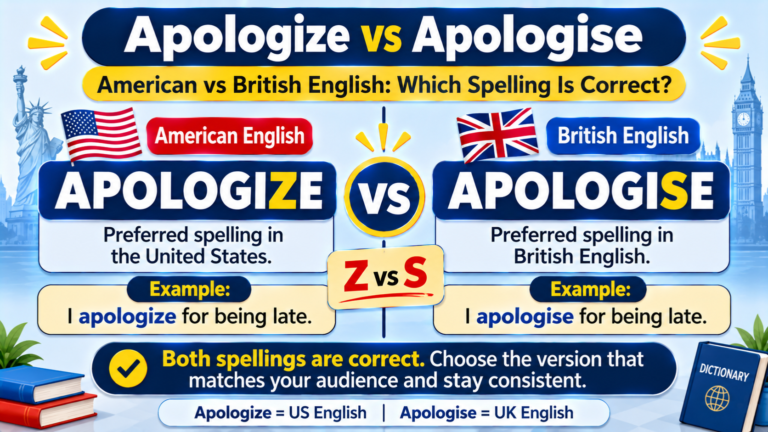
A spelling note on “realize.” American English spells it realize and British English often spells it realise. Both are accepted in their own regions, and the same split appears in other verbs. See our guides to prioritize vs prioritise, memorize vs memorise and apologize vs apologise for the same rule in action.
If you want to understand how checking and confirming work, our guide to clarify vs verify explains two verbs that sit close to “authenticate” in everyday writing.
Real vs. Authentic vs. Genuine vs. Original vs. Legitimate vs. True

Writers often swap these words, but each has its own flavor. Here is Real vs. Authentic next to five close neighbors.
| Word | Core meaning | Example |
| Real | Actually exists; not fake or imaginary | The gold ring is real. |
| Authentic | True to its source or origin | An authentic Ottoman coin. |
| Genuine | Honest, sincere, or not fake; close to “real” and “authentic” | She gave me a genuine smile. |
| Original | The first one; not a copy or later version | This is the original manuscript. |
| Legitimate | Lawful or officially valid | He is a legitimate business owner. |
| True | Correct or in line with facts | It is true that the earth orbits the sun. |
Quick guide: Use genuine for sincerity and honest items, original for the first version, legitimate for legal validity, and true for facts. Keep real for existence and authentic for origin and identity.
Two more words appear in this family. Actual is close to “real” but usually stresses “as opposed to what was expected” (“The actual cost was double the quote”). Bona fide is a formal, legal-sounding word meaning “in good faith” or “genuinely what it claims” (“a bona fide offer”).
If you enjoy these shades of meaning, you may also like our comparison of odious vs repugnant, another pair of strong, similar words.
Common Collocations
Each word in Real vs. Authentic appears in its own fixed partnerships.
With “real”:
- real life: In real life, he is much quieter.
- real world: Students need real-world experience.
- real estate: She works in real estate. (The phrase comes from the legal idea of “real property,” meaning land and buildings.)
- the real deal: This watch is the real deal.
- real time: The data updates in real time.
- real money: Players can win real money.
- for real: Are you serious? For real?
With “authentic”:
- authentic self: Be your authentic self.
- authentic voice: The author found her authentic voice.
- authentic experience: Tourists want an authentic experience.
- authentic cuisine: The town is known for authentic cuisine.
- certificate of authenticity: The artwork comes with a certificate of authenticity.
- authentic leather: The belt is made of authentic leather.
- authentic document: The clerk confirmed it was an authentic document.
Real vs. Authentic in Different Contexts
The Real vs. Authentic choice changes slightly depending on the situation.
Products and Shopping
Labels often use both words, and they can mean different things.
- “Real leather” usually tells you the material is actual animal hide, not plastic.
- “Authentic leather” often suggests the item is genuine leather from the maker it claims, though the exact meaning varies by brand and country.
- “Genuine leather” is a trap. In the leather trade, the phrase is often used for a lower grade than full-grain or top-grain leather, so it can be technically real and still not the quality you expected.
For expensive goods, look for proof of authenticity, such as serial numbers, holograms, receipts from authorized dealers, and certificates. A real product bought from a doubtful seller is not automatically an authentic one.
Food and Culture
When we say authentic cuisine, we mean food made in the traditional way, with traditional ingredients and methods, true to its culture.
- The pizza is real, because it exists and tastes good.
- The pizza is authentic Neapolitan only if it follows the tradition of Naples.
In most places, “authentic” has no legal definition on a menu, so it is partly a promise and partly marketing. Some foods are different. In the European Union, protected labels such as Protected Designation of Origin (PDO) cover products like Parmigiano Reggiano, and Neapolitan pizza has its own Traditional Specialty Guaranteed status. For those foods, “authentic” can be checked against rules.
Use “authentic” for food only when you can name the tradition it follows.
Art and Collectibles
In art, authentic is a technical word. An authentic work is one made by the artist it is attributed to. Experts check provenance, which is the recorded history of ownership, and they examine materials, style, and signatures to decide authenticity. A forgery is a real object but not an authentic work.
The same logic applies to rare coins, sports memorabilia, and antiques. A signed baseball is real. Whether the signature is authentic is a separate question, and it usually needs an expert or a trusted authentication service.
Money and Documents
Banks and offices use authentic for documents that are genuine and not forged, and counterfeit for fake money.
- The clerk confirmed that the signature was authentic.
- The note looked real but turned out to be counterfeit.
Here, “authenticate” means to prove that something is genuine. In some legal systems, an “authentic act” is an official document drawn up by a notary or public officer, which shows how seriously the word is taken in law.
Technology and Online Life
Technology gives the Real vs. Authentic question a new edge.
- Authentication is the process of proving identity, through passwords, fingerprints, or two-factor codes.
- A real user is an actual human being. An authentic user is the person they claim to be.
- A bot, a stolen account, and a deepfake are all real in the sense that they exist, and none of them is authentic.
That is why the word authenticate shows up in security, while real shows up in casual talk (“Is this a real person?”).
People and Personality
For people, real and authentic are close, but not identical.
- A real person is sincere and down to earth. (“She is so real.”)
- An authentic person is true to their own values and does not pretend to be someone else.
“Be your authentic self” means “stop performing, and act in line with who you really are.” Philosophers and psychologists have written whole books on this idea, such as Lionel Trilling’s Sincerity and Authenticity and Charles Taylor’s The Ethics of Authenticity.
Social Media and Branding
Brand authenticity means a company’s actions match its stated values. On social media, followers call content “authentic” when it feels honest and unscripted, and “inauthentic” when it feels staged.
A person can be real and still come across as inauthentic online. A real influencer who copies a lifestyle they do not live is real, but the content feels inauthentic.
Leadership and the Workplace
The phrase authentic leadership describes leaders who are honest, consistent, and transparent about their values. A real leader, in everyday speech, may simply be someone who is down to earth.
Travel and Tourism
Travelers often chase “authentic” experiences: a family-run guesthouse, a local market, a traditional festival. The sociologist Dean MacCannell described the problem of staged authenticity in 1973, where a place arranges a performance so it feels authentic to visitors. The festival is real, but a tourist show built for visitors may not be authentic to local life.
Real or Really? A Grammar Note
Since this site is about clear writing, one small grammar point is worth adding.
Real is an adjective. Really is its adverb. In formal writing, use really to modify an adjective or verb.
| Informal | Formal |
| That was real good. | That was really good. |
| It is a real big problem. | It is a really big problem. |
| Real quick, can I ask something? | Quickly, can I ask something? |
Using “real” as an adverb is common in American conversation, but avoid it in essays, emails to clients, and exams.
“Authentic” has no such shortcut. Its adverb is authentically, and it is rarely used.
Common Mistakes With Real vs. Authentic
Here are seven errors to avoid:
| Incorrect | Correct | Why |
| Dragons are not authentic. | Dragons are not real. | Use “real” for existence. Dragons have no “authentic source.” |
| The museum confirmed the painting is real Monet. | The museum confirmed the painting is an authentic Monet. | Use “authentic” when the artist or source is the point. |
| The review felt very unauthentic. | The review felt inauthentic. | “Inauthentic” is the standard opposite. “Unauthentic” is rare. |
| We need to authentificate the signature. | We need to authenticate the signature. | The verb is “authenticate,” not “authentificate.” |
| This is a very real authentic genuine original product. | This is an authentic product. | Stacking synonyms weakens your writing. |
| She felt authentic pain after the fall. | She felt real pain after the fall. | Physical feelings exist, so “real” fits better. |
| The food was real Italian, so the shop must be authentic. | The food was real, but only the recipe and method can make it authentic Italian. | Existing food is not automatically traditional food. |
One more habit to avoid: Overusing “authentic” as a marketing buzzword. Use it only when you can name an origin, a maker, or a tradition.
Memory Trick and Quick Self-Test
Two simple tools make Real vs. Authentic easy to remember.
Memory trick:
- Real = “Is it there?” Think of the word “reality.”
- Authentic = “Is it the genuine original?” Think of the word “author.” An authentic item comes from the true author or source. (This is a memory aid only, since the two words have different roots.)
Quick self-test. Ask yourself three questions:
- Does it exist, or is it true? If yes, real works.
- Does it matter who made it or where it came from? If yes, authentic is better.
- Is it about honesty or sincerity? Then try genuine or real, or authentic if you mean true to yourself.
Try it yourself. Fill in each blank with real, authentic, or inauthentic.
- The pain in her leg was very ______.
- The museum confirmed that the letter was an ______ Einstein manuscript.
- Dragons are not ______.
- This pizzeria serves ______ Neapolitan pizza.
- The compliment sounded forced and ______.
- Is this an ______ email from my bank, or a scam?
Answers: 1. real (a physical feeling exists). 2. authentic (the source is the point). 3. real (existence). 4. authentic (a named tradition). 5. inauthentic (the opposite of authentic). 6. authentic (the question is whether it truly comes from the bank).
Keep Learning: More Word Comparisons
If this Real vs. Authentic guide helped, try these word comparisons next:
- Reckon vs Value explains how two near-synonyms differ in everyday use.
- Stub vs Stud clears up a pair that many people mix up.
- Lag vs Log separates two short words with very different jobs.
- Throne or Thrown is a classic sound-alike pair.
- Moat vs Mote covers two words that differ by a single letter.
Want more? Browse all of our Vs comparison guides, explore the Spelling category, or read the latest posts on the ClearPenPress blog.
Frequently Asked Questions About Real vs. Authentic
What is the difference between real and authentic?
The Real vs. Authentic difference is simple. Real means something actually exists or is true. Authentic means something is the genuine original, made by the source it claims to come from. A copy can be real (it exists) but not authentic.
Can something be real but not authentic?
Yes. A forged painting is a real object, but it is not an authentic work by the artist it imitates. A copy of a designer bag is real leather but not an authentic product of the brand.
Can something be authentic but not real?
Not in the strict sense. Authentic things must exist, so they are real. The only exception is figurative, such as a story with invented characters that is still “authentic” in how faithfully it portrays a place or era.
Is authentic the same as genuine?
They are very close. Genuine often stresses honesty or “not fake,” while authentic stresses origin and faithfulness to the source. In many sentences, they can swap places, such as “genuine antique” and “authentic antique.”
Is real the opposite of fake?
Often, yes. “Real” and “fake” are common opposites, as in real vs fake money. But “real” also has other opposites, such as imaginary and unreal.
Can a person be real and authentic?
Yes. A real person is sincere and down to earth. An authentic person stays true to their own values. Many people use both words to praise someone who does not pretend.
Is inauthentic a word?
Yes. Inauthentic is the standard opposite of authentic. It describes something that feels fake, forced, or not true to its source. “Unauthentic” also exists but is rare.
Is authentic always better than real?
Not always. They do different jobs. If you only want to say something exists, “real” is the right word. If the origin or maker matters, “authentic” is the better choice.
Which word should I use in a product description?
Use real for materials (“real wood”) and authentic only when you can prove the maker or origin (“authentic Italian leather, made in Florence”). Avoid empty claims.
What does “authentic self” mean?
Your authentic self is the version of you that matches your true values, beliefs, and feelings, without pretending to impress others.
Is “real leather” the same as “genuine leather”?
Not necessarily. Both mean the item contains real leather, but “genuine leather” is often used for a lower grade than full-grain or top-grain leather. Read the product details instead of relying on the label.
How do you prove something is authentic?
Look for provenance (a record of where it has been), a certificate of authenticity, serial numbers, and a check by a recognized expert or authentication service. For documents, check signatures, seals, and official records.
What is the difference between authentic and original?
Original means the first version, not a copy. Authentic means genuine and true to its source. An original painting is almost always authentic, but an authentic reprint from the real publisher is not an original.
Do real and authentic have different spellings in British and American English?
No. Both words are spelled the same everywhere. The only spelling split in the “real” family is realize (American) versus realise (British).
Final Thoughts
The Real vs. Authentic choice becomes easy once you ask the right question. Use real when you mean something exists, is true, or is made of the true material. Use authentic when you mean something is the genuine original, true to its source, maker, or identity. Remember that authentic things are always real, but real things are not always authentic.
Next time you write about a painting, a recipe, a signature, a social media account, or your own personality, you will know exactly which word fits.
Memory tip: Real asks “Is it there?” and authentic asks “Is it the true original?”

One Comment