
Memorize vs Memorise: Same Word, Two Spellings (and Which One to Use)
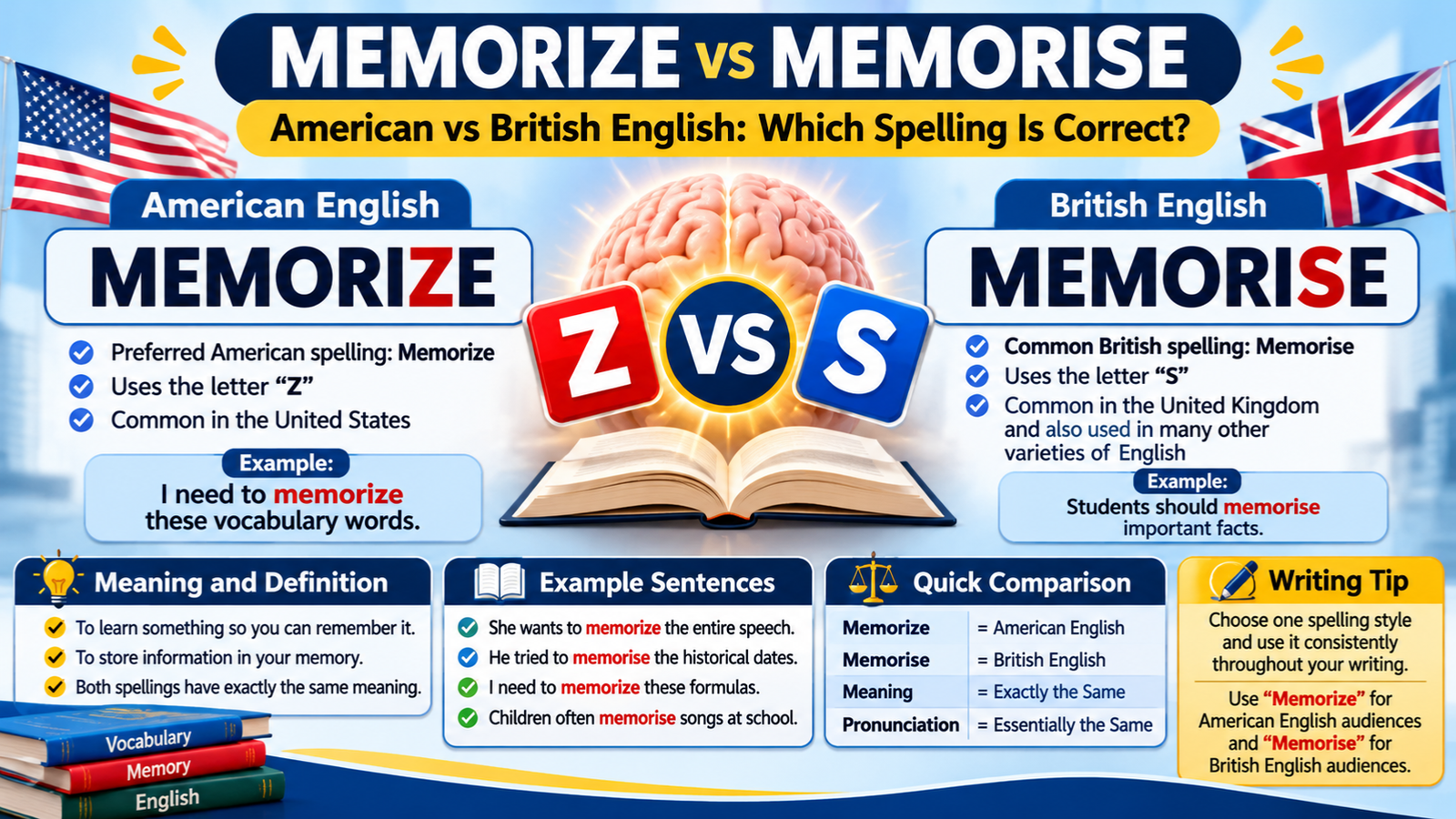
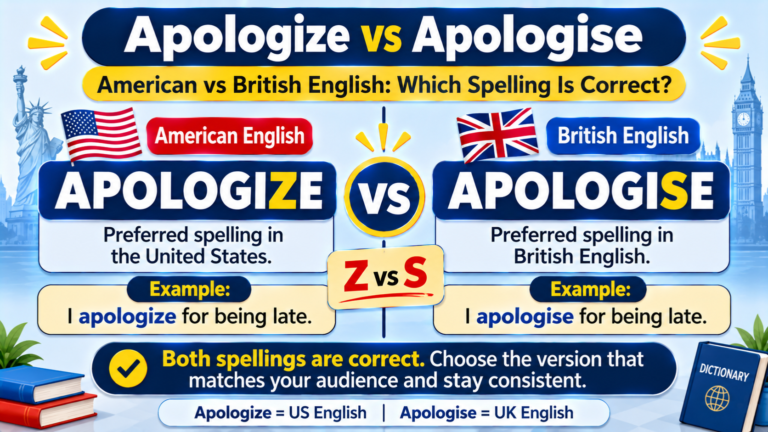
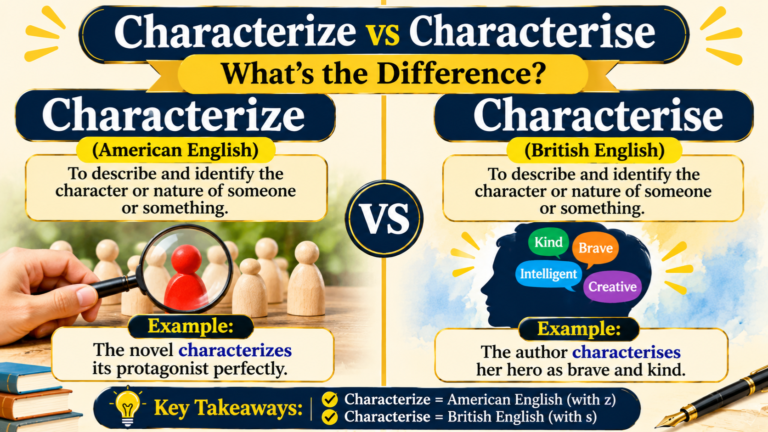
Memorize and memorise are the same word. “Memorize” is the standard American spelling and the usual choice in Canada. “Memorise” is the more common spelling in British, Australian and New Zealand writing. Both mean to learn something so well that you can recall it exactly, and neither is a mistake. Pick the one that suits your readers and stay with it.
That is the short answer to memorize vs memorise. The rest of this guide covers real usage numbers by country, why some British writers still use the “z,” the -ize/-ise rule and its exceptions, every verb form and the noun, the difference between memorize, remember and learn, a short and honest look at memorizing versus understanding, and a quick quiz at the end.
Memorize vs Memorise: The Quick Answer
The only difference is one letter, an “s” or a “z” in the ending.
| Word | American spelling | British spelling | Example |
| Memorize | memorize, memorized, memorizing | memorise, memorised, memorising | I need to memorize/memorise the formula. |
| Memorization | memorization | memorisation | Rote memorization/memorisation is tiring. |
| Realize | realize | realise | She didn’t realize/realise it was late. |
| Organize | organize | organise | We will organize/organise a study group. |
| Analyze | analyze | analyse | The class will analyze/analyse the poem. |
Meaning, pronunciation and grammar are identical. Only the spelling changes.
What Does Memorize (or Memorise) Mean?
Before the memorize vs memorise spelling, the meaning. To memorize is to learn something deliberately so you can remember it exactly later: a poem, a phone number, a set of dates, a speech. It is a verb, and a regular one: memorize, memorizes, memorized, memorizing (or memorise, memorises, memorised, memorising).
The word is built from memory plus the verb ending -ize. Dictionary.com records it in English from about 1585 to 1595. The idea is right there in the word: you are putting something into memory on purpose. Dictionaries also give “learn by heart” and “commit to memory” as plain-English ways to say it.
Most of the time memorize takes an object: She memorized the speech. You memorize something. Dictionary.com notes that the verb can also be used without an object, as in “She memorizes quickly,” but the version with an object is far more common.
Which Spelling Should You Use?
For memorize vs memorise, pick based on your readers, not on which one looks nicer.
Sapling’s usage data (out of 100 examples in each country) gives a clear picture:
- United States: memorize 98, memorise 2
- Canada: memorize 92, memorise 8
- India: memorize 67, memorise 33
- Ireland: memorize 51, memorise 49
- New Zealand: memorize 41, memorise 59
- United Kingdom: memorize 33, memorise 67
- Australia: memorize 33, memorise 67
So in the US and Canada, “memorize” is the clear winner. In the UK, Australia and New Zealand, “memorise” is more common. India leans toward “memorize,” and Ireland is almost a coin toss.
Look at the UK number once more. Even in Britain, “memorize” shows up about a third of the time in that data. Nobody will think it is an error.
Here is how I would decide:
- US or Canadian audience: memorize.
- UK, Australian or New Zealand audience: memorise, unless your publisher uses Oxford spelling (see below).
- Publisher, university or employer with a style guide: follow the guide, full stop.
- International audience with no guidance: memorize is the safer default. It is the most widely used form overall, and spellcheck tools accept it almost everywhere.
- Pakistan and India: many Pakistani and Indian schools and exam boards follow British conventions, so check your own board or teacher’s rules. Sapling’s data for India leans toward “memorize,” but I could not find a separate figure for Pakistan.
Whatever you choose, stay consistent. A document that says “memorize” in one paragraph and “memorised” in the next looks careless.
Oxford Spelling: Why British Writers Sometimes Use -ize
Here is the part that surprises people. The “z” is not purely American. Oxford University Press and some other British publishers use -ize endings for verbs formed with that suffix. That style is often called Oxford spelling, and it is a recognized British variety. In that style you would write memorize, realize and organize, even in a British book.
It still keeps analyse, paralyse and catalyse with an “s,” and it keeps -ise in words where the “ise” is part of the root, such as advise and surprise. If you see “memorize” in a British book, it may be a deliberate house style, not an American intrusion. (I am describing Oxford style from general style-guide knowledge, so check your own guide if you need to follow it precisely.)
The -ize vs -ise Rule (and Its Exceptions)
Memorize vs memorise is just one case of a bigger pattern, and the -ize/-ise split affects hundreds of English verbs.
In American English, nearly all of these verbs end in -ize: memorize, apologize, realize, organize, recognize, criticize, modernize.
In British English, both are acceptable. The -ise form is more common in everyday writing, and -ize is the Oxford style, so the one you choose just needs to be consistent.
Some words are always spelled -ise, in both American and British English, because the “ise” is not a verb ending that can switch to “ize.” These are the common ones:
- advertise
- advise
- comprise
- compromise
- despise
- devise
- disguise
- exercise
- improvise
- revise
- supervise
- surprise
- televise
So you never write “surprize” or “advertize.” And a related pair to watch: American English writes analyze, but British English (including Oxford style) writes analyse.
A memory hook for the American side: memoriZe has the Z of America. It is not a perfect rule, but it stops you second-guessing the US spelling.
Memorize Verb Forms: Every Tense in Both Spellings
The memorize vs memorise split continues through every form of the verb:
- Base form: memorize (US) / memorise (UK). I memorize my notes every night.
- Third person singular: memorizes / memorises. She memorizes poems quickly.
- Past tense and past participle: memorized / memorised. He memorized the speech.
- Present participle (-ing form): memorizing / memorising. They are memorizing the formulas.
If you pick the “z” version, every form keeps the “z,” and the same goes for “s.” Do not write “memorizeing” or “memoriseing,” because the final “e” drops before “-ing.”
Memorization or Memorisation?
The noun follows the same split. Memorization is American, and memorisation is British. Both mean the act or process of memorizing: Exam preparation often involves a lot of memorization.
You will also see two other forms:
- Memorizer / memoriser: a person who memorizes things.
- Memorizable / memorisable: an adjective for something that can be memorized, as in “a memorizable phone number.”
- Rememorize / rememorise: to memorize again. It is rare, but dictionaries list it.
- Memorable: an adjective meaning easy to remember or worth remembering. It has no spelling split.
Note that memorable is not the same as memorized. A memorable speech is one people remember. A memorized speech is one the speaker learned by heart.
How to Pronounce Memorize and Memorise
Despite the spelling difference, memorize and memorise are normally pronounced the same way: MEM-uh-rize, with the stress on the first syllable. Dictionary.com shows the US pronunciation as /ˈmɛm əˌraɪz/.
The ending is the key point. Both spellings end in a sound like “ize” (rhyming with size), not a sharp “iss.” So the British “s” does not change the sound. You can see the difference on the page but you cannot hear it, which is why spelling is where people slip.
Memorize vs Remember vs Learn
Beyond memorize vs memorise, the three verbs memorize, remember and learn overlap, and mixing them up is common.
Memorize is about taking in new information on purpose so you can recall it later: I need to memorize my lines for the play. It involves effort and practice.
Remember is about bringing back something you already have in memory, and it can happen with or without effort: Do you remember that time we went on a road trip?
Learn is the broadest word. You can learn facts, skills, languages and habits, and you do not always need to recall them word for word.
Compare these:
- I memorized the poem. (I can recite it exactly.)
- I remember the poem. (I can bring it to mind.)
- I learned the poem. (I know it, perhaps not word for word.)
British English also uses the phrase learn by heart, which means the same as memorize: The children learned the poem by heart.
Memorizing vs Understanding

Students often hear that memorizing is bad and understanding is good, as though you must choose one. The sources I checked say it is more nuanced than that.
The Learning Scientists, a group that summarizes research on learning, argue that memorizing and understanding are not opposites. They call the split a “false dichotomy.” Their summary is that learning tends to work better when both memory and understanding are emphasized. They also point to research suggesting that even “rote” tasks rely on connections, context and meaning, and that spacing out your practice and testing yourself from memory can support both remembering and critical thinking.
The practical takeaway is modest. Memorizing facts such as dates, definitions and formulas can be useful, especially in exams, but it works best when you also understand what you are learning. This is general information and not a guarantee of results, and different subjects and learners need different approaches.
Synonyms and Close Alternatives
When “memorize” feels too plain or too stiff, these are the closest options:
- Learn by heart. The most natural everyday match, and very common in British English: The children learned the poem by heart.
- Commit to memory. A little more formal: He committed the numbers to memory.
- Retain. Better when you mean keeping information over time: She retains what she reads.
- Recall. Better when you mean bringing information back: Can you recall the main dates?
- Study. Broader and about the effort, not the result: I studied for the exam all week.
Notice that study is not a synonym of memorize. You can study a topic without memorizing it, and you can memorize a list without studying the subject behind it.
Example Sentences: American and British Spelling Side by Side
The spelling changes, but the meaning does not.
- School. I have to memorize the periodic table. / I have to memorise the periodic table.
- Exams. She memorized the key dates for the history test. / She memorised the key dates for the history test.
- Acting. The actor memorized his lines in two days. / The actor memorised his lines in two days.
- Languages. He is memorizing new vocabulary every morning. / He is memorising new vocabulary every morning.
- Religion and culture. Many children memorize poems and verses from an early age. / Many children memorise poems and verses from an early age.
- Driving. I can’t memorize all the road signs yet. / I can’t memorise all the road signs yet.
- Work. Do you memorize phone numbers anymore? / Do you memorise phone numbers anymore?
- Music. The pianist memorized the whole piece. / The pianist memorised the whole piece.
- Noun. Rote memorization is not enough for this subject. / Rote memorisation is not enough for this subject.
- Quiz. Try to memorize five new words today. / Try to memorise five new words today.
Memorize vs Memorise in Academic Writing
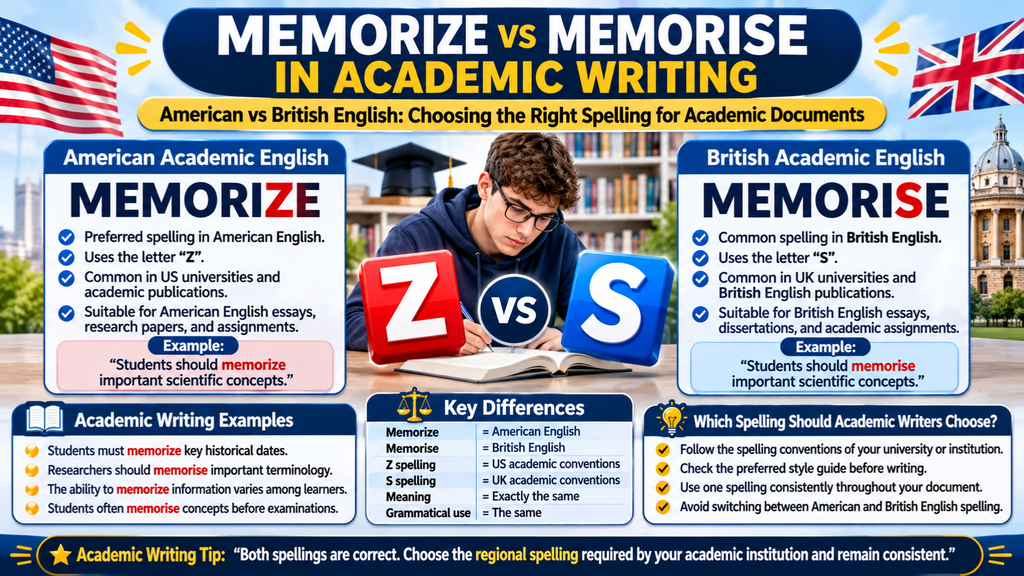
In academic work, the memorize vs memorise choice and spelling consistency matter even more. If your paper uses American spellings such as color, behavior and organize, then memorize fits. If you are writing for a British institution that follows British conventions, memorise usually fits better.
Before you submit, check these points:
- Your university’s or exam board’s language requirement.
- Your teacher’s preferred English variety.
- The required style guide.
- The spelling used in the rest of your paper.
- Any quotations: when you quote a source, keep its original spelling, even if it differs from yours.
The goal is not to prove one form is “more correct.” The goal is to follow the required variety from start to finish.
Memorize vs Memorise in Professional Writing
The memorize vs memorise principle is the same at work. A US company’s handbook might say, “Employees should memorize the emergency procedure,” while a British company might write “memorise.” Neither has made a mistake.
What matters is that the organization’s spelling stays consistent across its reports, websites, training materials, emails, manuals and presentations. A consistent style makes professional writing look deliberate and polished, and a mixed one looks unedited.
Common Mistakes
Most slips around memorize vs memorise are about consistency, not correctness.
Mixing the two spellings in one document. If you write “memorize” in paragraph one, do not switch to “memorised” later.
Mixing -ize and -ise words. Writing “I memorize the list and organise the notes” mixes American and British spelling. Choose one: memorize and organize, or memorise and organise.
Treating one spelling as wrong. Changing “memorize” to “memorise” in a British document, or the other way round, is a matter of house style, not of fixing an error, because both are real spellings.
Confusing memorize with remember. “I memorized my childhood home” is odd. You remember your childhood home, and you memorize a list or a speech.
Leaving out what was memorized. “She memorized” is grammatical, but it usually sounds unfinished without an object such as “the speech.”
Spelling the -ing form wrong. The correct forms are memorizing and memorising. “Memorizeing” and “memoriseing” are wrong.
Using “memorable” for “memorized.” A memorable lesson is one people remember, and a memorized lesson is one someone learned by heart.
Set Your Spellcheck to the Right Variety
Spellcheck will not settle memorize vs memorise for you. It will only flag a spelling if your language setting does not match the word, and that is why the setting matters.
In Microsoft Word, you can set the proofing language from the Review tab (the Language option), choosing something like English (United States) or English (United Kingdom). In Google Docs, use the File menu and choose Language, then pick the English variety you want. Exact menu names can differ between versions, so look for “Language” or “Proofing language.”
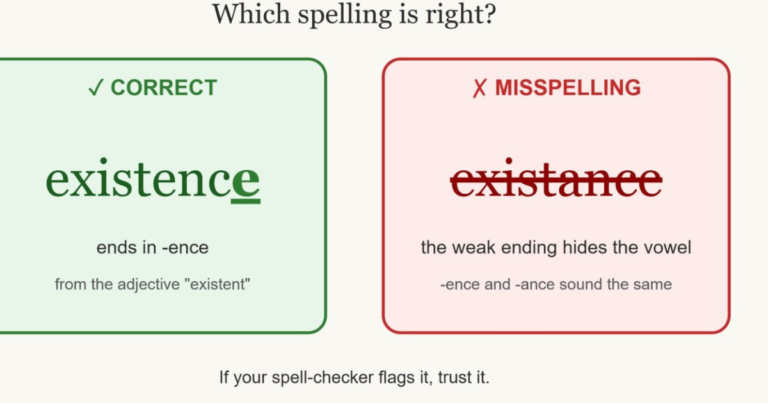
With English (United States) selected, “memorise” will usually get a red underline. With English (United Kingdom) selected, the checker may accept one form or flag the other, depending on its house style. Setting this once at the start of a document saves a lot of hunting later.
Quick Practice
Choose the spelling that fits the instruction. Answers follow.
- (American English) “I need to ______ these dates.” memorize or memorise?
- (British English, not Oxford style) “She ______ her lines last night.” memorised or memorized?
- Which of these is always spelled with -ise: memorize or advertise?
- Fix the mistake: “He is memorizeing the formula.”
- Which verb fits best: “Do you ______ our first meeting?” memorize, remember or learn?
Answers: 1. memorize. 2. memorised. 3. advertise (it is never “advertize”). 4. “He is memorizing the formula.” 5. remember (you bring back something you already know).
FAQs About Memorize vs Memorise
These are the questions people ask most about memorize vs memorise.
Is it memorize or memorise?
Both are correct. Memorize is the American spelling and the main choice in Canada. Memorise is common in British, Australian and New Zealand English. Choose the one that matches your readers.
Is memorise British or American spelling?
Memorise is the British spelling. American English uses memorize. In Britain, though, memorize is also accepted, especially in Oxford-style writing.
Are memorize and memorise the same word?
Yes. They have the same meaning, the same pronunciation and the same root. Only the spelling differs.
Which spelling is more common?
It depends on the country. According to Sapling’s usage data, memorize is far ahead in the US, Canada and India, while memorise leads in the UK, Australia and New Zealand.
Do British people use memorize?
Yes. Many British writers and publishers use “memorize,” and Oxford-style spelling keeps the “z.” It is not treated as an error in British English.
What is the difference between memorize and remember?
Memorize means learning something on purpose so you can recall it later. Remember means bringing back something you already know. You memorize a speech and remember a holiday.
What is the difference between memorize and learn?
Learn is broader. You can learn skills, facts and habits without knowing them word for word. Memorize means fixing specific information in memory so you can recall it exactly.
How do you spell memorizing?
Memorizing in American English and memorising in British English. The final “e” is dropped before “-ing” in both.
Is it memorization or memorisation?
Memorization is the American spelling, and memorisation is the British one. Both mean the act of memorizing.
What is the past tense of memorize?
Memorized in American English and memorised in British English. The same form works as the past participle: “She has memorized the poem.”
How do you pronounce memorize?
Say MEM-uh-rize, with the stress on the first syllable. Memorise is pronounced exactly the same way. The ending sounds like “ize,” even when it is spelled with an “s.”
Should I use memorize or memorise in academic writing?
Use whichever spelling your university, teacher or style guide requires. If there is no rule, choose one variety and use it throughout, and keep the original spelling inside any quotations.
Is memorise understood in American English?
Yes, American readers will understand it, but it is not the standard American spelling. If you are following American conventions, write memorize.
Which spelling should I use in Pakistan or India?
If your school, board or employer follows British conventions, use memorise. If you write for a global or American audience, use memorize. Always follow the style guide you were given.
Final Thoughts
Memorize vs memorise is a spelling question, not a grammar one. Use memorize for American and Canadian readers, memorise for most British, Australian and New Zealand readers, and whatever your style guide says if you have one. If nobody cares, go with memorize, since it is the most widely used form and the safest everywhere. Just keep your -ize/-ise words consistent from the first line to the last.
3 Comments