Throne or Thrown: What’s the Difference (and Which One Do You Need)?
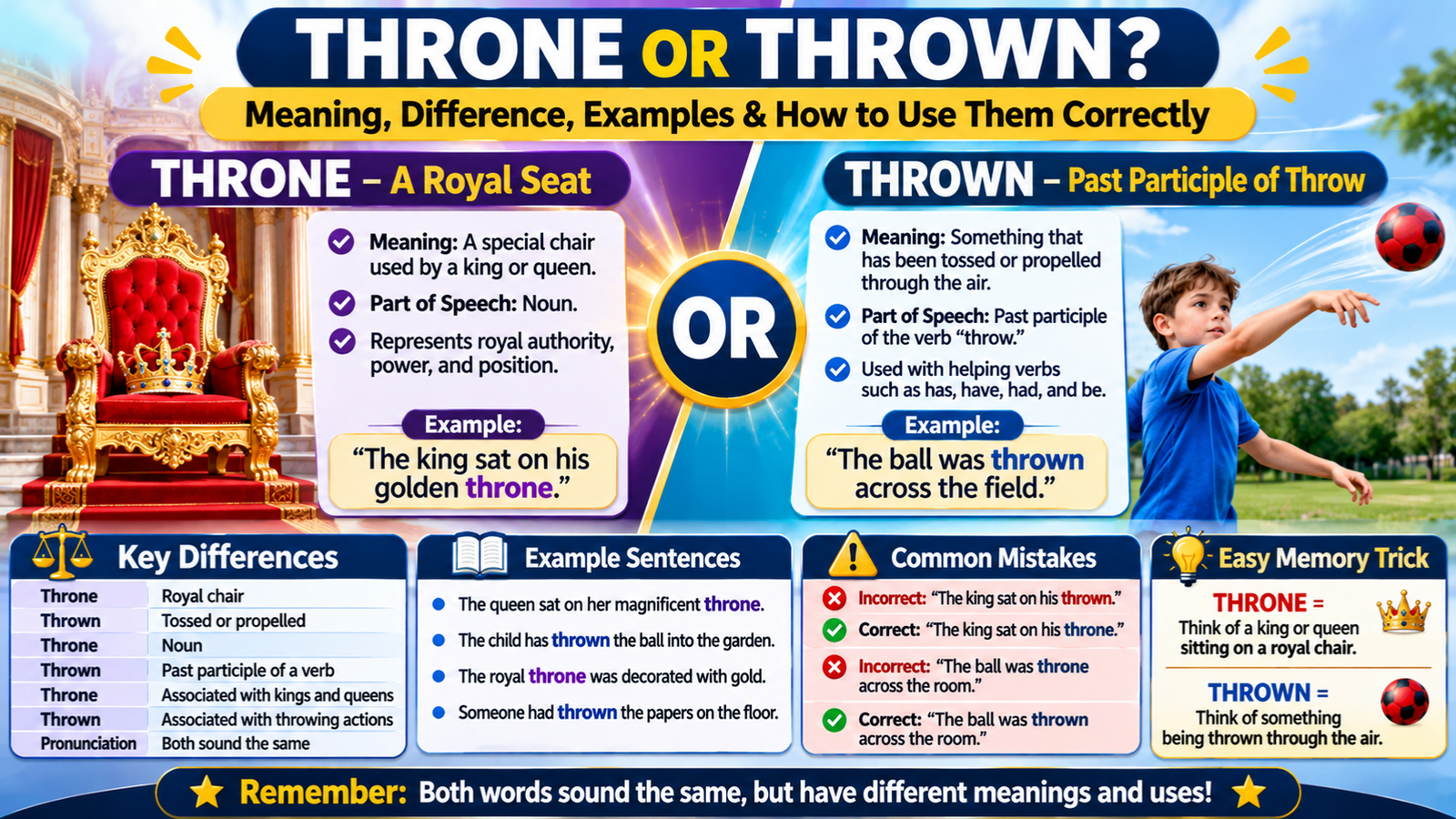
A throne is a ruler’s chair. Thrown is the past participle of “throw.” If your sentence is about a king, a queen or sovereign power, you want throne. If it is about something being tossed, hurled or suddenly forced, you want thrown. They are pronounced the same, which is exactly why people mix them up.
That is the short answer to throne or thrown. The rest of this guide covers what each word means, how to pronounce them, how throw, threw and thrown fit together, tricks for remembering the difference, example sentences, common phrases, a few other look-alikes, and a short quiz at the end.
Throne or Thrown: The Quick Answer
| Word | Part of speech | What it means | Example |
| Throne | Noun | A ceremonial chair for a ruler; also figuratively, sovereign power | The queen sat on the throne. |
| Thrown | Past participle (of “throw”) | Sent through the air; forced, tossed or suddenly moved | The ball was thrown across the field. |
Here is a simple test. Ask yourself: is this a chair or a power, or is it something that was thrown? A chair or power is a throne. An action done to something is thrown.
What Does Throne Mean?
The first half of throne or thrown is the noun. Throne is a noun. It is the ceremonial chair used by a king, queen or other high-ranking figure, and it stands for authority and power. Grammarly points out that it is also used figuratively for a dominant position.
That figurative sense is very common:
- The prince is next in line to the throne. (He may become the ruler.)
- She took the throne at the age of twenty. (She became queen.)
- He was the power behind the throne. (He held real influence without the official title.)
In informal speech, “the throne” is also a joking name for the toilet. That is slang, so keep it out of formal writing.
The word comes from the Greek thronos, meaning an elevated seat, according to Grammarist.
What Does Thrown Mean?
The second half of throne or thrown is the verb form. Thrown is the past participle of the verb throw. Grammarly describes it as the form used to talk about propelling something through the air with the hand and arm, and it is the form you use in perfect tenses and in the passive voice.
That sounds technical, so here are the two patterns where you will see it:
- Has/have/had + thrown: She has thrown the ball ten times.
- Was/were/is + thrown: The ball was thrown across the field.
Thrown also covers non-physical meanings. Grammarist notes that it can describe something suddenly transferred or forced into a new state:
- He was thrown off balance by the question. (He was upset or confused.)
- The plans were thrown into chaos. (They were suddenly disrupted.)
- The party was thrown together in an hour. (It was organized quickly.)
Grammarist traces thrown to the Old English word þrawan, which meant to twist or turn.
Are Throne and Thrown Homophones?
Yes. Grammarly lists both words with the same pronunciation, /θroʊn/, and Grammarist also calls them homophones. In everyday speech they sound identical: roughly throhn, starting with the “th” sound as in think and ending with the long “o” sound followed by an “n.”
Both words also rhyme with phone, stone, bone, known, grown and loan, which shows how close the sound is. That is why the mix-up shows up so often in texts, emails and school work, and why voice-typing tools can pick the wrong spelling: they hear the sound but have to guess the spelling from the surrounding words.
Because you cannot hear the difference, you have to rely on meaning and spelling. This is why context is the best guide: if the sentence involves royalty or power, use throne. If it involves tossing, hurling or being forced, use thrown.
How Throne and Thrown Work in a Sentence
The throne or thrown choice gets easier once you see how the two words behave in a sentence. That is another way to tell them apart.
Throne is a noun. It usually follows an article or a possessive and often sits after a preposition: the throne, a throne, his throne, the king’s throne, on the throne, beside the throne, behind the throne, near the throne. For example: The guards stood beside the throne.
Thrown is a past participle. It normally comes after a helping verb such as has, have, had, is, was, were or been: She has thrown the ball. The keys had been thrown onto the table. The package was thrown over the fence.
So if the word comes right after “the,” “a” or “his,” you almost certainly need throne. If it comes right after “was,” “has” or “been,” you almost certainly need thrown.
Throw, Threw and Thrown: Verb Forms
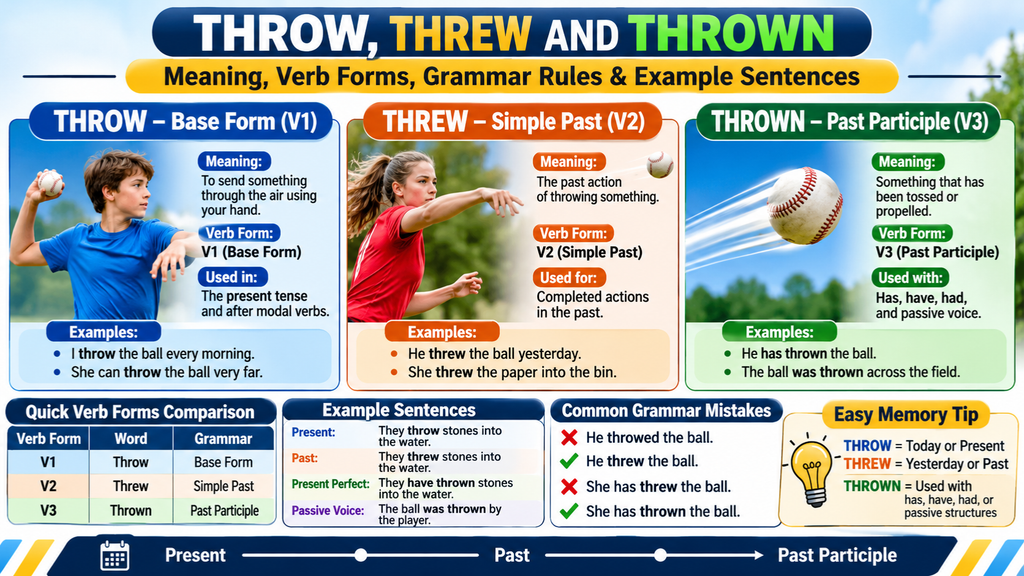
Thrown is part of an irregular verb, so its forms do not follow the usual “-ed” pattern:
- Base form: throw. I throw the ball.
- Third person singular: throws. She throws well.
- Simple past: threw. He threw the ball yesterday.
- Past participle: thrown. He has thrown the ball many times.
- Present participle: throwing. They are throwing the ball.
The difference between threw and thrown causes plenty of mistakes too. Use threw on its own for the simple past: She threw the ball. Use thrown with a helping verb such as has, have, had, was or were: She has thrown the ball. The ball was thrown.
A quick check: if you can put “has” or “was” in front of the word, use thrown. If not, and you mean a past action, use threw.
Throne or Thrown: How to Remember the Difference
Here are four tricks that make throne or thrown automatic.
1. Look for the “w.” Thrown has a w, just like the verb throw. Throne does not. If the word comes from throwing, it has a w.
2. Think “ruler’s seat.” A throne is where a ruler sits. If your sentence has a king, queen or ruling power in it, you want the one without the w.
3. Try the swap test. Replace the word with “tossed.” If tossed fits, you need thrown. If tossed sounds silly, you need throne. “The queen sat on the tossed” makes no sense, so it must be throne.
4. Try the “was/has” test. If you can say “was thrown” or “has thrown,” the word is thrown. You can never say “was throne” with this meaning.
Throne Example Sentences
- The king sat on his golden throne.
- She is the heir to the throne.
- The prince was too young to take the throne.
- The throne room was filled with courtiers.
- After the king died, a battle began over who would claim the throne.
- He gave up the throne to marry the woman he loved.
- The rebels marched on the palace to seize the throne.
- The old minister was the real power behind the throne.
Thrown Example Sentences
- The ball was thrown over the fence.
- She has thrown away her old notes.
- The driver was thrown from the car in the crash.
- The surprise question left him completely thrown.
- They have thrown a huge party for her birthday.
- The meeting was thrown into confusion when the power went out.
- The paper had been thrown in the bin by mistake.
- The batter was thrown out at second base.
Common Phrases and Idioms With Throne and Thrown
With throne:
- Heir to the throne: the person next in line to become ruler.
- Take the throne / ascend the throne: to become king or queen.
- Claim the throne: to say you have the right to rule.
- Abdicate the throne: to give up the position of ruler.
- Power behind the throne: a person with real influence who is not the official leader.
- Throne room: the formal room where a ruler receives guests.
With thrown:
- Thrown away / thrown out: discarded.
- Thrown off: confused, delayed or knocked off course.
- Thrown together: made quickly and without much planning.
- Thrown into confusion / chaos: suddenly disrupted.
- Have thrown a party: have hosted one, as in “They have thrown a huge party.”
- Thrown for a loop: badly surprised or confused: The sudden change threw her for a loop, and she felt completely thrown.
- Thrown under the bus: blamed or sacrificed to protect someone else: He felt thrown under the bus when the manager blamed him.
- Thrown from a horse: the literal use: The rider was thrown from the horse.
Notice that a ruler can also be thrown off the throne, meaning forced out of power. That sentence correctly uses both words, because the ruler was thrown (the verb) off the throne (the chair or the position).
Throne, Thorn, Throws and Throes: Other Look-Alikes
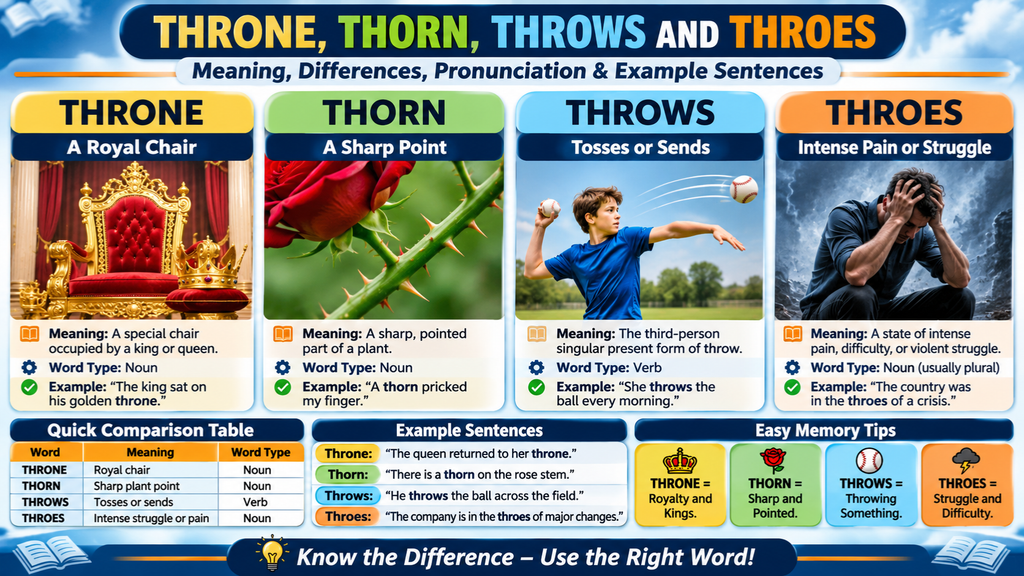
While we are in this corner of English, a few other words sit close by:
- Thorn is a sharp point on a plant, like on a rose. It looks and sounds close to throne but is a different word.
- Throws is the present tense of throw (she throws the ball) and also the plural noun (the throws in the game).
- Throes is a noun that means a severe struggle or pain, almost always in the phrase in the throes of: The country was in the throes of a crisis.
The most common slip is writing “in the throws of” when you mean “in the throes of.” If you mean a struggle, you want throes.
When Both Words Fit: “The Queen Was Thrown”
The throne or thrown decision can get tricky when the same sentence frame works with either word, and only the meaning decides:
- The queen was thrown from the carriage. (A passive verb: the carriage tipped and she fell out.)
- The queen sat on the throne. (A noun: the royal chair.)
And as noted above, one sentence can use both: The king was thrown off the throne. The king was forced out (thrown), and the position he lost is the throne. If you are stuck, ask whether you are naming a seat or power (use throne) or describing what happened to someone or something (use thrown).
Common Mistakes
Most throne or thrown mistakes come from a handful of patterns.
Writing “heir to the thrown.” This is the classic error. The heir inherits a throne, a seat or a position, not something that was thrown.
Writing “the thrown of England.” A seat of power is a throne, so it should be “the throne of England.”
Writing “he has throne the ball.” Throne is a noun, not a verb. The correct form is “he has thrown the ball.”
Writing “she threw” when you need “thrown.” “The ball was threw” is wrong. Use “The ball was thrown.”
Writing “she has threw.” The perfect tense needs the past participle: “She has thrown.”
Trusting spellcheck. Both words are real, so spellcheck will not flag them. You have to check the meaning yourself.
Quick Practice
Test your throne or thrown instincts by filling in each blank with throne or thrown. The answers follow.
- The young queen took the ______ at eighteen.
- The ball was ______ over the wall.
- He was ______ off balance by the sudden noise.
- The king refused to give up the ______.
- The guards stood beside the golden ______.
- The rider was ______ from the horse.
- The prince hoped to inherit the ______.
- The plans had been ______ together in an afternoon.
- Fix the mistake: “She is the heir to the thrown.”
- Fix the mistake: “He has threw the ball.”
Answers: 1. throne. 2. thrown. 3. thrown. 4. throne. 5. throne. 6. thrown. 7. throne. 8. thrown. 9. “She is the heir to the throne.” 10. “He has thrown the ball.”
FAQs About Throne or Thrown
These are the questions people ask most about throne or thrown.
What is the difference between throne and thrown?
A throne is a ceremonial chair for a ruler, and it can stand for sovereign power. Thrown is the past participle of “throw,” used when something has been tossed or suddenly forced.
Is it throne or thrown?
It depends on the meaning. Use “throne” for a ruler’s seat or power, and “thrown” for something that has been thrown or forced.
Are throne and thrown homophones?
Yes. Both are pronounced /θroʊn/, so they sound identical. You tell them apart by spelling and meaning.
What does throne mean?
A throne is a ceremonial chair used by a king, queen or other high-ranking person. It is also used figuratively for sovereign power, as in “heir to the throne.”
What does thrown mean?
Thrown is the past participle of “throw.” It is used after “has,” “have,” “had,” “was” or “were,” and it can describe tossing something or suddenly forcing a situation.
Is it “heir to the throne” or “heir to the thrown”?
It is “heir to the throne.” The heir inherits a seat of power, so the noun “throne” is the correct word.
What is the past participle of throw?
The past participle is “thrown.” The simple past is “threw,” and the other forms are “throw,” “throws” and “throwing.”
How do you pronounce thrown?
Say it as /θroʊn/, which sounds like “throhn,” with the “th” as in “think.” “Throne” is pronounced exactly the same way.
What is the difference between threw and thrown?
“Threw” is the simple past: “He threw the ball.” “Thrown” is the past participle used with a helping verb: “He has thrown the ball.”
What does “power behind the throne” mean?
It describes someone who holds real influence over a leader or organization without holding the official title.
Is it “sit on the throne” or “sit on the thrown”?
It is “sit on the throne.” A throne is the seat, and you can sit on it. “Thrown” is a verb form, so it cannot be a seat.
Is it “was thrown” or “was throne”?
It is “was thrown.” After “was,” you need the past participle of throw. “Was throne” is not correct when you mean something was tossed or forced.
Is thrown the past tense of throw?
Not exactly. The simple past is “threw,” and “thrown” is the past participle. So you say “She threw the ball” but “She has thrown the ball.”
Is throne always about royalty?
Usually, yes. A throne is a ruler’s seat or position, and it can also stand for any dominant position in figurative writing. It is not a verb and is never about throwing.
Final Thoughts
Throne or thrown comes down to one question: is it a seat of power or something that was thrown? A ruler’s chair is a throne. Anything that was tossed, hurled or suddenly forced is thrown. Remember that thrown has the w of throw, that you can say “was thrown” but not “was throne,” and that the heir inherits the throne, never the thrown.