
Class or Classs in English: Spelling, Plural, Possessive and Meaning
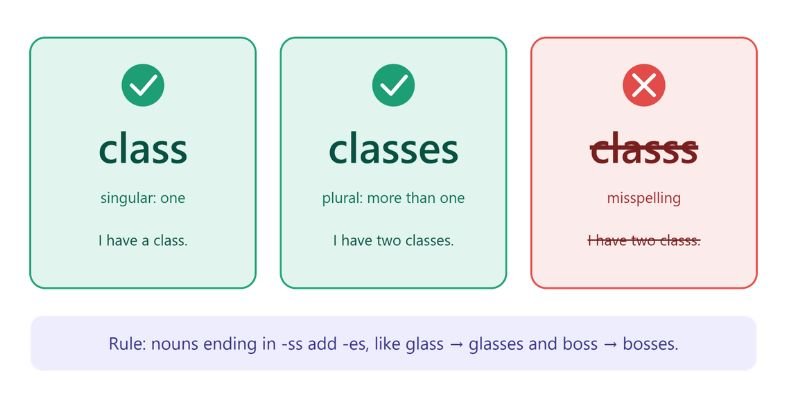
If you are choosing between class or classs in English, use class; the plural is classes. Classs is a misspelling, and it looks like a plural stacked onto a word that already ends in s. Below: the plural rule, how to tell classes from class’s and classes’, American and British pronunciation, the main meanings, and the slips to avoid.
Quick answer: The correct spelling is class (one) and classes (more than one). Classs is a misspelling, not a standard English word. Words ending in -ss add -es to form the plural, just like glass → glasses and boss → bosses. For ownership, use class’s (one class) or classes’ (several).
Is “Classs” a Word? Why the Spelling Is Wrong
Most English plurals just add -s: book → books, car → cars. Add -s to class and you get classs, which gives you three s’s in a row and no vowel for the extra syllable. The plural is actually spoken as KLASS-iz, and English spells that syllable -es.
The Plural Rule for Words Ending in -ss
When a noun ends in a hissing or buzzing sound (s, ss, x, z, ch, sh), add -es:
- class → classes
- glass → glasses
- bus → buses
- box → boxes
- church → churches
- dish → dishes
Two small exceptions: a few one-syllable words ending in z double it before -es (quiz → quizzes), and words ending in a ch that sounds like k just take -s (stomach → stomachs).
Common Misspellings of Class (Classs, Clases)
- classs: adds a lone s to a word that already ends in ss, which cannot spell the extra syllable you actually say. Wrong: I have three classs. Right: I have three classes.
- clases / clasess: variants that lose or misplace an s. The Spanish word clase is spelled with one s, but English keeps the double s: classes.
Class, Classes, Class’s and Classes’: Which One Do You Need?
These forms trip people up because three of them sound identical: classes, class’s and classes’ are all said KLASS-iz. Your ear cannot help here, so decide by meaning.
| Form | What it tells the reader | Example |
| class | one group or lesson | The class meets at noon. |
| classes | more than one | Her classes begin on Monday. |
| class’s | something belongs to one class | The class’s whiteboard is broken. |
| classes’ | something belongs to several classes | Both classes’ trips were cancelled. |
Two Quick Tests
- The number test. Can you put two, three or several in front of the word? Then you need the plural, classes, unless something also belongs to it: She teaches three classes.
- The “of” test. Can you rephrase the class? Then it is possessive: the class’s whiteboard means the whiteboard of the class. Use class’s for one class and classes’ for several.

Three Mistakes, Side by Side
| Wrong | Right | Why |
| Both class’s are full. | Both classes are full. | An apostrophe does not make a plural. |
| Our classes’ finish at noon. | Our classes finish at noon. | Nothing belongs to the classes, so there is no apostrophe. |
| The classes’s results are posted. | The classes’ results are posted. | The plural already ends in s, so add only the apostrophe. |
A Wrinkle: Class’s as a Contraction
The ending ’s can also stand for is or has, so The class’s starting now could mean The class is starting now. You will see this in speech and casual writing, but in formal writing spell the verb out so nobody mistakes it for a possessive.
Class’s or Class’?
Many style guides add ’s to a singular noun that ends in s, which gives class’s, and this article uses that form. Publishers differ, so follow the guide you write for.
What Does “Class” Mean in English?
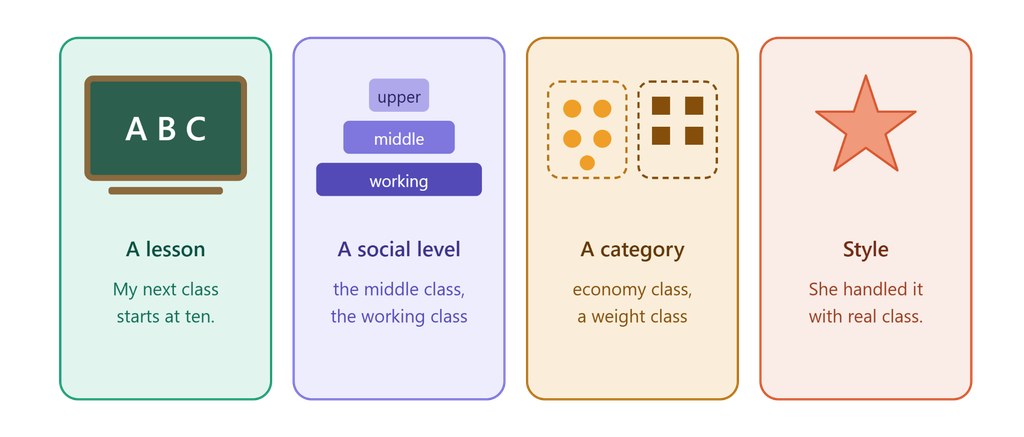
A class is a group of people or things that belong together. English uses the word in four main ways.
1. A group of students, or a lesson
- A group taught together: The class is quiet today.
- One lesson or meeting: My next class starts at ten.
- A course of study: She is taking a photography class.
- Students who finish school in the same year (mostly US): the class of 2030.
2. A level of society
People grouped by money, job or social position: working class, middle class, upper class. Writers and researchers often say social class.
3. A category of things
A set of things that share features: different classes of medicine, economy class on a plane, a weight class in boxing. In computer programming, a class is a blueprint that describes a type of object.
4. Style or quality (informal)
To have class means to show elegance and good manners: She handled the situation with real class. The adjective is classy.
Class as a verb
To class something means to put it in a category. It is much less common than the noun and tends to sound formal or technical: Experts class this snake as harmless.
How to Pronounce Class and Classes (IPA and Simple Respelling)
- class, American: /klæs/, say “KLASS” (rhymes with pass)
- class, British: /klɑːs/, say “KLAHSS” (a long, open vowel)
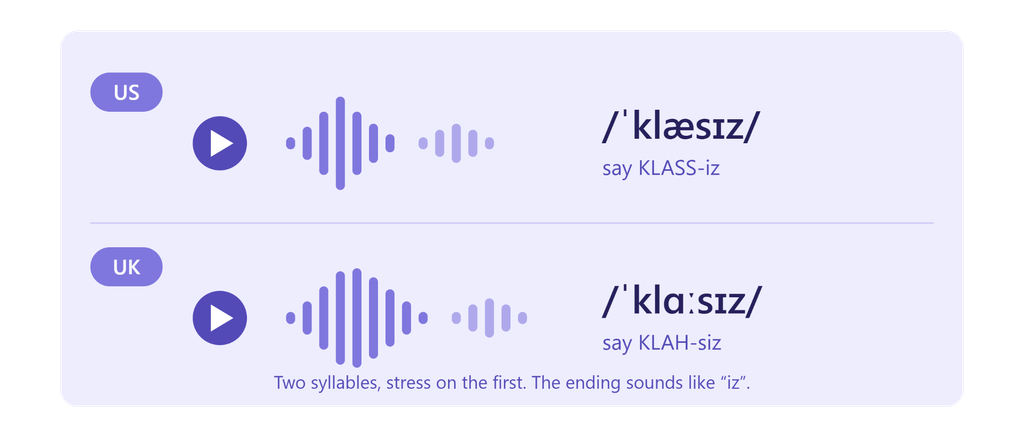
- classes, American: /ˈklæsɪz/, say “KLASS-iz”
- classes, British: /ˈklɑːsɪz/, say “KLAH-siz”
Pronunciation note: classes has two syllables, with the stress on the first. The ending sounds like “iz”, not a full “ess”. It rhymes with glasses and passes in both accents, but not with masses in standard British English, where mass keeps the short vowel of cat.
Why the Vowel Differs: The TRAP–BATH Split
Many southern British speakers use the long vowel /ɑː/ in words like class, glass, pass and last, while American speakers use the short /æ/ of cat. Linguists call this the TRAP–BATH split, after the two keywords used to label the vowel sets. It follows individual words, not spelling: mass and pass look alike, yet standard British English says /mæs/ and /pɑːs/. Many northern English speakers keep the short vowel in both, so a British accent does not always mean /klɑːs/.
Part of Speech: Is Class a Noun or a Verb?
Class is mainly a noun, and it can also be a verb.
- Noun: class (singular), classes (plural)
- Verb forms: class, classes (he/she/it), classed (past), classing (-ing form)
The form classes can be either a plural noun or a verb:
- The three classes are full. (plural noun)
- She classes these paintings as modern. (verb, third person)
Nouns often use class as a describing word too: class system, class size, class action, class trip.
How to Use Class in a Sentence: Grammar Rules
Is Class Countable or Uncountable?
- Countable: you can count them. I have three classes on Monday.
- Uncountable (no article): the general idea of being in lessons. I am late for class. Let’s talk after class.
Class with a Singular or Plural Verb (US vs. UK)
In American English, class takes a singular verb: The class is ready. In British English you may also see a plural verb when the speaker is thinking about the individual students: The class are working quietly.
Prepositions with Class: in, to, after and for
- in class: Please keep phones in your bag in class.
- to class: I walk to class every morning.
- during / before / after class: Questions can wait until after class.
- out of class: Some of the best learning happens out of class.
- for class: Read chapter three for class.
- a class in / on / about a subject: She teaches a class on pottery.
- in a class of its own: For sound quality, this speaker is in a class of its own.
- in the same class as: Your results are in the same class as mine.
Hyphens: “Middle Class” or “Middle-Class”?
Before a noun, the compound takes a hyphen; after a verb, it usually stays open. So you write a middle-class family but the family is middle class, and a first-class ticket but we flew first class. The same pattern applies to working class and upper class.
Example Sentences with Class and Classes
- Casual spoken: Skipping class again? Your attendance is going to tank.
- Everyday: My pottery classes start next Tuesday.
- Formal academic: Economists study how opportunities differ across social classes.
- Business writing: We offer three classes of service: basic, plus and premium.
- Informal compliment: The way she answered the criticism showed real class.
- Verb use, formal: The museum classes these tools as Bronze Age.
- Possessive, written: The class’s final project is due on Friday.
- Plural possessive, written: Both classes’ schedules overlap on Thursdays.
- Text message: Running late, save me a seat in class!
“I Have Class” vs. “I Have Classes”: What Is the Difference?
Both are correct; the difference is about tone and region, not meaning.
- I have class on Monday and Tuesday. sounds casual and general, like “I’m in school those days.” You will hear it often in American English.
- I have classes on Monday and Tuesday. stresses the separate sessions and is often the more natural choice in British English, where speakers may also say lessons.
A similar contrast: in class means “during lesson time” in general, while in the class points to a specific group: She is the youngest student in the class.
Synonyms for Class (and How Their Meanings Differ)
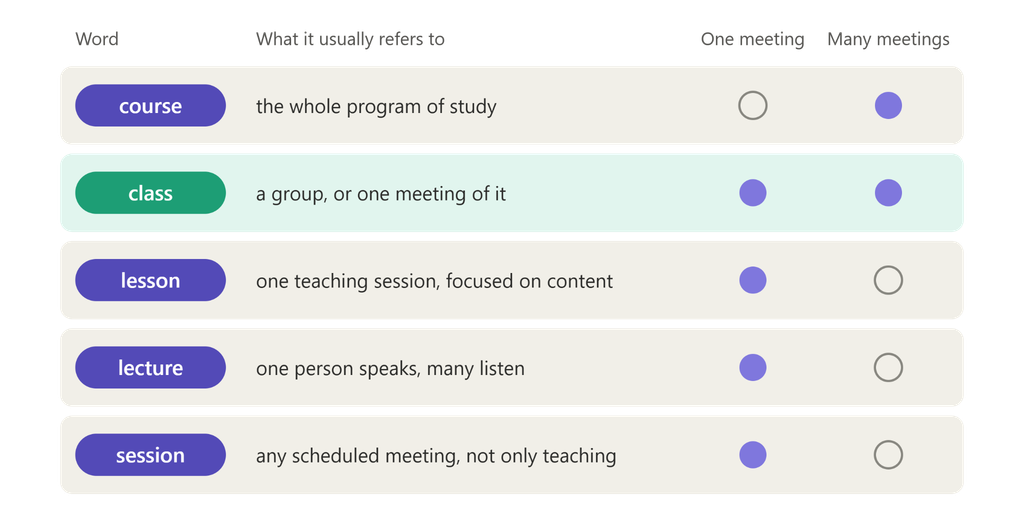
When you mean a lesson or course
- lesson: one session of teaching; it focuses on the content, while class focuses on the group or time slot, and lesson tends to sound more natural in British English.
- course: the whole program, often many classes over weeks or months.
- session: any scheduled meeting; it does not have to be teaching (a therapy session, a training session).
- lecture: one person speaks while many listen; typical at university.
- seminar: a smaller group built around discussion, not listening.
- workshop: hands-on practice where you make or try things yourself.
- period: a time slot on a school timetable; mostly used for school timetables.
- tutorial: small-group or one-person help, common in British university life.
When you mean a category
- category: a neutral, slightly formal word for a labeled group.
- type: the everyday, all-purpose choice.
- kind: more casual and flexible than “type”.
- grade: a group ranked by quality or level (grade A eggs).
- tier: one of several stacked levels, often used for prices and services.
When you mean social position
- social standing: a plain, polite way to refer to someone’s position.
- stratum: academic and formal, used by researchers describing layers of society.
- background: softer and less ranked; it says where someone comes from without placing them above or below others.
Opposites of Class: Antonyms and Contrasts
Class has no single true opposite, so here are the closest contrasts for each meaning.
- self-study: learning on your own, the opposite of learning in a class. I prefer self-study to evening classes.
- one-on-one tutoring: private teaching, the opposite of a group class. He switched to one-on-one tutoring before the exam.
- individual: one single case, the opposite of a whole class of cases. Judge each case as an individual, not as part of a class.
- crass / tacky: the opposite of classy. Mocking a guest was a crass thing to do.
Where Does the Word Class Come From? (Etymology)
Class entered English by about 1600 with the meaning “group of students”, from French classe (14th century), which came from Latin classis. In Latin, classis meant a class or division and also an army or a fleet, and it named the six orders into which, by tradition, Servius Tullius divided the Roman people for taxation. Etymonline connects it to Latin calare, “to call”, and to a reconstructed Proto-Indo-European root meaning “to shout”.
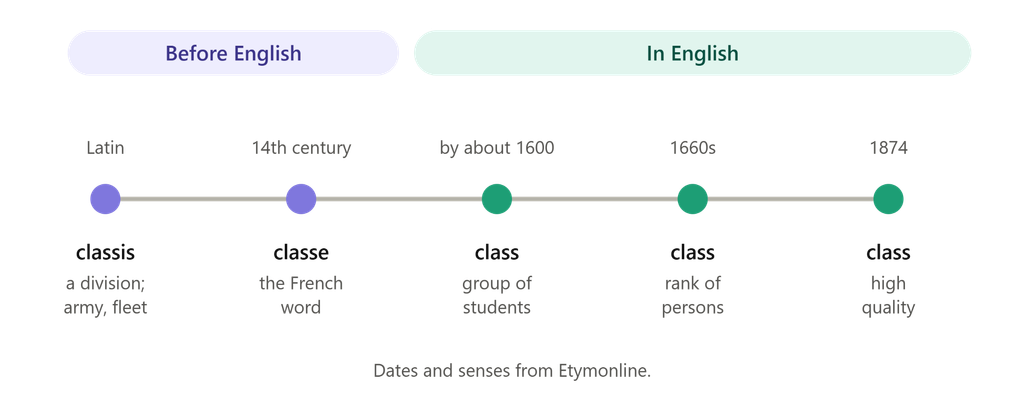
The lecture-or-course sense appeared in the 1650s and grew from the idea of a lecture reserved for scholars who had reached a certain level. The meaning “rank of persons” followed in the 1660s, the social-division sense by 1763, and “high quality” (as in she has class) in 1874. The verb to class is recorded from 1705, and class-consciousness (1903) comes from German Klassenbewusst. Related words from the same Latin source include classic, from Latin classicus, which referred to the highest class of Roman citizens, and classify, which came through French in 1782.
Common Mistakes with Class and Classes
- Using the wrong preposition. Wrong: I go in class by bus. Right: I go to class by bus. Use in class for where you are, and to class for where you are heading.
- Forgetting the article rules. Wrong: I’m late for the class every day (when you mean lessons in general). Right: I’m late for class every day. Use the class only for a specific group.
- Mixing up class and course. A course is the whole program; a class is one meeting or one group. I’m taking a French course with two classes a week.
- Confusing classy, classic and classical. Classy means stylish, classic means a lasting example, and classical relates to ancient Greece and Rome, or to music in the European concert tradition.
FAQs
Is “classs” a real word?
No. “Classs” is a misspelling, not a standard English word. The correct spelling is “class” for one group, lesson or category, and “classes” for more than one. The extra s can appear when writers add a plural s to a word that already ends in ss. Always write “class” or “classes.”
What is the plural of “class”?
The plural of “class” is “classes.” English adds -es, not just -s, to most nouns that end in s, ss, x, z, ch or sh, because the plural needs an extra spoken syllable. The same pattern gives glass → glasses, boss → bosses and box → boxes. Writing “classs” breaks this rule.
Why isn’t the plural “classs”?
Because the plural of “class” adds a spoken syllable, “iz,” and English writes that syllable with -es. A single added s would give “classs,” which has no vowel to carry the extra sound. Say it aloud: KLASS-iz, two syllables, with the stress on the first.
How do you pronounce “classes”?
In American English, “classes” is /ˈklæsɪz/, said KLASS-iz. In British English it is /ˈklɑːsɪz/, said KLAH-siz. It has two syllables, and the stress falls on the first. The ending sounds like “iz,” not a full “ess.” It rhymes with “glasses” and “passes” in both accents.
Do I say “I have class” or “I have classes”?
Both are correct. “I have class on Monday” sounds casual and general, like saying you are in school that day, and is heard often in American English. “I have classes on Monday” stresses separate sessions and is often more natural in British English, where “lessons” is also used. Choose either; the meaning is nearly the same.
What is the possessive of “class”?
The possessive of “class” is “class’s,” as in “the class’s whiteboard.” For more than one class, use “classes’,” as in “both classes’ trips.” Many style guides add ’s to singular nouns ending in s, though some publishers prefer only an apostrophe, so follow the guide you write for.
Is “classes’s” correct?
No, it is not standard. “Classes” is already plural and ends in s, so its possessive is just “classes’,” with the apostrophe after the final s. Write “the classes’ results,” not “the classes’s results.” The only ’s form you need is “class’s,” for something that belongs to a single class.
Should “classes” have an apostrophe?
Not when it simply means more than one class: “I attend three classes.” Add an apostrophe only to show ownership, as in “the classes’ trips.” An apostrophe does not make an ordinary plural, so “three class’s” and “our classes’ finish at noon” are both wrong.


One Comment