
Within vs Withing: What’s the Difference?
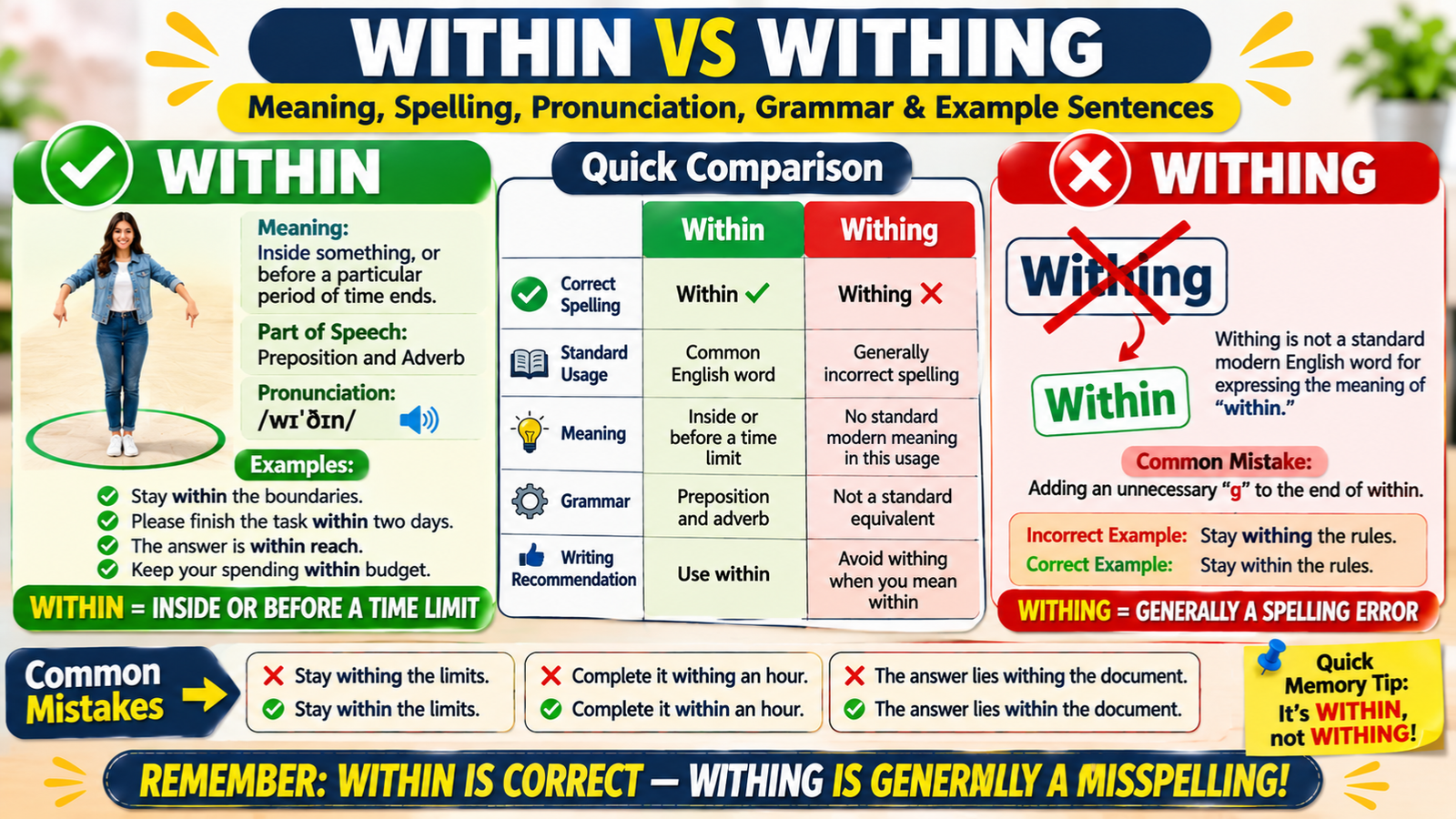
Within and withing are two different English word forms, but they are not interchangeable. Within is a common preposition and adverb meaning inside a place, inside a limit, or before a specified period of time ends. Withing is the present participle of the rare verb withe, which means to bind or fasten something with flexible twigs or branches.
If you are writing everyday English, within is almost certainly the word you need. Use withing only when referring to the unusual action of binding something with withes.
Quick Comparison: Within vs Withing
| Feature | Within | Withing |
| Word status | Common English word | Rare English word form |
| Part of speech | Preposition and adverb | Present participle of the verb withe |
| Meaning | Inside an area, limit, or time period | Binding or fastening with flexible twigs |
| Everyday usage | Very common | Extremely uncommon |
| Example | Please respond within two days. | The worker was withing the branches together. |
| Common purpose | Describing boundaries, limits, and time | Describing a traditional binding action |
What Does Within Mean?
Within is a preposition and adverb used to describe something inside a particular place, boundary, range, or period of time. It can also describe something that stays inside an established limit or falls within a person’s ability or responsibility.
The word is especially useful when you want to express that something does not go beyond a specific boundary.
1. Within as a Preposition of Place
When within describes location, it means inside a particular area, space, or boundary.
Examples:
- The children must remain within the school grounds.
- There is a small garden within the walls of the building.
- Several important documents are kept within the cabinet.
- The village is located within the national park.
- Please stay within the marked area.
In these sentences, within shows that a person or thing is inside a defined physical space.
2. Within for Time Limits
One of the most common uses of within is to describe a time limit. It means that something will happen before a specified period has passed or no later than the end of that period.
Examples:
- Please submit your application within seven days.
- The package should arrive within 48 hours.
- You will receive a confirmation email within an hour.
- The company promised to resolve the issue within a week.
- Students must complete the assignment within three days.
For example, if someone asks you to reply within 24 hours, you should respond before that 24-hour period ends.
3. Within for Limits, Rules, and Boundaries
Within can also describe something that stays inside a particular limit, standard, rule, or range.
Examples:
- The project must stay within the approved budget.
- Employees should work within company policies.
- The temperature remained within the normal range.
- The team completed the task within the agreed limits.
- Try to solve the problem within your available resources.
Here, the word does not necessarily describe a physical location. Instead, it refers to an abstract boundary or restriction.
4. Within as an Adverb
As an adverb, within can mean inside or on the inner side of something. It is often used in more formal or literary contexts.
Examples:
- The door was locked, but someone was calling from within.
- The building looked ordinary from outside, but it was beautiful within.
- The answer may already exist within.
- The noise came from within the house.
What Does Withing Mean?
Withing is a real but rare English word. It is the present participle and gerund form of the verb withe.
The verb withe means to bind, fasten, or secure something using a withe. A withe is a strong, flexible twig or branch, traditionally used for tying objects together.
Therefore, withing describes the action of binding or fastening something with these flexible branches.
Unlike within, this word is not used in ordinary conversations, emails, school assignments, or general business writing.
Understanding the Word Withe
To understand withing, it helps to understand its base word:
- Withe: A flexible twig or branch used for binding or fastening.
- Withe (verb): To bind or fasten something with withes.
- Withing: The present participle or gerund form of withe.
- Withed: The past tense and past participle of withe.
The word belongs to a specialized and uncommon vocabulary associated with traditional binding and craft practices.
How Is Withing Used?
Because withing is a rare word, examples should be understood in its specific traditional sense rather than as everyday English.
The following are illustrative sentences showing the intended meaning:
- The craft worker was withing the wooden frame with flexible willow branches.
- The traditional basket maker continued withing the bundles together.
- The workers were withing the branches to secure the structure.
These examples demonstrate the meaning of the word; they are not recommendations for everyday English writing.
Within vs Withing: Key Differences Explained
Although the two words look similar, their meanings and grammatical functions are completely different.
1. Difference in Meaning
Within describes an inside position, a boundary, or a time limit. Withing describes the action of binding something with flexible twigs.
- Correct: The report must be completed within two days.
- Incorrect for the intended meaning: The report must be completed withing two days.
The second sentence should use within because it refers to a time limit, not a binding action.
2. Difference in Grammar
Within functions as a preposition or adverb.
Example: The documents are within the folder.
Withing is a verb form: the present participle of withe.
Example: The worker is withing the branches together.
3. Difference in Everyday Usage
Within is widely used in spoken and written English. You will see it in instructions, emails, academic writing, business communication, and everyday conversations.
Withing is rare and usually relevant only when discussing the specific action of binding something with withes.
4. Difference in Context
The surrounding sentence helps determine which word is appropriate.
| Context | Correct word | Example |
| Time limit | Within | Finish the work within an hour. |
| Physical location | Within | The keys are within the drawer. |
| Budget limit | Within | The project stayed within budget. |
| Traditional twig binding | Withing | The craft worker was withing the branches. |
Within vs Withing: Example Sentences
Here are practical examples to help you understand the difference.
Examples of Within
- Please complete the registration within five minutes.
- The restaurant is within walking distance of the hotel.
- All employees must work within company guidelines.
- The package arrived within three business days.
- The answer lies within the first chapter.
- Keep your phone within reach during the meeting.
- The temperature remained within the safe range.
- The school is located within the city limits.
- We need to finish the project within our budget.
- You should receive a response within 24 hours.
- The solution is within your control.
- The children played within the garden.
- The report must be submitted within the deadline.
- The entire process was completed within a week.
- The information is available within the official document.
Examples of Withing
The following sentences illustrate the rare verb form:
- The craft worker was withing the willow branches around the frame.
- The traditional method involved withing flexible twigs together.
- The workers continued withing the branches to secure the structure.
Remember that these are specialized examples. In normal modern writing, you are unlikely to need withing.
Common Mistakes When Using Within and Withing

Because the two words share similar letters, writers sometimes confuse them. The most important rule is to consider the intended meaning before choosing a spelling.
Mistake 1: Using Withing Instead of Within
Incorrect: Please send the documents withing two days.
Correct: Please send the documents within two days.
Why? The sentence describes a time limit, so within is the correct word.
Mistake 2: Writing Withing a Specific Period
Incorrect: The company will respond withing 48 hours.
Correct: The company will respond within 48 hours.
Why? The sentence means that the response will arrive before 48 hours have passed.
Mistake 3: Confusing Within with With
These words have different meanings.
- With means accompanied by or using something.
- Within means inside a boundary or before a time limit ends.
Examples:
- She went to the meeting with her colleague.
- She completed the assignment within two hours.
Do not add or remove letters without checking the meaning.
Mistake 4: Confusing Withing with Withings
Withings is also the name of a technology and health-device brand. It is a proper brand name, not the same word as withing.
For example:
- Withings makes connected health devices.
This spelling should not be treated as an example of the verb withing.
Within vs In vs Inside: What Is the Difference?

Writers sometimes confuse within with in and inside. Although these words can have related meanings, they are not always interchangeable.
| Word | Main meaning | Example |
| Within | Inside a boundary or not beyond a limit | The office is within the building. |
| In | Located inside something | The keys are in the bag. |
| Inside | On or toward the inner part of something | The children are inside the house. |
When Should You Use Within?
Use within when emphasizing a boundary, restriction, distance, or time limit.
Example: The office is within five miles of the station.
When Should You Use In?
Use in for ordinary statements about location, periods, or situations.
Example: The keys are in the drawer.
When Should You Use Inside?
Use inside when you want to emphasize the interior of a place or object.
Example: Please wait inside the building.
A useful distinction is that within often emphasizes a limit, while in usually describes a location or situation more generally.
Synonyms and Alternatives for Within
Depending on the sentence, you can sometimes replace within with another expression.
| Alternative | Meaning or use | Example |
| Inside | In the interior of something | Stay inside the building. |
| In | Located in a place or situation | The documents are in the folder. |
| Not beyond | Staying inside a limit | The cost is not beyond our budget. |
| No later than | Before or at a specified deadline | Reply no later than Friday. |
| In less than | Before a specified amount of time passes | The parcel arrived in less than a day. |
| Inside the limits of | Within a defined boundary | Work inside the limits of the agreement. |
These alternatives are context-dependent. They should not be substituted automatically in every sentence.
Easy Ways to Remember the Difference
Use these simple reminders:
- Within = inside a limit. Think about a place, boundary, budget, or deadline.
- Withing = binding with withes. Think about flexible twigs or branches used for fastening.
- If you are talking about time, distance, rules, or boundaries, you almost certainly need within.
- If you are writing ordinary everyday English, do not use withing as a spelling variation of within.
Frequently Asked Questions
1. Is within or withing the correct word?
Both are real English word forms, but they have different meanings. Within is the common word for describing an inside position, limit, or time period. Withing is the rare present participle of withe.
2. Is withing a real English word?
Yes. Withing is a real but uncommon word. It is formed from the verb withe, meaning to bind or fasten something with flexible twigs.
3. What does within mean?
Within means inside a particular place, boundary, range, or period of time. For example, “Please reply within two days” means you should reply before two days have passed.
4. What does withing mean?
Withing means binding or fastening something with withes, which are flexible twigs or branches used for tying things together.
5. Can I use withing instead of within?
No. The two words are not interchangeable. Use within for time limits, physical spaces, and boundaries. Use withing only when referring to the rare action of binding something with withes.
6. What is the difference between within and in?
In generally describes a location or situation. Within often emphasizes being inside a particular boundary, range, or limit.
7. Is within a preposition or an adverb?
Within can function as both a preposition and an adverb. Its grammatical role depends on how it is used in a sentence.
8. What is the base word of withing?
The base word is withe. Its present participle is withing, and its past tense and past participle are withed.
9. Is withing a common word?
No. It is rare and specialized. Most English speakers will rarely need it in ordinary writing or conversation.
10. Why do people write withing instead of within?
It is usually a typing or spelling mistake caused by the visual similarity of the two words. In sentences about deadlines, locations, and limits, within is the correct spelling.
Final Thoughts
The difference between these words becomes simple once you understand their meanings. Within is the everyday English word used for describing something inside a place, boundary, range, or time limit. Withing is a rare verb form connected to withe, meaning to bind something with flexible twigs or branches.
For everyday writing, remember to use within when discussing time, distance, rules, spaces, or limits. Do not use withing as an alternative spelling.
Understanding this distinction will help you avoid spelling mistakes and choose the correct word in your writing



2 Comments