
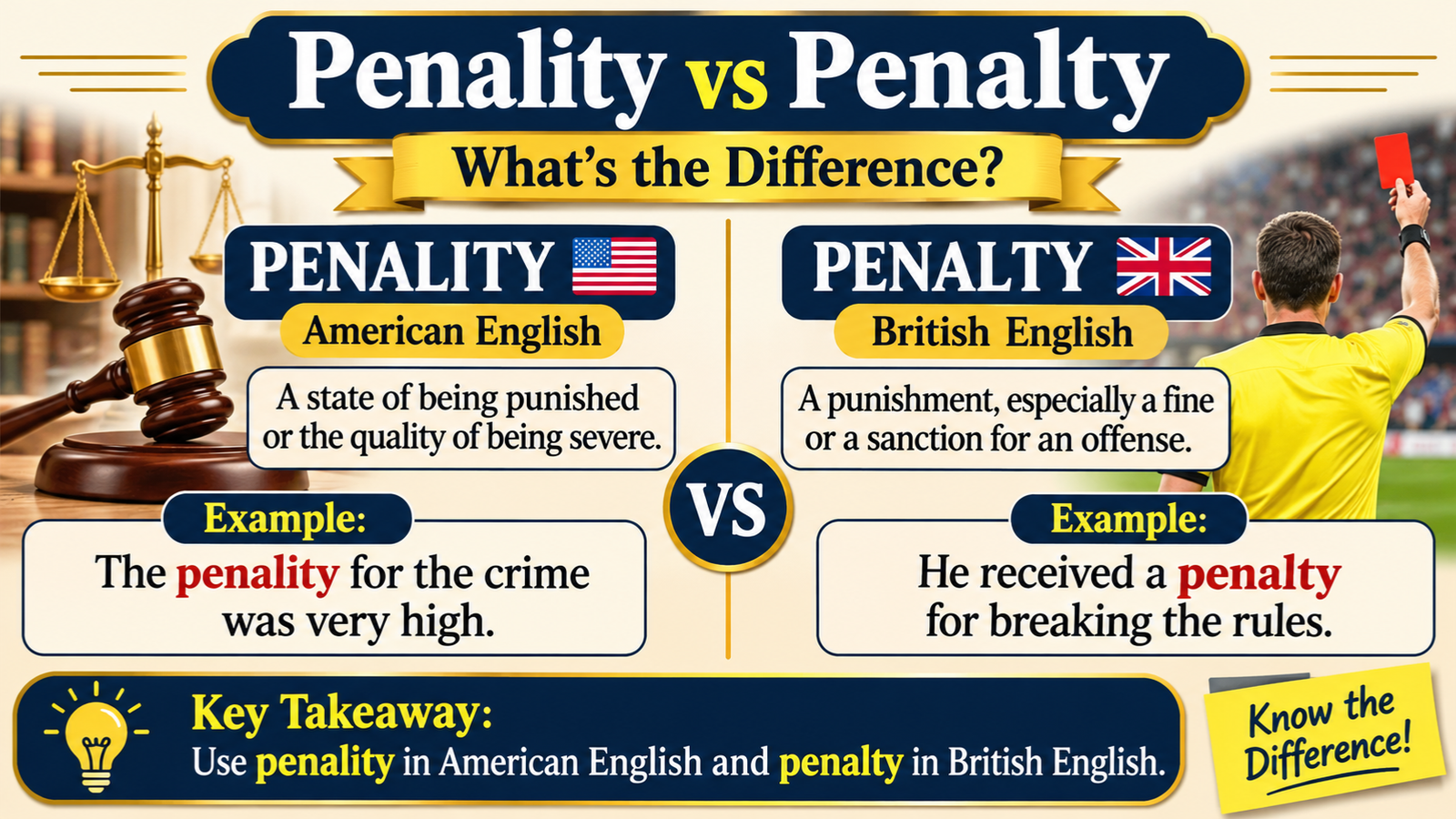
Penality vs Penalty: Which Spelling Is Correct? Meaning, Plural and Examples
Quick answer: Write penalty. “Penality” is usually a misspelling of it. It is also, to be fair, a very rare noun in its own right: Wiktionary-based dictionary pages such as YourDictionary list it as meaning “the quality or state of being penal; liability to punishment.” That is a narrow, formal sense, and it is not a spelling variant of penalty. If you mean a punishment, a fine, a sports penalty or a price paid for breaking a rule, the word you want is penalty, and its plural is penalties.
If you typed penality vs penalty into a search bar, a spell-checker has probably just underlined something in red. You have your answer above. The rest of this penality vs penalty guide explains what each word means, where penalty comes from, why the wrong version looks so natural, how to use the right one in real sentences, and how it differs from fine, punishment and sanction. There is a short self-test near the end.
I have corrected this slip in more student essays than I can count. It is rarely carelessness. It is a sensible guess based on how English spells other words, and it happens to be wrong here. Once you see the pattern, the mistake tends to vanish.
Penality vs Penalty: The Quick Answer in Plain English
Here is the whole matter in one breath. The everyday word is spelled p-e-n-a-l-t-y. The spelling p-e-n-a-l-i-t-y is a different, rare word that almost nobody needs.
So the penality vs penalty question is not a choice between two spellings of equal standing, the way you would choose between colour and color. In nearly every sentence you will ever write, “penality” is the mistake and penalty is the answer.
The honest footnote is that “penality” is not just a typo. YourDictionary lists it as a noun with the plural “penalities”, and the Wiktionary data behind it carries no “obsolete” or “archaic” tag. It simply has a narrow meaning of its own, covered below. For ordinary writing, forget it exists and use penalty.
What Does Penalty Mean?
Penalty is a noun, and it is a handy one because it covers several related ideas. The common thread is a cost or disadvantage that follows from breaking a rule, missing a deadline or doing something wrong.
Here are the main senses you will meet.
- A punishment set by law or rules. The penalty for speeding is a fine and points on your licence.
- A disadvantage imposed for breaking a rule. The team lost ten points as a penalty for cheating.
- A sports penalty. The referee awarded a penalty in the final minute.
- A financial charge for failing to do something on time. There is a penalty for paying the bill late.
- A natural or unavoidable cost. Missing sleep carries its own penalty the next morning.
A good test for penality vs penalty is to ask yourself, “Is something being paid, lost or suffered because a rule was broken or a choice was made?” If yes, penalty is almost certainly the right word.
Penalty is a countable noun
Penalty is usually countable. You can have one penalty or several penalties, a heavy penalty or a light one. It can also appear without an article in general statements: “Cheating carries a penalty.”
Because it is a noun, it often follows words like a, the, severe, maximum, minimum, financial or legal. It also sits inside many common phrases:
- the death penalty
- a penalty clause
- a penalty kick
- on pain of penalty (rare and old-fashioned)
- to pay the penalty
- a late payment penalty
If you know one thing about the word, know that it ends in -lty, with no i between the l and the t.
Is Penality a Word?
Yes, but a very rare one, and not the one you want.
YourDictionary lists penality as a noun meaning “the quality or state of being penal; liability to punishment.” The Wiktionary data that it draws on gives the plural as penalities and records the origin simply as “see penalty.” Neither source labels it obsolete or archaic. It is a real dictionary word, just an uncommon and formal one.
Two things follow from that.
First, “penality” is not a variant of penalty. The two do not mean the same thing. Penalty is the punishment or cost itself. Penality, in its rare sense, is the abstract quality of being subject to punishment.
Second, in everyday writing it counts as a mistake, because a reader who sees it will assume you meant penalty. Even if you wanted the rare sense, plain phrases such as “liability to punishment” would be clearer and would not send the reader to a dictionary.
So when someone asks “is penality a word?”, the fair answer on penality vs penalty is: technically yes, practically no. If you are writing an essay, a contract, an email or an exam answer, use penalty.
What Penality Means When It Is Used Correctly
For completeness, here is how the rare sense works. The word is built from penal, meaning relating to punishment, plus the suffix -ity, which turns an adjective into a noun naming a state or quality. It follows the same pattern as real becoming reality or similar becoming similarity.
So “penality” would name the state of being penal, that is, of being liable to punishment. A writer using it in that sense is talking about whether an act is punishable, not about the punishment itself.
Here is an illustration written for this guide, not a quotation from any source: Lawyers in the debate disagreed about the penality of the act, meaning whether it should count as punishable at all.
You can see how heavy that sounds, and why penality vs penalty is usually settled in favour of the second word. Most modern writers would say “whether the act should be punishable” instead. That is why the rare word has stayed rare, and why this guide keeps pointing you back to penalty.
Where Penalty Comes From
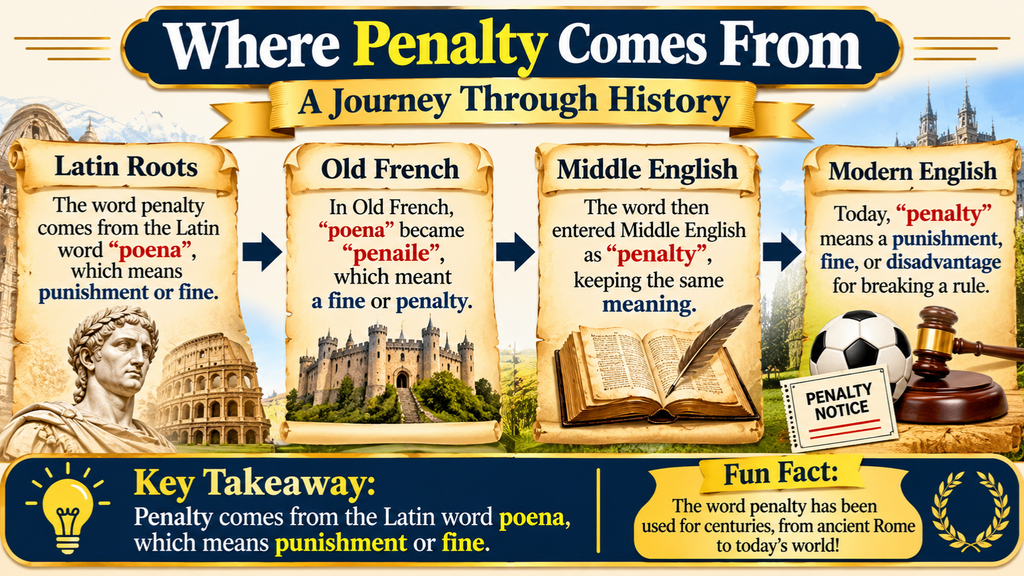
The history of the word also explains the spelling trap, so it is worth a quick look.
According to Etymonline, penalty entered English around 1500 with the meaning “punishment.” It came through Old French penalite from Medieval Latin, and ultimately from Latin poenalis, “pertaining to punishment.” The legal sense, a punishment set by law or a court, dates to the 1510s. The sports sense, a disadvantage imposed for breaking the rules, is much newer and dates to 1885.
Behind the Latin sits poena, which Etymonline traces to Greek poinē, meaning “blood-money, fine, penalty, punishment.” That in turn goes back to an ancient root meaning to pay, atone or compensate.
The adjective penal, as in penal code or penal colony, comes from the same Latin family. Etymonline dates it to the mid-1400s with the meaning “of or pertaining to punishment by law.”
Notice the Old French form penalite, which matters for penality vs penalty. It ended in -ite, the ancestor of English -ity. English later reshaped the ending into -ty. That is one reason “penality” feels so natural to the eye: it sits closer to the older French shape than the modern English spelling does. The shortened form won out, and the modern word is penalty.
The idea of paying for a wrong runs through the whole word family. A penalty is, in the oldest sense, what you pay.
Why People Write Penality (the -ity Trap)
If “penality” is wrong in most sentences, why does it look so right? Several things push in the same direction.
English has many -ity words. Quality, reality, ability, activity, similarity, possibility. Your eye has seen the -ity ending thousands of times, so it feels like the default way to end a long noun.
Related words invite it. The adjective is penal, and the common pattern is adjective plus -ity, as in real and reality. So penal seems to lead naturally to penality.
The old French shape lingers. As noted above, the word came into English through a form ending in -ite. The modern spelling shrank that ending, but the longer shape still feels familiar.
The sound can mislead. When people say penalty quickly, the middle can sound like pen-uh-tee, which makes it easy to wonder whether a letter is missing.
A real dictionary word exists. Because “penality” does appear in some dictionary lists, a writer who checks may think it has been confirmed. It has, but only for the rare sense.
The penality vs penalty confusion is understandable, and falling into it says nothing bad about your spelling. It says you are applying a pattern that works often enough to feel reliable.
Other -ity vs -ty pairs worth knowing
English has plenty of words that end in -ty and plenty that end in -ity. They are easier to keep straight once you notice a rough rule.
- Many -ity words come from adjectives: able gives ability, real gives reality, similar gives similarity, active gives activity.
- Many -ty words end in -alty or -ulty or are older borrowings: royalty, loyalty, casualty, faculty, penalty, specialty.
- A few come in both versions with different meanings, such as penalty and the rare penality.
There is no perfect rule, and English likes exceptions, so the safest habit is to learn the common words as shapes. For penalty, that shape is pen-al-ty.
If you enjoy this type of spelling puzzle, our guides on existence vs existance and vacuum vs vaccum walk through two more cases where one version is simply a common misspelling, and proove or prove does the same for a verb that people respell by ear.
Penality vs Penalty: Side-by-Side Table
| Penalty | Penality | |
| Status | Standard, everyday word | Rare noun; usually a misspelling in practice |
| Part of speech | Noun | Noun |
| Meaning | A punishment, fine, disadvantage or cost for breaking a rule or making a choice | The quality or state of being penal; liability to punishment |
| Plural | penalties | penalities |
| Related forms | penalize / penalise, penalized, penal | penal |
| Common? | Very common | Very rare |
| Should you use it? | Yes, in nearly every sentence | Almost never |
| Example | The penalty for late payment is ten dollars. | Never write: The penality for late payment is ten dollars. |
One small point before we leave the penality vs penalty table. Notice the plural of each. Penalty follows the usual rule for words ending in a consonant plus y: change the y to ies. That gives penalties, never “penaltys”.
How to Use Penalty in a Sentence
Examples teach the word faster than definitions do. Here are original sentences across different settings.
In sports
- The referee awarded a penalty after the defender handled the ball.
- The match went to a penalty shootout after a goalless draw.
- The player was sent to the penalty box for two minutes.
- A flag on the play meant a ten-yard penalty against the home team.
- She scored the winning goal from a penalty kick.
- The team gave away too many needless penalties in the first half.
In law and government
- The penalty for the offence is a fine of up to five thousand dollars.
- Judges must consider the maximum and minimum penalty set by law.
- In some countries, the death penalty has been abolished.
- The new rules carry heavier penalties for repeat offenders.
- Failing to file your tax return on time can attract a penalty.
- The company paid a financial penalty for breaking the safety regulations.
In money and contracts
- There is a penalty for withdrawing your savings early.
- The contract includes a penalty clause for late delivery.
- A late payment penalty is added after thirty days.
- Breaking the lease early may cost you a penalty equal to two months’ rent.
- The bank charged an interest penalty on the overdue balance.
- Always read the small print for hidden penalties.
At school and at work
- Late submissions carry a penalty of five marks per day.
- The teacher explained the penalty for copying another student’s work.
- Plagiarism is punished with a severe penalty.
- There is no penalty for guessing on this test.
- Missing the deadline will incur a penalty under the agreement.
- Employees face a penalty if they ignore the safety rules.
In everyday life
- Skipping breakfast carried its own penalty by mid-morning.
- The penalty for oversleeping was a very rushed commute.
- Parking in the wrong spot cost him a penalty notice.
- She paid the penalty for ignoring the weather forecast and got soaked.
- Walking home in the rain was the penalty for forgetting the umbrella.
- For every extra day, the library adds a small late-return penalty.
With plural, verb and adjective forms
- Both teams received penalties during the heated match. (plural)
- The league may penalise clubs that break the spending rules. (UK verb spelling)
- The league may penalize clubs that break the spending rules. (US verb spelling)
- Judges follow the penal code when sentencing. (adjective)
Read a few aloud, and the penality vs penalty question will feel settled. Notice also how many of these sentences are about cost, not just punishment. That is the beauty of the word: it covers anything that follows from a broken rule or a poor choice.
Forms: Penalty, Penalties, Penalize, Penalise, Penal
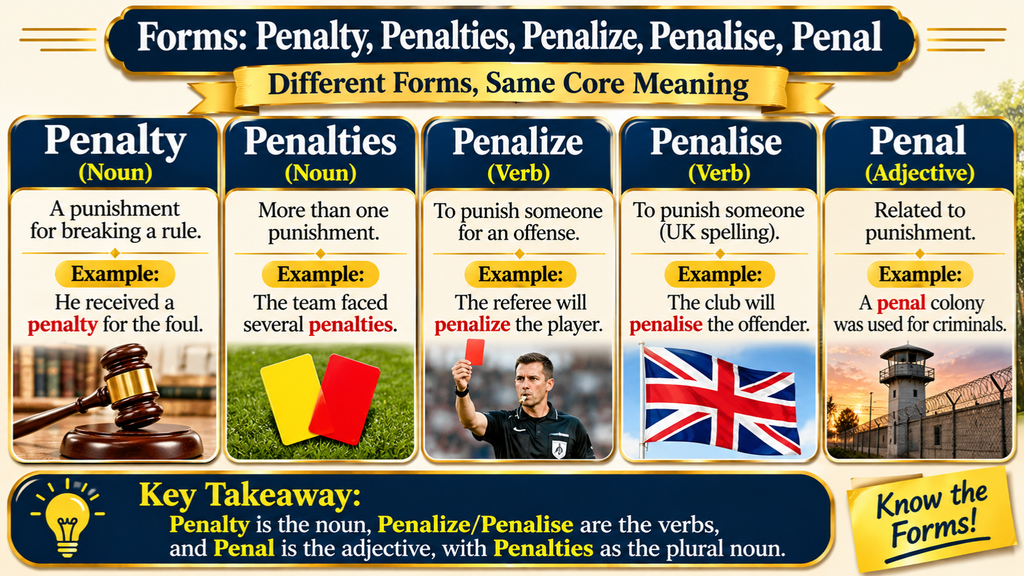
Once penality vs penalty is settled, penalty has a small family of related words to learn.
- Noun: penalty
- Plural noun: penalties
- Verb: penalize (US) or penalise (UK)
- Past tense and past participle: penalized / penalised
- Present participle and gerund: penalizing / penalising
- Adjective: penal
- Related noun (rare): penality
Plural: penalties, never “penaltys”
Words that end in a consonant plus y change the y to ies in the plural. Penalty follows that rule: penalties. The same pattern gives party and parties, country and countries, city and cities.
“Penaltys” is always wrong. If a spell-checker flags it, accept the fix. For another plural spelling puzzle, see tomatos or tomatoes and class or classs.
Penalise vs penalize (UK vs US)
Both spellings are correct. Penalize is the standard American spelling, and it is also common in Canada and in Oxford-style British publishing. Penalise is the common British, Australian and New Zealand spelling. The meaning is identical.
The rule is simple: pick the spelling that matches your readers and keep it consistent throughout the document. Do not switch between penalize and penalise in the same article.
Penal is an adjective
Penal means relating to punishment, especially by law. It appears in phrases such as penal code, penal system, penal colony and penal reform. It is not interchangeable with penalty.
- The penal code sets out the punishments for crimes. (adjective)
- The penalty for the crime is five years in prison. (noun)
A quick check: if the word describes something, use penal. If it names the punishment or cost, use penalty.
Penalty vs Fine vs Punishment vs Sanction
These four words overlap, so people swap them without noticing. Spelling penality vs penalty is the easy part; meaning takes more care. Each has a slightly different centre of gravity.
Penalty vs fine
A fine is a sum of money you must pay as a punishment. A penalty is broader. It can be a fine, but it can also be lost points, extra time, a ban, a jail term or any disadvantage.
- The fine for littering is fifty dollars. (money only)
- The penalty for littering is a fine and community service. (a package of consequences)
Every fine is a type of penalty, but not every penalty is a fine.
Penalty vs punishment
Punishment is the act of punishing or the suffering imposed for wrongdoing. It carries a moral weight. Penalty is more neutral and often points to a specified consequence set out in advance, such as in a rulebook or contract.
- The punishment was too harsh for such a small mistake. (the suffering imposed)
- The penalty for late delivery is stated in clause nine. (a defined consequence)
Penalty vs sanction
A sanction is a formal measure imposed to enforce a rule or law, often by an authority or between countries. It has a famous quirk: sanction can also mean official approval. So “the council sanctioned the plan” usually means it approved it, while “sanctions on a country” are penalties.
If you want to avoid confusion, use penalty for the cost of breaking a rule, and keep sanction for formal, official contexts.
A quick summary of the four
- Penalty: a cost or disadvantage that follows from breaking a rule.
- Fine: a payment imposed as a penalty.
- Punishment: the act or experience of being punished.
- Sanction: a formal enforcement measure, or official approval, depending on context.
Penalty in Sports, Law, Finance and School
The same word shows up in very different places, which is part of why you will need it so often.
Penalty kick and penalty shootout
In football (soccer), a penalty kick is awarded for a serious foul inside the penalty area. A penalty shootout is a tie-breaker where players take turns taking penalty kicks. In ice hockey, a player may be sent to the penalty box for a set time. In American football, a penalty flag signals a rule violation, and the offending team loses yards.
In sports, the word was fixed in this sense in the 1800s, with Etymonline dating the sporting meaning to 1885.
Penalty clause in contracts
A penalty clause is a term in a contract that says what a party must pay if they break the agreement, such as missing a deadline. Courts in many places treat true penalty clauses differently from genuine estimates of loss, so the wording matters. This is general background, not legal advice. If you are drafting or signing a contract, ask a qualified professional.
In finance and school
Banks and lenders use penalty for charges such as an early withdrawal penalty or a late payment penalty. Schools use it for deductions such as a late submission penalty, where marks are lost for each day an assignment is overdue. The idea stays the same: a cost follows from not meeting a rule or deadline.
Synonyms and Related Words
Penalty has plenty of relatives, though none is a perfect match.
- Fine: a money penalty.
- Punishment: the act of punishing, or what is suffered.
- Sanction: a formal enforcement measure.
- Forfeit: something lost as a result of breaking a rule.
- Charge: an amount asked for, sometimes a penalty.
- Surcharge: an extra payment, sometimes imposed as a penalty.
- Handicap: a disadvantage, especially in sports.
- Drawback: a disadvantage that comes with something.
- Price: what you pay, often used figuratively: “the price of failure.”
Pick the one that fits your tone and context. Whichever you choose, the penality vs penalty answer stays the same when your meaning is “a cost for breaking a rule”: write penalty.
Pronunciation
Say it as PEN-ul-tee, with the stress on the first syllable. The middle vowel is weak, so it often sounds like uh, and the ending sounds like tee.
That weak middle vowel is part of the problem. When you hear pen-uh-tee, your brain can easily imagine an i in there, as if the word were pen-ah-lih-tee. The spoken form hides the spelling. When you write, slow down and say each letter: p-e-n-a-l-t-y.
Here is a trick that helps writers who keep tripping on penality vs penalty. Say the word out loud with three clear beats, pen-al-ty, and tap the desk once on each beat. Three beats, three chunks, no extra i.
Common Mistakes
A few errors come up again and again.
Writing “penality.” The big one in any penality vs penalty check. In nearly every sentence, the correct word is penalty.
Writing “penaltys.” The plural of penalty is penalties, because the y changes to ies.
Writing “penalities” for the plural. In penality vs penalty terms, this is the plural of the rare word penality, not of penalty. You almost certainly want penalties.
Mixing up penal and penalty. Penal is an adjective for things related to punishment. Penalty is the noun for the punishment or cost itself.
Using fine for every penalty. A fine is only one kind of penalty. If the consequence is lost points, extra time or a ban, penalty is the better word.
Mixing penalize and penalise in the same text. Both are correct, but pick one and stay with it.
Writing “penalty” for a sports situation that needs another word. In some sports, other terms are used, such as foul, infraction or free kick. In football, though, penalty has a precise meaning: a kick from the spot for a foul inside the box.
If you tend to slip on word endings in general, our guides to handle or handel and class or classs are good next reads.
Memory Tricks
Penality vs penalty advice only helps if you can recall it when you are writing at speed. Here are four tricks, and then my honest pick.
1. Hide “alt” inside “penalty.” Look at the middle: pen-alt-y. The letters alt sit side by side, with no i in between.
2. Think “pen” and “alty.” Pen like the writing tool, then alty. A pen writes the rule, and the penalty follows when you break it.
3. Link it to “penal”. The adjective penal is spelled p-e-n-a-l. Add ty on the end, and you get penalty. There is no extra i in the family.
4. Count the beats. Say pen-al-ty with three beats and tap on each. Three beats, three chunks, no extra i.
My own pick is the first one. It is simple, and it fixes the exact spot where the mistake happens. A student once told me that she underlines alt every time she writes the word. It sounds silly, but she stopped making the mistake within a week.
Quick Self-Test
Try these penality vs penalty questions before you scroll to the answers.
- The ___ for late payment is ten dollars. (penalty / penality)
- What is the plural of penalty?
- True or false: “penaltys” is an acceptable plural.
- Which is the adjective: penal or penalty?
- Fill the gap: “The league may ___ clubs that break the rules.” (UK spelling)
- A sum of money paid as a punishment is called a ___. (fine / penalty kick)
- Which of these words means “liability to punishment”: penalty or penality?
- Pick the better word: “The referee awarded a (penalty / penality) in the last minute.”
Answers. 1) penalty. 2) penalties. 3) False. The plural is penalties. 4) Penal. 5) penalise. 6) fine. 7) Penality, in its rare sense. 8) penalty.
If you got seven or eight, penality vs penalty is no longer a problem for you. If you missed two or three, reread the plural section and try again.
FAQs
Is it penalty or penality?
In the penality vs penalty question, it is penalty almost every time. “Penality” is usually a misspelling. It is also a rare noun meaning “liability to punishment” in some dictionaries, but it is not a spelling variant of penalty. If you mean a punishment, fine or sports penalty, write penalty.
Is penality a word?
Technically yes, practically no. YourDictionary lists penality as a rare noun meaning “the quality or state of being penal; liability to punishment,” with the plural penalities. It carries no archaic label, but almost nobody uses it. In normal writing, replace it with penalty.
What does penality mean?
In its rare sense, penality means the quality or state of being penal, that is, of being liable to punishment. It is not the punishment itself. Because the word is so uncommon, most writers say “liability to punishment” or “punishability” instead.
What does penalty mean?
A penalty is a punishment, fine or disadvantage that follows from breaking a rule or making a choice. It can be set by law, such as a fine, or by rules, such as lost points in a game. It can also be a natural cost, as in “the penalty of staying up late.”
How do you spell penalty?
For penality vs penalty, spell it p-e-n-a-l-t-y, with no i between the l and the t. Three chunks help: pen-al-ty. The plural is penalties. If you ever write “penality” or “penaltys”, your spell-checker should flag it.
What is the plural of penalty?
The plural is penalties. Penalty ends in a consonant plus y, so the y changes to ies, just like party becomes parties. “Penaltys” is always wrong, and “penalities” belongs to the rare word penality, not to penalty.
What is the difference between penalty and fine?
A fine is specifically a payment of money. A penalty is broader and can include fines, lost points, bans or extra time. Every fine is a penalty, but not every penalty is a fine. If money is the only consequence, fine is precise. Otherwise, penalty fits.
What is the difference between penalty and punishment?
Punishment is the act of punishing or the suffering imposed for wrongdoing, and it carries moral weight. Penalty is more neutral and often refers to a defined consequence set out in advance, such as in a rulebook or contract. The two overlap a lot in everyday speech.
What is the difference between penal and penalty?
Penal is an adjective meaning relating to punishment, as in penal code or penal system. Penalty is a noun naming the punishment or cost itself. If the word describes something, use penal. If it names the consequence, use penalty.
Is it penalise or penalize?
Both are correct. Penalize is the standard American spelling and also common in Canada. Penalise is the usual British, Australian and New Zealand spelling. Pick the one that suits your readers and keep it consistent through the whole document.
How do you use penalty in a sentence?
Use it as a noun naming a consequence: “The penalty for late delivery is stated in the contract.” It often follows the, a or an adjective, as in a heavy penalty. It also appears in fixed phrases such as penalty kick, penalty clause and penalty box.
What are synonyms for penalty?
Close relatives include fine, punishment, sanction, forfeit, surcharge, handicap and drawback. None matches perfectly. Choose by context: fine for money, forfeit for something lost, sanction for formal enforcement, and penalty when you want the general word.
How do you pronounce penalty?
Say PEN-ul-tee, with the stress on the first syllable. The middle vowel is weak and sounds like uh. That weak vowel is part of why people wonder about an extra letter, so spell it slowly: p-e-n-a-l-t-y.
Why do people write penality?
Mostly because, in penality vs penalty, English has many -ity words, such as quality and reality, and the adjective penal seems to lead naturally to penality. The Old French source word also ended in a form close to -ity, so the longer shape feels familiar. The result is a very understandable mistake.
How can I remember the spelling of penalty?
Look for alt in the middle: pen-alt-y. Or say the word in three beats, pen-al-ty, and tap on each one. Pick whichever trick you can recall mid-sentence, because the best one is the one you will actually use.
Final Thoughts
The penality vs penalty question has an easy, one-sided answer for ordinary writing: penalty is the word, and “penality” is a rare noun that usually shows up as a typo. Penalty has no i before the t, its plural is penalties, and its verb is penalize or penalise. It names a cost or disadvantage that follows from breaking a rule or making a choice.
If you remember only one thing about penality vs penalty, remember the middle of the word. Look for alt, link it to penal, and the rest looks after itself. Everything else, from the Old French origin to the fine-versus-sanction distinction, is a bonus.
And the next time your spell-checker draws a red line under a word, treat it as a prompt to check, not as an insult. Even careful writers trip over the -ity ending.
Penality vs penalty sorted? Want to sharpen another pair before you close the tab? Pick your next one from our Vs guides or browse the spelling guides and fix your next mistake in under two minutes.



2 Comments