

Handle or Handel in English? Correct Spelling, Meaning and Pronunciation
Type “handel” into an English sentence and nothing looks wrong, yet it is the wrong word. If you were deciding between handle or handel in English, the answer is handle. “Handel” does exist, but it belongs to German and to a famous composer, and the two words sound close enough that people mix them up all the time. This guide shows how to tell them apart and why the mistake happens.
Quick Answer
Handle is the correct English spelling: a verb meaning to deal with or manage something, and a noun for the part of an object you hold. Handel is not an English word. It is the German word for trade and the surname of the composer George Frideric Handel, whose name usually sounds like “handle” in English.
Handle (English): verb meaning to manage or deal with, noun meaning a grip or online username, pronounced HAN-dul. Handel (German): noun meaning trade or commerce, also the composer’s surname, pronounced HAHN-dl in German. Handel is not an English word.
Handle or Handel: How to Decide
| What you mean | Write |
| To manage, cope with or deal with something | handle |
| The part of a door, mug or tool you grip | handle |
| Your username on social media | handle |
| The baroque composer of Messiah | Handel |
| “Trade” or “commerce” in a German sentence | Handel |
If your sentence is in English and isn’t about the composer, it’s handle.
What “Handle” Means
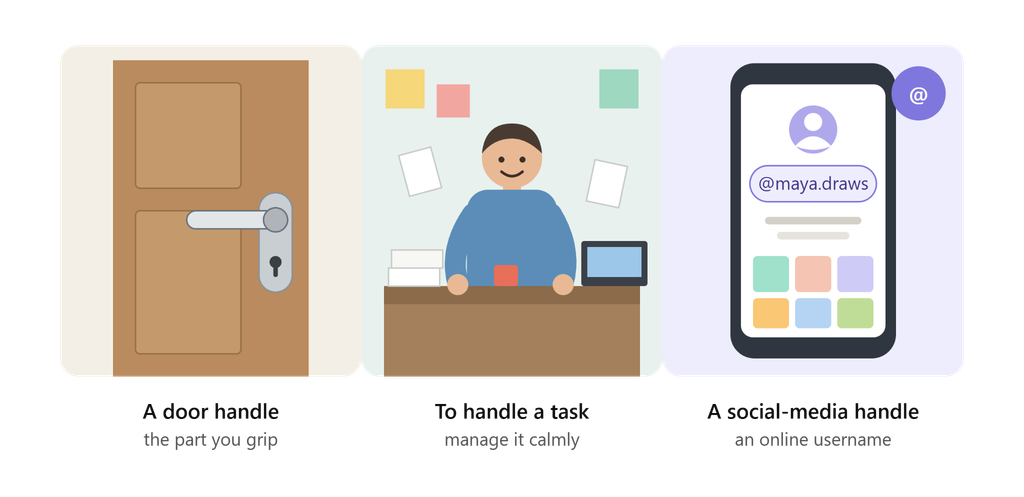
As a verb, handle means to take charge of something so that it gets dealt with.
- A task: She handles our invoices.
- A difficult feeling or situation: He handled the news calmly.
- A person: I can’t handle my boss when she’s angry.
- A physical object: Please handle the glass with care.
- How a vehicle responds: The van handles badly in strong wind.
- Goods in business: The shop handles imported teas.
As a noun, it has four main senses:
- A grip: a door handle, a saucepan handle.
- A nickname or username: What’s your handle on Instagram?
- A way of grasping a problem: I finally have a handle on the budget.
- The total amount bet on a race or game: a niche sense that dictionaries mark as mainly American.
Two idioms show up most often. To fly off the handle means to lose your temper suddenly, and to get a handle on something means to start to understand or control it.
What “Handel” Means
You will see it in three places.
The composer. In English text, “Handel” means George Frideric Handel (1685–1759), born Georg Friedrich Händel in Halle, Germany, who settled in London and became a British subject in 1727. Messiah and Water Music are among his best-known works.
A German noun. Der Handel means trade or commerce: der Handel zwischen den beiden Ländern (“trade between the two countries”). Don’t confuse it with the verb handeln, which can mean “to act,” “to trade,” or “to bargain,” or with “handlung, which means “action” or “plot.”
Other languages. Dutch, Polish, Swedish, Norwegian and Danish all have handel, centred on trade or commerce. Spelling, gender and extra senses vary.
Why the Mix-Up Happens
The composer is a perfect homophone. In English the composer’s name is normally said exactly like “handle.” Anyone who has heard it spoken and then tries to spell the ordinary word has a ready-made wrong spelling in memory.
The ending sounds like “-ul,” and English spells that sound several ways. Compare label, level, hotel with table, bottle, candle. After “nd,” though, English almost always uses -le: handle, candle, bundle, kindle, spindle, dwindle. If the letters before the ending are “nd,” pick -le.
First-language habits. If your own language writes “handel,” your hand will write it too.
Autocorrect doesn’t always help. “Handel” is a valid proper name, so it may slip through unflagged.
How to Pronounce Handle and Handel
| Word | Simple sound | IPA |
| handle (English) | HAN-dul | /ˈhæn.dəl/ |
| Handel (the composer, said in English) | HAN-dul | /ˈhæn.dəl/ |
| Handel (German noun, “trade”) | HAHN-dl | /ˈhan.dl̩/ |
| Händel (the composer’s German name) | HEN-dl | /ˈhɛn.dl̩/ |
The last two rows are the surprise. The German noun and the German spelling of the composer’s name start with different vowels, because of the umlaut. The English version of his name (no umlaut) follows English “handle.”

Grammar of “Handle”
Part of speech: verb and noun.
Verb forms: handle, handles, handled, handling. It is regular.
Transitive and intransitive: usually transitive (She handled the complaint). It is intransitive when describing how a vehicle or tool behaves (The bike handles smoothly).
Countable or not: the noun is countable (two handles). The related noun handling is usually uncountable (careful handling of parcels).
Patterns that work:
| Pattern | Example |
| handle + object | I’ll handle the booking. |
| handle + something + for + someone | Can you handle this for me? |
| handle … with care | Handle the samples with care. |
| get a handle on + noun | Try to get a handle on your schedule. |
| can/can’t handle + noun or -ing | I can’t handle waiting any longer. |
A pattern that doesn’t: handle takes its object directly. Don’t say “handle with the problem” (that is deal with).
Example Sentences
- Casual: “Leave the dishes. I’ve got them handled.”
- Workplace email: “Priya will handle your refund request and reply within two working days.”
- Formal report: “Complaints are handled by a dedicated team under the supervision of the compliance officer.”
- Online: “Change your handle before you start posting, because followers will search for it.”
- Emotional: “Moving countries was a lot to handle, but my neighbours made it easier.”
- Product review: “The camera handles low light better than last year’s model.”
- Music writing: “The choir will sing a Handel chorus to close the evening.”
- German: “Der Handel mit Kaffee ist in dieser Stadt sehr alt.” (“The coffee trade is very old in this city.”)
Handle vs. Similar Words
Try this test sentence: “I can’t ___ him.” Each synonym changes the picture.
| Word | How it differs from handle |
| manage | Control over time; I can’t manage him sounds like supervising a difficult employee or child. |
| deal with | Needs with; stresses facing an unpleasant job or person. |
| cope with | About surviving stress; I can’t cope with him points to your feelings, not his behaviour. |
| tackle | Active and brisk; used for challenges and tasks, rarely people. |
| address | Formal; used for issues and concerns, not people or objects. |
| take care of | Warmer and more personal; also used for people who need looking after. |
| oversee | You supervise but don’t do the work yourself. |
| operate | Machines and systems only. |
Opposites of “Handle”
Handle has no single true antonym. These work in context:
- mishandle: to deal with something badly (The courier mishandled the package.)
- neglect: to give something too little attention (She neglected the garden all summer.)
- avoid: to stay away from something difficult (He avoids hard conversations.)
- fumble: to handle clumsily or drop (He fumbled the keys and dropped them.)
- botch: to do something badly (They botched the repair and the pipe leaked again.)
Where the Words Come From
Handle comes from Old English handle, a word for something held in the hand, formed from hand plus a suffix. The verb goes back to Old English handlian, “to touch or move with the hands.” The German noun Handel comes from the verb handeln, which is a cognate of the English verb: both go back to the same Germanic word built on “hand.”
So the two words are relatives, but separate vocabulary. English handle did not come from German Handel, and the composer’s surname has nothing to do with the English noun.
Common Mistakes
1. Spelling it “handel.”
✗ I can handel it. → ✓ I can handle it.
2. Misspelling the other forms.
✗ handeling, handeld → ✓ handling, handled.
3. Mixing handle with deal with.
✗ She handled with the problem. → ✓ She handled the problem. / She dealt with the problem.
4. Writing the composer’s name with an English word.
✗ Handle’s Messiah → ✓ Handel’s Messiah.
5. Using “Handel” for trade in an English sentence.
✗ Handel between the two countries → ✓ Trade between the two countries.
6. Assuming handle is only physical.
Learners sometimes avoid it for problems and emotions. It works for both: handle pressure, handle a complaint.
7. Mixing up Handel and Handlung in German.
Handlung is “action” or “plot”; Handel is “trade.”
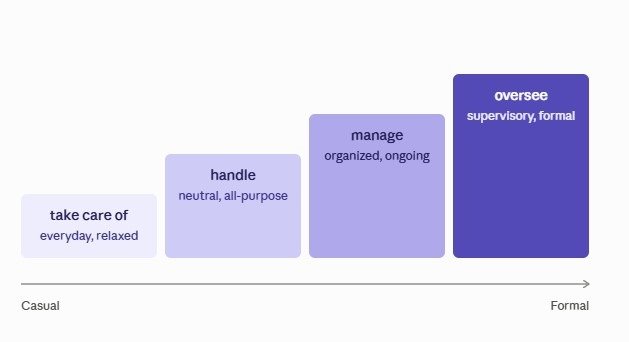
- take care of: everyday and relaxed. “I’ll take care of the tickets.”
- handle: neutral and all-purpose, so it works in almost any setting. “She handled the complaint well.”
- manage: more organized and ongoing, often with responsibility over time. “He manages the whole project.”
- oversee: supervisory and formal, since you direct the work rather than do it yourself. “She oversees the audit.”
FAQs
Is it handle or handel in English?
Handle is the correct English spelling. It is a verb meaning to deal with or manage something, and a noun meaning the part of an object you hold. “Handel” is not an English word. It is the German word for trade and the name of the composer George Frideric Handel.
What does “Handel” mean in English?
In English, Handel almost always means the composer George Frideric Handel, who wrote Messiah. You will rarely see it as an ordinary word. In German, der Handel means trade or commerce, so you will meet it mostly in German sentences.
How do you pronounce “handle” and “Handel”?
In English, handle is HAN-dul (/ˈhæn.dəl/), and the composer Handel is normally pronounced the same way. The German noun Handel sounds closer to HAHN-dl, and the composer’s German name, Händel, sounds like HEN-dl. Dictionary audio is the best final check.
Is “handel” a word in German, Dutch or Polish?
Yes. German, Dutch, Polish and the Scandinavian languages all use handel for trade or commerce, though spelling, gender and extra meanings differ. English never adopted it as an ordinary word, so in English writing it is a misspelling of handle unless you mean the composer.
What is the difference between “handle” and “manage”?
Handle is the everyday word for dealing with a task, problem or person: “I’ll handle the invoices.” Manage suggests organising or controlling something over time, such as a team or budget, and often sounds more formal. They overlap, but handle fits a job you deal with, while manage fits something you keep running.
2 Comments