
Prioritize vs Prioritise: Which Spelling Is Correct?
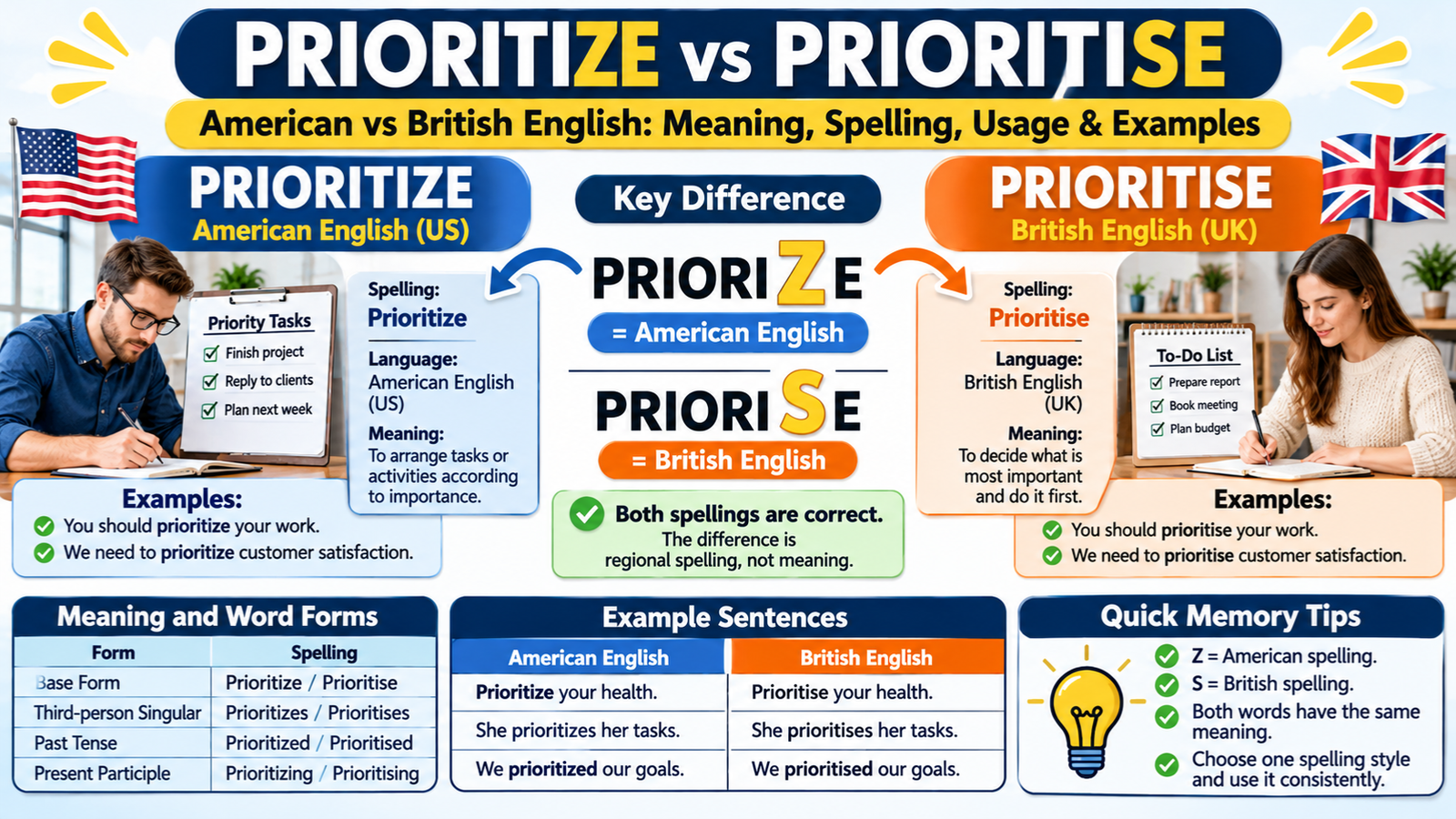
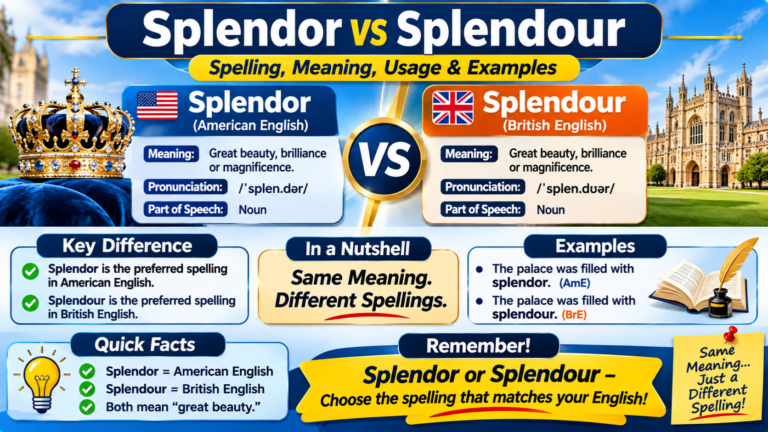
Both spellings are correct. Prioritize is the American spelling, and prioritise is the standard British one. They mean the same thing: to put tasks, goals or needs in order of importance and deal with the most important first. Pick the spelling that suits your audience, then use it consistently from the first paragraph to the last.
This guide covers the full prioritize vs prioritise question: meaning, pronunciation, every verb form, regional usage in the US, UK, Canada, Australia, New Zealand, Ireland and India, the Oxford spelling twist, example sentences, common mistakes and a short quiz.
Prioritize vs Prioritise: The Quick Answer
Nobody made a mistake here. Prioritize is spelled with a z, and prioritise with an s, and both appear in respectable writing.
Dictionary.com lists prioritise as the British spelling of prioritize. Oxford Learner’s Dictionaries does the same, showing US prioritize and British prioritise. Cambridge Dictionary also labels prioritise as the UK spelling. Grammarist adds that the American spelling is considered correct and is gaining ground around the world.
If your spellchecker flagged one of them, it is probably set to the other region. Change the language setting in Microsoft Word, Google Docs or Grammarly, or change the letter, and move on.
| American English | British English | |
| Spelling | prioritize | prioritise |
| Meaning | to rank by importance | to rank by importance |
| Pronunciation | same | same |
The only real rule is consistency. One document should not use “prioritize” in paragraph one and “prioritise” in paragraph four.
What Does Prioritize Mean?
The prioritize vs prioritise question is about spelling only, so the meaning is identical for both.
Prioritize is a verb with two main senses. Dictionary.com defines it as arranging tasks or items by importance, or giving something high priority. Oxford Learner’s Dictionaries splits it into two closely related meanings:
- To arrange tasks, problems or similar items by importance, so the most important can be handled first.
- To treat something as more important than other things. Oxford labels this sense formal.
In everyday terms, you prioritize your to-do list when you decide what comes first, and a company prioritizes safety when it treats safety as more important than speed.
The verb works with an object and without one. “She prioritized the difficult chapters” has an object. “You have to learn to prioritize” does not. Grammarist and Dictionary.com both note that it can be transitive or intransitive.
Word origin. Prioritize is built from priority plus the suffix -ize. Dictionary.com says it was first recorded in 1965 to 1970, while Grammarphobia points to an Oxford English Dictionary example from 1954, so the sources differ slightly. Either way, it is a fairly modern word. Priority itself goes back to Middle English in the early 1300s and comes from the Latin prior, meaning “earlier” or “former”.
Is prioritize just jargon? The American Heritage Dictionary notes that prioritize has sometimes been criticized as corporate or bureaucratic language, but it still treats the word as standard. There is no grammatical reason to avoid it.
Prioritize or Prioritise: Which Region Uses Which?
Here is the regional pattern, put together from Dictionary.com, Oxford Learner’s Dictionaries and Sapling’s usage data.
| Region | Usual spelling | Sapling usage score |
| United States | prioritize | Standard American spelling |
| Canada | prioritize | 94 out of 100 |
| India | prioritize | 77 out of 100 |
| United Kingdom | prioritise | 77 out of 100 |
| Australia | prioritise | 75 out of 100 |
| New Zealand | prioritise | 67 out of 100 |
| Ireland | prioritise | 64 out of 100 |
Two notes on this table. The scores come from Sapling’s own data, so treat them as a rough direction rather than a precise statistic. Also, the UK, Australia, New Zealand and Ireland figures are well below 100, which means plenty of writers in those countries use prioritize anyway.
If you write for a global audience, check where most of your readers live in your analytics and pick the matching spelling.
Is -ize Really American? The Oxford Spelling Story
The prioritize vs prioritise split is part of a much bigger -ize vs -ise pattern, and that pattern is often explained wrongly.
Many people believe -ize is an American invention and -ise is the “real” British spelling. It is a neat story, but it is not quite right.
The -ize ending traces back to the Greek -izein, which passed through Latin. French later shifted toward -iser, and that French influence helped -ise spread in British writing. American English, shaped in part by Noah Webster’s dictionaries, kept and standardized -ize.
Wikipedia’s Manual of Style describes three conventions that matter here:
- British English uses -ise for most of these words, especially in the UK popular press.
- American English uses -ize.
- Oxford spelling is a third system. The Oxford English Dictionary and Oxford University Press use -ize for most of these words, such as organize and realize, while keeping other British spellings like colour and centre.
So -ize is not purely American. It is also the Oxford house style in Britain. The Manual of Style lists prioritise for British English, and prioritize for both Oxford spelling and American English.
In practice, if a British publisher tells you to use Oxford spelling, prioritize is correct there. If a British newspaper uses prioritise, that is correct for the paper. Canada sits closer to the American side: the Manual of Style notes that Canadian English follows American spellings more closely than other Commonwealth varieties do.
All the Forms in One Table
Most searches don’t stop at the base verb. Here is every common form side by side, based on the forms listed by Grammarist, Dictionary.com, Collins and Oxford Learner’s Dictionaries.
| Form | US spelling | UK spelling |
| Base verb | prioritize | prioritise |
| Third person singular | prioritizes | prioritises |
| Past tense | prioritized | prioritised |
| Past participle | prioritized | prioritised |
| -ing form (present participle) | prioritizing | prioritising |
| Noun | prioritization | prioritisation |
| Person who does it | prioritizer | prioritiser |
| Reverse verb | deprioritize | deprioritise |
| Do again | reprioritize | reprioritise |
Swap the z for an s and you have the other spelling in every row. The rest of the word never changes. It is always prioritize or prioritise, never “priorotize” or “prioritse”.
Prioritized vs prioritised. Both are the past tense and past participle. “The team prioritized the bug fixes” is American. “The team prioritised the bug fixes” is British.
Prioritizing vs prioritising. Both are the -ing form. “Prioritizing sleep helped him focus” is American. “Prioritising sleep helped him focus” is British.
Prioritization vs prioritisation. Both are the noun. “Good prioritization saves time” is American. “Good prioritisation saves time” is British.
Which Spelling Should You Use?
Settling prioritize vs prioritise for your own writing takes four quick checks. The answer is rarely about right and wrong. It is about who is reading.
1. Check your audience. A reader in the United States or Canada expects prioritize. A reader in the UK, Australia, New Zealand or Ireland more often expects prioritise.
2. Check the style guide. Companies, journals and schools usually have a house rule. American publishers following the Chicago Manual of Style or AP style use prioritize. Oxford-style houses also want -ize. Many British newspapers prefer -ise. Follow the guide even if you like the other spelling better.
3. Match your spellchecker’s language setting. Set English (US) or English (UK) at the start, and the red underlines will agree with your choice.
4. Be consistent. This matters more than the choice itself. Mixed spelling makes a document look carelessly edited.
If you have no audience and no style guide, pick the spelling you will remember to keep using. Both are accepted, so you cannot be wrong.
How to Use Prioritize: “Prioritize X Over Y”
One of the most common patterns is prioritize X over Y. It means giving X greater importance than Y, and it creates a clear hierarchy in one sentence.
- The company prioritized customer safety over short-term profit.
- She prioritized studying over social media.
- The team prioritizes quality over speed.
- The city prioritises public transport over new car parks. (UK spelling)
The pattern works the same in American and British English. Only the spelling changes.
Other useful collocations:
- prioritize tasks, prioritize work, prioritize deadlines
- prioritize goals, prioritize needs, prioritize resources
- prioritize safety, prioritize health, prioritize customers
- prioritize your time, prioritize your workload
- prioritize and delegate, prioritize and schedule
Prioritize vs Rank vs Give Priority To
These options overlap, but they are not perfect substitutes.
| Word or phrase | Emphasis | Example |
| prioritize | Deciding what deserves attention first | The manager prioritized the projects with the greatest customer impact. |
| rank | Placing items in an ordered sequence | The manager ranked the projects from one to ten. |
| give priority to | Same idea as prioritize, but longer | The company gave priority to safety. |
| put first | Informal and direct | She put her family first. |
| triage | Sorting by urgency, often in emergencies | The support team triaged the tickets. |
Prioritize is shorter and more direct than “give priority to”, which makes it useful when several goals compete: “The committee prioritized affordable housing, public transport and emergency services.”
Is prioritize formal or informal? It works in both. “I need to prioritize my errands today” is casual. “The department should prioritize infrastructure improvements in areas with the greatest need” is formal.
Prioritize at Work, at School, at Home and in Tech
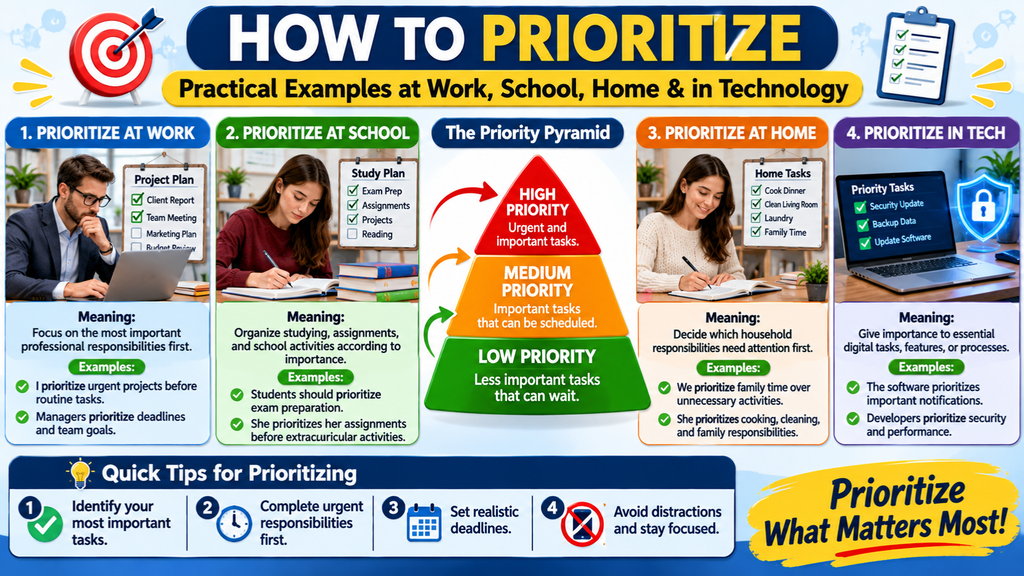
The verb appears everywhere because people constantly have to decide what deserves attention first.
At work. Workplaces involve competing deadlines, emails, meetings and customer requests. Typical phrases include prioritize deadlines, prioritize urgent requests and prioritize business goals. Example: “The support team must prioritize customers whose systems are completely down.” That sentence does more than say “pay attention to customers.” It sets an order.
At school. Students juggle assignments, exams and study time. Example: “With three exams in one week, Maya had to prioritize the subjects that needed the most preparation.”
In personal life. Common phrases include prioritize family time, prioritize rest and prioritize spending. Example: “If you want to finish the project this month, you’ll need to prioritize it over less urgent hobbies.”
In technology and product development. Product teams have more feature ideas than development time. They rank features using factors such as customer value, business impact, urgency, development effort, security risk and technical dependencies. In project management, this is often called backlog prioritization. A product manager might say, “We should prioritize the security issue before adding the new interface feature.”
A quick case study: prioritizing a busy workday
| Task | Urgency | Impact | Priority |
| Fix a critical customer issue | High | High | 1 |
| Prepare tomorrow’s presentation | High | High | 2 |
| Review routine paperwork | Medium | Medium | 3 |
| Organize archived files | Low | Low | 4 |
| Redesign an internal spreadsheet | Low | Low | 5 |
A list only shows what exists. Prioritization decides what happens first. The manager fixes the customer issue, then finishes the presentation, and lets the low-impact tasks wait.
Prioritize in Emails, CVs and Reports
Spelling choices show up where people judge you quickly.
CVs and cover letters. Look at the country you are applying in. A job ad that says “organisation” and “specialise” tells you to use -ise. A job ad that says “organization” and “specialize” points the other way. Matching the employer’s spelling is a small signal that you read carefully.
Emails. One email, one spelling. If your whole team writes “prioritise”, a single “prioritize” will stand out.
Academic writing. Your school, journal or publisher usually decides. Ask for the style sheet or check how earlier documents spelled it.
Business writing. Reports, proposals and project plans use the noun prioritization often, so check it matches the verb you chose.
Phrases that come up often:
- “Prioritize your tasks before you start.”
- “We need to prioritise customer feedback.”
- “Which items should we prioritize first?”
- “Our team will prioritise safety this year.”
Deprioritize and Reprioritize
If prioritize means to rank something high, deprioritize means the reverse: to lower its rank. Wiktionary defines it as “to reduce the level of priority.” Reprioritize means to change the order of things you already ranked.
Grammarphobia says deprioritize appeared about two decades after prioritize, citing a March 1977 issue of the Journal of Police Science and Administration as the earliest example. In a 2019 post, the authors noted that it was not yet in standard dictionaries or the OED, so check a current dictionary if you need its present status.
The same z/s rule applies: deprioritize and reprioritize in American English, deprioritise and reprioritise in British English. If you would rather avoid the word, “lower the priority of” always works.
Other Words That Follow the Same Pattern
Prioritize belongs to a large family of verbs that swap z for s between American and British spelling:
- organize / organise
- realize / realise
- recognize / recognise
- apologize / apologise
- memorize / memorise
- incentivize / incentivise
- summarize / summarise
Wikipedia’s Manual of Style uses organise and realise as examples of the -ise list for British English, and organize and realize for both American and Oxford spelling.
Watch out for exceptions. Some verbs end in -ise in every variety of English because the -ise is part of the word, not a suffix. The Manual of Style lists advise, revise, supervise, surprise, exercise and promise among them. A few words end in -ize everywhere, such as size, seize and prize. So “advize” is wrong in American English too.
For more pairs like this, see our guides to apologize vs apologise, organize vs organise and realize vs realise.
How to Pronounce Prioritize
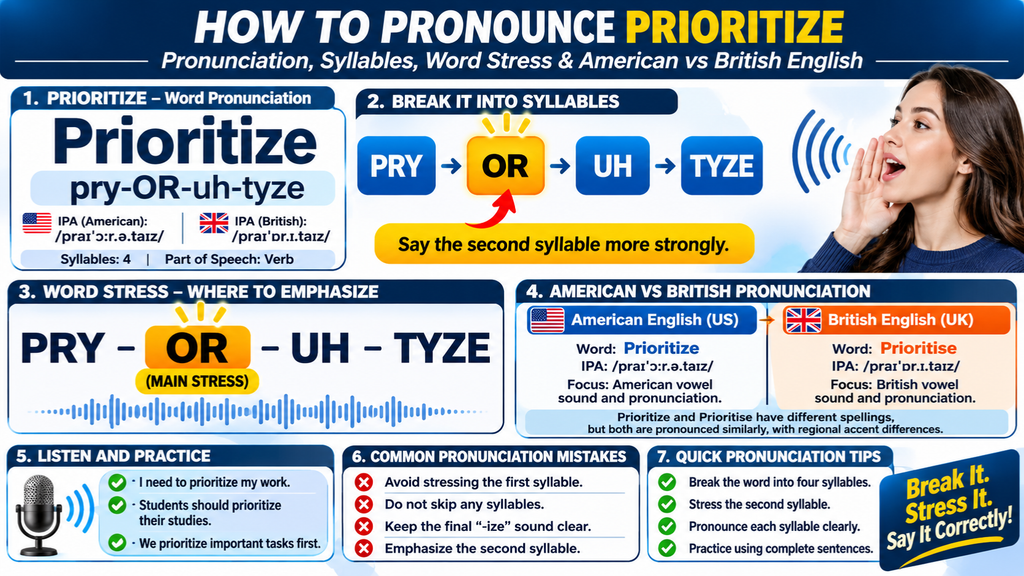
Same sound, different spelling. Dictionary.com gives the US pronunciation as “prahy-AWR-i-tahyz” or “prahy-OR-i-tahyz”, and the UK pronunciation as /praɪˈɒrɪˌtaɪz/. Oxford Learner’s Dictionaries shows two variants, /praɪˈɒrətaɪz/ and /praɪˈɔːrətaɪz/.
The stress falls on the second syllable: pry-OR-ih-tize. The ending sounds like “size” whether you spell it with a z or an s. If someone says the word aloud, you cannot tell which spelling they intended.
Example Sentences
With prioritize (American English):
- Before the exam, she prioritized the chapters she found most difficult.
- You have to prioritize, or everything will feel urgent.
- The council will prioritize repairs to the busiest bridges.
- We prioritized the bug fixes that affected the most customers.
- Which task should I prioritize this morning?
- By prioritizing sleep, he stopped relying on coffee.
- The new policy prioritizes safety over speed.
- Effective prioritization helps teams use limited resources well.
With prioritise (British English):
- Our team prioritises customer feedback when planning each new feature.
- I need to prioritise my workload before the holidays.
- The school has prioritised reading in the early years.
- Most managers prioritise deadlines over small improvements.
- We prioritised the list in order of cost.
- How do you prioritise when everything is urgent?
- The charity will prioritise families who need help the most.
- Good prioritisation separates urgent work from important work.
Common Mistakes
Most slips around prioritize vs prioritise are about consistency, not correctness.
Mixing both spellings in one document. This is the most common one. Pick one and search the page before you publish.
Treating one spelling as wrong. Prioritize is not an error in British English, and prioritise is not an error in American English. Oxford Learner’s Dictionaries and Dictionary.com list both. In a US-focused piece, prioritise will simply look like a regional variant.
Thinking they are different words. They are two spellings of one verb with the same definition and grammar.
Writing “prioritse” or “priorotize”. Neither is a spelling in any variety. The middle letters stay the same: p-r-i-o-r-i-t-i-z/s-e.
Matching the verb but not the noun. Writing “prioritise” and then “prioritization” in the same paragraph. If the verb has an s, the noun has an s: prioritisation.
Mixing other regional spellings. “The team will prioritize the project and organise the files” is understandable, but it mixes American and British conventions. Keep colour, centre and organise together with prioritise, and color, center and organize together with prioritize.
Over-correcting other words. Not every -ize or -ise word can switch. Advise, revise and surprise end in -ise in American English too, while size and seize end in -ize in British English too.
Forgetting the spellchecker setting. If your document is set to US English while you write British, every correct word looks wrong. Fix the setting first.
How to Remember It
A z for the US, an s for the rest, and pick one per document.
For a quick check, look at where your reader lives. United States or Canada: z. UK, Australia, New Zealand or Ireland: s, unless a style guide says Oxford, in which case the z is back.
Then remember the meaning: both forms mean “put in order of importance.”
Quick Practice Quiz
Choose the correct answer. Answers follow.
- You are writing for a US university. Which is standard? (prioritize / prioritise)
- You are writing for a British newspaper that uses -ise. Which fits? (prioritize / prioritise)
- A British publisher follows Oxford spelling. Which do they use? (prioritize / prioritise)
- Which noun matches “prioritise”? (prioritization / prioritisation)
- Which past form matches “prioritize”? (prioritized / prioritised)
- Which spelling is wrong in every variety? (prioritse / prioritise)
- Which word ends in -ise even in American English? (revise / realize)
- Which word is spelled with a z in British English too? (size / surprise)
- Which sentence is consistent American English? (“We prioritize color and organize files.” / “We prioritize colour and organise files.”)
- Which verb means to lower something’s rank? (reprioritize / deprioritize)
Answers: 1. prioritize. 2. prioritise. 3. prioritize. 4. prioritisation. 5. prioritized. 6. prioritse. 7. revise. 8. size. 9. The first sentence. 10. deprioritize.
FAQs
Is it prioritize or prioritise? Both are correct. Prioritize is the American spelling, and prioritise is the British one. Pick the one that suits your reader and keep it the same throughout the document.
Is prioritize spelled with an s or a z? In American English it is spelled with a z: prioritize. In British English it is usually spelled with an s: prioritise.
Is prioritise a word? Yes. Dictionary.com lists prioritise as the British spelling of prioritize, and Oxford Learner’s Dictionaries lists it as an accepted British variant.
Is prioritise British or American? British. Prioritize is the American spelling.
Is prioritize correct in UK English? Yes, in some settings. Oxford spelling uses -ize, and Wikipedia’s Manual of Style lists prioritize for Oxford spelling. Many British publications prefer -ise, so check the style guide of whoever you write for.
Can I use prioritise in American English? Readers will understand it, but prioritize is the standard choice for US writing. Using prioritise in a US document will look like a regional variant.
What is the difference between prioritize and prioritise? Only the spelling. The meaning, pronunciation and grammar are the same.
What does prioritize mean? To arrange things in order of importance, or to treat something as more important than other things. “Prioritize your tasks” means decide which one comes first.
What does prioritise mean? Exactly the same as prioritize. It is the common British spelling.
Which is correct in the US: prioritize or prioritise? Prioritize.
Which is correct in the UK: prioritize or prioritise? Prioritise is the common choice, although prioritize is accepted in Oxford spelling.
Is it prioritized or prioritised? Both. Prioritized goes with the American spelling, and prioritised with the British one.
Is it prioritizing or prioritising? Both, following the same rule. Prioritizing is American, and prioritising is British.
Is it prioritization or prioritisation? Both. Use prioritization with prioritize and prioritisation with prioritise.
What is the British spelling of prioritization? Prioritisation, with an s.
What is the past tense of prioritize? Prioritized in American English and prioritised in British English.
What is the noun form of prioritize? Prioritization in American English and prioritisation in British English.
Is prioritize a real word? Yes. It is a standard English verb listed in major dictionaries, including Oxford Learner’s Dictionaries and Dictionary.com.
Is “deprioritize” a word? It is in use and means to lower the priority of something. Grammarphobia noted in a 2019 post that standard dictionaries and the OED did not list it yet, so check a current dictionary if it matters.
Do I say “prioritize over” or “prioritize above”? “Prioritize X over Y” is the standard pattern: “We prioritize safety over speed.”
Is prioritize American or British? It is the standard American spelling and is also accepted in British Oxford spelling. The common British spelling is prioritise.
Final Thoughts
Prioritize vs prioritise comes down to your audience, not to right and wrong. Prioritize is the American spelling, prioritise is the common British one, and Oxford spelling brings the z back in Britain too. The meaning, pronunciation and grammar never change.
Look at your readers, check your style guide, set your spellchecker, and keep the same spelling from start to finish.



4 Comments