
Tomatos or Tomatoes in English? The Correct Plural, Spelling and Pronunciation
Tomatos or tomatoes in English? Write tomatoes. The extra e looks wrong because the singular, tomato, has none, but the plural follows the same pattern as potatoes, heroes and echoes. Below you’ll find which -o words take -es, which don’t, how Americans and Britons say the word, and the small grammar traps around tomato that catch even confident writers.
Quick Answer: The Plural of Tomato
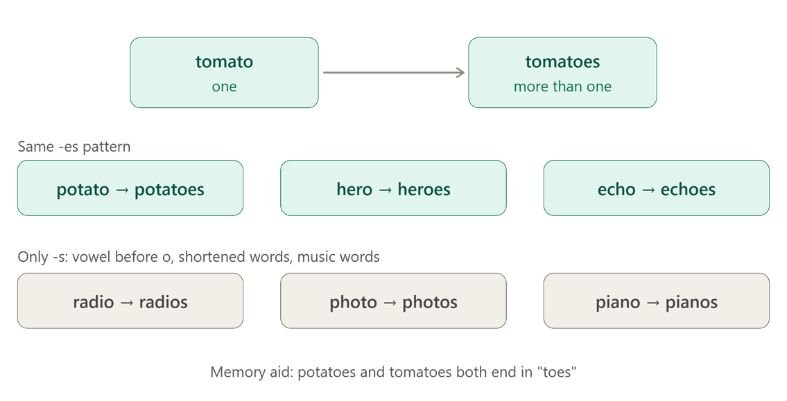
The correct plural of tomato is tomatoes. Tomatos is a misspelling. Some English nouns ending in a consonant plus o add -es in the plural, such as potato → potatoes and hero → heroes. Example: Slice two tomatoes for the sandwich.
Spelling rule card showing tomato becomes tomatoes, like potato, hero and echo
Why Tomatoes Takes -es, and Why Tomatos Is Wrong
Most English nouns simply add -s, so tomatos is an understandable slip. But a group of nouns ending in a consonant plus o takes -es, and tomato belongs to it: tomato → tomatoes, potato → potatoes, hero → heroes, echo → echoes, veto → vetoes.
The -es changes the spelling only. Tomatoes ends in a z sound, the same sound you would get from -os, so your ear can’t tell you which spelling is right. You have to remember it.
A memory aid: potatoes and tomatoes both end in the word toes. Picture that shared ending and the e stays in place.
Which -o Words Take Only -s? Exceptions to the Tomato Plural Rule
Here is the awkward truth: no rule predicts every word. English has a small, memorable group that takes -es and several groups that take -s. Use these checks in order.
- Vowel before the o: add -s. Radios, videos, zoos, studios.
- A shortened word: add -s. Photos (from photograph), kilos (from kilogram), memos.
- A music word: add -s. Pianos, cellos, solos.
- The short -es list to memorize: tomatoes, potatoes, heroes, echoes, vetoes.
- Everything else: check a dictionary. Some words are listed with two plurals, such as avocado (avocados, with avocadoes as a variant) and mango
- If you’re writing under time pressure, step 4 covers the words most people actually use.
Common Misspellings: Tomatos, Tomatoe and Tomato’s
- tomatos: applies the default -s rule. It also matches the Spanish plural tomates, which uses just -s. Wrong: Slice the tomatos. Right: Slice the tomatoes.
- tomatoe: puts the plural’s e on the singular. One tomato has no e.
- tomato’s as a plural: an apostrophe marks possession, not number. Three tomato’s is wrong; the tomato’s skin is correct.
The potato has the same trap. In 1992, Vice President Dan Quayle was widely reported to have corrected a student’s correct spelling of potato to potatoe, and the story is still told as a cautionary tale about trusting your instinct over a dictionary.
What Does “Tomato” Mean in English?
A tomato is a soft, juicy fruit, usually red, eaten raw or cooked, and also the plant that bears it. It belongs to the nightshade family.
- The fruit: She sliced a tomato onto the toast.
- The plant: My tomato is taller than the fence.
Is a Tomato a Fruit or a Vegetable?
Botanically it is a fruit, because it grows from the flower and holds seeds. In the kitchen it is treated as a vegetable. In the 1893 US Supreme Court case Nix v. Hedden, it was classed as a vegetable for tariff purposes.
Tomato in Recipes and Labels: When to Use the Plural
This is where the spelling question turns up in real life, so it’s worth separating the three jobs the word does.
- Counting whole fruit: plural. Add three ripe tomatoes.
- Describing a noun: singular. Tomato soup, tomato sauce, tomato plants. Say tomato plants, not tomatoes plants.
- The substance: singular, like a mass noun. There’s tomato on your sleeve. How much tomato is in this sauce?
Ingredient lists on packaging commonly name the fruit in the plural (tomatoes, onion, salt) and processed forms in the singular (tomato paste). If you are unsure which to write, ask whether you can count the pieces.
How to Pronounce Tomato and Tomatoes
| Word | Accent | IPA | Say it |
| tomato | American | /təˈmeɪtoʊ/ | tuh-MAY-toh |
| tomato | British | /təˈmɑːtəʊ/ | tuh-MAH-toh |
| tomatoes | American | /təˈmeɪtoʊz/ | tuh-MAY-tohz |
| tomatoes | British | /təˈmɑːtəʊz/ | tuh-MAH-tohz |
The stress falls on the second syllable. The plural keeps the singular’s three syllables and just adds a z at the end. That is different from class → classes, where the plural adds a whole extra syllable. Many learners pronounce tomatoes with a fourth syllable because of the -es spelling, but the spelling doesn’t add one.
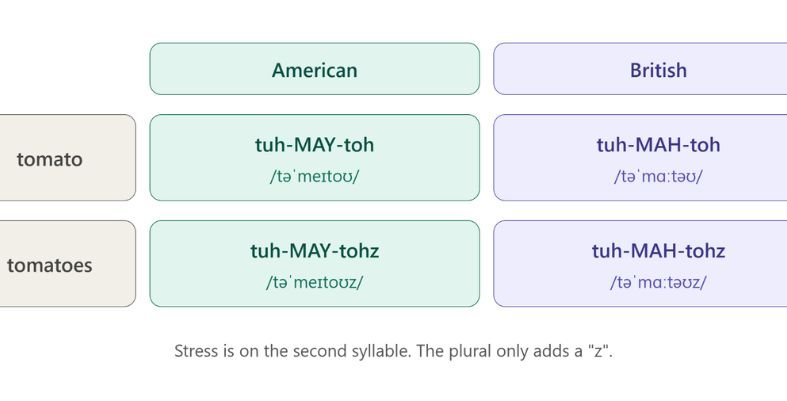
US and UK pronunciation chart for tomato and tomatoes with IPA and simple respellings
Tomayto or Tomahto?
The two pronunciations gave English a ready-made idiom for a difference too small to argue about, thanks to the song “Let’s Call the Whole Thing Off” (1937). Americans mostly say the first and British speakers the second, but you’ll hear both in each country.
Tomato Grammar: Part of Speech and Word Forms
Tomato is a noun. It is not used as a verb in standard English.
| Form | Example |
| Singularm | tomato |
| Plural | tomatoes |
| Singular possessive | the tomato’s skin |
| Plural possessive | the tomatoes’ flavor |
Quantity words: use many, few and how many with the plural (How many tomatoes do we need?) and much, a little and how much for the substance (How much tomato is in this sauce?).
Prepositions that pair with it:
- of: a can of tomatoes, a slice of tomato
- in: tomatoes in olive oil
- on: oil drizzled on the tomatoes
- with: Top the toast with tomato.
- to: Add the tomatoes to the pan.
Example Sentences with Tomato and Tomatoes
- Casual, spoken: We’re out of tomatoes, so I’ll swing by the shop.
- Recipe: Simmer the tomatoes for twenty minutes, then stir in the basil.
- Agricultural, formal: Late blight reduced this season’s tomato harvest.
- Packaging: Ingredients: tomatoes, onion, salt.
- Text message: Got the tomatoes. Bread next?
- Mass use: There’s tomato on your sleeve.
- Singular possessive: The tomato’s skin split after the rain.
- Plural possessive: The tomatoes’ flavor improved once the weather warmed.
- The plant: My tomato is taller than the fence.
Words Related to Tomato
Tomato has no true synonyms. These related terms each cover something narrower:
- love apple: an older English name for the tomato, now old-fashioned.
- cherry tomato: small and round, usually eaten whole.
- plum tomato: oval and meaty, often used for sauces.
- beefsteak tomato: large, mainly for slicing.
- heirloom tomato: a variety grown from older, saved seed. The word is about the variety’s history, not its size or shape.
There is no true antonym either. Useful contrasts include green vs. ripe (Pick the green tomatoes before the first frost) and fresh vs. canned (canned tomatoes suit long-simmered sauces).
Where Does “Tomato” Come From?
English took tomato from Spanish tomate, which came from Nahuatl tomatl. Etymonline reports that the -o ending was probably influenced by potato, which would help explain why the two words share a plural.
Common Mistakes with Tomato and Tomatoes
| Wrong | Right | Why |
| Slice the tomatos. | Slice the tomatoes. | Tomato belongs to the -es group. |
| One tomatoe is enough. | One tomato is enough. | The extra e belongs only to the plural. |
| Three tomato’s are left. | Three tomatoes are left. | An apostrophe shows ownership, not a plural. |
| I took five photoes. | I took five photos. | Over-correction: photo is a shortened word and takes -s. |
| These tomato are ripe. | These tomatoes are ripe. | These needs a plural noun. |
| Water the tomatoes plants. | Water the tomato plants. | A noun describing another noun stays singular. |

Spelling correction showing tomatos is wrong and tomatoes is the correct plural
FAQs
Is it tomatos or tomatoes?
The correct plural is “tomatoes.” “Tomatos” is a misspelling. English nouns that end in a consonant plus o often take -es in the plural, and tomato follows the same pattern as potato, hero and echo. Some shortened or borrowed words, such as photo and piano, take just -s.
Why does tomato add -es and not just -s?
The -es is a spelling convention, not a different sound; the ending is just a z. Many everyday nouns ending in a consonant plus o, such as potatoes, heroes and echoes, take -es. Etymonline says the spelling of tomato was probably influenced by potato, which helps explain why their plurals match.
Is “tomatos” acceptable in British English?
No. “Tomatoes” is the standard plural in both British and American English. You may see “tomatos” in brand names or informal writing, but treat it as an error in regular writing. Some websites claim otherwise without citing a dictionary, so check a dictionary if you are unsure.
How do you pronounce tomatoes?
In American English, “tomatoes” is /təˈmeɪtoʊz/, said tuh-MAY-tohz. In British English it is /təˈmɑːtəʊz/, said tuh-MAH-tohz. The plural has the same three syllables as the singular and only adds a z sound, with the stress on the second syllable.
Which -o words take -es and which take -s?
Many everyday words take -es: tomatoes, potatoes, echoes, heroes. Words with a vowel before the o take -s: radios, zoos. Shortened and music words also take -s: photos, pianos, solos. A few words, such as avocado, vary between sources, so check a dictionary when unsure.
Final Thoughts
If you’re wondering “Tomatos or Tomatoes in English,” the correct spelling is tomatoes. Although many English nouns form their plurals by adding -s, tomato follows the -es pattern, just like potatoes, heroes, and echoes. Remember that tomato’s indicates possession, while tomatoes means more than one tomato. Understanding these simple spelling rules, pronunciation differences, and common mistakes will help you write confidently and use the correct form in everyday conversations, recipes, and professional writing.


2 Comments