
Odious vs Repugnant: What’s the Difference?
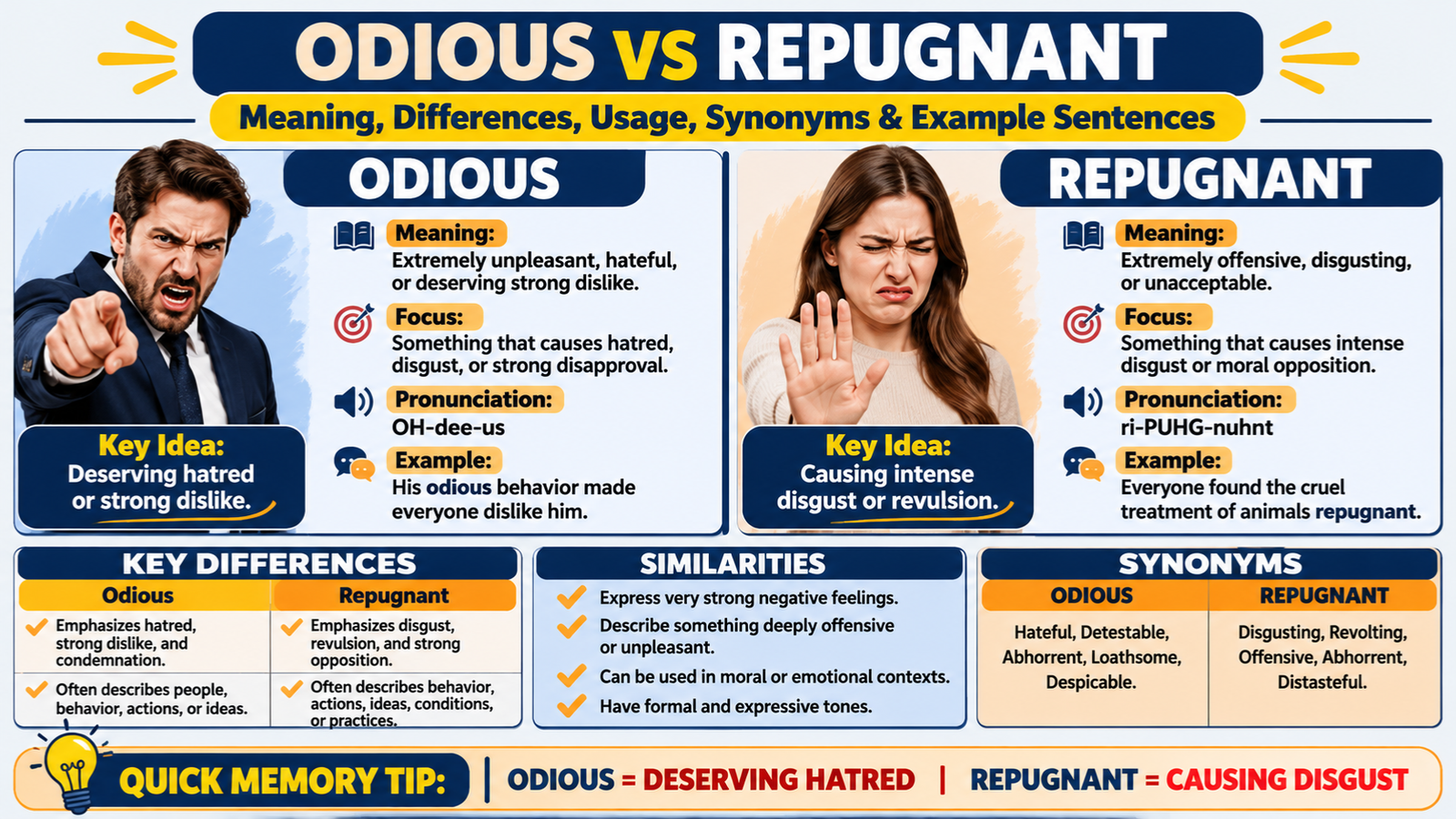
Odious describes what causes or deserves hatred; repugnant describes what causes strong disgust or aversion. Dictionaries often define odious with repugnant, so the overlap is real. The difference is emphasis: odious leans toward hatred, repugnant toward recoil, and only repugnant also means incompatible.
Both words sit at the strong end of disapproval, which is why people swap them. Below: what each means, how the older dictionaries handled them, where they overlap, the phrases they live in and how to choose.
The short answer and a simple test
Here’s a rule of thumb, not a dictionary rule: ask whether the thing makes you want to hate it or recoil from it. If it earns hatred or condemnation, odious fits. If it turns your stomach or offends your sense of what’s acceptable, repugnant fits.
The caveat is real. Both words can describe moral disgust, and in many sentences either works. The odious vs repugnant choice is about emphasis, not about right and wrong. Merriam-Webster even uses the word repugnance to define odious.
What odious means

Odious means arousing or deserving hatred, in Merriam-Webster’s wording, and its kids’ entry says causing hatred or strong dislike. Dictionary.com adds a second sense: highly offensive, repugnant, disgusting. The subject can be an act, a comparison or a smell. Merriam-Webster’s examples include an odious crime and a false and odious comparison, and American Heritage gives an odious smell.
The word comes from Latin odiosus, from odium, “hatred”, by way of Anglo-French and Middle English. Merriam-Webster dates it to the 14th century and Etymonline to the late 14th, though Collins Concise says the 17th century, so the date depends on the source. Merriam-Webster also notes that odium is related to the verb annoy.
What repugnant means
Merriam-Webster’s first sense is causing a strong feeling of distaste or aversion, as in repugnant language or a morally repugnant practice. Dictionary.com’s example is a repugnant smell. Nothing in either entry says the word has to be moral: it can be sensory or ethical.
The second sense is incompatible or inconsistent, and odious doesn’t have it. It turns up in the pattern “repugnant to,” especially in formal and legal writing. Merriam-Webster’s legal entry defines repugnant as characterized by contradiction and irreconcilability, with the example of an arbitrator’s decision that was not repugnant to an Act. A third sense, hostile, is labeled archaic. Like desirous of, the word comes with a fixed preposition.
The word comes from Latin repugnare, “to fight against”. Merriam-Webster gives the Middle English sense as opposed, contradictory, incompatible, and dates the word to the 15th century.
How the older dictionaries handled repugnant
Webster’s 1913 dictionary, now in the public domain, opens its entry with the opposing senses: disposed to fight against, hostile, at variance, contrary, inconsistent. Distaste comes second, introduced with “also.” The entry adds that the word is “usually followed by to, rarely and less properly by with.” Merriam-Webster today flips that order, putting distaste first and incompatibility second. The 1913 entry for abhorrent uses the same “to” pattern for contrary or inconsistent.
Odious vs repugnant side by side

| Feature | Odious | Repugnant |
| Core meaning | Arousing or deserving hatred | Causing strong distaste or aversion |
| Rule-of-thumb emphasis | Hatred, condemnation | Recoil, disgust |
| Typical subjects | Crimes, comparisons, smells | Language, practices, smells |
| “To” pattern | None | Repugnant to (inconsistent with) |
| Extra sense | None | Incompatible, inconsistent |
| Related forms | odiously, odiousness, odium | repugnantly, repugnance, repugnancy |
| Tone | Strong disapproval | Strong disapproval; the legal sense is neutral |
| Example | a false and odious comparison | a repugnant smell |
Where they overlap
Both are adjectives of strong disapproval, and the connotation differs only slightly. Dictionary.com defines odious as highly offensive, repugnant, disgusting, and Collins as offensive, repugnant. An odious smell and a repugnant smell are the same bad smell, so either word works in most sentences.
Two things break a repugnant vs odious tie. Only repugnant means inconsistent with something. And only odious anchors the fixed idiom “odious comparison.”
Common phrases
Fixed phrases are where the odious vs repugnant choice stops being optional.
Odious. An odious comparison and an odious crime are both Merriam-Webster examples, and American Heritage gives an odious smell. “Odious debt” is a legal term, explained in the FAQs below. Then there’s the proverb “comparisons are odious.” Phrase Finder credits John Lydgate, around 1440, with the earliest recorded use, while other sources credit Sir John Fortescue’s 15th-century De laudibus legum Angliae, so the attribution is disputed. Shakespeare’s Dogberry garbles it as “odorous” in Much Ado About Nothing, a joke that works because the proverb was already familiar.
Repugnant. A morally repugnant practice and repugnant language come from Merriam-Webster, and a repugnant smell from Dictionary.com. In legal writing the pattern is “repugnant to,” as in repugnant to an Act.
Which one should you choose?
The odious vs repugnant decision usually comes down to four situations:
- Condemning an act, comparison or idea as deserving hatred: odious.
- Describing a smell, sight or idea that makes you recoil: repugnant.
- Saying one thing contradicts another in formal or legal writing: repugnant to.
- Writing professionally about people: aim the strong word at behavior, never at a person, and prefer plainer words like unacceptable or inappropriate. Ignorant vs stupid covers a similar choice.
Odious and repugnant in a sentence
- The critic dismissed the comparison between the two films as odious and unfair.
- The odious smell of spoiled milk filled the kitchen.
- He found the cruelty of the prank odious and left the room.
- The smell from the broken fridge was repugnant.
- The clause is repugnant to the terms of the main agreement.
- She found the cruel joke repugnant and said so.
Similar words
A thesaurus will throw all of these at you as synonyms, so check which emphasis each one carries. Several neighbors compete with odious or repugnant. Heinous is the narrowest: Merriam-Webster defines it as hatefully or shockingly evil and describes it as a word for acts, deeds and crimes. Abhorrent, per Dictionary.com, means causing repugnance, detestable, loathsome, and it shares repugnant’s “opposed to” sense (abhorrent to reason). Loathsome means causing loathing, and Dictionary.com glosses it as disgusting and revolting.
Despicable, per Vocabulary.com, describes something that deserves to be despised, and detestable appears with hateful in Dictionary.com’s gloss of odious. Repulsive and repellent are how dictionaries gloss repugnant: Merriam-Webster’s kids’ entry says repulsive, and the British entry on Dictionary.com says repellent to the senses.
Pronunciation
Merriam-Webster respells odious as OH-dee-us (ˈō-dē-əs), and the British entry on Dictionary.com gives /ˈəʊdɪəs/. Repugnant is ri-PUG-nuhnt (ri-ˈpəg-nənt) in Merriam-Webster, and /rɪˈpʌɡnənt/ in the British entry. Whether you say repugnant or odious aloud, the stress differs: first syllable for odious, second for repugnant.
Quick quiz
- Which word means causing strong disgust or aversion?
- Which of the two can mean incompatible with something?
- Fill in the blank: The new clause is ___ to the main agreement.
- True or false: Merriam-Webster defines odious with the word repugnance.
- Which Latin verb gives repugnant its root, and what does it mean?
Answers: 1. Repugnant. 2. Repugnant. 3. Repugnant. 4. True. 5. Repugnare, “to fight against.”
FAQs
Is odious the same as repugnant?
Close, but not identical. Dictionaries use repugnant to define odious, so most sentences tolerate either word. The split shows in the extras: odious anchors idioms like odious comparison, and only repugnant means inconsistent with something. Choose by emphasis.
Which one is stronger?
I couldn’t find a dictionary or usage guide that ranks odious or repugnant, so treat them as roughly equal in force. Pick by emphasis, hatred or recoil, and let context do the rest instead of hunting for a volume knob.
Is repugnant only about morals?
No. Merriam-Webster’s examples include repugnant language and a morally repugnant practice, Dictionary.com’s example is a repugnant smell, and the incompatibility sense isn’t about morals at all. So the word stretches from sensory to ethical to purely logical uses.
What does “repugnant to” mean?
In formal and legal writing it means inconsistent with something, as in a decision that was not repugnant to an Act. In everyday speech it can also mean offensive to someone, as in repugnant to your morals.
What is odious debt?
Legal scholars describe it as a doctrine, formalized in a 1927 treatise by Alexander Nahum Sack, under which debt incurred by a regime for purposes that don’t serve the nation shouldn’t be enforceable. One law-review article notes that no court or international body has formally adopted it.
What is the noun for odious?
Odiousness, as in the odiousness of the act. The related noun odium, from the Latin root, means hatred or disgrace, according to Merriam-Webster. For repugnant, the nouns are repugnance and repugnancy.
Is odious an insult?
Not by label, but it’s a harsh judgment. Calling a person odious sounds like an attack, so aim the word at behavior, a comparison or a thing, and pick plainer words in professional writing.
Can a smell be odious?
Yes. American Heritage gives an odious smell as its own example, and Dictionary.com’s example for repugnant is also a smell. For smells, the two words are interchangeable, so pick whichever fits your sentence.
What is another word for odious?
Dictionary.com lists execrable, despicable, objectionable and abominable, and Wordsmyth adds abhorrent, detestable, loathsome and repellent. Each carries a slightly different edge, so check which emphasis you mean before swapping one in.
Final Thoughts
Reach for odious when something earns hatred or condemnation, and for repugnant when it makes you recoil or when you mean inconsistent with. The odious vs repugnant question is mostly about emphasis, so match the word to your reaction. If both fit, pick one and move on, and save either for things that really deserve it.



One Comment