Boiling vs Parboiling: What’s the Difference and When Should You Use Each?
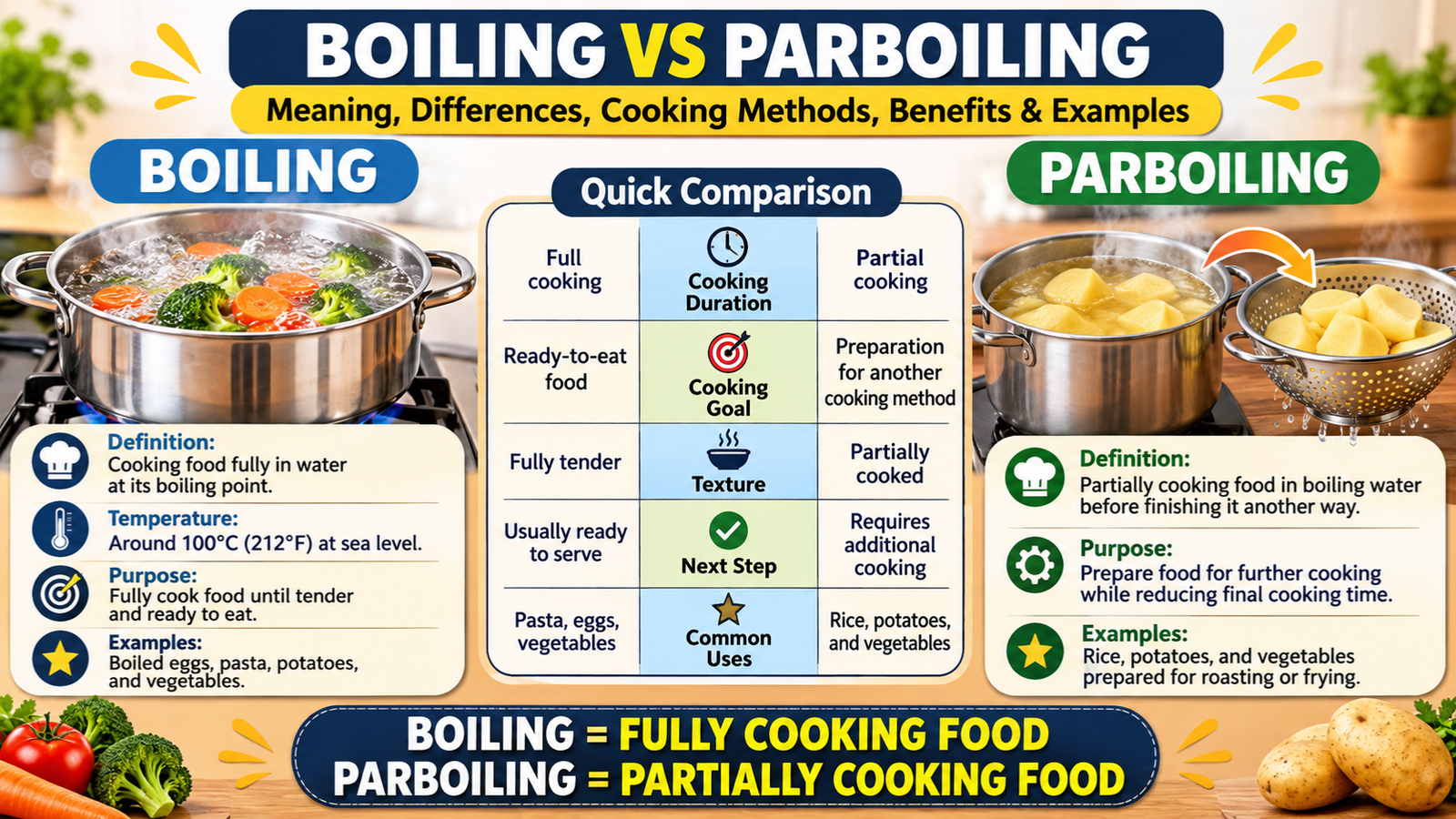
Quick answer: Boiling cooks food in hot water until it is fully done. Parboiling cooks food only partway so it can be finished using another method, such as roasting, frying, grilling, or sautéing. The main difference is the intended level of doneness: boiled food is usually ready to serve, while parboiled food needs another cooking step.
If a recipe tells you to boil pasta until tender, the water is doing the complete cooking job. If a roast potato recipe says to parboil the potatoes before putting them in the oven, the water is only giving them a head start. Both methods use hot water, but they have different purposes.
Understanding boiling vs parboiling helps you follow recipes accurately, choose the right cooking method, and get the texture you want. It can mean the difference between tender potatoes for mash and fluffy-centered, crispy-edged potatoes for roasting.
This guide explains the meaning of both terms, compares their uses, provides practical examples, and shows you how to parboil potatoes. It also covers related cooking methods, parboiled rice, common mistakes, and important food-safety precautions.
What Does Boiling Mean?
Boiling is a cooking method in which food is cooked in liquid that has reached its boiling point. At sea level, pure water boils at approximately 100°C (212°F). As the water boils, bubbles rise continuously to the surface and steam is released.
In everyday cooking, boiling is used to prepare foods such as eggs, pasta, potatoes, corn, beans, and lentils. Depending on the recipe, the food may be placed in cold water before heating or added after the water has started boiling.
The goal is generally to cook the food until it reaches the required texture and doneness. Once it is fully cooked, it can be drained, seasoned, mashed, or served.
Rolling Boil, Gentle Boil, and Simmer
Recipes sometimes use different terms to describe how strongly the water should bubble. Knowing the difference helps prevent overcooking.
- Simmer: Small bubbles appear gently and occasionally break the surface. This is useful for soups, stocks, sauces, and slow cooking.
- Gentle boil: Moderate bubbles rise steadily. It is suitable for many vegetables and other foods that need controlled cooking.
- Rolling boil: Large, vigorous bubbles continue moving across the surface, even when the water is stirred. Pasta recipes often call for this stage.
A more vigorous boil does not necessarily cook food faster. Once water is boiling, increasing the heat mainly produces more steam and evaporation. It can also make delicate foods break apart.
Boil, Boiled, and Boiling: Meaning and Word Forms
The word boil can perform different grammatical jobs in English. These forms often appear in recipes and everyday writing.
- Boil (verb): To heat a liquid until it bubbles, or to cook food in boiling liquid. Example: “Boil the potatoes until they are tender.”
- Boil (noun): The state or process of bubbling liquid. Example: “Wait until the water reaches a boil.”
- Boiled (adjective or past-tense form): Describes food cooked in boiling liquid. Example: “We served boiled eggs for breakfast.”
- Boiling (present participle or adjective): Describes the action of boiling or something extremely hot. Example: “The boiling water is ready.”
In American English, recipes commonly say “bring to a boil.” British English also commonly uses “bring to the boil.”
Boiling in Example Sentences
These examples show how boil, boiled, and boiling are used in cooking-related contexts.
- “Boil the eggs for the amount of time specified in your recipe.”
- “The pasta should be added after the water reaches a rolling boil.”
- “She boiled the potatoes until a fork passed through them easily.”
- “Keep the soup at a gentle simmer rather than a rapid boil.”
- “Bring the water to a boil before adding the vegetables.”
- “The recipe calls for boiled rice, not fried rice.”
- “Drain the boiled carrots before adding the butter.”
- “The boiling water softened the dried ingredients.”
- “He waited for the pot to come to a boil.”
- “Boiling the vegetables for too long can make them mushy.”
Common Expressions with “Boil”
The word boil also appears in figurative English expressions. These are not cooking instructions, but readers may encounter them in general writing.
- Boil down to: To be reduced to the most important point. Example: “The decision boils down to time and cost.”
- Off the boil: Less active, exciting, or successful than before. Example: “Interest in the event has gone off the boil.”
- Bring something to a boil: To make a tense situation more intense. Example: “The disagreement brought tensions to a boil.”
- Boiling mad: Extremely angry. Example: “He was boiling mad after the argument.”
- Simmering tension: A situation in which anger or disagreement continues quietly. Example: “There was simmering tension between the two teams.”
These expressions are useful language notes, but the cooking meaning remains the focus of this guide.
What Is Parboiling?
Parboiling is the process of partially cooking food in boiling water before completing the cooking with another method. The food is removed from the water before it is fully cooked, then finished by roasting, frying, grilling, baking, or sautéing.
For example, a recipe may instruct you to parboil potato chunks before roasting them. The brief water-cooking stage softens the outside and starts cooking the inside. The oven then finishes the potatoes and develops their browned, crisp exterior.
Parboiling is therefore a form of partial cooking. It is not usually intended to produce food that is ready to eat immediately.
Parboil Meaning and Word Forms
The word parboil is used in several related forms:
- Parboil (verb): To cook food partially in boiling water. Example: “Parboil the potatoes before roasting.”
- Parboiled (past tense or adjective): Food that has undergone partial boiling or a specific processing method. Example: “Add the parboiled vegetables to the pan.”
- Parboiling (noun or present participle): The process or action of partially boiling food. Example: “Parboiling can help prepare firm vegetables for another cooking method.”
In a recipe, “parboil” generally means to cook the food in water for a limited time, drain it, and continue with the next instruction.
Where Does the Word “Parboil” Come From?
The history of parboil is slightly surprising. Historical word references trace it to Middle English and Old French parboillir, which originally meant “to boil thoroughly.” The modern sense of partial boiling developed later, influenced by the English association of par- with “part.”
Because word histories can be more complicated than their modern spelling suggests, avoid explaining parboil simply as a word formed from “part” plus “boil.” The historical meaning and the modern cooking meaning are not identical.
Parboil, Par-Cook, and Precook: Are They the Same?
These terms are related, but they are not interchangeable in every recipe.
- Parboil: Partially cook food in boiling water. It is specifically a water-based method.
- Par-cook: Cook food partly using any suitable method. For example, a cook may par-fry potatoes or par-bake a pastry base.
- Precook: Cook something before its final preparation. Depending on the recipe, this may mean partly cooking or fully cooking it in advance.
If a recipe says to par-cook an ingredient, check the next instruction. It may require a different method from boiling.
Parboiling in Example Sentences
The following examples show how parboil, parboiled, and parboiling are used in practical cooking contexts.
- “Parboil the potato chunks before placing them in the roasting tray.”
- “The carrots were parboiled before being glazed in butter.”
- “Parboiling the vegetables reduced the time they needed in the pan.”
- “Drain the parboiled potatoes thoroughly so their surfaces can dry.”
- “The recipe asks you to parboil the green beans before sautéing.”
- “She parboiled the potatoes to prepare them for a crispy oven finish.”
- “Do not parboil the pasta unless the recipe specifically tells you to.”
- “The parboiled vegetables still need their final cooking step.”
- “Parboiling can help dense vegetable pieces cook more evenly.”
- “The chef used parboiled potatoes to prepare the roast dinner.”
These sentences demonstrate the central idea: parboiling is a partial cooking stage, not the final preparation.
Boiling vs Parboiling: Key Differences
The most important difference between boiling and parboiling is how much the food is cooked in water.
Boiling usually continues until the food is fully cooked. Parboiling stops earlier because another cooking method will complete the process.
| Feature | Boiling | Parboiling |
| Meaning | Cooking food in boiling liquid | Partially cooking food in boiling liquid |
| Main purpose | Cook food until done | Give food a head start |
| Cooking duration | Continues until the required doneness | Stops before the food is fully cooked |
| Final texture | Usually tender throughout | Partly cooked; texture depends on the food |
| Next step | Serve, drain, mash, or use in a recipe | Usually roast, fry, bake, grill, or sauté |
| Common examples | Eggs, pasta, lentils, potatoes | Potatoes for roasting, carrots, parsnips |
| Ready to eat? | Usually yes, if fully cooked | Usually no; a finishing step is needed |
| Main concern | Overcooking or uneven cooking | Stopping at the correct stage and finishing safely |
Simple way to remember: Boiling is generally the complete cooking process. Parboiling is a partial cooking stage before another step.
Why Do Cooks Parboil Food?
Parboiling can make certain recipes easier to prepare and improve the final texture. It is especially useful when food needs to become tender inside while developing a browned or crisp surface later.
Common reasons include:
- Preparing crispy roast potatoes: A short boil softens the outer layer. Roughening the drained potatoes creates a starchy surface that can become crisp in the oven.
- Helping dense vegetables cook evenly: Carrots and parsnips may benefit from a head start before roasting or glazing.
- Reducing the finishing time: Partially cooked vegetables need less time in the final pan or oven.
- Preparing ingredients for another cooking method: Some recipes use a brief boil before sautéing, frying, or grilling.
- Creating a particular texture: A partial cook can soften the outside while leaving the center firm enough to withstand the next stage.
The Science Behind Parboiling
Two cooking concepts help explain why parboiling works well for potatoes.
Starch gelatinization happens when starch granules absorb water and swell as they are heated. In potatoes, this contributes to a softer, fluffier texture.
The Maillard reaction is a series of chemical reactions that creates browned color and complex flavors when food surfaces are exposed to suitable dry-heat conditions. It contributes to the appealing crust on roasted potatoes.
Parboiling helps soften the potato before roasting. Drying and roughening the surface then prepare it for browning in the oven. The two stages produce a contrast between the soft interior and crisp exterior.
Which Foods Should You Boil or Parboil?
The best method depends on the dish and the texture you want. The same ingredient may be boiled for one recipe and parboiled for another.
Foods Commonly Parboiled
- Potatoes: Partially boiled before roasting.
- Carrots: Given a head start before roasting or glazing.
- Parsnips: Partially cooked before roasting.
- Green beans: Briefly cooked before sautéing, depending on the recipe.
- Some pasta or lasagna sheets: Pre-cooked only when the recipe or package instructions require it.
Foods Commonly Fully Boiled
- Eggs: Cooked in water until the desired doneness is reached.
- Pasta: Usually boiled until tender or al dente, according to the recipe.
- Lentils: Simmered or boiled until fully tender.
- Dried beans: Cooked thoroughly according to safe preparation instructions.
- Potatoes for mash: Boiled until tender enough to mash.
- Corn: Boiled or cooked using another method until tender.
The ingredient alone does not determine the method. The intended dish does. For example, potatoes for mashed potatoes are usually fully cooked, while potatoes for crispy roasting are often parboiled first.
Parboiling vs Blanching, Simmering, Poaching, and Steaming

These cooking methods all use heat, but they differ in water temperature, cooking time, and purpose.
Parboiling vs Blanching
Blanching usually involves placing food in boiling water for a short time and then cooling it rapidly, often in an ice bath. It is commonly used to help preserve vegetable color, loosen skins, or prepare vegetables for freezing.
Parboiling generally continues longer and aims to partially cook the food so it can be finished using another method. An ice bath is not automatically part of parboiling.
Comparison of Common Cooking Methods
| Method | Heat or water condition | Main purpose |
| Boiling | Bubbling liquid | Cook food fully |
| Parboiling | Boiling liquid for a limited time | Partially cook before another method |
| Blanching | Brief boiling-water treatment, often followed by chilling | Set color, loosen skins, or prepare produce |
| Simmering | Gentle bubbles below a rolling boil | Cook soups, stocks, sauces, and stews |
| Poaching | Gentle heat below a simmer | Cook delicate foods carefully |
| Steaming | Hot water vapor | Cook food without submerging it in water |
Steaming can be useful when you want to limit direct contact between food and cooking water. The best choice depends on the ingredient and recipe.
Is Parboiled Rice the Same as Parboiling?
No. Parboiled rice is not simply rice that has been partially boiled at home. The term usually refers to a processing method applied to rice while it is still in the husk, before milling.
In general, paddy rice is soaked, steamed or heated, and dried before the outer layers are removed. The processed rice is then milled and sold. It is also known in some markets as converted rice; in South Asia, the term sella rice is widely used.
This is different from parboiling potatoes or vegetables in a home kitchen.
Parboiled Rice in Pakistan and South Asia
Sella rice is familiar in Pakistan, India, and Bangladesh. It is often selected for dishes such as biryani and pulao because many varieties tend to hold their shape and produce separate grains when cooked properly.
However, texture depends on the rice variety, processing, quality, and cooking method. Follow the package instructions rather than assuming every parboiled rice product needs the same amount of water or cooking time.
Remember the distinction:
- Home parboiling: Partially cooks food in water before another cooking step.
- Parboiled rice processing: Treats paddy rice before milling as part of grain production.
How to Boil Food Correctly
The exact method depends on the food, but these general steps provide a useful starting point.
- Choose a suitable pot. Use a pot large enough to hold the food and water without overflowing.
- Add water. Use enough liquid for the food to cook properly.
- Season if appropriate. Salt can add flavor to foods such as pasta and vegetables.
- Heat the water. Bring it to the stage specified by the recipe.
- Add the food carefully. Avoid splashing hot water.
- Adjust the heat. Maintain a rolling boil, gentle boil, or simmer as required.
- Check doneness. Use the recipe’s guidance and test the texture where appropriate.
- Drain or serve. Follow the next instruction in the recipe.
Cooking times vary with food type, quantity, piece size, pot, and heat level. Use recipe times as guidance rather than a guarantee.
How to Parboil Potatoes for Crispy Roasting
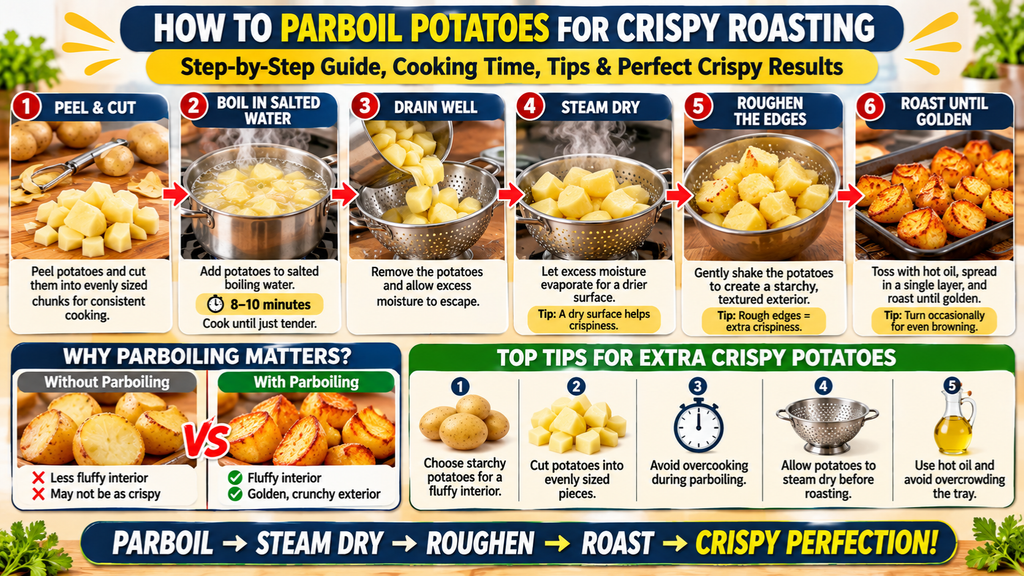
Parboiling potatoes before roasting is one of the best-known uses of this method. It helps create a soft interior and a rough surface that can become golden and crisp in the oven.
Step-by-Step Method
- Choose suitable potatoes. Select potatoes appropriate for roasting and wash them thoroughly.
- Cut them evenly. Similar-sized pieces cook at a more consistent rate.
- Place them in a pot. Cover with water and add salt if desired.
- Bring the water to a boil. Once boiling, adjust the heat to maintain a controlled boil.
- Cook until partly tender. For medium-sized chunks, around 8–12 minutes is a common starting range, but size and variety affect the time. The outside should begin to soften while the center remains firm.
- Drain carefully. Remove the water without breaking up the pieces.
- Allow the steam to escape. Let the surface dry for a few minutes.
- Roughen the edges. Gently shake the potatoes in the pot or colander to create a slightly rough surface.
- Roast in a hot oven. Place them on a preheated tray with hot oil or roasting fat, leaving space between pieces.
- Turn as needed. Roast until the potatoes are golden, crisp, and cooked through.
The time range is only a guide. Check the potatoes as they cook rather than relying on the timer alone.
Simple Crispy Roast Potato Recipe
Ingredients
- About 1 kg (2 lb) potatoes, cut into even chunks
- Salt, to taste
- 3–4 tablespoons cooking oil or suitable roasting fat
- Optional: garlic, rosemary, or thyme
Method
- Place the potato chunks in a pot and cover with water.
- Add salt and bring the water to a boil.
- Cook until the outside begins to soften but the centers remain firm.
- Drain the potatoes and allow excess steam to escape.
- Gently shake them to roughen the edges.
- Add the potatoes to a preheated roasting tray with hot oil.
- Roast, turning once or twice, until golden and crisp and cooked through.
- Add herbs or extra seasoning before serving.
Oven temperatures and cooking times vary. Use the appearance and texture of the potatoes to judge when they are ready.
Nutrition, Texture, and Cooking Results
Boiling and parboiling can affect food texture and the amount of nutrients retained, but the result depends on the ingredient and cooking conditions.
Does Boiling Remove Nutrients?
Some water-soluble vitamins can move from food into cooking water. The amount varies with the food, the size of the pieces, cooking time, and the amount of water used.
If the cooking liquid is suitable for the dish, using it in a soup or sauce can help retain some of the nutrients that moved into the liquid. Steaming is another option when you want to reduce direct contact with water.
Avoid assuming that one cooking method always preserves more nutrients. The result depends on the food and preparation method.
How Do Boiling and Parboiling Affect Texture?
- Boiling: Food is cooked until it reaches the texture required by the recipe. It may become soft and tender throughout.
- Parboiling: Food is only partly cooked. Its exterior may soften while the center remains firm, allowing the next cooking stage to finish the job.
The final texture also depends on what happens after the water stage. Roasting can create a browned surface, while sautéing can add color and flavor.
Food Safety When Partially Cooking Food
Food safety is especially important when handling meat and poultry. Partially cooked meat is not automatically safe to eat, and it should not be treated like a finished dish.
Do not partially cook meat or poultry, refrigerate it, and plan to finish cooking it later. USDA guidance says meat and poultry should not be partially cooked and stored for later completion. If partial cooking is used as part of a method, the food must be transferred immediately to the hot grill to finish cooking.
Keep these precautions in mind:
- Finish cooking properly. Meat and poultry must reach a safe final internal temperature before serving.
- Use a food thermometer. Color, smell, and texture alone cannot reliably confirm that meat is safe.
- Avoid cross-contamination. Keep raw meat, its juices, utensils, and cutting boards separate from ready-to-eat food.
- Handle food promptly. Do not leave perishable ingredients sitting at room temperature.
- Follow official storage advice. Use reliable food-safety guidance for cooling, refrigeration, and freezing.
For reference, US guidance lists 74°C (165°F) for poultry, 71°C (160°F) for ground meat, and 63°C (145°F) with a three-minute rest for whole cuts of beef, pork, lamb, and veal. Requirements can vary by food and jurisdiction, so consult the current official guidance for the food you are preparing.
For vegetables, follow appropriate blanching and freezing instructions for the specific vegetable. Do not assume that the rules for blanching vegetables also make partially cooked meat safe to store.
Common Mistakes to Avoid
- Cooking for too long: Food may become too soft to handle during the next cooking stage.
- Using uneven pieces: Different-sized pieces cook at different rates.
- Boiling too vigorously: Excessive movement can break delicate food apart.
- Skipping the draining stage: Excess surface water can interfere with browning.
- Overcrowding the roasting tray: Pieces need room for hot air to circulate.
- Assuming parboiled means ready to eat: Most parboiled ingredients need a finishing step.
- Treating meat like vegetables: Meat and poultry require stricter food-safety handling.
- Ignoring recipe instructions: Not every ingredient benefits from partial boiling.
Troubleshooting Common Problems
| Problem | Possible reason | What to do |
| Potatoes break apart during parboiling | They cooked too long or the water boiled too vigorously | Reduce the cooking time and maintain a controlled boil |
| Roast potatoes are not crisp | The surface is wet or the tray is overcrowded | Let potatoes steam-dry and leave space between pieces |
| Potato centers remain hard | Pieces are too large or the partial cook was too short | Cut more evenly and check doneness before roasting |
| Vegetables taste bland | The cooking water was not seasoned or the dish needs final seasoning | Season appropriately during and after cooking |
| Green vegetables lose their bright color | They were cooked too long | Shorten the cooking time and follow the recipe’s cooling instructions |
| Meat is not safely cooked | It did not reach the required internal temperature | Continue cooking and check with a food thermometer |
When Should You Use Boiling or Parboiling?
Choose the method according to the final dish.
| Food or dish | Suitable method | Reason |
| Mashed potatoes | Full boiling | The potatoes need to become tender enough to mash |
| Crispy roast potatoes | Parboiling, then roasting | The water softens the potatoes before the oven browns them |
| Hard-boiled eggs | Full cooking | The eggs need to reach the desired doneness |
| Pasta | Full boiling | The pasta cooks in water until ready |
| Lentils | Boiling or simmering | They need to cook until tender |
| Roasted carrots | Parboiling if needed, then roasting | A head start can help larger pieces cook evenly |
| Green beans for sautéing | Blanching or brief partial cooking, as the recipe directs | Reduces the time needed in the pan |
| Sella rice | Follow the package instructions | It is processed rice, not a home parboiling instruction |
Real-Life Examples of Boiling and Parboiling
Sunday roast dinner: You want potatoes with a fluffy middle and crisp edges. Parboil them briefly, drain them, roughen the surfaces, and finish them in a hot oven. Fully boiling them until soft would make them more likely to break apart during roasting.
Weeknight pasta: You need pasta that is cooked and ready to serve. Boil it according to the package or recipe instructions, then drain and add the sauce. A separate parboiling stage is not normally needed.
Vegetables for a quick sauté: Some firm vegetables can be briefly cooked in water before going into a hot pan. This gives them a head start and reduces the time needed for the final sauté.
Mashed potatoes: Here, the aim is a tender texture throughout. Boil the potatoes until they are soft enough to mash rather than stopping at the partial-cooking stage.
Biryani with sella rice: Sella rice is a processed rice product. Prepare it according to the instructions for that particular rice rather than treating it as ordinary home parboiling.
Frequently Asked Questions
What is the main difference between boiling and parboiling?
Boiling generally cooks food fully in water. Parboiling cooks it only partway so it can be finished using another method, such as roasting, frying, or sautéing.
Is parboiling the same as boiling?
No. Both methods use boiling water, but they have different purposes. Boiling usually completes the cooking process, while parboiling is a partial cooking stage.
What does parboil mean in a recipe?
It means to cook an ingredient briefly in boiling water, remove it before it is fully cooked, and continue with the next cooking step.
How long should you parboil potatoes?
Medium-sized potato chunks may take around 8–12 minutes as a starting guideline. The exact time depends on their size and variety. Check that the outside has softened but the center remains firm.
Is parboiling the same as blanching?
No. Blanching is usually a brief treatment in boiling water followed by rapid cooling, often in an ice bath. Parboiling generally cooks food further so another method can finish it.
Can you parboil vegetables before roasting?
Yes. Firm vegetables such as potatoes, carrots, and parsnips may benefit from a partial cook before roasting. Adjust the time according to their size and the recipe.
Can you parboil chicken?
Food-safety guidance is important here. Do not partially cook chicken and refrigerate it to finish later. If a method involves partial cooking on the stove, USDA guidance says to transfer it immediately to a hot grill to finish cooking. Always check the final internal temperature with a food thermometer.
Is parboiled rice the same as boiled rice?
No. Parboiled rice is processed while it is still paddy rice, before milling. Boiled rice usually describes rice cooked in water at home.
Does parboiling reduce cooking time?
It can reduce the time needed in the final cooking stage because the food has already started cooking. The total time depends on the ingredient and the finishing method.
Do you need to salt water when parboiling?
Salt is optional, but it can season the food during cooking. Follow the recipe and adjust the seasoning to taste.
Can you parboil potatoes a day ahead?
For food safety, do not assume that partially cooking food and refrigerating it for later completion is safe—especially with meat and poultry. For make-ahead potato preparation, use a tested recipe and reliable food-storage guidance that specifies how to cool, store, and finish the potatoes safely.
Does boiling remove nutrients?
Some water-soluble vitamins can move into the cooking liquid. The amount depends on the food and cooking conditions. Using the liquid in a suitable dish may retain some of what has leached out.
Is parboiling healthy?
Parboiling is a cooking technique, not a health benefit by itself. The nutritional value of the finished dish depends on the ingredients, cooking method, added fats, salt, and portion size.
Should you cover a pot when boiling food?
A lid can help water reach boiling temperature more quickly. Once food is cooking, adjust the lid and heat according to the recipe to prevent the pot from boiling over.
Final Thoughts
The difference between boiling and parboiling comes down to how much cooking happens in the water. Boiling usually takes food to its required doneness, while parboiling gives it a partial cook before another method finishes the job.
Use full boiling for foods such as pasta, eggs, lentils, and potatoes intended for mashing. Consider parboiling potatoes and firm vegetables when a recipe calls for a head start before roasting or sautéing. Remember that parboiled rice is a separate grain-processing method, and handle partially cooked meat and poultry with particular care.
The easiest rule is simple: boil when the water is meant to finish the cooking; parboil when another cooking step is waiting.