Status vs Statuses: Which Is the Correct Plural?
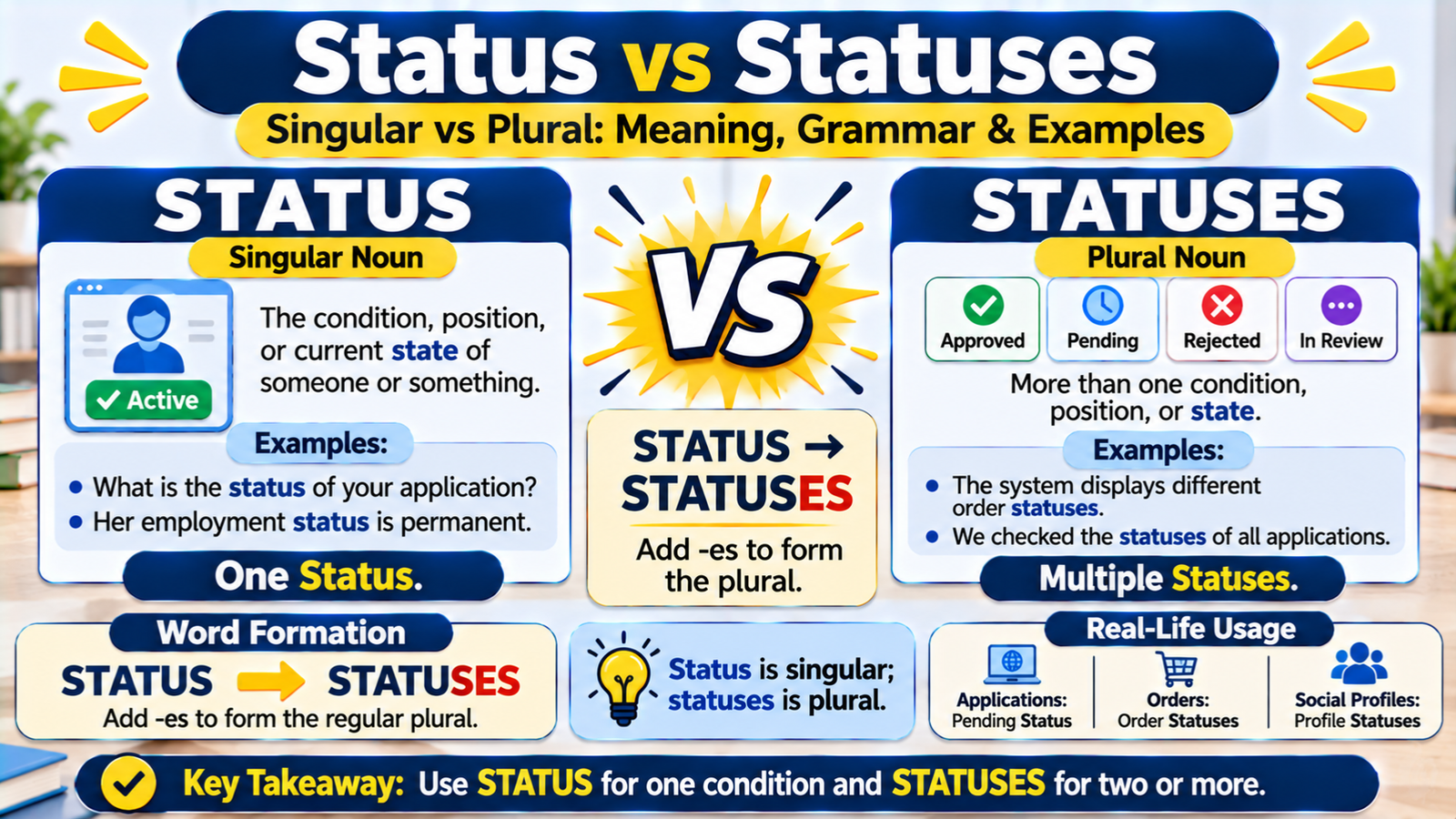
The standard plural of “status” is “statuses.” Dictionaries such as Dictionary.com list it, and the Oxford English Dictionary supplement notes that the plural is now usually “statuses.” Some grammar sites also accept “status” as an unchanged plural, but “statuses” is the safest choice. “Stati” is never correct.
That is the short answer to status vs statuses. The rest of this guide covers what the word means, why the Latin origin confuses people, which similar words follow the same pattern, how to handle “status” in reports and software, what to do with “status quo,” and a short quiz to test yourself.
Status vs Statuses: The Quick Answer
If you mean one condition or position, write status: Her legal status is pending.
If you mean more than one, write statuses: The statuses of the three orders were updated.
| Word | Number | Example |
| Status | Singular | The status of the project is “in progress.” |
| Statuses | Plural | The system shows three different statuses. |
| Status (as a plural) | Plural, less common | Some sources accept it, but it can confuse readers. |
| Stati | Not used | Never correct in English. |
A quick memory trick: status + es = statuses, the same way bus becomes buses, virus becomes viruses and campus becomes campuses. Dictionary.com describes status as following the same pattern as words like surplus and census.
What Does Status Mean?
Before the status vs statuses question, the meaning. Status is a noun with a few closely related meanings:
- A person’s rank or standing compared with others, especially in social or professional life (social status, high status).
- A person’s legal standing (marital status, immigration status, employment status).
- The current condition or progress of something (project status, order status).
- In everyday online use, a short post about your current situation or thoughts, as in a social media or messaging-app status.
It is pronounced STAY-tuhs or STAT-uhs. Dictionary.com records the word as first appearing in English in the late 1600s, borrowed from Latin, where it meant a standing condition and is related to the verb stare, “to stand.”
How to Pronounce Status and Statuses
Dictionary.com gives two common pronunciations for the singular: STAY-tuhs and STAT-uhs. Both are accepted, and which one you hear depends on the speaker and region.
The plural adds one syllable. Say STAY-tuh-sez or STAT-uh-sez, with the stress still on the first syllable. That extra syllable is a good clue about the spelling: when a noun ending in s needs an extra sound in the plural, English writes it with -es.
Why Is the Plural “Statuses”?
The status vs statuses rule is the ordinary English rule. English usually forms the plural of nouns that end in s by adding -es: dress → dresses, class → classes, bonus → bonuses. Status follows that ordinary rule, which gives statuses.
Dictionary.com lists the plural as statuses and points out that the word does not change to -i like cactus → cacti or fungus → fungi. The Canadian government’s Wordsleuth column adds that the Oxford English Dictionary supplement lists the plural as “now usu. statuses,” and that its author found no evidence in English usage for “stati.”
So when you are unsure, statuses is the answer that every reputable source accepts.
Is “Stati” Ever Correct?
No. “Stati” looks plausible because many Latin words ending in -us turn into -i in the plural, such as cactus → cacti and radius → radii. That is probably why people reach for it.
But status belongs to a different group of Latin nouns. In Latin its plural is also status (with a long “u,” written statūs), not stati. English never adopted the -i plural for this word. Grammarbook is blunt: “Stati” is never the correct plural. Grammar Monster says the same, noting that “stati” is simply not used.
Can “Status” Also Be the Plural?
Here the sources disagree a little, so let me be honest about it.
Grammarbook says both status (unchanged) and statuses are technically acceptable, and it describes the unchanged form as common. Grammar Monster also lists both, although it says statuses is slightly more common and that the unchanged form has been losing ground. Dictionary.com and the Oxford English Dictionary supplement, as quoted by the Canadian government’s Wordsleuth column, give statuses.
What does that mean for you? If you write “The system has four status levels,” the word status is working as a describing word in front of another noun, which is perfectly normal (see below). But if you want the plural noun by itself, “statuses” is clearer and safer. Some readers will stumble over an unchanged plural such as “The status of the orders were updated,” because the verb and noun do not seem to agree.
Similar Words That Follow the Same Pattern
If statuses sounds awkward to you, look at how many ordinary plurals sound the same way:
- bus → buses
- virus → viruses
- campus → campuses
- bonus → bonuses
- census → censuses
- surplus → surpluses
Every one of these ends in -us and adds -es. None becomes -i. Once you see status as part of that family, “statuses” stops sounding strange.
The ones that do take -i (cactus/cacti, fungus/fungi, radius/radii) are the exceptions, and they come from a different group of Latin words. When in doubt with an -us word, the regular -es plural is almost always accepted in modern English.
When to Use Status vs Statuses
Use “status” for one. The status of my visa is approved.
Use “statuses” for more than one. Each shipment has its own status, so the dashboard shows many statuses at once.
Use “status” as a describing word. In phrases like status update, status report, status meeting and status symbol, “status” stays singular even if you are talking about many of them. You write “five status updates,” not “five statuses updates.”
Try the replacement test. If you can swap in “states,” “positions” or “classifications” and still mean several separate things, “statuses” is probably right. The applications have different statuses works because you could say “different states.” Social status affects how people are treated does not, because you are talking about one general idea.
Think about countable vs uncountable use. When status means general rank or prestige, it is often treated as one thing: She enjoys high status in her field. You do not usually pluralize it here. It becomes plural when you compare several different positions or conditions: the legal statuses of different visa types, the different statuses of the tasks.
Statuses in Everyday and Professional Writing
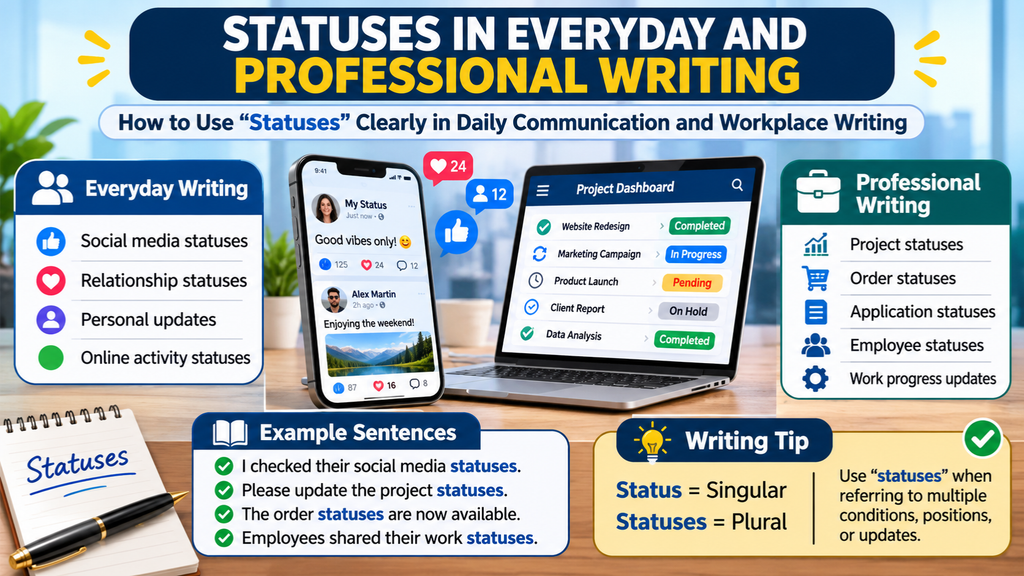
The status vs statuses choice comes up most often at work, so here are the common settings.
Reports and emails. When you list more than one condition, write “statuses”: Please review the statuses of the open tickets.
Project and task tools. If a tool lets people mark work as “To do,” “In progress” and “Done,” those three labels are the task statuses. A dropdown that lists them might be called “Task statuses.” Writing “status options” or “task status values” is also fine and avoids the plural entirely.
Order and delivery tracking. An online shop may support statuses such as “pending,” “shipped” and “delivered.” In a spreadsheet or database, a column might be called “status” (singular, because each row holds one), while a settings page might be called “Order statuses” (plural, because it lists the choices).
Social media and messaging. People post statuses, and you can scroll through your friends’ statuses. Dictionary.com now lists this social media sense of the word.
Legal and official forms. Forms use marital status and employment status in the singular, because each person has one. A report comparing groups might discuss “different marital statuses.”
Example Sentences
Status (singular):
- What is the status of my application?
- Her marital status is listed as single.
- The shipment’s status changed from “packed” to “dispatched.”
- He cares a lot about social status.
- Check the order status before you contact support.
- The company reviewed the project status every Monday.
Statuses (plural):
- The system supports four statuses: open, assigned, resolved and closed.
- The report compares the immigration statuses of different applicants.
- All the task statuses are shown on the board.
- She scrolled through her friends’ statuses before bed.
- The nurses recorded the statuses of each patient.
- Different employment statuses affect how the form is filled in.
- Managers should update the statuses every morning.
- The spreadsheet lists the statuses of all pending invoices.
Status in Technical Writing and Status Codes
Status vs statuses matters most in technical writing. Software and databases use “status” constantly, so the plural turns up a lot. A single record has one status, and the whole system has many statuses. These pairs follow the usual pattern:
- account status → account statuses
- order status → order statuses
- payment status → payment statuses
- delivery status → delivery statuses
- user status → user statuses
- subscription status → subscription statuses
Watch out for status codes. In “HTTP status codes,” the word “status” describes the codes, so it stays singular and the plural noun is “codes.” You do not write “statuses codes.”
A naming tip for forms and spreadsheets: a column that holds one value per row is usually labeled Status (singular), while a settings page that lists all the possible choices is usually labeled Statuses (plural).
Status in Medical and Academic Writing

The status vs statuses rule holds in formal science too. Researchers and clinicians use the word in a technical sense, meaning the condition of a person or group in some respect. For one patient you might read about “health status” or “nutritional status.” If a study compares several groups, the plural becomes natural: The study compared the nutritional statuses of the participants. The same goes for social science: The researchers examined the socioeconomic statuses of different households. The rule has not changed. One condition is “status,” and several separate conditions are “statuses.”
Possessives: Status’s and Statuses’
Once you know status vs statuses, apostrophes add a second layer of confusion, so here are the forms side by side.
- Singular possessive: status’s. The status’s effect on the project was clear.
- Plural possessive: statuses’. The statuses’ definitions differ between teams.
Many style guides add ‘s to a singular noun ending in s, which gives “status’s.” Some writers use only an apostrophe (“status'”), but that is less common for this word. The simplest fix is to avoid the problem by rewording: the effect of the status or the definitions of the statuses. Both read more smoothly.
Status Quo: What About Its Plural?
Status quo is a Latin phrase that people use in English to mean the existing state of affairs: The new manager wants to challenge the status quo. It is almost always used in the singular.
Because the phrase is a fixed Latin expression, a plural is rarely needed, and the sources I checked do not give a standard plural form. If you ever need to talk about more than one, the cleanest option is to rewrite the sentence: say “existing situations,” “current conditions” or “the different current states of affairs” instead of forcing a plural onto status quo.
Common Mistakes
Most slips in status vs statuses fall into a few patterns.
Writing “stati.” This is the classic error, caused by the cactus/cacti pattern. English uses statuses.
Writing “statuss” or “statusses.” The plural is statuses, with one s before -es.
Writing “statuses updates.” In status update, “status” describes the update and stays singular. The correct plural is status updates.
Pluralizing when you mean one condition. “The statuses of the order is pending” is wrong if you mean one order with one state. Use “the status of the order.”
Mixing singular and plural verbs. “The statuses is listed below” is wrong because “statuses” is plural. Write “The statuses are listed below.” And “The status of the orders are pending” is wrong because the main noun is “status.” Write “The status of the orders is pending.”
Writing “statuses codes.” The correct phrase is “status codes,” because “status” describes the codes.
Treating “statuses” as an error. It is not. It is the plural that dictionaries list, even if it looks unusual on the page.
Quick Practice
Choose the correct form. Answers follow.
- What is the ______ of your visa application? (status / statuses)
- The dashboard shows five ______ for each task. (status / statuses)
- Fix the mistake: “The stati of the orders were updated.”
- Fix the mistake: “We reviewed five statuses updates.”
- True or false: “stati” is an acceptable plural of status in English.
Answers: 1. status. 2. statuses. 3. “The statuses of the orders were updated.” 4. “We reviewed five status updates.” 5. False.
FAQs About Status vs Statuses
These are the questions people ask most about status vs statuses.
What is the plural of status?
The standard plural is “statuses.” Dictionary.com lists it, and the OED supplement describes it as the usual form now. Some sources also accept “status” unchanged, but “statuses” is the safer choice.
Is it status or statuses?
Use “status” for one condition and “statuses” for more than one. If you mean “status” as part of a phrase like “status update,” keep it singular.
Is “statuses” a real word?
Yes. It is the recognized plural of “status” in standard English. It may look unusual, but it follows the same pattern as “buses,” “viruses” and “campuses.”
Is “stati” the plural of status?
No. English does not use “stati.” Even though many Latin words ending in “-us” take “-i,” this one does not, and reference sources say it is never correct.
What does status mean?
Status means a person’s rank or standing, their legal position, or the current condition of something. In everyday online use it can also mean a short post about what you are doing.
What is the plural of status quo?
There is no commonly accepted plural, and it is rarely needed. If you must express more than one, rewrite the sentence with a phrase like “existing situations.”
Is status countable or uncountable?
Both, depending on the sense. Rank or prestige often behaves as an uncountable idea (“high status”). Specific positions or conditions you can list are countable (“three statuses”).
What is the difference between status and state?
They overlap, but “status” usually describes a standing, position or progress at a given moment (“project status”), while “state” is a broader word for a condition or form (“the state of the economy,” “a liquid state”).
Is it “status updates” or “statuses updates”?
It is “status updates.” The first word describes the second, so it stays singular. “Statuses updates” is incorrect.
How do you pluralize words ending in -us?
Most add “-es” (bus → buses, virus → viruses, campus → campuses). A smaller group of Latin words take “-i” (cactus → cacti, fungus → fungi). Check a dictionary if you are unsure.
What is the possessive of status?
The singular possessive is “status’s” (the status’s effect), and the plural possessive is “statuses'” (the statuses’ definitions). Rewording with “of the status” is often easier.
Is it “status codes” or “statuses codes”?
It is “status codes.” In that phrase, “status” describes the codes, so it stays singular. The plural noun is “codes.”
Is status singular or plural?
Status is the singular form. It can also work as an uncountable noun when it means general rank or prestige. When you mean several separate conditions, the plural is “statuses.”
Final Thoughts
Status vs statuses is a simple choice once you know the rule: status for one, statuses for more than one. “Stati” is never right, and an unchanged “status” plural is something a few sources tolerate but many readers will find confusing. When you are writing for a report, a form or a software screen, use statuses, and remember that in status update the word stays singular.