
Another Word for “They”: 15+ Alternatives, With Examples and Common Mistakes
Another word for “they”: there is no exact one-word synonym, because it is a pronoun. Replace it with a noun phrase (the team, these people), a collective noun (the group), a generic word (people, one), or the person’s name, depending on who you mean.
Writers usually look for another word for “they” for one of two reasons: the paragraph has too many of them, or the reader can’t tell who “they” refers to. Those are different problems with different fixes, so the replacements below are sorted by what “they” is standing in for.
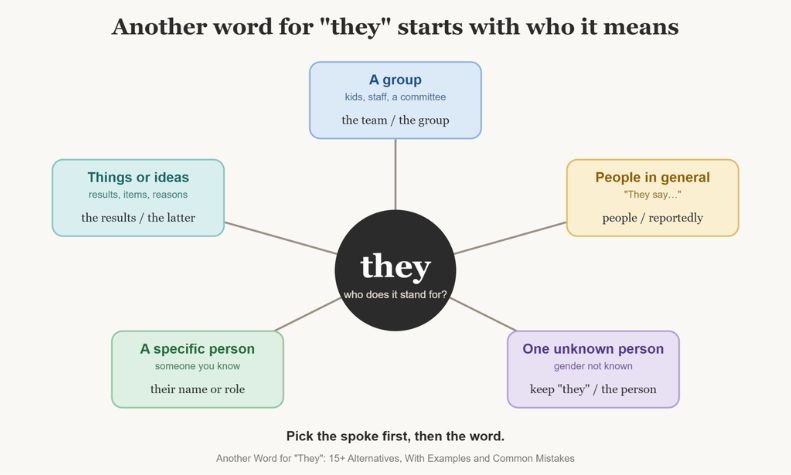
“they” sits in a dark hub in the middle, and five spokes run out to color-coded boxes. Each box has a title, a short context line, and one or two replacements. The colors and spoke order match the flowchart.
- A group: the team / the group
- People in general: people / reportedly
- One unknown person: keep “they” / the person
- A specific person: their name or role
- Things or ideas: the results / the letter
What “They” Stands For
“They” replaces people or things you’ve already mentioned. In “My neighbours are loud, and they never apologize,” it saves you from saying “my neighbours” twice.
It does three jobs, and you need to know which one you’re dealing with before you can swap it out:
- A group: The kids were hungry, so they ate.
- People in general or an unnamed source: They say the shop closes soon. Nobody in particular is “they” here, which is exactly why this use can sound evasive in serious writing.
- One person: Sam said they would call later. This covers a person whose gender is unknown and a person who uses they/them pronouns.
Even when “they” means one person, it takes a plural verb, the same way “you are” does for a single listener. Say they are, never they are.
How to Pronounce “They”
- Simple phonetics: thay (rhymes with day)
- IPA: /ðeɪ/
The opening sound, /ð/, is the voiced “th.” Put your tongue lightly between your teeth and let your voice buzz. If you whisper it, you get the unvoiced “th” of think instead. Learners often replace /ð/ with /d/ or /z/, which turns “they” into something like “day” or “zay.”
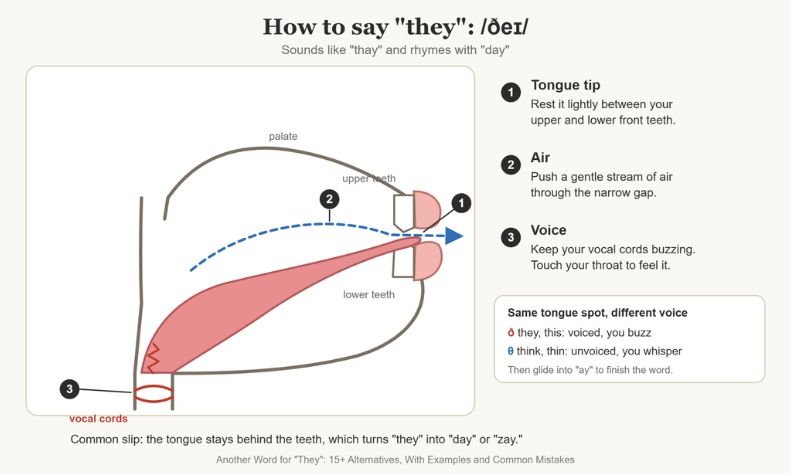
- Left: a simplified side view of the mouth with the tongue tip resting between the upper and lower front teeth. A dashed blue arrow shows air flowing through the gap, and red marks at the throat show the vocal cords buzzing. Numbered markers 1–3 tie each part to the steps on the right.
- Right: three short steps (tongue tip, air, voice), then a comparison box. It contrasts the voiced /ð/ in they and this with the unvoiced /θ/ in think and thin, which use the same tongue position.
- Footer: the common slip described in the article, where the tongue stays behind the teeth and “they” comes out as “day” or “zay.”
Grammar of “They”: Forms, Verbs and Prepositions
“They” is a third-person personal pronoun, and it works as the subject of a sentence.
| Role | Form | Example |
| Subject | they | They left early. |
| Object | them | I called them. |
| Possessive adjective | their | Their car broke down. |
| Possessive pronoun | theirs | The blue bag is theirs. |
| Reflexive | themselves | They taught themselves. |
Some writers use themself for one person, but themselves is the safer choice in formal writing
Verbs: “they” always takes the plural form: they are, they were, they have, they walk.
Prepositions: after a preposition, use them: with them, to them, about them, between them.
For the object form, see our guide to another word for “them”.
Another Word for “They”: Alternatives by Meaning
Instead of “they” for a group
- The group / the team / the committee: collective nouns that sound organised. British English tends to treat them as plural (the team are ready), while American English tends to treat them as singular (the team is ready).
- Those people / these people: points at a particular set, and can sound cold or critical depending on your tone.
- The participants / the employees / the respondents: role-based and precise, which suits reports.
- Both / all / each / several: put the focus on how many, not who.
Instead of “they” for people in general (“They say…”)
- People: plain and neutral. People say the bakery is closing.
- Reportedly / it is said: signals that nobody has confirmed the claim, which is why news writing favours it.
- One: very formal. One must plan carefully.
“They say” hides its source. If a source exists, name it: The council says… is stronger than They say….
Instead of “they” for one unknown person
- He or she: clear but clunky, and it leaves out people who use neither.
- S/he: shorter, but awkward to read aloud.
- The person / the applicant / the employee: the cleanest fix when you only need to avoid a repeated pronoun.
Instead of “they” for a specific person
- The person’s name or role: the safest choice. Dana, the manager, approved it.
- Neo-pronouns (xe, ze, per): use these only for someone who has told you they use them. They are not general substitutes for “they.”
Instead of “they” for things or ideas
- The items / the results / these factors: more concrete than “they.”
- The former / the latter: picks one of two things you’ve already named.
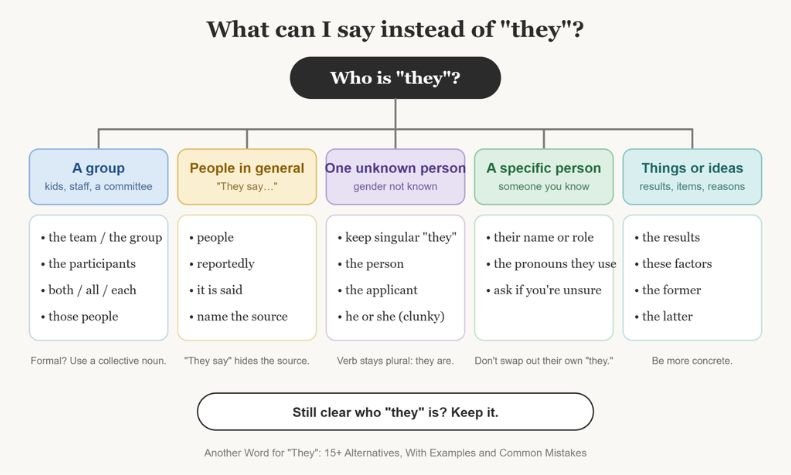
It starts with “Who is ‘they’?” and branches into five cases, each with replacement options and a one-line tip:
- A group: the team, the participants, both/all/each
- People in general: people, reportedly, name the source
- One unknown person: keep singular “they,” the person, he or she
- A specific person: their name or role, the pronouns they use
- Things or ideas: the results, these factors, the former/the letter
Which Replacement Fits? A Comparison
| Replacement | Best for | Register | Watch out for |
| The team | Organised groups | Neutral to formal | Verb agreement varies by region |
| Those people | Pointing at a group | Neutral to cold | Can sound judgmental |
| The participants | Reports, research | Formal | Wordy in casual writing |
| People | Generic statements | Neutral | Less specific than a named source |
| One | Formal general truths | Very formal | Stiff in speech |
| He or she | Unknown single person | Formal to neutral | Clunky if repeated |
| A name or role | Any specific person | Any | Repeating the same name |
When Not to Replace “They”
Replacing a pronoun isn’t always an improvement. Keep “they” when:
- The reader can easily tell who it means. Swapping in nouns just makes the prose heavier.
- You’re speaking. “The committee has announced…” sounds like a press release at a dinner table.
- The person uses they/them. Replacing “they” with “he or she” or constantly repeating a name to avoid it is not a neutral edit. It changes what the person asked for. Some people also use a mix, such as she/they, so use what they’ve told you.
Formal vs. Casual: Same Idea, Three Registers
Casual: They told me the meeting was cancelled.
Neutral: The organisers told me the meeting was cancelled.
Formal: The committee has announced that the meeting has been cancelled.
Example Sentences
- Casual: They’re running late, so let’s order without them.
- Formal: The board reviewed the proposal and, after discussion, approved the budget.
- News: Residents say they were not warned about the road closure.
- Singular, unknown person: Someone left their umbrella here; I hope they come back for it.
- Singular, known person: Alex said they’d join us after they finish work.
- Generic: They say the best time to plant tomatoes is in spring.
- Collective noun: The committee met on Friday. It approved the new policy.
Rewrite Lab: Too Many “They”s
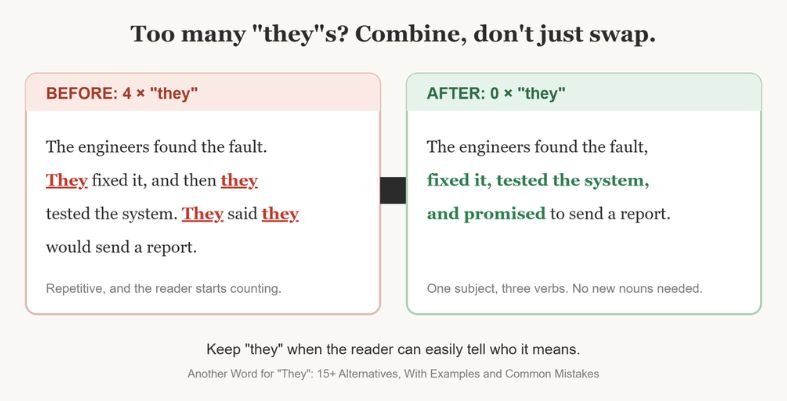
Before:
The engineers found the fault. They fixed it, and then they tested the system. They said they would send a report.
After (nouns swapped in):
The engineers found the fault. After fixing it, the team tested the system and promised a report.
After (one subject, several verbs):
The engineers found the fault, fixed it, tested the system, and promised to send a report.
The second version is usually the better edit. It removes four “they”s without adding a single new noun.
Common Mistakes with “They”
- Mixing up they’re, their, there. They’re means “they are,” their show ownership, and there is a place. They’re going to their house over there. More in our guide to they’re, there and there.
- An unclear referent. In “Ana told Mia they were late,” “they” could be Ana, Mia or both. Name the person.
- Saying “they is.” Use they are or they were, even for one person.
- Mixing singular and plural. “The team lost its match, and they were upset” switches mid-sentence. Pick one.
- Overusing “one” in speech, which sounds stiff.
- Switching between “he or she” and “they” in one document. Pick one approach and stick to it.
- Replacing a person’s own “they” with a name or “he or she” (see above).
Is There an Opposite of “They”?
A pronoun has no true antonym, but you can contrast “they” with the other persons:
- I / we: the speaker. They left, but we stayed.
- You: the listener. They invited you, not me.
- He / she / it: one third person. He called, but they didn’t answer.
Need other everyday swaps? See another word for “people”.
Where “They” Comes From
“They” came into English from Old Norse, not from the Old English pronoun it eventually replaced. Dictionary.com dates its first record to 1150–1200, from Middle English thei, from Old Norse there, replacing Old English hī(e). “Them” has the same Norse source, according to the Dictionary.com entry on “them,” so two of the pronouns in this guide are Scandinavian imports. dictionarydictionary
Linguists often point out that languages rarely borrow pronouns because they are part of a language’s closed class words, which form the deeply embedded grammatical core of a language. Singular “they” is also not a recent invention.they” ,earliest recorded use of the singular to 1375 in the Middle English romance William and the Werewolf.
FAQs
What is another word for “they” in English?
There is no exact single-word synonym for “they,” because it is a pronoun. Choose a replacement that fits who you mean: a collective noun like “the team,” a noun phrase like “these people,” a generic word like “people” or “one,” or simply the person’s name. The right choice depends on tone and clarity.
Is it correct to use “they” for one person?
Yes. Singular “they” is widely used for a person whose gender is unknown or who uses they/them pronouns, and many major style guides now accept it, though conservative publications may differ. The verb stays plural: “they are,” never “they is,” even for one person. Check your own style guide for formal work.
How do I avoid repeating “they” in my writing?
Combine short sentences so one subject covers several verbs, swap in the group’s name or role, or use a collective noun such as “the team.” Keep “they” when the reader can easily tell who it means. Replace it only when repetition feels heavy or the reference becomes unclear.
What is the difference between “they,” “those people,” and “the group”?
“They” is short and neutral. “Those people” points at a specific set and can sound distant or critical. “The group” treats the people as one unit and sounds more organised and formal. Choose “they” in casual writing, “the group” in reports, and “those people” only when you must single out a set.
Is “they” singular or plural?
They” is traditionally plural, but it can also refer to one person. In both cases it takes a plural verb: “they are,” “they were,” “they have.” Never write “they are.” Its object form is “them,” its possessive adjective is “their,” and its possessive pronoun is “theirs.”
Conclusion
Choosing another word for “they” depends on who or what the pronoun refers to. Words such as “the team,” “the group,” “people,” or a person’s name can make writing clearer and reduce repetition. However, singular “they” remains appropriate when referring to someone whose gender is unknown or who uses they/them pronouns. The best approach is to prioritize clarity, natural wording, and correct grammar rather than replacing every pronoun. By understanding the context and choosing alternatives carefully, you can make your writing more precise, readable, and effective.
Visit to explore more https://clearpenpress.com/




One Comment