Condescension Meaning in English: Definition, Examples and Pronunciation
Looking for the condescension meaning in English? In short, condescension is talking down to someone as if you are better, smarter or more important than they are. In modern English it is almost always an insult, although older writing sometimes uses the word kindly. This guide gives the full condescension meaning in English, including the definition, pronunciation, grammar, word family, synonyms, antonyms, origin and common mistakes, with plenty of real examples.
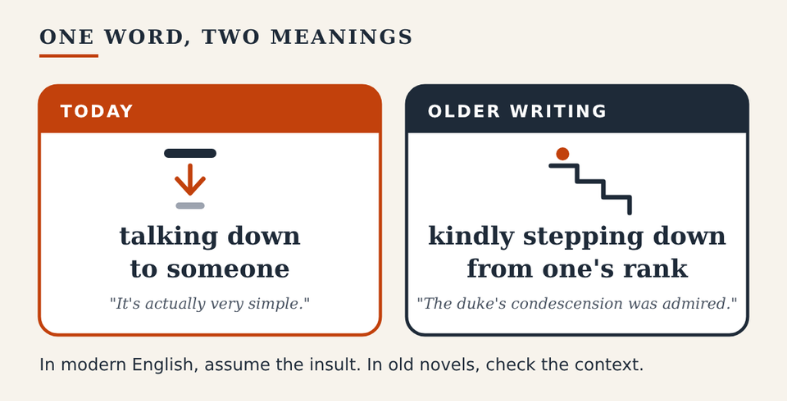
Quick answer: In English, condescension is a patronizing attitude. It means speaking or acting as if you are superior and the other person is less intelligent, capable or important. Today the word is negative. In older texts, it could also mean a person of high rank kindly stepping down to treat others as equals.
What Does Condescension Mean in English?
Condescension is the attitude or behavior of looking down on someone and letting it show. Merriam-Webster defines it as a patronizing attitude or behavior. The core condescension meaning in English is that the superiority is communicated to the other person, through words, tone, facial expression or actions.
Condescension lives in the tone as much as in the words. Explaining something obvious as if to a child, or sounding surprised that someone did a task well, are classic examples. The speaker often believes they are being helpful, which is part of why condescension irritates people so much.
Here is a simple example. Imagine you ask a coworker how to use new software, and they reply, “Oh, it’s really simple. Anyone can figure it out.” The answer is technically correct, but it quietly suggests you should already know. That small judgment is what makes the reply condescending.
Knowing more than someone is not condescension. A doctor can know more about medicine than a patient, and a teacher can know more about math than a student, without talking down to anyone. The difference lies in how the gap in knowledge or status is communicated.
Condescension Meaning in Simple English
In very simple terms, condescension means treating someone as if you are better than they are. You can think of it as “talking down to someone.”
Another way to put it: condescension is the message “I am above you,” delivered politely or impolitely. It can show up in:
- Tone of voice: a slow, sugary or exaggerated way of speaking.
- Word choice: phrases such as “obviously” or “as I said before.”
- Body language: an eye roll, a sigh, a pat on the shoulder.
- Behavior: taking over a task because you assume the other person cannot do it.
Because it depends on tone, the same sentence can sound friendly from one person and cutting from another. That is why condescension is often easier to feel than to define.
The Older, Kinder Meaning of Condescension
The word was not always an insult. Merriam-Webster lists a second sense, “voluntary descent from one’s rank or dignity,” and dates the first recorded use of the noun to 1647. The entry for the verb condescend adds that the word originally had a neutral sense of willingly lowering oneself. Over time, the idea of a show of superiority took over, and the negative sense became the main one.
So if you meet a line like “his condescension was much admired” in an old novel, it may be praise for a high-ranking person who was gracious to those below him. In anything modern, assume it is a criticism.
How to tell: ask whether the speaker’s tone says “you are less than me.” If it does, it is condescension, however politely it is worded.
How to Pronounce Condescension
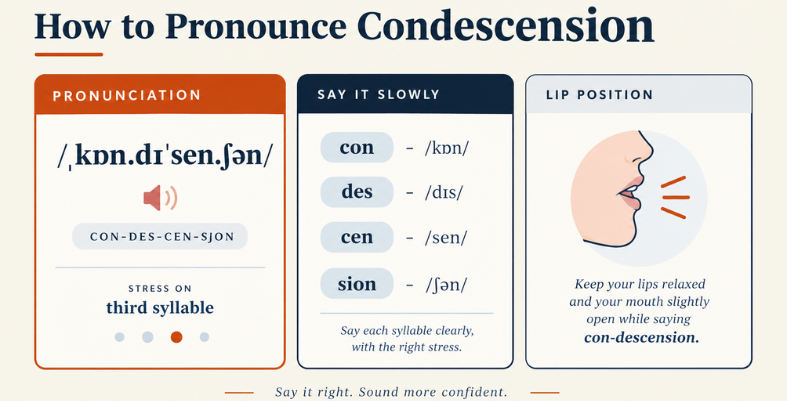
- Simple phonetics: kon-dih-SEN-shun
- IPA (US): /ˌkɑːn.dəˈsen.ʃən/
- IPA (UK): /ˌkɒn.dɪˈsen.ʃən/
- Syllables: four (con-de-scen-sion)
- Stress: on the third syllable, “scen”
The ending -sion sounds like “shun.” A helpful memory trick is to hear the word descend inside it, which fits the meaning of coming down to someone’s level. Do not stress the first syllable. The related word condescending is pronounced kon-dih-SEN-ding, with the same stress pattern.
Condescension Grammar: Part of Speech, Forms and Prepositions
Part of speech: Condescension is a noun.
Countable or uncountable: It is normally uncountable. You say “She spoke with condescension,” not “a condescension.” A plural is possible in theory but rarely used.
Common patterns:
- condescension toward (or towards) someone: “his condescension toward junior staff”
- with condescension: “She smiled with condescension.”
- an air or tone of condescension: “an air of condescension”
- without condescension: “He explained it without any condescension.”
The Condescension Word Family
| Form | Part of speech | Example |
| condescension | noun | “I couldn’t stand his condescension.” |
| condescend | verb | “She never condescends to her readers.” |
| condescending | adjective | “a condescending reply” |
| condescendingly | adverb | “He smiled condescendingly.” |
The Verb Condescend Is Intransitive
This is where learners often slip. According to Merriam-Webster, condescend is intransitive, so it cannot take a direct object. It needs the preposition to, and it has two main uses:
- condescend to + person: to act as though you are superior. “The author never condescends to her readers.”
- condescend to + verb: to do something while treating it as beneath you. “He finally condescended to answer the question.”
Britannica labels the verb formal and disapproving, so it sounds stiff in casual speech. In conversation, people more often say “talk down to” or “be condescending.”
Condescension in a Sentence: Examples for Different Situations
| Context | Sentence |
| Workplace email | “I’d rather you didn’t explain the budget as if I’d never seen a spreadsheet. The condescension isn’t helpful.” |
| Family | “Her grandmother’s condescension toward her cooking made every dinner tense.” |
| Customer service | “The agent’s tone dripped with condescension, so I asked for a manager.” |
| Written review | “The book is useful, but the author’s constant condescension toward beginners grows tiresome.” |
| Between friends | “Don’t take that tone with me. I can hear the condescension.” |
| Formal writing | “The report criticized the minister’s condescension toward local councils.” |
| Positive denial | “The manager answered the question without a trace of condescension.” |
| Historical sense | “The duke’s condescension in dining with his tenants was spoken of for years.” |
More short examples:
- She couldn’t hide her condescension when a colleague asked a basic question.
- His voice was full of condescension whenever someone challenged him.
- I don’t mind being corrected, but I do mind the condescension.
- Her polite words could not hide the condescension underneath.
Condescending Phrases and What to Say Instead
Judge condescension by its effect on the listener, not only by the words. The “why it lands badly” column below is a teaching judgment, not sourced research.
| Condescending phrase | Why it lands badly | Neutral rewrite |
| “It’s actually very simple.” | Implies the listener is slow for not seeing it | “Here’s how it works.” |
| “Let me explain this in simple terms.” | Assumes they cannot follow ordinary language | “Here’s a quick summary. Tell me if you’d like more detail.” |
| “Wow, you actually did it!” | Shows surprise at their competence | “Nice work on that.” |
| “Don’t worry, I’ll handle it. It’s complicated.” | Assumes they cannot cope | “I’ll take this one, and I’m happy to walk you through it later.” |
| “Good job, sweetie.” (to an adult colleague) | A pet name can sound like talking to a child | “Good job.” |
| “You finally figured it out.” | Turns praise into a dig | “Great, that’s exactly right.” |
| “Obviously, that’s not how it works.” | Treats a mistake with contempt | “Not quite. Here’s how it works.” |
The pet-name example depends on culture and relationship. Between close friends or family it can be affectionate, but in a professional setting it often reads as belittling.
How to Recognize Condescension
Condescension can be subtle, and some of the clearest examples sound polite on the surface. Watch for these four signs.
1. A superior tone. Neutral words such as “Sure, I’ll help you” can carry a very different message when delivered with a sigh or an eye roll.
2. Unnecessary simplification. Simplifying is not condescending by itself, since good teachers do it constantly. It becomes condescending when the speaker simplifies because they assume you cannot understand.
3. Dismissive corrections. Correcting a real mistake can help. Interrupting only to show off knowledge, such as pointing out “their” versus “there” mid-conversation, can feel condescending.
4. Insulting praise. Lines such as “You did surprisingly well” or “I’m impressed you understood that” can hide the message “I did not expect you to manage.”
In writing, the common warning signs are over-explaining and surprise at competence, with no tone of voice to soften either. In speech, tone carries much of the effect.
Condescension vs Patronizing vs Arrogance vs Sarcasm
These words overlap, so choosing the wrong one blurs your point. The distinctions below are a teaching judgment, not a dictionary ranking.
| Word | What it focuses on | Example |
| Condescension | The attitude of looking down on someone | “His condescension was obvious.” |
| Patronizing | How it sounds: kindly, “there, there” | “a patronizing pat on the head” |
| Arrogance | An inflated sense of your own importance, no listener needed | “His arrogance put people off.” |
| Sarcasm | Ironic mockery, a way of speaking | “Wow, you turned the computer on. Genius.” |
| Disdain | Open contempt for someone or something | “She looked at the offer with disdain.” |
| Paternalism | Deciding for people “for their own good” | “The policy was criticized as paternalism.” |
Condescension vs patronizing: They overlap heavily and are often used interchangeably. Condescension is the broader attitude of superiority, while patronizing describes the way it is expressed, often with a falsely kind or protective tone.
Condescension vs arrogance: Arrogance can exist without an audience. A person can brag about being the smartest in the room and be arrogant. Condescension is aimed at a particular person. It is how arrogance shows when you talk down to them.
Condescension vs sarcasm: Sarcasm is a style of speaking that uses irony to mock. Condescension is an attitude of superiority. The two can overlap, for example when sarcasm is used to belittle someone’s intelligence.
Synonyms for Condescension and How Each One Differs
- Patronizing behavior: the closest everyday match, with a kindly, talking-down tone.
- Superciliousness: scornful superiority you can see in someone’s face.
- Haughtiness: proud, stiff superiority in how someone carries themselves.
- Hauteur: the same idea in a more formal, literary word.
- Disdain: contempt, which can be aimed at things as well as people.
- Snobbery: looking down on people because of class, taste or status.
- Smugness: self-satisfaction, which need not involve talking down to anyone.
Antonyms of Condescension
- Respect: treating someone as an equal. “She spoke to the interns with respect.”
- Humility: not thinking yourself better than others. “His humility won people over.”
- Deference: yielding to someone’s judgment. “He showed deference to his elders.”
- Modesty: not boasting about your abilities. “She accepted praise with modesty.”
- Courtesy: polite, considerate behavior. “The staff answered every question with courtesy.”
Condescension at Work and in Everyday Life
Workplaces offer many chances for condescension because people differ in authority, experience and expertise. A manager can give instructions without it: “This report needs three more sections. Here’s the format we use.” Compare that with “I’m surprised I have to explain something this basic,” which adds an unneeded judgment.
Workplace example. A new employee asks a senior colleague how to submit an expense report.
- Condescending: “You just fill out the form and attach the receipt. Honestly, it’s not complicated.”
- Respectful: “You fill out the form, attach the receipt and submit it through the finance portal. If it’s your first time, I can walk you through it.”
Both answers take seconds, but the second teaches without belittling.
Condescension also appears among friends, family, partners, teachers and students, customers and staff, older and younger people, experts and beginners, and online communities. A very common pattern is assuming that someone’s lack of experience means a lack of intelligence. Those are not the same thing.
How to Respond to Condescension
When someone talks down to you, you do not need to start an argument. A calm reply can expose the behavior without escalating it. Name the effect, not the person’s character.
- Ask for clarification. “What do you mean by that?” This makes a condescending remark harder to hide behind humor.
- State the problem directly. “I understand the point. You don’t need to explain it as if I don’t.”
- Use an “I” statement. “I felt talked down to when you explained it that way.”
- Redirect. “Let’s focus on the problem we’re trying to solve.”
- Set a boundary. “I’m happy to discuss this, but I’d appreciate being spoken to respectfully.”
If it keeps happening, raise it privately with the person or with a manager, depending on the setting.
How to Avoid Being Condescending
- Ask before explaining. “Would you like me to walk you through it?” lets people say yes or no.
- Assume intelligence. Not knowing something is not the same as not being able to understand it.
- Drop loaded words such as “obviously,” “simply” and “just” when giving instructions.
- Praise the work, not your surprise. Say “Great job on this” instead of “I didn’t think you could do it.”
- Match your tone to an equal. Avoid sing-song voices, pet names and exaggerated slowness with adults.
- Let people decide. Give the facts and trust them to choose.
Condescension Etymology: Where the Word Comes From
The noun condescension comes from Late Latin condescensio, from condescendere, according to Merriam-Webster, and its first recorded use in English dates to 1647. The verb condescend is older. Merriam-Webster traces it through Middle English and Anglo-French condescendre to Late Latin condescendere, from Latin com- (“with”) plus descendere (“to descend”), first recorded in the 14th century.
Etymonline says the word was first used for God or a king making a “gracious allowance” for human weakness. By the early 16th century it meant setting aside the dignity of one’s rank to treat inferiors as equals, which was generally positive. The modern negative sense grew from the idea that this could be a mere show or pretended air of superiority.
That history explains the modern word: it started with graciously coming down to someone’s level and ended up meaning looking down on people.
Condescension in American English
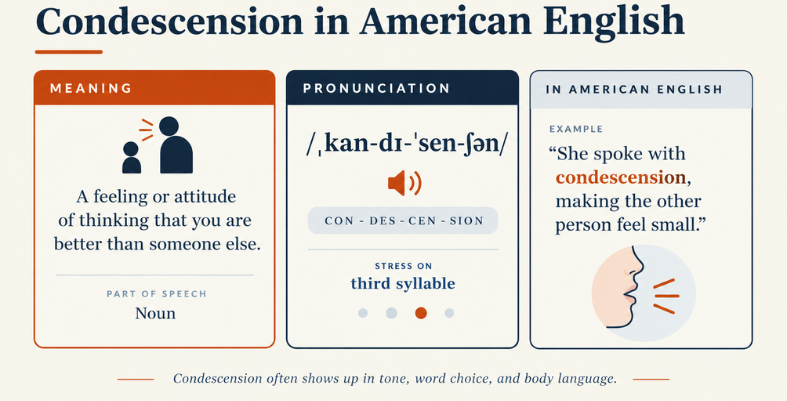
In the United States, condescension is most often heard in complaints about workplace communication, customer service, politics and online arguments. Phrases such as “a condescending tone,” “a condescending email” and “don’t be condescending” are everyday American usage, and feedback about tone is common in performance reviews.
Americans also use several informal expressions for the same idea:
- Talk down to someone: the most common spoken equivalent of “condescend to.”
- Look down your nose at someone: to treat them as socially or intellectually beneath you.
- Act high and mighty: to behave as if you are above everyone else.
- Bless your heart: a Southern expression that can be sincere sympathy or a polite, condescending dig, depending on tone.
Some phrases are also well known as warning signs: “Well, actually…,” “No offense, but…” and “With all due respect…” Each can be harmless, but each often introduces a correction or criticism delivered from a position of assumed superiority.
Condescending vs Mansplaining
People in the US often ask how condescension differs from mansplaining. Mansplaining describes a man explaining something to a woman in a condescending or patronizing way, usually assuming she knows less than she does. It is a specific type of condescension, defined by who is talking to whom.
Condescension itself has no gender. Anyone can talk down to anyone, whether the speaker is a manager, a parent, an expert or a stranger online. Use condescending for the general behavior, and mansplaining only when the pattern fits the gendered situation.
| Term | What it means | Example |
| Condescension | Talking down to anyone as if they are inferior | “Let me make this simple for you.” |
| Patronizing | A kindly, “there, there” version of talking down | “That’s a cute idea, sweetie.” |
| Mansplaining | A man condescendingly explaining something to a woman who likely already knows it | Explaining her own job to her |
Common Mistakes with Condescension
- Using condescend with a direct object. “He condescended me” is wrong. Say “He condescended to me” or “He was condescending to me.”
- Confusing it with condensation. Condensation is water vapor turning to liquid. The words look alike but are unrelated.
- Confusing it with condolence. Condolence is sympathy after a loss.
- Using condescending as a compliment. In modern English it criticizes.
- Misreading old texts. In older writing, “condescension” may mean kindness from a superior.
- Misspelling it. Condescention and condesention are errors. The ending is -sion.
- Using it for plain bluntness. Being direct is not condescending unless the tone suggests the other person is inferior.
- Calling a person “a condescension.” Say “he is condescending” or “he showed condescension.”
Frequently Asked Questions
What does condescension mean in simple words?
Condescension means talking or behaving as if you are better or smarter than someone else. It shows in tone, word choice and body language, for example by over-explaining something obvious. It is often heard as disrespectful, even when the speaker believes they are being helpful.
What is an example of condescension?
A simple example is “Don’t worry, I’ll explain it slowly so you can understand.” The sentence assumes the listener cannot follow a normal explanation, which makes it condescending.
Is condescension a negative word?
Yes, in modern English. Dictionaries mark it as disapproving, and it usually suggests that someone is treating another person as inferior. Historically it could be positive, so avoid using it as praise today.
Is condescension the same as being patronizing?
They overlap, but they are not identical. Condescension is the broader attitude of looking down on someone. Patronizing describes how it is expressed, often with a kindly, “there, there” tone. In everyday use the two are often interchangeable.
What is the difference between condescension and arrogance?
Arrogance is an inflated sense of your own importance and can exist without anyone else present. Condescension is aimed at a particular person and is how arrogance shows when you talk down to them. You can be arrogant without being condescending, but condescension usually carries some arrogance.
What is another word for condescension?
Depending on the context, good alternatives include patronizing behavior, superciliousness, haughtiness, hauteur, disdain and snobbery.
What is the opposite of condescension?
Common opposites are respect, humility, deference, modesty and courtesy. The best choice depends on the sentence.
What is the difference between condescension and condescending?
Condescension is a noun (“His condescension was obvious”). Condescending is an adjective (“His tone was condescending”). Both describe the same idea of superiority but work differently in a sentence.
Can condescension ever be positive?
Historically, yes. In earlier centuries the word could describe a person of high rank kindly speaking to someone lower, and Merriam-Webster still lists “voluntary descent from one’s rank or dignity” as a sense. In modern English it is usually negative.
How do you respond to condescension?
Stay calm and name the effect, not the person’s character: “I felt talked down to when you explained it that way.” Then ask for what you would like instead, such as being given the facts and trusted to decide. If it continues, raise it privately or with a manager.
Final Thought
The condescension meaning in English comes down to one message underneath the words: “I’m above you.” The same sentence can be friendly or cutting depending on tone, which is why condescension is easier to feel than to define. To avoid it, give people information, assume they can follow it and let them make their own decisions