Focusses or Focuses in English: Which Spelling Is Correct?
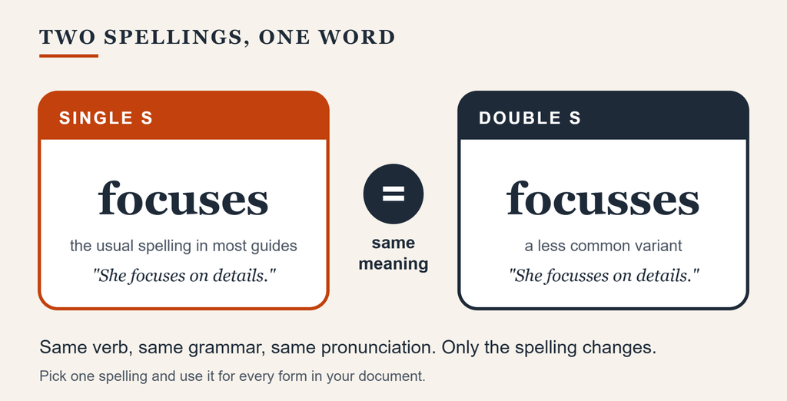
Wondering about focusses or focuses in English? Both spellings are accepted and mean exactly the same thing. For US readers, focuses is the standard spelling and the safe choice, while focusses is a less common variant that many dictionaries link to British English. This guide shows every form of focus in both spellings, explains what the sources agree and disagree on, and covers meanings, plurals, grammar, pronunciation, origin and the mistakes writers make most often.
Quick answer: Focuses and focusses are two spellings of the same word. Use focuses, focused, focusing for US readers and for any audience you are unsure about. Use focusses, focussed, focussing only when a British-style guide asks for them. Whichever set you choose, use it for every form in the document.
Focusses or Focuses: What’s the Difference?
The difference between focusses and focuses is spelling, not meaning. Grammar, pronunciation and meaning are identical. Only the written form changes.
| Spelling | Status | Where you’ll see it | Example |
| focuses | Standard | The usual form in most guides and in US writing | “The workshop focuses on public speaking.” |
| focusses | Accepted variant | Less common; Dictionary.com labels the double-s forms “especially British” | “The workshop focusses on public speaking.” |
Both spellings can be the third-person form of the verb (“she focuses on details”) or the plural of the noun (“the report’s two focuses”). The sentence tells you which one you are reading.
Is “Focuses” Correct?
Yes. Focuses is correct and is the form most US readers expect. It is the third-person singular present tense of the verb focus:
- I focus, you focus, we focus, they focus
- he focuses, she focuses, it focuses
Examples: “The article focuses on common grammar mistakes.” “The company focuses on customer service.” “The camera focuses on the subject.”
Is “Focusses” Correct?
Yes, as an accepted variant. Focusses is not a typo and not a grammatical error, but it is less common and may look wrong to American readers. Britannica lists the double-s forms as variants, and Dictionary.com labels them “especially British.”
Examples: “The report focusses on public health policy.” “The documentary focusses on rural communities.” The meaning matches the single-s versions exactly.
Focusses or Focuses in English: Which Spelling Should You Use?
The short answer to focusses or focuses in English is to match your audience and stay consistent.
What the sources say about US, UK, Canada and Australia
The sources do not agree on the regional picture, so treat any firm country-by-country claim with caution:
- Dictionary.com labels focusses, focussed and focussing “especially British.”
- Britannica lists the double-s forms as variants with no regiHow to pronounce focus, focuses and focussesonal label.
- Proofed says focussed is more common in British and Australian English than in American English, and that in American English it may be seen as an error.
- QuillBot says both spellings are acceptable in British and American English, and that the single-s forms are more common in both.
The practical conclusion: the single-s forms are safe everywhere, and the double-s forms are safest only in a British-style context.
Quick decision table
| You’re writing for | Safe choice |
| US or Canadian readers | focuses, focused, focusing |
| UK, Australian or New Zealand readers | Either; the single-s forms are the safer default unless a house style says otherwise |
| An employer, publisher or university with a style guide | Whatever the guide says |
| An international audience | The single-s forms |
| A website or blog with US English settings | focuses, focused, focusing |
| Editing someone else’s text | Keep their spelling; fix only inconsistency |
What dictionaries list first
Merriam-Webster lists focused and focusing first, with focussed and focussing as “also” variants. Britannica lists focuses first with focusses as “also,” and does the same for the other verb forms.
Style guides and spellcheck
If your employer, publisher or university has a style guide, follow it. It overrides everything above. Do not rely on spellcheck to catch inconsistency, because it may accept both spellings.
The one rule that matters: be consistent
Use one spelling for every form in a document.
- Inconsistent: “The team focussed on cost, the report focuses on safety, and we are focusing on training.”
- Consistent: “The team focused on cost, the report focuses on safety, and we are focusing on training.”
Every Form of Focus in Both Spellings
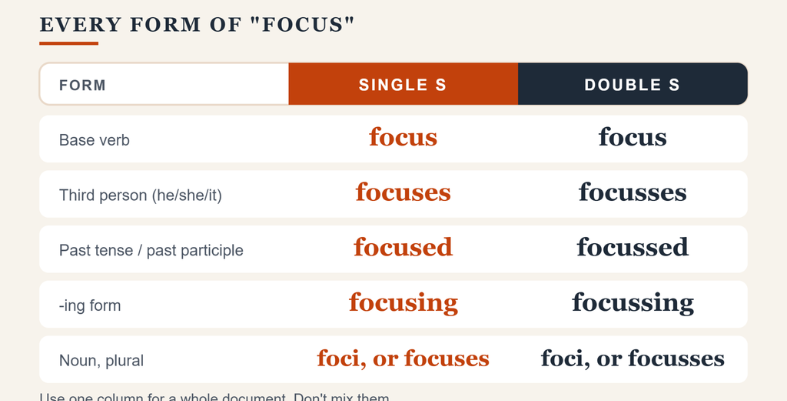
| Form | Single-s spelling (US standard) | Double-s variant |
| Base verb | focus | focus |
| Third person (he/she/it) | focuses | focusses |
| Past tense / past participle | focused | focussed |
| -ing form | focusing | focussing |
| Noun, singular | focus | focus |
| Noun, plural | foci, or focuses | foci, or focusses |
The verb’s third-person form and the noun’s plural are spelled the same, so context tells you which is meant.
Focused or Focussed?
The same choice applies to the past tense and the adjective. Merriam-Webster lists focused first and gives focussed as an “also” form. In US English, use focused: “She focused on the main issue.” “A focused discussion.” If your style uses the double s, write focussed everywhere, never a mix of both in one piece.
Focusing or Focussing?
The -ing form follows the same pattern. Focusing is listed first by Merriam-Webster, with focussing as a variant. Keep the set together: focuses, focused and focusing, or focusses, focussed and focussing.
What Does “Focus” Mean?
Focus is a small word with many jobs. These senses are shown with original examples:
| Sense | Part of speech | Example |
| Direct attention or effort | verb (+ object, + on) | “The new rules focus attention on food safety.” |
| Concentrate | verb (no object, often + on) | “I can’t focus when the radio is on.” |
| Adjust a lens or your eyes for a clear image | verb | “She focused the microscope on the slide.” |
| Subject of study or discussion | noun | “The workshop’s main focus is first-time managers.” |
| Main purpose or interest | noun | “After the move, he found a new focus.” |
| The point where light or sound rays meet | noun (technical) | “A magnifying glass brings sunlight to a focus.” |
| Clarity of an image | noun | “The old photograph is slightly out of focus.” |
Dictionary.com also lists specialist senses: a fixed reference point in geometry, an earthquake’s point of origin, and the main site of a disease.
Focuses as a Verb vs Focuses as a Noun
Focuses can be a verb or the plural of the noun, in either spelling. A quick test: if you can swap in concentrates, it is the verb (“She focuses on the details”). If you can swap in priorities or areas of attention, it is the noun (“The report has two main focuses”).
What Is the Plural of Focus? Focuses vs Foci
The noun has two plurals. Merriam-Webster and Britannica list foci first, with focuses as “also.” Dictionary.com lists focuses first, then focusses and foci, and labels the last two “especially British.”
| Plural | Typical feel | Example |
| foci | Technical, scientific, formal | “An ellipse has two foci.” |
| focuses | General English | “The project has several focuses.” |
Use foci in geometry, optics and academic writing. Use focuses in ordinary writing. You do not need foci just because it sounds more scholarly.
Focus Grammar: Transitive Use and Prepositions
The verb works with and without an object
Britannica and Dictionary.com show focus working both ways:
- With an object: “She focused the lens.” “The campaign focuses attention on road safety.”
- Without an object: “Try to focus on one task at a time.”
Common patterns with focus
The main pairing is focus on, which Britannica identifies as the standard pattern for attention, effort and subject matter. These patterns work in either spelling:
- focus on + noun: “We focused on the budget.”
- focus on + -ing: “He focuses on improving his writing.”
- focus attention on + noun: “The campaign focuses attention on road safety.”
- focus (your) efforts on + noun: “Focus your efforts on the three biggest risks.”
- focus primarily/mainly on + noun: “The study focuses mainly on children under five.”
- focus + object (cameras, lenses): “She focused the telescope.”
- in focus / out of focus / into focus: “The mountains came into focus as the fog lifted.”
- focus in on (informal): similar to zero in on, as in “Let’s focus in on the details.”
Avoid “focus to” and “focus at.” The preposition is almost always on.
Countable or uncountable?
As a noun, focus is countable in some senses (a focus, two foci) and uncountable in others (“a life that lacks focus”). Britannica marks the “main purpose” and “clarity” senses as noncount.
How to Pronounce Focus, Focuses and Focusses
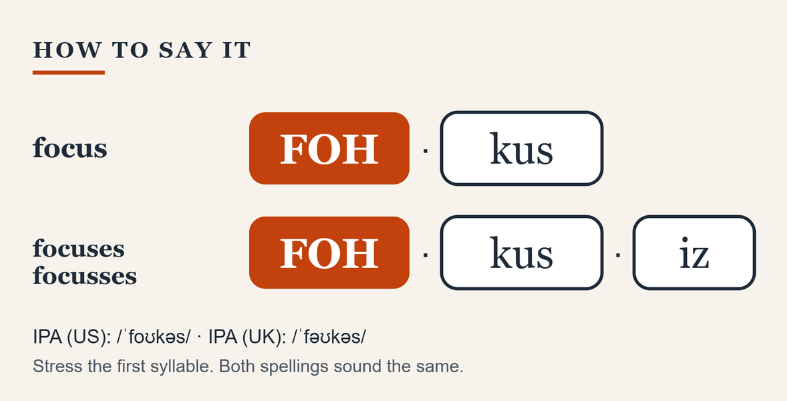
- Simple phonetics: FOH-kus (the base word), FOH-kus-iz (focuses/focusses)
- IPA, US: /ˈfoʊkas/ (Britannica and Dictionary.com)
- IPA, UK: /ˈfəʊkəs/ (Dictionary.com)
- IPA, foci: /ˈfoʊˊsaɪ/ (Britannica); Merriam-Webster also gives a “-kigh” variant
Both spellings sound identical, and the stress falls on the first syllable.
Why Does “Focussed” Have a Double S?
This is the part most guides get wrong. Several give an explanation, but they conflict:
- The usual rule says a final consonant doubles when a suffix is added only if the last syllable is stressed. Focus is stressed on the first syllable, so the rule does not predict focussed.
- Proofed’s account is that the final s was often doubled anyway, producing focussed and focussing, and that simplified American spelling later dropped the extra letter.
- None of the guides we reviewed cites a source for its explanation, and none of the dictionary entries explains it either.
So the honest answer is that the reason for the doubled s is not settled here. If you read a confident explanation elsewhere, check where it comes from.
Focuses and Focusses in a Sentence
| With focuses | With focusses |
| The article focuses on grammar. | The article focusses on grammar. |
| The study focuses on language development. | The study focusses on language development. |
| The course focuses on writing skills. | The course focusses on writing skills. |
| The report focuses on workplace safety. | The report focusses on workplace safety. |
| The discussion focuses on education. | The discussion focusses on education. |
| The company focuses on quality. | The company focusses on quality. |
| The research focuses on consumer behavior. | The research focusses on consumer behaviour. |
| The documentary focuses on history. | The documentary focusses on history. |
More examples by context:
| Context | Sentence |
| Formal report | “The review focuses on three areas: safety, cost and training.” |
| Casual | “She focuses so hard on her game that she doesn’t hear me.” |
| Written review | “The book focuses less on technique than on the artist’s life.” |
| Camera | “He focused the lens and waited for the bird to land.” |
| Noun, plural | “The two main focuses of the course are writing and research.” |
| Geometry | “The ellipse has two foci.” |
| Business | “Our team is focusing on retention this quarter.” |
The second column uses British spelling throughout (including behaviour) because a double-s style normally goes with British spelling overall.
Case Study: Choosing the Right Form for a US Blog
A US website publishes an article on workplace productivity. The writer drafts: “The article focuses on productivity. The team focused on employee behavior. The study is focusing on distractions.” These three forms work together naturally.
If the writer swaps in focusses, focussed and focussing, the sentences are still valid, but the spelling pattern is unusual for US readers and may look like errors. For a US publication, keep focuses, focused, focusing.
Case Study: Academic Writing
A US paper might say: “The study focuses on reading comprehension. Researchers focused on three variables, and the current analysis is focusing on classroom interaction.” A UK journal using double-s forms would write focusses, focussed and focussing instead. Grammar and meaning are identical. The journal’s style sheet decides.
Synonyms for Focus and How Each One Differs
- Concentrate: the plainest swap, for attention or effort (“concentrates on her studies”).
- Center on / revolve around: about a topic, not a person’s effort (“the debate centers on funding”).
- Zero in on: informal, suggests narrowing quickly to one target.
- Home in on: similar, but suggests approaching a target step by step.
- Fixate on: obsessive, and usually negative.
- Direct (attention) at: formal, used with attention or effort.
- Target: aims at a specific group or goal (“the campaign targets young voters”).
Antonyms of Focus
- Neglect: fail to give something the attention it needs. “He neglected his studies.”
- Ignore: deliberately pay no attention. “She ignored the interruptions.”
- Overlook: miss something by accident. “We overlooked the deadline.”
- Get distracted: lose your attention to something else. “He got distracted by his phone.”
- Scatter: spread your effort too thin. “She scatters her energy across too many projects.”
- Blur (for images): lose sharpness. “The photo blurred when the camera moved.”
Where Does the Word “Focus” Come From?
Focus comes from Latin focus, meaning “hearth” or “fireplace,” according to Merriam-Webster and Dictionary.com. Dictionaries place its first use in English in the mid-1600s, and the exact dates differ slightly between sources.
According to Dictionary.com, the word moved from the hearth to specialist uses: Thomas Hobbes used it for a fixed point in geometry in the 1650s, Isaac Newton did the same in the 1690s, and medical and physics senses arose in the late 1600s. The everyday senses of attention and concentration had spread by the early 1800s, and the original “fireplace” sense has since died out in English.
Common Mistakes with Focuses and Focusses
- Mixing spellings in one document. Focuses with focussed looks inconsistent.
- Adding an apostrophe. The third-person form is focuses or focusses, never focus’s or focusses’.
- Misspelling it as “focuss.” Neither spelling ends in a single s.
- Dropping the verb ending. “She focus on details” is wrong. Use focuses.
- Choosing the wrong preposition. Use focus on, not “focus to” or “focus at.”
- Confusing the verb with the plural noun. “She focuses on X” is the verb, and “two focuses” is the noun. The spelling is the same.
- Calling focusses a typo. It is a less common variant, not an error, though it may look like one to US readers.
- Treating foci as the only correct plural. Dictionaries also list focuses.
- Assuming only Britain uses focusses. Sources differ, so avoid absolute regional claims.
Frequently Asked Questions
Is it focusses or focuses?
Both are accepted and mean the same thing. Focuses is the usual spelling and the safer choice if you are unsure, while focusses is a less common variant, mostly British. Whichever you choose, use it consistently, including in focused/focussed and focusing/focussing.
Is focusses a word?
Yes. Focusses is a recognized variant spelling of focuses. It is not a typo, but it is less common, and US readers may read it as one.
Is focusses wrong in American English?
It is not a mistake, but American readers may see it as one. Merriam-Webster lists focussed only as an “also” form of focused, and Dictionary.com labels the double-s spellings “especially British.” For a US audience, use focuses, focused and focusing.
Do Americans use focusses?
Rarely. You may see it in American writing that follows British conventions or a particular editorial style, but focuses is the standard choice for US English.
Do British people use focusses?
Some do. Focusses is an accepted variant in British English, but the single-s forms are common there too, so it is inaccurate to say British English requires the double s.
Is focused or focussed correct?
Both are correct. Focused is standard in American English, and Merriam-Webster lists it first. Focussed is the variant. Pick one and use it for every form.
Is focusing or focussing correct?
Both are recognized. Focusing is listed first by Merriam-Webster and is the form to use for US readers.
What is the plural of focus?
The noun has two plurals: foci and focuses. Foci is more technical or formal, as in geometry (“an ellipse has two foci”), and focuses suits ordinary writing.
Do focuses and focusses mean the same thing?
Yes. They are two spellings of the same word with identical meaning, grammar and pronunciation. Only the spelling differs, so choose by audience and stay consistent.
Is “focuses on” correct?
Yes. Focuses on is a standard and very common construction: “The study focuses on language development.”
Which spelling is better for SEO content written for US readers?
Use focuses, focused and focusing for US English content. You can still mention “focusses or focuses” when the spelling comparison itself is the topic of the page.
Why do some people write focussed with two s’s?
It is a long-standing variant, especially in British writing. No source we reviewed gives a settled reason for the doubled letter.
Final Thought
Do not lose sleep over focusses or focuses in English. Neither spelling is an error. For US readers, choose focuses, focused and focusing. For a British-style publication, focusses, focussed and focussing are acceptable. Pick the set that suits your readers, use it for every form of the word, and spend the saved energy on what the text actually says.