
Prioritize vs Prioritise in English: Which Is Correct?
Stuck on prioritize vs prioritise in English? Here is the good news: both spellings are correct, and they mean exactly the same thing. What changes is where your readers live. This guide shows which country uses which spelling, how to pronounce the word, how it behaves in a sentence, and the slips that catch out even careful writers. You will also find every form of the word (prioritized, prioritizing, prioritization and their British twins), real usage data, and a quick check you can run before you hit send.
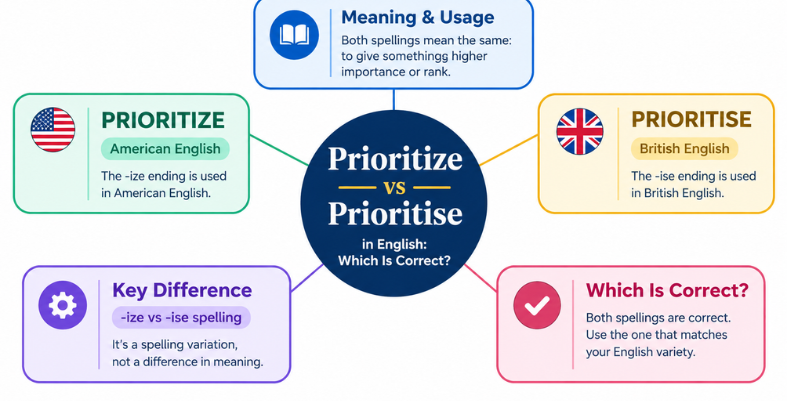
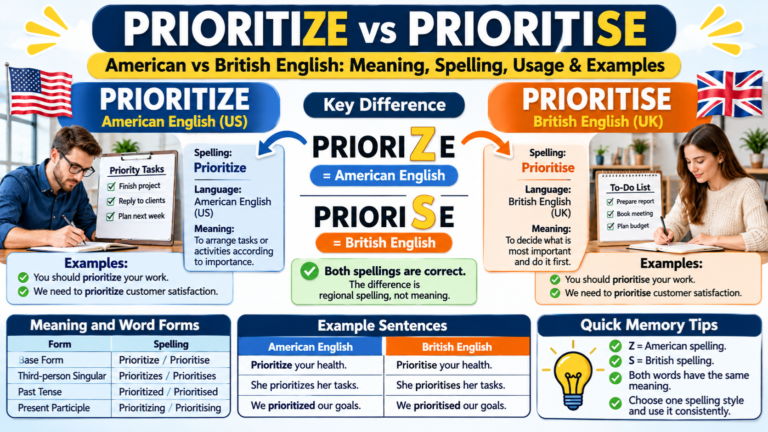
Quick answer: Prioritize and prioritise mean the same thing: to put the most important things first. Prioritize is standard in the US and Canada. Prioritise is standard in the UK, Australia and New Zealand. Choose the spelling that matches your audience and keep it consistent within a document. The pronunciation is identical, so the prioritize vs prioritise in English question is purely about spelling.
What does prioritize mean?
To prioritize is to rank things by importance and then deal with the most important ones first. Merriam-Webster defines it as listing or rating projects, goals and similar items in order of priority. Oxford adds a second, closely related sense: treating something as more important than other things.
If you have twelve tasks and four hours, prioritizing is deciding which four get your time. A plain to-do list tells you what exists. Prioritizing tells you what happens first.
The verb is the same whether you spell it with a z or an s. When people search for prioritize or prioritise, they are usually asking one simple question: which spelling should I use?
Prioritize vs prioritise in English: the two spellings side by side
| Spelling | Standard in | Example |
| prioritize | US, Canada | “We need to prioritize the safety checks.” |
| prioritise | UK, Australia, New Zealand | “We need to prioritise the safety checks.” |
Notice what stays the same: the subject, the tense, the sentence structure and the meaning. Only the spelling convention changes, and the choice of prioritize vs prioritise tells your reader which variety of English you are following.
Is prioritize American or British?
Prioritize is the standard American English spelling. It is also the standard in Canada. Merriam-Webster and American Heritage both list prioritize as the headword, and Merriam-Webster dates its first known use to 1961.
British writers often use prioritise instead, and Cambridge and Oxford both label prioritise as the usual UK spelling. But prioritize is not foreign to British English. It appears in British writing, especially from publishers that follow Oxford spelling (explained below). So the honest answer is: prioritize is American, prioritise is the most common British choice, and both are accepted in the UK.
Is prioritise correct in American English?
Not usually. American writers use prioritize, and a US reader who sees prioritise will most likely read it as a British spelling, or in some cases as a typo. It is not wrong in any absolute sense, but it is not the standard American form either. If you are writing for a US publication, employer or school, use the z form.
Sapling’s usage data (shown in the next section) puts prioritise at only about 2% of US writing, which explains why American readers notice it.
Prioritize vs prioritise usage: what writers in each country actually do
Dictionaries tell you what is standard. Usage data tells you what people really write. One usage analysis by Sapling reports these shares:
| Country | prioritize | prioritise |
| United States | 98% | 2% |
| Canada | 94% | 6% |
| India | 77% | 23% |
| United Kingdom | 23% | 77% |
| Australia | 25% | 75% |
| New Zealand | 33% | 67% |
Two details stand out. First, the UK is not one-sided: roughly one writer in four uses the z form. Second, India leans towards prioritize, which surprises people who assume that “British-influenced” always means -ise. If your readers are in India, the z form is the safer bet.
The Oxford spelling: -ize inside British English
“Oxford spelling” is an established house style that uses -ize endings within otherwise British English. It keeps British spellings such as colour and centre, but writes prioritize, organize and recognize with a z. That is why you will sometimes see prioritize in a British book or journal, and why it is not a typo there.
The z in these words traces back to the Greek ending -izein, so the Oxford style is not an Americanism. It is an older, etymology-based choice that some British publishers kept.
Prioritize vs prioritise: which spelling for your situation?
- CV or cover letter: match the employer’s country. A US company expects prioritize; a UK or Australian firm expects prioritise.
- Essay or thesis: follow your institution’s style guide. If it gives none, pick one spelling and keep to it.
- Company or publication style guide: it overrides everything else on this list.
- Website with international readers: use the spelling most of your readers use, and apply it to every related form.
- Email to a colleague abroad: matching their spelling is a courtesy, but not a requirement. Neither choice will be read as an error.
The goal is not to declare one spelling better. The goal is to match the spelling to the English variety you are using and then stay consistent.
Prioritized vs prioritised (past tense)
The past tense and past participle follow the same pattern. American and Canadian English use prioritized; British, Australian and New Zealand English commonly use prioritised.
- US: “The manager prioritized the urgent requests.”
- UK: “The manager prioritised the urgent requests.”
Use it for something that happened in the past (“We prioritized customer complaints last week”) and as a participle after have or had (“The team has prioritised the critical bugs”). Collins lists prioritized as both the past tense and the past participle of prioritize.
Prioritizing vs prioritising (-ing form)
The -ing form is prioritizing in American English and prioritising in British English. It works as a present participle and as a gerund.
- US: “She is prioritizing her most important tasks.” / “Prioritizing urgent work prevents delays.”
- UK: “She is prioritising her most important tasks.” / “Prioritising urgent work prevents delays.”
Prioritization vs prioritisation (the noun)
The noun for the process of deciding what comes first is prioritization in American English and prioritisation in British English.
- US: “Effective prioritization helps a team focus on its biggest goals.”
- UK: “Effective prioritisation helps a team focus on its biggest goals.”
This noun appears constantly in project management, product development and business writing, so it is the form most likely to slip through unchecked. An older and simpler noun is priority, which is countable: “one priority,” “many priorities.”
The complete prioritize word family
| Role | US / Canada | UK / Australia / NZ |
| Base verb | prioritize | prioritise |
| Third person singular | prioritizes | prioritises |
| Past tense | prioritized | prioritised |
| Past participle | prioritized | prioritised |
| -ing form | prioritizing | prioritising |
| Noun | prioritization | prioritisation |
| Opposite verb | deprioritize | deprioritise |
The easiest memory trick: US = Z, UK = S. Pick your variety once and carry the same letter through every form.
How to pronounce prioritize and prioritise
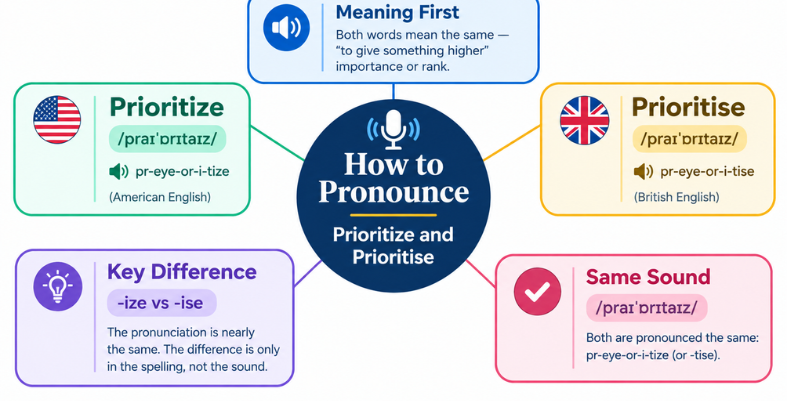
The spelling difference looks bigger than it sounds. Both words end in a “z” sound, and both are pronounced the same way.
- Simple phonetics: pry-OR-uh-tize
- IPA (US): /praɪˈɔːrəˌtaɪz/
- IPA (UK): /praɪˈɒrɪtaɪz/
- Syllables: four (pri·or·i·tize), with the main stress on the second syllable and a lighter stress on the last.
So when you say the word aloud, you never have to choose. The choice only appears when you write it.
Grammar: how prioritize works in a sentence
Prioritize is a verb. Merriam-Webster labels it transitive, meaning it normally takes an object: “She prioritized the urgent requests.” In practice, people often drop the object when it is obvious, as in “You have to learn to prioritize.”
Common patterns:
- prioritize + noun: “Prioritize the bridge project.”
- prioritize X over Y: “The team prioritised accuracy over speed.” This sets up a clear hierarchy: X comes first, Y comes second.
- prioritize + -ing: “He prioritizes saving over spending.”
Because it is a verb, prioritize is neither countable nor uncountable. The related noun priority is countable.
Common phrases with prioritize
| Phrase | Example |
| prioritize tasks | “Prioritize your tasks before you start work.” |
| prioritize safety | “The company must prioritize employee safety.” |
| prioritize goals | “The team should prioritise its long-term goals.” |
| prioritize needs | “The programme prioritises community needs.” |
| prioritize customers | “The business prioritizes customer satisfaction.” |
| prioritize resources | “The agency must prioritize its limited resources.” |
| prioritize health | “She learned to prioritize her health.” |
Where people use prioritize
At work. Workplaces are full of competing deadlines, so prioritize appears in phrases like prioritize deadlines, prioritize urgent requests and prioritize business goals. “The support team must prioritize customers whose systems are completely down” sets an order of importance, not just a general instruction to pay attention.
In education. Students juggle assignments, exams and revision. “With three exams in one week, Maya had to prioritize the subjects that needed the most preparation.”
In personal life. The word appears when people talk about rest, family time, money and goals. “If you want to finish the project this month, you will need to prioritize it over less urgent hobbies.”
In technology and product development. A product team may have dozens of possible features and limited time. Teams rank them by customer value, business impact, urgency, effort and security risk. “We should prioritize the security issue before adding the new interface feature.”
Is prioritize formal or informal?
It works in both. You can say “I need to prioritize my errands today” in casual speech, and you can write “The department should prioritize infrastructure improvements in the areas of greatest need” in a formal report.
Some critics have called prioritize business or bureaucratic jargon. The OED, in 1989, described it as a word that sits uneasily in the language, and American Heritage notes the same criticism while still treating it as standard. The word has since become ordinary. There is no grammatical reason to avoid it, though in formal writing you should save it for genuine ranking rather than trivial choices (“I prioritized lunch” sounds odd).
Example sentences
| Context | Sentence |
| Formal report (UK) | “The committee will prioritise projects that reduce emissions.” |
| Formal report (US) | “The committee will prioritize projects that reduce emissions.” |
| Casual chat | “I can’t do everything today, so I’m prioritizing the dentist.” |
| Work email | “Could you prioritise the invoice queries before lunch?” |
| Academic writing | “The study found that students who prioritised sleep scored higher.” |
| Spoken advice | “When everything feels urgent, prioritize what can’t wait.” |
| Job application | “I prioritized client communication and cut response times in half.” |
Synonyms for prioritize, and how they differ
- Rank: puts things in order, but does not mean you act on the top item first. “The manager ranked the projects from one to ten.”
- Triage: a fast sort of urgent cases under pressure, borrowed from emergency medicine.
- Put first: plain and informal, with no sense of a full ordering.
- Give priority to: wordier and formal, common in policy writing. “The company gave priority to safety.” It means almost the same as prioritize, but prioritize is shorter and more direct.
- Focus on: narrows your attention without ranking everything else.
- Sequence: orders by time, not importance, as in project plans.
Opposites and contrasting words
There is only one true opposite, and the others are related contrasts rather than strict antonyms.
- Deprioritize / deprioritise: move something lower on the list. “We deprioritized the redesign until spring.”
- Neglect: fail to give something the attention it needs. “He neglected his health.”
- Ignore: deliberately pay no attention. “She ignored the warning.”
- Overlook: miss something by accident. “We overlooked the deadline.”
- Postpone: delay it until later. “They postponed the meeting.”
Other words with the same spelling choice
The -ize/-ise split affects well over a hundred English verbs. The ones you are most likely to meet:
- A real choice: organize/organise, recognize/recognise, realize/realise, apologize/apologise, criticize/criticise.
- Always -ise (both varieties): advise, supervise, surprise, revise, exercise, compromise.
- -yze vs -yse: American English uses analyze; British English uses analyse.
A rule of thumb: when -ize is the suffix that turns a noun or adjective into a verb, as in prioritize, you usually have a choice. When the -ise is part of the root word, as in advise, the spelling is fixed. English has plenty of exceptions, so treat this as a guide, not a law.
Where the word comes from
Prioritize is priority plus the verb ending -ize. It is a fairly recent coinage: Merriam-Webster dates its first known use to 1961, while Etymonline says it appeared by 1967 in US government jargon and was popularised during the 1972 presidential race.
On the spellings, Etymonline traces the ending to Greek -izein and notes that English spellings varied from Old French and Middle English onward. A 1694 French dictionary favoured -s-, which influenced English. American English has long preferred -ize, while British writing leans towards -ise.
Common mistakes with prioritize and prioritise
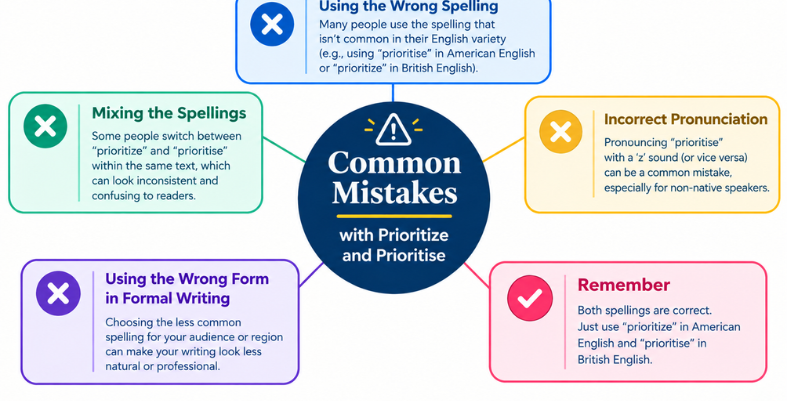
- Mixing spellings in one document. “We prioritise… the prioritization of…” looks careless. Use the Find check below.
- Mismatching the related forms. Pair prioritized with prioritization, and prioritised with prioritisation.
- “Correcting” the other spelling. Neither is a mistake, so do not mark down a British colleague for prioritise or an American for prioritize.
- Mixing other regional spellings. “The team will prioritize the project and organise the files” mixes American and British conventions. Keep the whole document in one variety.
- Treating spellcheck as the judge. A clean spellcheck only means each word is accepted, not that your spelling is consistent.
- Misspelling it. Priortize (missing an i) and prioritice are errors. The word has four syllables and ends in -ize or -ise.
- Using it as a noun. “My prioritize is health” does not work. Use priority: “My priority is health.”
- Stretching it to trivial choices in formal writing. Save it for real ranking.
A practical check before you send
Open Find (Ctrl+F or Cmd+F) and search for “priorit.” That catches every form at once: prioritize, prioritized, prioritizing, prioritization and their -ise twins. If you see both spellings, change them to match.
Do not rely on spellcheck for this. Many UK language settings accept the z form without flagging it, and many US settings accept the s form only with a squiggle, so the tool will not tell you whether the whole document is consistent.
Prioritize vs prioritise in English: quick summary
- Prioritize and prioritise are the same verb with the same meaning and pronunciation.
- US and Canada: prioritize, prioritized, prioritizing, prioritization.
- UK, Australia and New Zealand: prioritise, prioritised, prioritising, prioritisation.
- Whichever spelling you choose, keep it consistent from the first line to the last.
Frequently asked questions
Is it prioritize or prioritise?
Both are correct. Prioritize is standard in the US and Canada, and prioritise is standard in the UK, Australia and New Zealand. The meaning is identical. Choose the spelling that matches your readers, then use it consistently, including in related forms such as prioritized and prioritization.
Is prioritize American or British?
Prioritize is the standard American spelling. British English commonly uses prioritise, although prioritize is also accepted there, especially in Oxford style.
Is prioritise correct in American English?
Not usually. American writers use prioritize, and prioritise reads as a British spelling. In Sapling’s usage data, prioritise accounts for only about 2% of US writing, so a US reader may take it for a typo.
Can I use prioritize in British English?
Yes. Prioritize appears in British writing, including publishers that follow Oxford spelling, though prioritise is more common. Sapling’s figures put the z form at roughly 23% of UK usage. If your employer or publication has a style guide that specifies -ise, follow it.
Do prioritize and prioritise mean the same thing?
Yes. They share the same meaning, grammar and pronunciation, with a final z sound in both. Only the spelling differs by region, so you can swap one for the other without changing the meaning of a sentence.
Is prioritize a real word?
Yes. It is a standard English verb, recorded in Merriam-Webster, Oxford and Cambridge. Some people call it jargon, but dictionaries treat it as standard.
What is the past tense of prioritize?
The past tense is prioritized (US) and prioritised (UK). The same form serves as the past participle.
What is the noun form of prioritize?
The noun is prioritization in American English and prioritisation in British English. An older noun is priority, which is countable. Keep the noun’s spelling consistent with the verb.
Is prioritizing correct in British English?
Yes, particularly in Oxford-style writing, though prioritising is more common in the UK.
Which spelling do Australians and New Zealanders use?
Mostly prioritise, with about 75% of Australian writers and 67% of New Zealand writers choosing it in Sapling’s data.
Which spelling do Indian writers use?
Mostly prioritize. In Sapling’s data, about 77% of Indian writers use the z form.
Is prioritize formal or informal?
It suits both. It is common in business and policy writing, and it is also fine in everyday speech.
What is the opposite of prioritize?
The closest opposite is deprioritize (or deprioritise): to move something lower on the list.
How do you pronounce prioritize?
Say pry-OR-uh-tize, with four syllables and the main stress on the second. The ending is a z sound whichever way you spell it.
Final thought
In the prioritize vs prioritise in English debate, neither spelling is better, and neither is a mistake. Prioritize and prioritise are the same verb with the same meaning, and only your readers decide which one looks right. If they are in the US or Canada, use the z. If they are in the UK, Australia or New Zealand, lean towards the s. If you are unsure, follow your style guide, and run the Find check before you publish.

One Comment