Fueled vs Fuelled in English: Correct Spelling (US vs UK), Meaning and Pronunciation
Fueled or fuelled? If you have ever hovered over that second l, you are not alone. Fueled vs fuelled in English comes down to a single letter, and neither version is an error. Which one is correct depends on who is reading. This guide gives you the rule, the reason behind it, and a few habits that keep your spelling consistent.
Quick Answer: Is It Fueled or Fuelled?
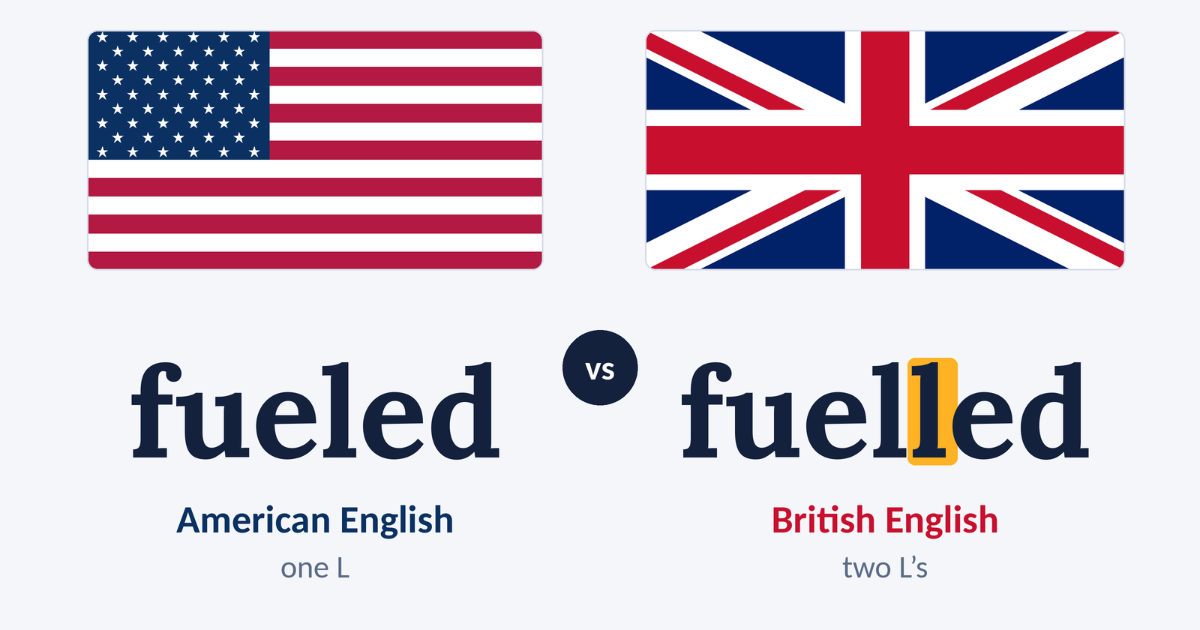
Fueled is the American spelling and fuelled is the British spelling of the past tense and past participle of the verb fuel. Both mean the same thing, supplied with fuel or made stronger, and both sound identical. Use fueled for US readers, fuelled for UK, Australian and many other readers, and never mix them in one text.
US and UK Spellings at a Glance
- American English: fuel, fuels, fueled, fueling, refueled, refueling, fueler
- British English: fuel, fuels, fuelled, fuelling, refuelled, refuelling, fueller. Grammarist reports the two-l forms as the norm in the UK, Ireland, Australia, South Africa and New Zealand.
- Canada: mixed. Grammarist cites a sample of 2013 Canadian news in which the American forms appeared about a quarter of the time.
- Sound, meaning and grammar: the same in every variety.
A shortcut: if you write traveled in American English, write fueled. If you write travelled in British English, write fuelled.
Which Spelling Should You Use?
| Your reader | Write | Note |
| American | fueled, fueling | The standard American forms. |
| British, Irish, Australian, New Zealand or South African | fuelled, fuelling | The norm in these varieties, according to Grammarist. |
| Canadian | Follow your publication’s style guide | Usage is mixed. |
| Mixed or unknown | Choose one and use it everywhere | Consistency matters more than the choice. |
| Exam or class | Follow the instructions you were given | Check the published rules. |
The tolerance is lopsided. Merriam-Webster lists fuelled as a variant, so a double-l spelling in American text reads as British, not wrong. WordReference goes the other way and labels the single-l forms as not correct in British English. If you truly cannot tell who your readers are, that is one argument for choosing fuelled. The same US/UK split shows up in other words too, such as prioritize vs prioritise.
Whatever you choose, set your word processor’s proofing language (English US or English UK) before you start. The spell-checker will then flag the odd one out for you.
Why the Spellings Split (and Why Fuel Doubles at All)
British spelling largely followed Samuel Johnson’s dictionary of 1755. American spelling took its lead from Noah Webster’s dictionary of 1828, and Webster liked simpler forms, including not doubling a final unstressed l (Dictionary.com).
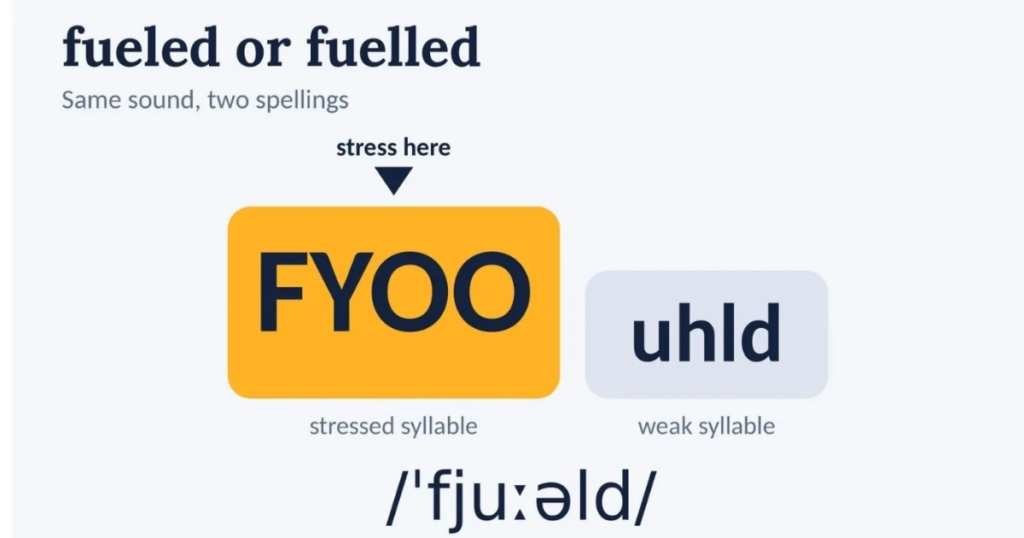
The working rule is short. In both varieties a final consonant doubles when the stress falls on the last syllable, so compel becomes compelled and rebel becomes rebelled on both sides of the Atlantic. Fuel is stressed on its first syllable (FYOO-uhl), so American English leaves the l alone and writes fueled. British English doubles a final l almost whatever the stress, and that gives fuelled.
Fuel has plenty of company. American spelling comes first in each pair:
- traveled / travelled
- labeled / labelled
- canceled / cancelled
- modeled / modelled
- signaled / signalled
- counseled / counselled
- dueled / duelled (Merriam-Webster lists both for the verb duel)
Duel is the closest sibling: the same -uel ending and the same stress on the first syllable. Doubling can cause doubt in other places too; see maxed or maxxed in English.
How did the American form win? Grammarist’s graph of US books from 1900 to 1950 shows fueled and fuelled competing briefly before fueled became the usual form in the 1920s. It also notes that the verb was rare until the twentieth century.
Rule versus reality. Do writers follow the split? Mostly, but not perfectly. Grammarist says the two-l forms still win by a large margin in the UK. Sapling’s web-usage figures for refueled and refueling put the single-l spellings ahead even for UK writers (73 to 27 for refueled, 53 to 47 for refueling). Sapling does not explain how it counts, so we would not build a style rule on those numbers. They do show that real-world text is messier than the dictionaries imply. For your own writing, the dictionary rule is still the safe one.
What Fueled and Fuelled Mean
To fuel something is to give it the energy it needs to keep going. Fueled and fuelled are the past tense and past participle, and they cover two senses.
The literal sense is supplying a vehicle, machine or fire with fuel: the crew fuelled the plane overnight, or someone fueled the campfire with dry wood.
The figurative sense is adding energy to a feeling or a situation so that it grows or lasts. When a rumour fuels panic, it works like wood thrown on a fire. The verb usually suggests that something is already under way: you kindle a fire to start it, and you fuel it to keep it going.
There is also the phrasal verb fuel up, which means to take in fuel. People use it in cars, and jokingly by themselves before a big meal or a long exam.
How to Pronounce It
- Simple respelling: FYOO-uhld
- IPA: /ˈfjuːəld/
- Stress: on the first syllable
- Both spellings sound the same. The extra l changes nothing you can hear.
Dictionaries mark the length of the first vowel a little differently (some show /ˈfjuəld/), but in practice it is the same sound: “fyoo” as in few, then a short “uhld”. The most common slip is dropping the final d, which turns fueled into the present-tense fuel. Say fuel, then add a clear d.
Grammar: Verb Forms and Prepositions
Verb forms
- Base form: fuel
- Third person singular: fuels
- Past tense and past participle: fueled (US) / fuelled (UK)
- Present participle and gerund: fueling (US) / fuelling (UK)
Transitive and intransitive. Most uses are transitive: someone fuels something. The workers fueled the generator. Rumours fuelled the panic. With up the verb stands alone: We stopped to fuel up.
Prepositions. By names the cause, usually in the passive: The panic was fuelled by rumours. With names the substance: The truck was fueled with diesel. On follows fuel up: She fueled up on coffee.
Compound adjectives. Before a noun, join the parts with a hyphen: a diesel-fuelled generator, an adrenaline-fuelled sprint.
The noun. Fuel is normally uncountable (we are low on fuel). It takes a plural only for kinds of fuel, as in fossil fuels.
Example Sentences
- US, formal written: Rising demand for electric vehicles has fueled new investment in battery research.
- UK, formal written: The minister insisted that the dispute had been fuelled by misinformation rather than genuine disagreement.
- US, casual: I fueled up on coffee and finally finished my essay at two in the morning.
- UK, casual: We fuelled the barbecue with the last of the charcoal and hoped the rain would hold off.
- UK, technical: The ground crew fuelled the aircraft before dawn.
- UK, compound adjective: He gave an adrenaline-fuelled performance that stunned the crowd.
- US, compound adjective: A caffeine-fueled study session is not a long-term plan.
- UK, present participle: Fuelling a diesel engine with petrol can ruin it.
- US, present participle: Fueling the plane took less time than the crew had expected.
- US, spoken: Don’t fuel the argument; just let it go.
Synonyms, With the Subtle Differences
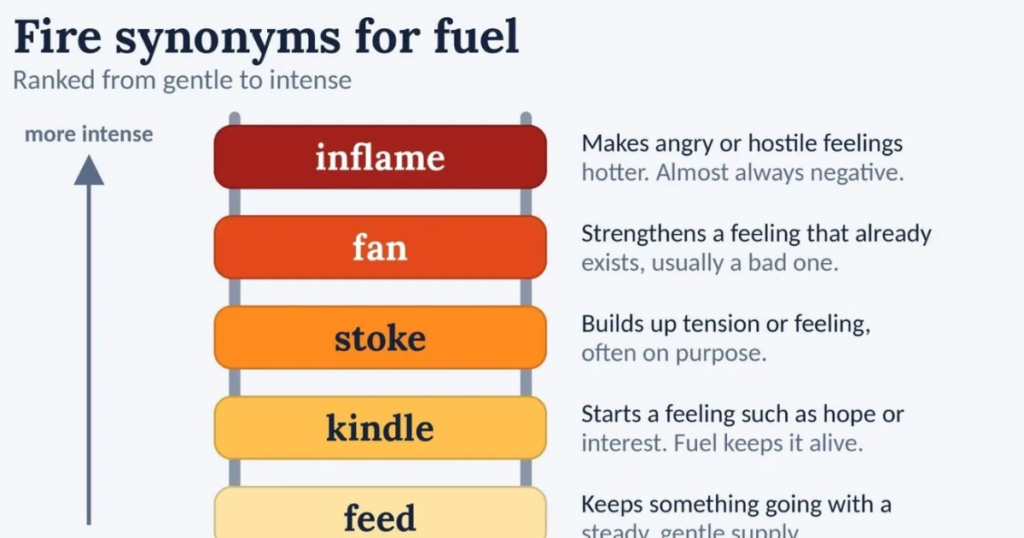
Many figurative synonyms of fuel keep the fire imagery, which tells you how the word thinks. Those come first, then the ones that leave the fire behind.
Staying with the fire
- Stoke: to add fuel to a fire and keep it going; figuratively, to build up feelings or tension, often on purpose.
- Kindle: to light a fire; figuratively, to start a feeling such as hope or interest. Fuel keeps a flame alive, kindle begins it.
- Feed: to keep something going with a steady supply. Gentler than fuel, and good for habits and appetites.
- Fan: to blow on flames; figuratively, to strengthen a feeling that already exists, usually a bad one, as in fan the flames of resentment.
- Inflame: to make angry or hostile feelings hotter. Almost always negative.
Leaving the fire behind
- Drive: to push something forward with a direction or purpose. Ambition drives her sounds more purposeful than ambition fuels her.
- Spur: to urge a person to act or try harder; one push rather than a steady supply.
- Bolster: to add support so that something becomes stronger. Positive, like a plan or a person’s confidence.
- Intensify: neutral. It makes something stronger and says nothing about why.
- Exacerbate: formal. It makes a bad situation worse and never suits good news.
For the literal sense (a vehicle or machine)
- Power: supplies the energy to run a machine, without implying that you add fuel.
- Refuel: to fill up again, usually after the fuel has been used.
- Fill up, top up, gas up: fill up fills the tank; top up adds a little to a tank that is not empty; gas up is informal and mainly American.
Antonyms
The opposites either put the fire out or take the pressure down.
- Dampen: to reduce enthusiasm or energy gently. The delay dampened everyone’s mood.
- Douse: to put out a fire, or a strong feeling, quickly. Her calm reply doused the argument.
- Extinguish: to put out completely; formal for hopes and feelings. Nothing extinguished his curiosity.
- Quell: to bring a disturbance or strong feeling under control. Police quelled the unrest.
- Stifle: to hold something back so it cannot grow. Strict rules stifled creativity.
- Curb: to limit or restrain. She tried to curb her spending.
- Defuse: to remove the danger from a tense situation. He defused the row with a joke. This one comes from bombs, not fires.
Word Origin
Fuel is a hearth word. According to Etymonline, the noun appears around 1200 as feuel or feul, meaning material for burning. It came from Old French foaille, a word for heating fuel, which came from the Medieval Latin legal term focalia: the right to demand material for making fire, or to cut fuel. That goes back to classical Latin focalia, brushwood used as fuel, from focalis, relating to a hearth, from focus, the hearth itself. Yes, fuel and focus are relatives.
The dates Etymonline gives tell a small story:
- Around 1200: the noun, material for burning
- 1570s: the noun used figuratively
- 1590s: the verb, to supply with fuel, literal and figurative
- 1811: refuel
- 1876: food as fuel for the body
- 1880: the intransitive verb, to get fuel (originally firewood)
- 1886: liquid fuel for an internal combustion engine
The figurative meanings are centuries older than the engine. Etymonline records the verb from the 1590s, while Grammarist says it stayed rare, and mostly figurative, until twentieth-century technology made it more useful. Both can be true: a verb can exist for a long time before it becomes common.
Common Mistakes
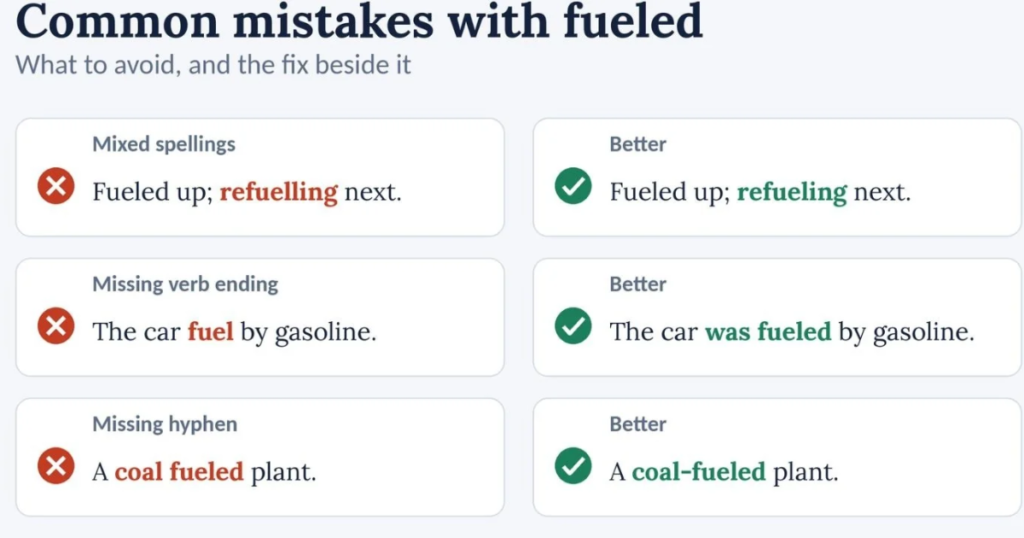
| Mistake | Better | Why it happens |
| fueled in one paragraph, fuelling in another | One system for the whole text | Writers copy from sources written in different varieties. |
| refuelled next to fueled | Convert the whole family: fuel, refuel, fueler | The prefix hides the word. |
| fueld, fuled | fueled (fuel + ed) or fuelled (fuel + led) | The u, e and l are easy to shuffle. |
| The car fuel by petrol | The car was fuelled by petrol | The passive needs was or were plus the participle. |
| fuelled of anger | fuelled by anger | By names the cause. |
| We need more fuels for the trip | We need more fuel | Fuel is usually uncountable. |
| a coal fueled plant | a coal-fueled plant | A compound adjective before a noun takes a hyphen. |
| Treating the other spelling as a typo | Check which variety the text uses | A spell-checker set to one region flags the other. |
Switching a Text Between US and UK Spelling
Editors often need to convert a whole article. A short routine saves time:
- Decide the target variety and set the document’s proofing language first.
- Search, ignoring capitals, for fueled and replace it with fuelled (or the reverse). Because refueled contains fueled, the same replacement fixes are refueled too.
- Repeat for fueling and fuelling, then for fueler and fueller. These are separate strings, so one search will not catch them all.
- Check each hit inside direct quotations, brand names and titles. Keep the original spelling there.
- Look in the places a search misses: headings, image alt text, captions, meta descriptions and file names.
Collocations and Tone
Look at the partners dictionaries list for fueled: the blaze, her anger or rage, speculation, rumours and gossip, and causes such as drugs, alcohol and caffeine (from WordReference’s collocations list). Most are heated or negative. Positive partners such as ambition exist, but the verb carries a little heat, so a sentence about a calm, steady process may sit better with support or encouragement. If you want more words for strong feelings, see passion synonyms in English.
FAQs
Is it fueled or fuelled?
Both are correct. Fueled, with one L, is the standard American spelling. Fuelled, with two L’s, is the standard spelling in British English and in many other English-speaking countries. They mean the same thing and sound identical, so choose the one that matches your readers and use it consistently throughout your writing.
Is “fuelled” wrong in American English?
No, but it is less common. Merriam-Webster lists fuelled as a variant, but most American writing uses fueled, so the double-L form usually looks British to US readers. For an American audience, choose fueled and fueling. For a British audience, choose fuelled and fuelled. Either way, keep your choice consistent.
Do refuel, fueling and fuel follow the same rule?
Yes. The same pattern applies across the whole word family. American English uses refueled, refueling and fuel, while British English uses refuelled, refuelling and fueller. Whichever spelling you choose for fueled or fuelled, apply the matching forms to every related word in the same text so your spelling stays consistent.
Do fueled and fuelled sound or mean anything different?
No. They have the same pronunciation, the same meanings and the same grammar. The only difference is spelling: one L in American English and two in British English. Both are pronounced roughly FYOO-uhld, with stress on the first syllable, and some speakers shorten the word to one syllable in quick speech.
Which spelling should I use for an international audience?
Choose the spelling that matches the largest share of your readers, then use it everywhere. If you cannot tell, follow your publication’s or employer’s style guide. Most readers accept either form, but they notice when one article mixes fueled and fuelled, so consistency matters more than which spelling you pick.
Final Thought
Fueled or fuelled in English is a question about your reader, not about right and wrong. Write fueled for American readers and fuelled for British, Irish, Australian and many other readers, then keep that choice from the first paragraph to the last. If you remember one thing, remember the stress: fuel is stressed on its first syllable, so American English keeps a single l and British English doubles it, just as it does when travelling and cancelled.