Maximize vs Maximise: Which Spelling Is Correct?
Both spellings are correct. Maximize is the American and usual Canadian spelling, while maximise is the standard British, Australian and New Zealand spelling. The meaning, pronunciation and grammar are identical.
The maximize vs maximise question is not a matter of right and wrong, only of audience. This guide shows which version to pick for your readers, how the -ize vs -ise pattern works across American, British, Canadian and Australian English, what “Oxford spelling” really means, and how to keep your spelling consistent from the first word to the last. You will also find every word form (maximizing, maximised, maximization and more), the computing and business senses of the word, maximize vs optimize, sample sentences, common mistakes and 15 quick FAQs.
Quick Answer: Maximize vs Maximise
| Question | Answer |
| Is it maximize or maximise? | Both are correct |
| Which is American? | Maximize (-ize) |
| Which is British? | Maximise (-ise), though Oxford style also uses maximize |
| Which is Canadian? | Maximize |
| Which is Australian and New Zealand? | Maximise |
| Does the meaning change? | No |
If your readers are mixed, the safest rule is simple: pick one spelling for the whole document and stick to it.
Maximize vs Maximise: What Is the Difference?
The only difference is one letter: maximize ends in -ize, maximise ends in -ise. Both spellings are the same verb, meaning to make something as large, great or effective as possible.
Merriam-Webster treats maximise as the British spelling of maximize. The Oxford Learner’s Dictionary lists maximize first and notes that British English also uses maximise, and the Britannica Dictionary gives the same pairing, including the noun maximization/maximisation. Cambridge Dictionary and Collins do the same. No major dictionary treats either form as an error.
| Maximize | Maximise | |
| Spelling | -ize | -ise |
| Part of speech | Verb | Verb |
| Meaning | To make as large or effective as possible | Identical |
| Pronunciation | Identical (ends in “-eyes”) | Identical |
| Typical region | United States, Canada | United Kingdom, Australia, New Zealand |
Think of the two spellings as two roads to the same place. The route looks different, but the destination does not change.
What Does Maximize (or Maximise) Mean?
To maximize means to make something as great, large or effective as possible. It can also mean to make the best possible use of something, and in computing it means to expand a window so it fills the screen. The opposite is minimize.
In practice, you can maximize profit, maximize study time, maximize storage space or maximize your chances of success. The verb does not create more of something that is fixed. Maximizing your time does not add hours to the day; it means using the hours you have as effectively as possible.
Maximize in Everyday English
In everyday writing, the verb often pairs with nouns such as time, space, effort, opportunities, resources, potential, benefits, results, chances and value.
- “Smart furniture can maximize the space in a small apartment.”
- “She maximized her chances of a good deal by comparing three quotes.”
- “Block out your mornings to maximize deep work.”
Maximize in Business and Economics
Business writing uses the word constantly because companies try to increase revenue, efficiency, productivity and returns. Common collocations include maximize profit, maximize revenue, maximize shareholder value, maximize efficiency, maximize returns and maximize customer lifetime value.
In economics, profit maximization is a core concept: the idea that a firm chooses the output and price that give the highest possible profit. The related noun utility maximization describes consumers choosing the combination of goods that gives them the greatest satisfaction within a budget. In psychology, a maximizer is someone who searches for the best possible option rather than one that is merely good enough, in contrast to a “satisficer”.
Maximize in Mathematics and Optimization
In mathematics, to maximize a function is to find the input that produces its greatest output. Linear programming, calculus and machine learning all rely on this idea. “The goal is to maximize the function subject to these constraints” is a typical sentence. The related adjective is maximal, used in technical writing (“maximal oxygen uptake”).
Maximize in Computing
In computing, to maximize a window means to enlarge it so it fills the available screen area. Operating systems such as Windows and macOS include a maximize button (on Windows it sits beside the minimize and close buttons).
- American: “Click the button in the corner to maximize the window.”
- British: “Click the button in the corner to maximise the window.”
The regional spelling changes, but the meaning does not. Software interfaces localized for the UK often show “Maximise” in menus and tooltips, while US versions show “Maximize”.
Maximize vs Maximise in American, British, Canadian and Australian English
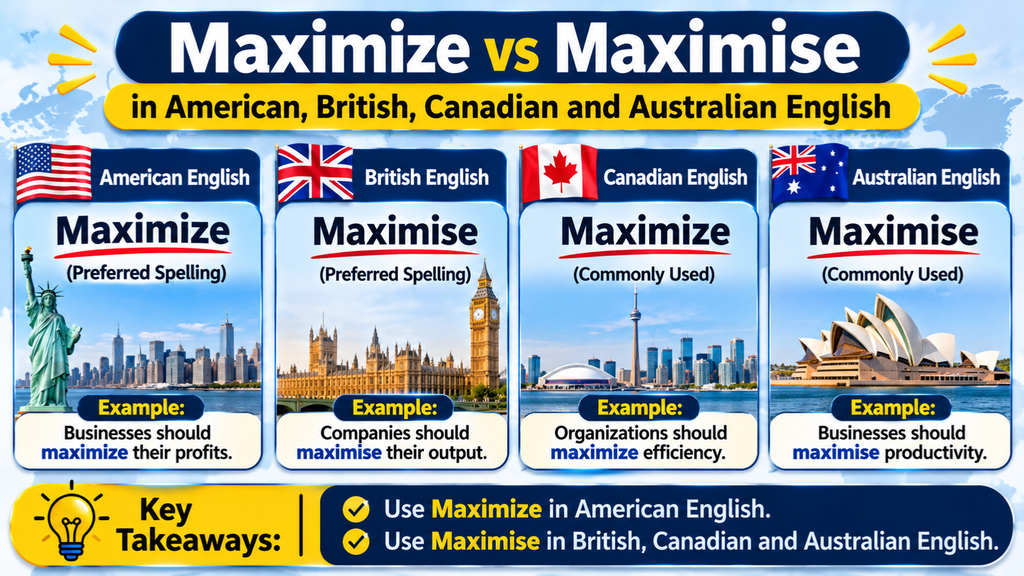
American English uses maximize, British English uses maximise (with maximize also accepted in Oxford style), Canadian English usually uses maximize, and Australian and New Zealand English mostly use maximise.
| Variety of English | Usual spelling | Also seen | Example |
| American English | maximize | none | We need to maximize profits. |
| British English | maximise | maximize (Oxford spelling) | We need to maximise profits. |
| Canadian English | maximize | maximise (less common) | We need to maximize profits. |
| Australian English | maximise | maximize (rare) | We need to maximise profits. |
| New Zealand English | maximise | maximize (rare) | We need to maximise profits. |
Why American English Uses Maximize
American spelling was shaped in part by lexicographer Noah Webster, whose early 19th-century dictionaries promoted simpler, more regular spellings and favoured the -ize ending. Today American style guides, including the Chicago Manual of Style and the AP Stylebook, use -ize.
Why British English Mostly Uses Maximise
In Britain, -ise became the dominant ending over time, helped by the influence of French -iser. Most UK newspapers and many organisations, such as The Guardian and The Economist, follow -ise house style. So maximise is the normal British choice.
Canadian English: The Odd One Out
Canadian English borrows -our and -re endings from British English (colour, centre) but keeps -ize and -yze like American English (organize, analyze). Canadian style guides and the Canadian Oxford Dictionary favour -ize, so maximize is the standard choice in Canada, even though many people assume -ise is the Canadian form. The Government of Canada’s Writing Tips guide also recommends -ize, with a short list of exceptions.
Australian and New Zealand English
Australian and New Zealand English follow British conventions for this ending, so maximise is standard. The Australian government’s Style Manual, for example, uses -ise forms. Maximize is understood everywhere but is rare in formal Australian and New Zealand writing.
Oxford Spelling: Why Maximize Is Not Just “American”
Oxford spelling is a British spelling standard that uses -ize, so a British writer can use maximize and still be writing British English. It is named after Oxford University Press (OUP), whose house style, including the Oxford English Dictionary (OED), prefers -ize endings.
This catches many writers out, because -ize is often dismissed as an Americanism. It is not. The -ize ending has been used in English for centuries and comes from Greek -izein, through Latin -izare. The -ise ending arrived later through French -iser and became dominant in everyday British usage.
Oxford spelling differs from standard British spelling in a few ways:
- It uses -ize in most verbs that can take it (organize, realize, maximize), while ordinary British spelling uses -ise.
- It keeps British spellings elsewhere: colour, centre, defence.
- It uses -yse rather than -yze (analyse, paralyse), because the -lys- part belongs to the Greek stem and is not a suffix.
- It is flagged in digital documents with the language tag en-GB-oxendict.
Oxford spelling is also different from what most British publishers do today. Many UK organisations use -ise, and the University of Oxford’s own style guidance for staff prefers -ise because it is more common and needs fewer exceptions. So “Oxford” here refers to OUP’s house style, not to everyone in Oxford.
In short: maximise is the normal British choice, maximize is a legitimate British choice in Oxford style, and maximize is the American and Canadian choice.
Meaning and Origin of Maximize
Dictionaries trace the verb to the Latin maximus, “greatest”, the superlative of magnus, “great”. English built maximize on the noun maximum by adding the suffix -ize. Both Merriam-Webster and the OED record the verb in the early 19th century, with evidence dating to 1815. The philosopher and reformer Jeremy Bentham, associated with utilitarianism and the principle of the “greatest happiness”, used it in his writing, which helped bring it into circulation.
That history explains why both spellings are valid in British English: -ize follows the Greek and Latin origin, while -ise follows the French influence.
Maximize Word Forms: Maximizing, Maximized, Maximization and More
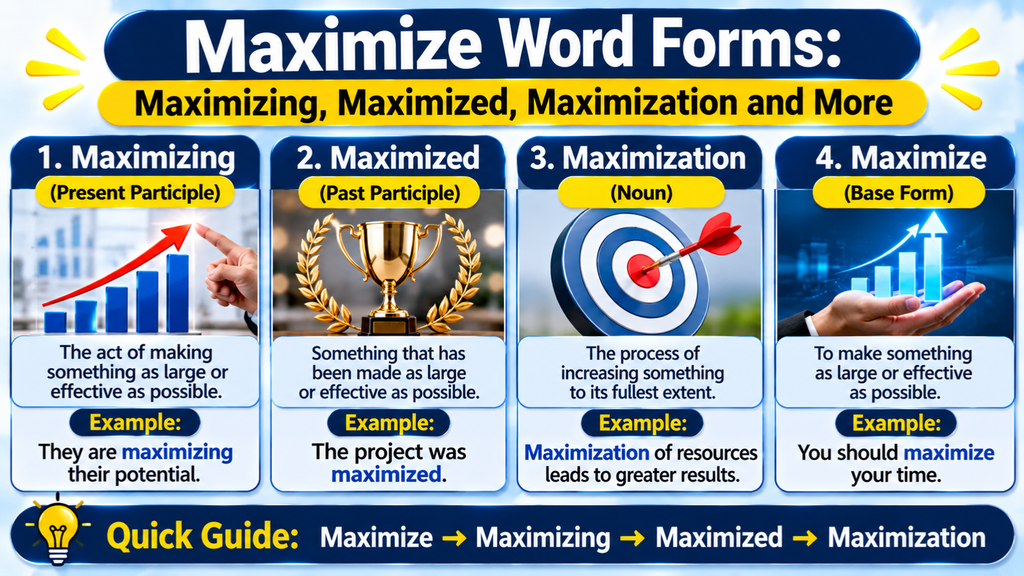
Every form of the word follows the same -ize or -ise pattern. Choose your base spelling first and the rest follow.
| Form | American | British |
| Verb | maximize | maximise |
| Third person | maximizes | maximises |
| Past tense / past participle | maximized | maximised |
| -ing form | maximizing | maximising |
| Noun (process) | maximization | maximisation |
| Noun (person or tool) | maximizer | maximiser |
Maximizing or maximising? Maximizing is the American spelling and maximising is the British one: “She is maximizing her savings” or “She is maximising her savings”, depending on your audience.
Maximized or maximised? Maximized is the past tense in American English, and maximised is the past tense in British English. The same word is the past participle: “We have maximised our reach.”
Maximization or maximisation? Maximization (US) and maximisation (UK) name the act or process, as in “profit maximization” or “revenue maximisation”.
Maximizer or maximiser? A maximizer (US) or maximiser (UK) is a person or thing that maximizes, a term common in economics, psychology and gaming.
Maximum and Maximal
Maximum is a separate word: a noun or adjective meaning the greatest amount, degree or size possible. It is spelled the same in every variety of English, so there is no -ise/-ize choice. Maximal is an adjective meaning the greatest possible, used mostly in technical and scientific writing. Neither has a spelling variant.
Maximize vs Maximise Examples
Here are matching sentences in both spellings. The meaning and grammar never change.
| American English | British English |
| We need to maximize profit this quarter. | We need to maximise profit this quarter. |
| The new layout will maximize storage space. | The new layout will maximise storage space. |
| Try to maximize your study time before the exam. | Try to maximise your study time before the exam. |
| The campaign is designed to maximize customer engagement. | The campaign is designed to maximise customer engagement. |
| Linear programming helps us maximize output with limited resources. | Linear programming helps us maximise output with limited resources. |
| Experienced players maximize every resource in the first ten minutes. | Experienced players maximise every resource in the first ten minutes. |
| Researchers should maximize the reliability of the results. | Researchers should maximise the reliability of the results. |
| Click the button to maximize the window. | Click the button to maximise the window. |
Which Spelling Should You Use?
Use the spelling that matches your audience, and use it consistently. The right answer depends on who will read your writing and which style guide you follow.
By Audience
Writing for US or Canadian readers: use maximize. Writing for readers in the UK, Australia or New Zealand: use maximise. A global audience can be served by either, as long as you stay consistent.
For a Website or SEO Content
Pick the spelling of your main market and set your site language to match. A UK business would use maximise and lang=”en-GB” in its page metadata, while a US store would use maximize and lang=”en-US”. If your traffic is split, choose the majority audience and keep the whole site consistent.
For spelling-comparison articles like this one, naturally mentioning both forms makes sense because the difference is the topic. For ordinary pages, do not force both spellings into the text just to catch both searches. Search engines treat the two spellings as closely related, and natural writing ranks better than stuffed variants.
For Business Writing and Emails
Follow your company style guide or the location of your reader. A US firm writes “The new strategy will maximize revenue”, while a UK firm writes “The new strategy will maximise revenue”. Neither version sounds more professional; it only reflects the chosen standard.
For Academic Writing
Follow the journal, university or publisher style guide. Some international and scientific publishers use Oxford spelling and therefore maximize alongside colour and centre. Others require plain British or American spelling. Before submitting, check the author guidelines, the required style manual and recent articles from the same publication.
With a Style Guide
The style guide always wins. If you do not have one, write a short rule for your team, such as “UK English, -ise endings”, and apply it everywhere.
The Consistency Rule
Never mix maximize and maximise in one document. If you write maximise on page one, use maximised, maximising and maximisation throughout. Readers rarely mind either spelling, but a mixture looks careless.
Words Like Maximize: The -ize vs -ise Pattern
Most verbs that end in -ize in American English end in -ise in British English, so if you know the pattern, you can predict the spelling of hundreds of verbs.
| American (-ize) | British (-ise) |
| maximize | maximise |
| minimize | minimise |
| optimize | optimise |
| organize | organise |
| realize | realise |
| recognize | recognise |
| summarize | summarise |
| prioritize | prioritise |
| customize | customise |
| analyze | analyse |
Note that analyze/analyse follows a slightly different pattern: British spelling uses -yse, and Oxford spelling keeps -yse as well.
Exceptions: Words That Are Always -ise
Some words end in -ise in every variety of English, because the ending is not the -ize suffix. Never change these to -ize.
| Word | Note |
| advertise | Not built with the -ize suffix |
| advise | Same |
| comprise | Same |
| compromise | Same |
| devise | Same |
| exercise | Same |
| revise | Same |
| supervise | Same |
| surprise | Same |
| despise | Same |
Americans and Canadians use -ise for these too, so “advertise” and “exercise” are not British spellings.
Maximize vs Optimize: What Is the Difference?
Maximize means to increase something to the greatest possible level, while optimize means to make something as effective, efficient or functional as possible, often by balancing several factors. The two follow the same spelling pattern: optimize (US) and optimise (UK).
- “We want to maximize revenue.” The target is the highest possible amount.
- “We want to optimize the sales process.” The target is the best overall performance, which may mean trading some of one thing for another.
Maximizing one number can even harm the whole system. A website that maximizes ad impressions may hurt user experience, whereas optimizing the page balances ads, speed and readability.
Common Mistakes With Maximize and Maximise
- Mixing both spellings in a document. Writing “maximize profit” in paragraph one and “maximised revenue” in paragraph five makes the text look unedited.
- Using the wrong spell checker language. A checker set to US English will flag maximise, and one set to UK English may flag maximize, even though both are valid for different readers.
- Treating maximise as a typo. It is not. It is the standard British, Australian and New Zealand spelling.
- Treating -ize as only American. Oxford spelling shows that -ize has a long British history.
- Changing words that never take -ize. Do not “correct” advertise, exercise or surprise to -ize.
- Forgetting the related forms. If you write maximise, also write maximised, maximising and maximisation.
- Thinking the meaning or pronunciation changes. It does not. The z/s switch changes spelling only.
Case Study: Choosing a Spelling for a Global Website
Imagine a software company with customers in the United States and the United Kingdom. Its marketing team writes: “Our platform helps businesses maximize productivity and optimise workflows.” The sentence is clear, but it mixes -ize and -ise.
If the main audience is American, the consistent version is: “Our platform helps businesses maximize productivity and optimize workflows.” If the main audience is British, it becomes: “Our platform helps businesses maximise productivity and optimise workflows.”
The company then sets lang attributes to match, adds the choice to its style guide and runs a final find-and-replace check before publishing. The lesson: choose one convention, record it and apply it everywhere.
How to Set Your Spell Checker to US or UK English
Set the proofing language to English (US) for maximize or English (UK) for maximise, then let the tool flag anything inconsistent. Menu names change between versions, so treat the steps below as a guide.
- Microsoft Word: open the Review tab, choose Language, then Set Proofing Language, and pick English (United States), English (United Kingdom), English (Canada) or English (Australia).
- Google Docs: use the File menu and choose Language to select the variety of English.
- Grammarly: use its dialect setting to choose American, British, Canadian or Australian English.
- Web pages: declare the language in your HTML, for example lang=”en-US” or lang=”en-GB”.
Write one sentence in your style note and follow it everywhere, for example: “We use British English with -ise endings (maximise, organise, realise).”
Frequently Asked Questions
Is it maximize or maximise? Both are correct. Maximize is the American and Canadian spelling, and maximise is the British, Australian and New Zealand spelling.
Is maximise correct? Yes. Maximise is a correct, standard spelling. Merriam-Webster labels it the British spelling of maximize, and British dictionaries list it as a normal variant.
Is maximise British or American? Maximise is the usual British spelling and is also common in Australia and New Zealand. Maximize is used in the United States and, in Oxford style, in some British publications.
Is maximize spelled with an S or a Z? In American English, maximize is spelled with a Z. In British English, maximise is usually spelled with an S.
Do Canadians use maximize or maximise? Canadians usually use maximize. Canadian English keeps -ize and -yze endings, even though it follows British spelling in words such as colour and centre.
Can you use maximize in British English? Yes. Oxford spelling uses -ize, and the OED lists maximize as a headword, so maximize is acceptable in British writing that follows Oxford style. Most UK newspapers still use maximise.
What is the past tense of maximize? The past tense is maximized in American and Canadian English and maximised in British, Australian and New Zealand English. The same form is the past participle.
How do you spell maximizing in American and British English? Maximizing is American; maximising is British.
Is it maximization or maximisation? Both exist: maximization is the American form and maximisation is the British form. They name the same process.
What is the noun form of maximize? The noun is maximization (American) or maximisation (British). A person or thing that maximizes is a maximizer (maximiser in British spelling).
Is maximize a word? Yes. Maximize is a standard English verb found in Merriam-Webster, Oxford, Britannica and other major dictionaries.
Do maximize and maximise mean the same thing? Yes. Both mean to make something as great or effective as possible, or to make the most of it.
What is the difference between maximum and maximize? Maximum is a noun or adjective meaning the greatest amount possible, while maximize is a verb meaning to make something as great as possible. For example: “The maximum speed is 100 km/h” and “We want to maximize speed.”
Does maximize mean “make the most of”? Yes. One established sense of maximize is to make the most of something, alongside the sense of increasing to a maximum.
What is the difference between maximize and optimize? Maximize aims for the greatest amount of one thing, while optimize aims for the best overall result across several factors.
Final Thought
In the maximize vs maximise debate, neither spelling is wrong. Use maximize for American and Canadian readers, and maximise for British, Australian and New Zealand readers. Oxford spelling shows that -ize has British roots too, but most UK publishers use -ise today.
Pick one spelling, apply it to every form of the word (maximizing or maximising, maximized or maximised, maximization or maximisation), set your spell checker to match, and keep it consistent from start to finish.