
Die vs Dice: Meaning, Plural, Examples and Easy Rules
You are in the middle of a board game, and someone asks, “Who has the dice?” You find only one cube and wonder: is this a die or a dice? The Die vs Dice question confuses learners and native speakers alike, because the two words look almost identical but follow an unusual plural pattern.
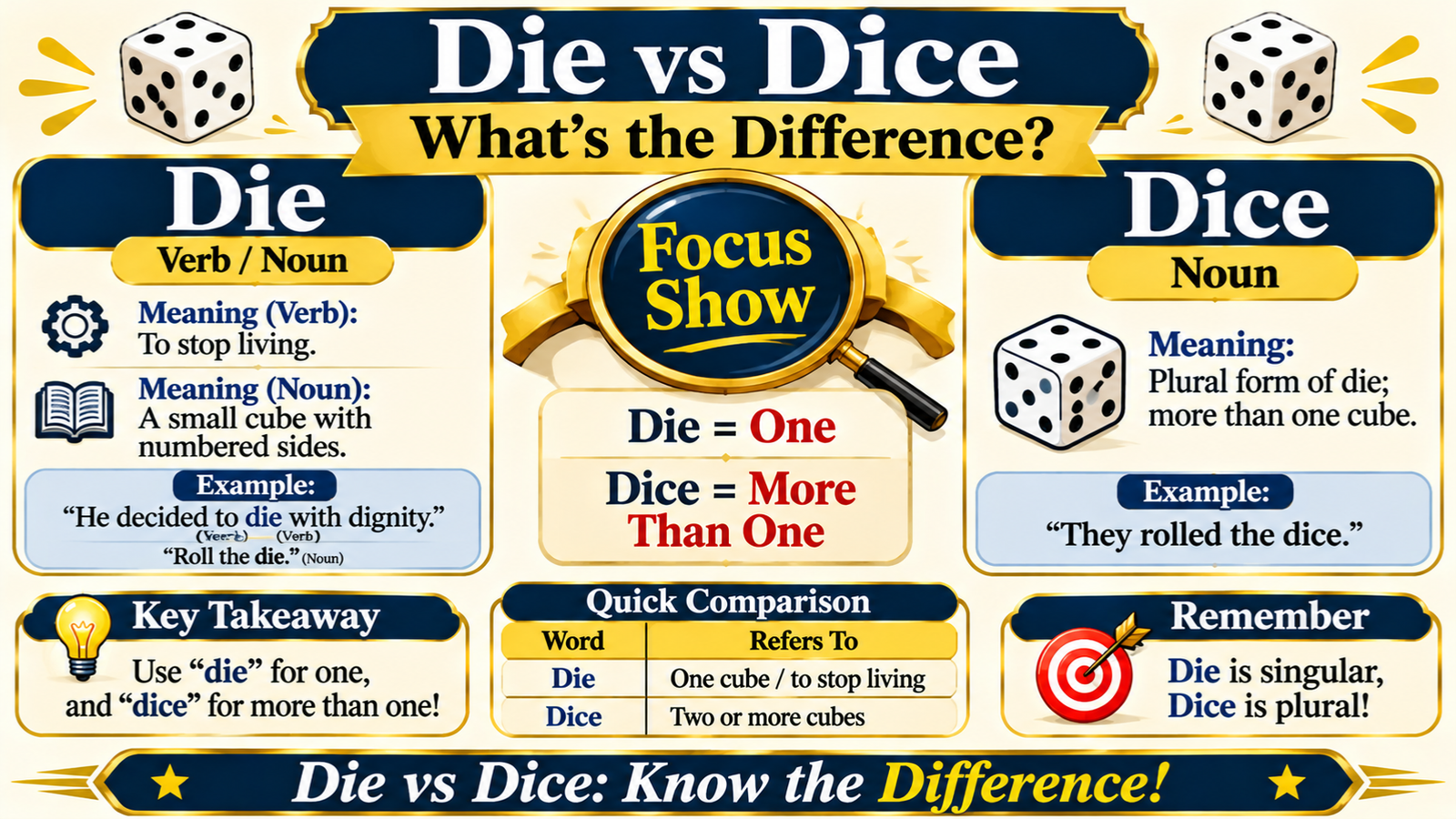
Here is the short version. Die is one cube. Dice is two or more. In this guide, you will learn the exact meaning of each word, the reason the plural is irregular, whether “one dice” is acceptable, how “dice” works as a verb in cooking, and how to avoid the most common mistakes. Every point comes with simple examples, so you can use the right word with confidence.
Die vs Dice: Quick Answer
The rule is simple:
One die. Two or more dice.
- Die is the singular noun for one small cube with marked sides.
- Dice is the plural noun for two or more of these cubes.
| Number of cubes | Correct word | Example |
| 1 | die | I rolled one die. |
| 2 or more | dice | I rolled two dice. |
Many people also say “one dice” in everyday speech, and dictionaries record this casual use. Still, in formal writing, school work, and published content, one die is the correct and safest choice.
What Does “Die” Mean?
A die is a small cube used in games of chance. Each of its six faces is marked with a number of dots, called pips, from one to six. When you throw it, the face on top gives a random result. The common six-sided version is also called a d6.
Pronunciation: /daɪ/ (it sounds like “dye”)
Examples of “die” (singular):
- Roll the die and move your piece forward.
- The die landed on four.
- Each player gets one die in this game.
- I found a die under the sofa.
- She picked up the die and shook it.
In each sentence, “die” points to a single cube, so the singular form is correct.
What Does “Dice” Mean?
Dice is the plural of die. Use it for two or more cubes, no matter what game you are playing. It appears in classic games such as Ludo, Monopoly, Yahtzee, backgammon, and craps, and in role-playing games such as Dungeons & Dragons, where players use polyhedral dice with 4, 8, 10, 12, or 20 sides (d4, d8, d10, d12, d20).
Pronunciation: /daɪs/ (it rhymes with “nice” and “twice”)
Examples of “dice” (plural):
- We need two dice to play this game.
- She rolled the dice and got a double six.
- The dice are on the table.
- He bought a new set of dice for the tabletop game.
- Both dice landed on the same number.
Notice the verb in “The dice are on the table.” Because dice is plural, it takes a plural verb.
Die vs Dice Comparison Table
This quick comparison table sums up the Die vs Dice difference:
| Feature | Die | Dice |
| Part of speech | Noun (also a verb with another meaning) | Noun and verb |
| Number | Singular | Plural |
| Meaning as a noun | One gaming cube | Two or more gaming cubes |
| Pronunciation | /daɪ/ | /daɪs/ |
| Verb agreement | The die is red. | The dice are red. |
| Example | Roll the die. | Roll the dice. |
| Other meaning | To stop living | To cut into small cubes |
Why Is the Plural of Die “Dice”?
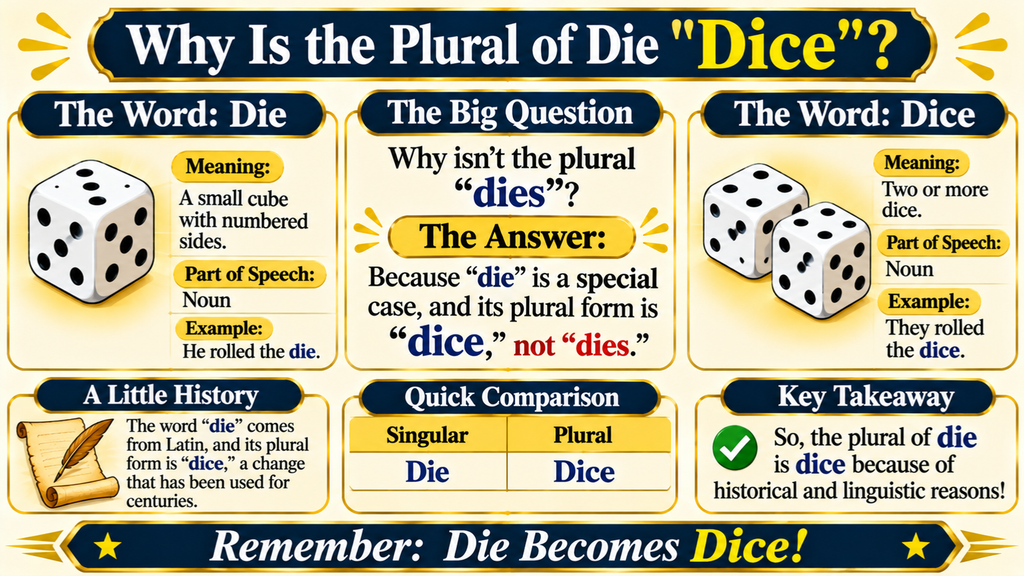
English has many irregular plurals, and die → dice is one of them. You do not simply add an “s.” The word has a long history that passes through Old French and goes back to Latin datum, meaning “something given or thrown.” Over the centuries, Middle English spelling shifted until the plural settled as “dice.”
The “ce” ending is not unusual. English often uses it to show a clear /s/ sound, just as in mice and pence. That is why the plural looks different from the singular in more than one letter.
Other irregular plurals follow their own historical patterns:
| Singular | Plural |
| die | dice |
| mouse | mice |
| goose | geese |
| tooth | teeth |
| man | men |
So when you wonder about the plural of die, think of mouse and mice. One mouse, two mice. One die, two dice.
Is “One Dice” Correct?
This is the biggest question behind Die vs Dice. Let’s answer it clearly.
Traditional grammar: “Dice” is plural, so “one dice” is not the standard form. The correct phrase is one die.
Modern usage: In casual speech, a lot of people say “a dice” or “one dice.” Major dictionaries, including Merriam-Webster and Cambridge Dictionary, note that “dice” is sometimes used as a singular noun in modern English.
Why does this happen? The reason is frequency. Most games use more than one cube, so people hear “dice” far more often than “die.” Over time, “dice” started to sound normal for a single cube too.
So what should you do?
- Casual conversation: “One dice” is understood and widely used.
- Exams, essays, instructions, and professional writing: Use one die.
Using “die” correctly also makes your writing look more careful and trustworthy.
Die vs Dice in American and British English
Unlike spelling pairs such as memorize vs memorise or colonize vs colonise, Die vs Dice is not a spelling difference between American and British English. Both varieties use the same forms: die for one cube and dice for more than one.
The real difference is how often people use each word. In both countries, “dice” is the everyday word, and “die” sounds more formal or technical. You are more likely to hear “Let’s roll the dice” than “Let’s roll the die,” even when only one cube is involved.
If your audience is international, stick with the traditional rule: one die, two dice. It works everywhere and avoids any confusion.
Die vs Dice vs Dies
A third form, dies, makes things trickier. The word die has several noun meanings, and each meaning can have its own plural.
| Meaning of “die” | Plural | Example |
| Gaming cube | dice | We rolled two dice. |
| Metal tool that cuts or shapes material | dies | The factory replaced two worn dies. |
| Tool used to stamp coins | dies | The mint made new dies for the coin. |
| Small piece of a silicon wafer in electronics | dies | Hundreds of dies are cut from one wafer. |
The rule is easy: for games, use dice. For tools and technical objects, use dies.
Also note that “dies” can be a verb form too: “The plant dies without water.” Context tells you which one is meant.
“Die” as a Verb
Here is another reason Die vs Dice feels confusing: die is also a verb meaning “to stop living” or “to stop working.” This verb has nothing to do with games.
| Form | Word | Example |
| Base form | die | Flowers die without water. |
| Third person singular | dies | The battery dies quickly. |
| Past tense | died | My grandfather died in 2010. |
| Present participle | dying | The plant is dying. |
Two things to remember:
- The verb die never becomes dice. You cannot say “The flowers dice.” The correct sentence is “The flowers die.”
- Do not mix up dying and dyeing. Dying comes from die (to stop living), while dyeing comes from dye (to color fabric or hair). Spelling the past tense of tricky verbs correctly matters too, as in our guide to lyed or lied.
“Dice” as a Verb
Dice is also a verb. In the kitchen, to dice means to cut food into small, even cubes. The cubes look like tiny gaming dice, which is how the word got this meaning.
| Form | Word | Example |
| Base form | dice | Dice the onions finely. |
| Third person singular | dices | She dices the carrots every evening. |
| Past tense | diced | He diced the tomatoes for the salad. |
| Present participle | dicing | I am dicing potatoes for the soup. |
Notice that the final “e” drops before “-ing”: dice → dicing.
Cooks often describe dice sizes like this:
- Small dice: about ¼ inch (6 mm)
- Medium dice: about ½ inch (12 mm)
- Large dice: about ¾ inch (20 mm)
You may boil or soften vegetables before cutting them, so it helps to know the difference between boiling vs parboiling.
A few related words also use “dice”:
- Slice and dice: to cut something into pieces, or to analyze data from many angles. “She sliced and diced the sales data.”
- Dicey: an informal adjective meaning risky or uncertain. “The weather looks a bit dicey.”
Popular Expressions With Die and Dice
Both words appear in well-known idioms:
- The die is cast. A decision has been made and cannot be undone. The phrase is linked to Julius Caesar, who is said to have used it when crossing the Rubicon in 49 BC. It uses the singular die.
- Roll the dice. To take a risk. “Starting a business is a roll of the dice.”
- No dice. An informal way to say “no” or “that will not work.” “I asked for a refund, but no dice.”
- Dice with death. To take a very dangerous risk. “Driving fast in the fog is dicing with death.”
- Loaded dice. Dice secretly weighted to cheat. It is also used figuratively for an unfair situation.
Since dice are thrown, be careful with look-alike words. Our guide to throne or thrown explains that mix-up.
Die vs Dice in Probability and Games
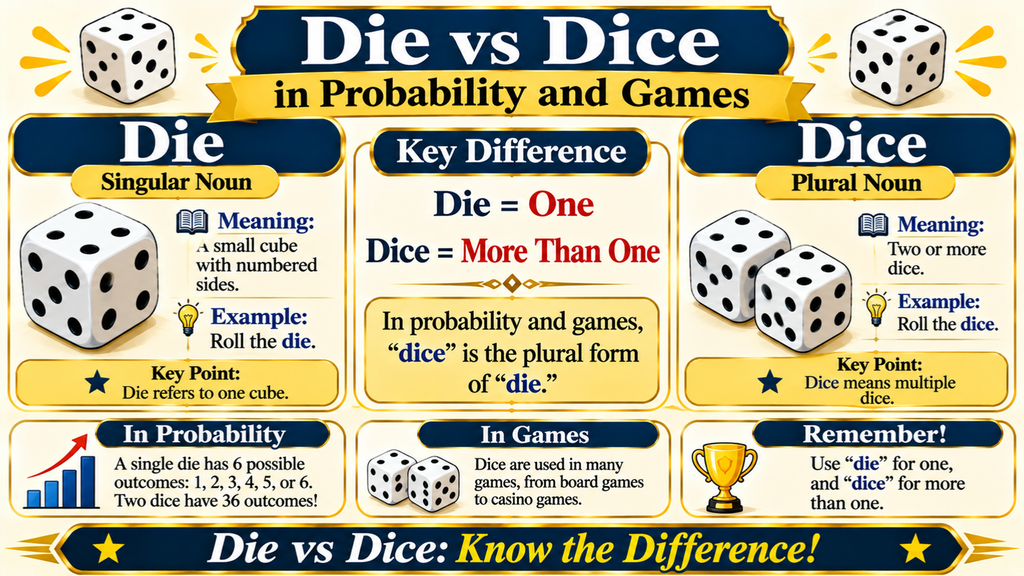
The difference between one die and two dice matters in mathematics too.
- A fair six-sided die has 6 equally likely outcomes, so the chance of rolling any one number is 1 in 6, or about 16.7%.
- Two fair dice give 6 × 6 = 36 possible ordered outcomes.
- A total of seven can happen in 6 ways (1+6, 2+5, 3+4, 4+3, 5+2, 6+1), so the chance is 6/36, or 1 in 6.
- A total of twelve can happen in only 1 way (6+6), so the chance is 1 in 36.
This is why seven is the most common total in games like craps and Monopoly. It is also a useful reminder that a single die and a pair of dice behave very differently.
Common Mistakes With Die vs Dice
Here are the most frequent errors and their fixes:
| Incorrect | Correct | Why |
| I rolled one dice. | I rolled one die. | One cube needs the singular form in formal English. |
| We rolled two dies. | We rolled two dice. | Gaming cubes use “dice,” not “dies.” |
| Three die are missing. | Three dice are missing. | More than one needs the plural. |
| The old tree dice last year. | The old tree died last year. | “Dice” is never the past tense of “die.” |
| Please die the potatoes. | Please dice the potatoes. | To cut into cubes is “dice.” |
| The plant is dieing. | The plant is dying. | The “ie” changes to “y” before “-ing.” |
Easy Memory Tricks
- Mouse and mice: One mouse, two mice. One die, two dice.
- The “s” sound: Dice ends with the /s/ sound, just like plural words. Die ends with a clean “eye” sound.
- Games versus tools: Games use dice. Machines use dies.
- Kitchen cue: If you are cutting vegetables, the word is always dice.
Frequently Asked Questions
Is it die or dice?
Use die for one cube and dice for two or more. For example, “I rolled one die” and “I rolled two dice.”
Is dice singular or plural?
Traditionally, dice is plural. The singular form is die. In casual modern English, some people also use “dice” for a single cube, but this is less formal.
Can I say “one dice”?
You can in casual speech, and most people will understand you. For formal or exam English, say one die.
What is the plural of die?
For the gaming cube, the plural is dice. For tools used to shape or stamp material, the plural is dies.
What is the singular of dice?
The singular of dice is die. For example, “Pick up the die and roll again.”
Is dice a verb?
Yes. As a verb, dice means to cut food into small cubes. Its forms are dice, dices, diced, and dicing.
What is the difference between die and dice?
Die means one gaming cube, while dice means two or more. Die is also a verb meaning to stop living, and dice is also a verb meaning to cut into cubes.
Is “a dice” grammatically correct?
It appears in modern speech and is recorded by dictionaries, but “a die” is the traditional and preferred form in formal writing.
Final Thoughts
The Die vs Dice puzzle comes down to number and meaning. Use die for one gaming cube and dice for more than one. Remember that dies belongs to tools and machines, that die can also mean to stop living (die, died, dying), and that dice can also mean to cut food into cubes (dice, diced, dicing).
Although “one dice” is common in casual talk, one die is the correct choice for careful writing. Keep the mouse-and-mice trick in mind, and you will never mix them up again.

2 Comments