Stub vs Stud: The Real Difference (and Why Everyone Mixes Them Up)
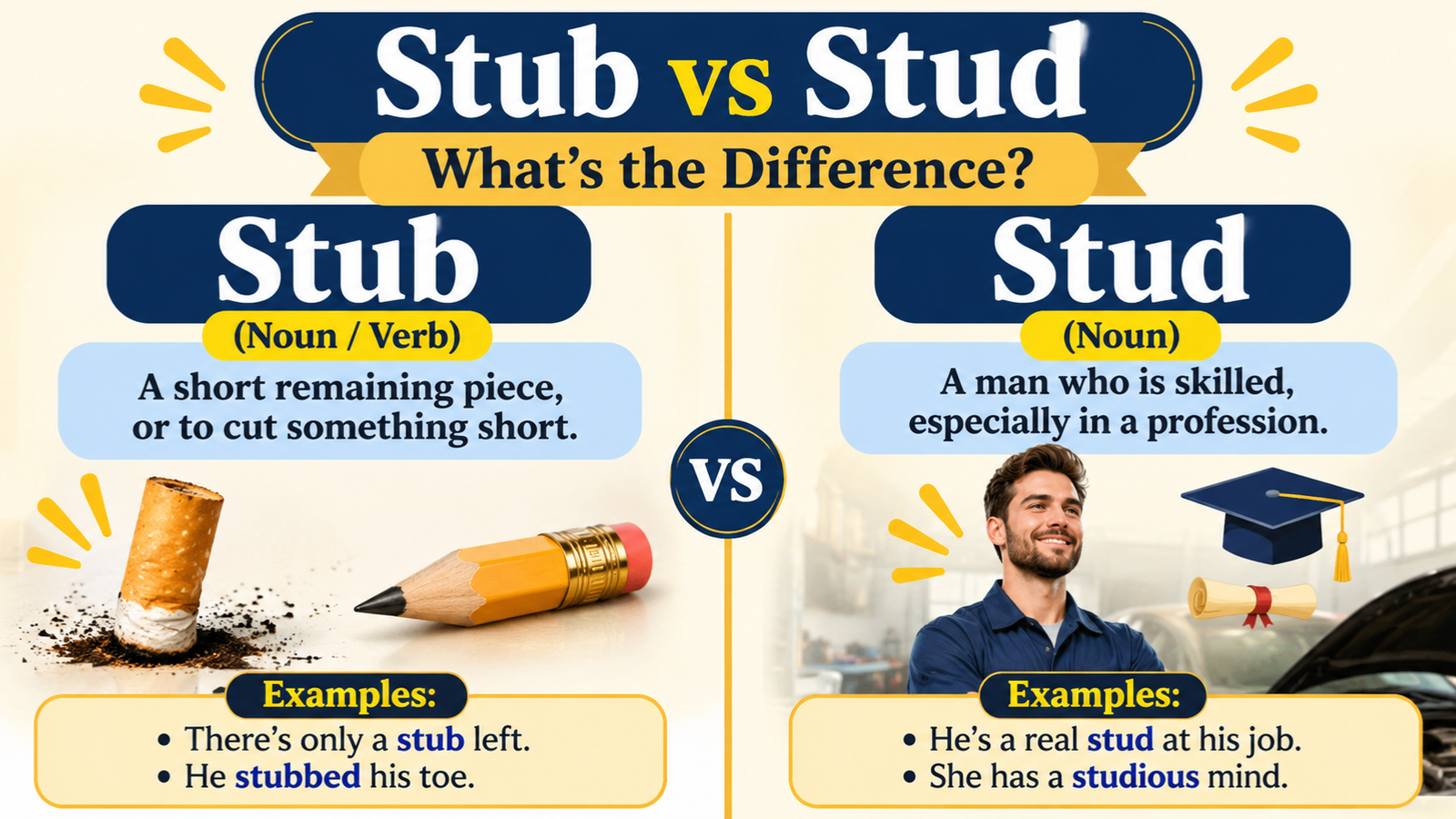
A stub is what’s left over. A stud is what stands up, holds something up, or sticks out on purpose.
That’s the whole difference in one breath. If it’s all you needed, close the tab with my blessing.
But most people searching stub vs stud aren’t after a dictionary line. They’re standing in a hallway holding a drill. Or they’re squinting at a plumber’s quote. Or they’ve got a pair of earrings sitting in a cart and a nagging feeling the word means something else too. Fair enough. The two words look alike, sound alike, and each carries more meanings than it has letters.
So this page settles stub vs stud by situation. Meanings first, then walls, pipes, bolts, jewelry and everyday English. A table sits in the middle you can screenshot, and the mistakes section near the end covers where this confusion actually costs money.
Stub vs Stud: The Quick Answer
Working on a wall? A stud is the vertical framing piece hidden inside it. A stub is a short piece of something: a short wall, or a short length of pipe or conduit left poking out until someone connects it.
Reading a parts list? A stud bolt is a headless rod threaded at one or both ends. “Stub bolt” is a looser term, and I’ll explain why you shouldn’t trust it blindly.
Shopping for jewelry? Stud means a small post-style earring that sits flat against the earlobe.
Just using English? A stub is the bit that remains after you’ve used the rest of something: a ticket, a pencil, a cheque. It’s also what you do to your toe. A stud is a decorative metal knob, a male animal kept for breeding, or slang for a confident, good-looking guy.
Short, stump-like, leftover: stub. Upright, supporting, fixed in place: stud. Hold onto that pair and every stub vs stud question below will feel obvious.
What Does Stub Mean?
The word comes from Old English stybb, a tree stump. That origin explains nearly every modern use. A stub is a short, blunt remainder of something that used to be longer.
As a noun, it has more uses than people realize:
- The remainder of something used up. The stub of a pencil, a candle or a cigar.
- The kept part of a ticket. A ticket stub, the piece you hold onto after the rest is torn away.
- The record section of a cheque book. In American English, a check stub. The same idea gives us the pay stub, the earnings statement attached to wages. Brits call it a payslip.
- A tree stump. The oldest meaning, and the source of all the others.
- A pen with a short, blunt nib. Calligraphers talk about stub nibs, which are broad, flat nibs that give thick downstrokes.
- A specimen mount in a lab. Scientists attach samples to small metal stubs before putting them under a scanning electron microscope.
- A placeholder in code. A stub is a stand-in function that returns a fixed result until the real one is written, common in unit testing.
- A short capped pipe or conduit. More on that in the plumbing section.
As a verb, stub means to bump your toe against something fixed, as in “I stubbed my toe on the bed frame at 2 a.m.” It also means to press out a cigarette (to stub it out). A rarer, older use means to clear land of stumps, which is why you’ll still see “stub up roots” in dictionaries.
I kept a concert ticket stub in my wallet for something like six years. The show was forgettable. The stub, soft and gray at the edges, outlasted three phones and two jobs. That’s the odd thing about stubs: the useful part is gone, and people keep the remainder anyway. That’s the stub half of the stub vs stud pair: short, leftover, kept.
One more note on a stubbed toe, since it comes up. It’s usually just painful, but a hard hit can fracture the bone. If you can’t put weight on it, or it’s badly swollen, bruised or looks out of line, get it looked at.
What Does Stud Mean?
Stud goes back to Old English studu, a post or prop. Opposite energy from stub: a stud holds, props, supports, or is fixed in place.
The horse-breeding sense comes from a different Old English word, stod, meaning a herd of horses kept for breeding. So the two “studs” are technically separate words that ended up spelled the same, which explains why one means a wall post and the other means a stallion.
Here’s the full spread:
Construction. The vertical member inside a wall frame, wood or steel, that drywall and fixtures attach to.
Machinery and hardware. A short rod or pin fixed into something and sticking out. A stud bolt (headless, threaded rod) is the common version. Wheel studs on cars are the same idea. Ships use stud-link chain, where a small brace across each link stops the chain from kinking.
Decoration. An ornamental nail with a large head, or a knob or boss on leather, denim, belts and boots. In formal wear, a shirt stud is a decorative fastener that goes through buttonholes in a tuxedo shirt instead of being sewn on.
Jewelry. A post-style earring that sits flat against the earlobe.
Sports and tires. Football boots have studs (Americans say cleats), and referees call a dangerous tackle “studs up.” Winter tires can have metal studs for ice, though rules on using them vary by place.
Animals. A stud is a male animal kept for breeding. That’s where stud farm, stud fee and “at stud” come from. A stud horse is a stallion used for breeding.
Slang. A stud is a confident, good-looking man. Stud muffin has aged about as well as you’d expect.
Cards. Five-card stud and seven-card stud are poker games in which some cards stay face up on the table.
As a verb or adjective. To stud something is to scatter it thickly with points or ornaments. That gives us “studded.” A star-studded cast, a jewel-studded crown, a field studded with wildflowers. The grammar mirrors the construction sense: points set into a surface.
There’s also an old, rare use meaning a stem or trunk, but you’ll almost never meet it in modern writing.
That covers the stud half of stub vs stud. The construction sense deserves the most space, so let’s go there.
Stub vs Stud in Construction and Framing
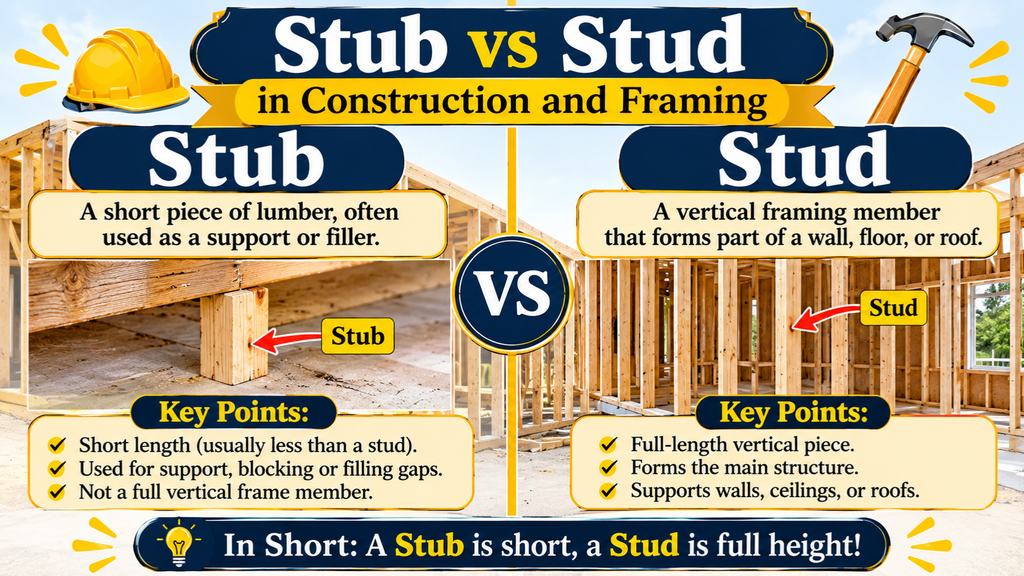
Walls are where most of the stub vs stud mix-ups happen, and the confusion is understandable.
A stud is a vertical piece of framing, usually a 2×4 or 2×6 (about 1.5 by 3.5 inches and 1.5 by 5.5 inches in real measurements), set at 16 or sometimes 24 inches apart, center to center. Drywall gets screwed to them. Shelves, TVs and cabinets get anchored to them. Steel studs do the same job in commercial buildings and don’t warp.
Studs run between a bottom plate (sole plate) on the floor and a top plate at the ceiling. Around a door or window, the frame adds king studs, jack studs (also called trimmers) and shorter cripple studs. If someone says “king stud” at your renovation, they’re still talking about a stud, just one with a specific job.
The first time I hung a heavy shelf, I trusted the wall and used drywall anchors where I should have found a stud. The shelf held for about nine days. Then it let go around 2 a.m., and the sound carried through the whole apartment. A $20 stud finder would have saved me a patched wall and an apology to a neighbor. If you haven’t used one, the basics are simple: electronic finders detect changes in density behind drywall, magnetic ones find the screws or nails holding the drywall to the studs. Once you’ve found one stud, measure 16 inches along and check, but verify instead of assuming.
Stud Wall vs Stub Wall
A stud wall is simply a wall built from studs. In the UK, “stud wall” is the standard name for an interior timber-framed partition.
A stub wall is a short wall that doesn’t run floor to ceiling. Think of the half wall between a kitchen and living room, a low wall that supports a bar-height counter, or the short partition that hides plumbing behind a toilet. Some people call these pony walls, and the terms overlap depending on region and trade.
In framing terms, stub vs stud comes down to role and height. Here’s the part that trips people up: a stub wall is usually built out of studs. They aren’t rivals. One is a component, the other is a kind of wall made from that component. Asking “stud wall vs stub wall” is a bit like asking “bricks vs garden wall.” The difference is height and purpose.
Stub vs Stud in Plumbing and Electrical
This section earns its own heading, because “stub” does a lot of real work on job sites and almost none of it involves studs.
In plumbing, a stub-out is a short length of pipe that comes out of a wall or floor, usually capped, waiting for a fixture or valve to be connected. The supply lines under a bathroom sink start as stub-outs, often finished with a shut-off valve. The drain a sink trap connects to starts the same way. During rough-in, before drywall goes up, the plumber sets these in the right places, pressure-tests the lines and caps them.
Basements are a good example. When a builder pours a slab, they often leave a capped drain stub-out in the floor so a future bathroom can be added without breaking up the concrete.
Electricians use similar language. A conduit stub-up is a short vertical piece of conduit that rises out of a slab or floor so wiring can be pulled through later.
My plumber once told me, “I’ll stub out the line by Thursday.” I nodded like I understood, then spent a minute quietly wondering whether he was about to frame something. He wasn’t. He meant he’d run the pipe to the spot and cap it, nothing more. That kind of misunderstanding costs nothing if you ask and a lot if you don’t.
So in this context, the stub vs stud question has a clean answer. A stub is a short, capped end of a pipe or conduit. A stud is the wooden or steel frame member the pipe may happen to run through.
Stub Bolt vs Stud Bolt
Fasteners are the third place where stub and stud collide, and this is where mistakes cost real money.
A stud bolt, usually just called a stud, is a rod threaded at both ends (sometimes along its whole length) with no head. One end screws into a tapped hole, and a nut goes on the other end. You’ll find them in pipe flanges, engine blocks, pressure vessels and wheel hubs. In flanged joints, B7 studs with matching nuts are a common specification.
Wheel studs are the posts your lug nuts tighten onto. Many European cars use wheel bolts instead, which thread directly into the hub, so “does my car have studs or bolts?” is a fair question to ask before buying lug nuts.
“Stub bolt” is murkier. There isn’t a universal standard definition. Suppliers and tradespeople tend to use it for short bolts, and some use it loosely for anything stubby. So if a drawing or order says “stub bolt,” don’t assume. Check the thread spec, diameter, length and material, because the nickname alone won’t tell you what you’ll receive. In this corner of stub vs stud, specs beat vocabulary every time.
A guy who worked a hardware counter for years once told me that half the people who ask for “a stud bolt” walk away with a headed bolt, and about a third of those come back. His advice was blunt: bring the old part, or at least a photo with a ruler next to it.
Stub vs Stud in Everyday English and Jewelry
Outside the workshop, stub vs stud stops being a mix-up and becomes two clearly separate vocabularies.
Ticket Stubs and Other Leftovers
A ticket stub is the part you keep after the usher tears the ticket. A pay stub is the earnings statement. A cigarette stub, in British English, is the end you press out. A pencil stub is what’s left when you’ve sharpened it down to a thumb’s length. They all share one idea: something big got used, and a small piece remains.
Stud Earrings Basics
Stud earrings are small earrings with a decorative face on a straight post that passes through the piercing and is held by a backing: butterfly, push-back or screw-back. They sit flush against the earlobe, which makes them the standard first earring after a new piercing and an everyday go-to. Diamond studs, pearl studs and plain gold or steel studs are the main types. Flat-back studs, sometimes called labret studs, are common for cartilage piercings.
Material matters more than style. A stud with a nickel-heavy post can irritate a fresh piercing, and implant-grade titanium or surgical-grade steel is the usual safer choice. A piercer can tell you more than a product listing can.
I lost one backing from a favorite pair on a train once. I found the earring back at home, still in my ear, held on by nothing but optimism and the friction of the post. Buy spare backings.
Spelling the Forms: Stubbed, Stubbing, Studded, Studding
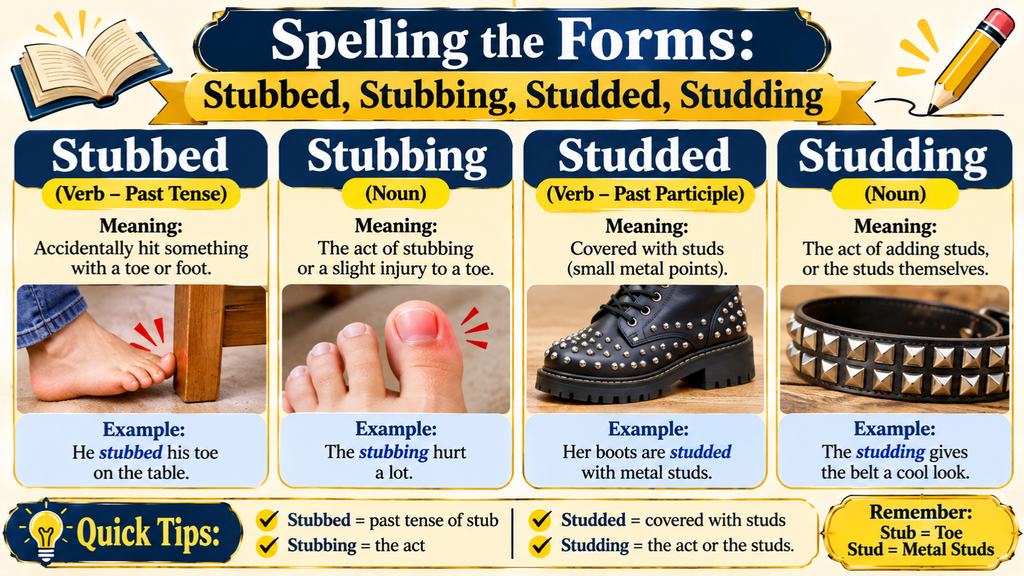
Both halves of stub vs stud double their final consonant when you add an ending. Stub becomes stubbed and stubbing. Stud becomes studded and studding. That’s the short-vowel rule: a single vowel followed by a single consonant usually doubles the consonant before -ed or -ing. If you like spelling puzzles of this kind, Marveled or Marvelled covers another doubled-letter question where American and British spelling split.
Typical slips are “stubed” and “studed.” Spellcheck usually catches them, but not always in captions.
Example Sentences
Here’s stub vs stud in real sentences, so you can hear the difference.
Stub:
- She tucked the ticket stub into the book she was reading and forgot about it for a decade.
- I stubbed my toe on the doorframe and said a word I won’t repeat here.
- He stubbed out his cigarette and walked back inside.
- The check stub showed exactly what the deposit was for.
- Write the unit test first, then replace the stub with the real function.
- The plumber capped the stub-out until the sink arrived.
- The tree stub in the corner of the yard had been there since before the house.
Stud:
- Drill into the stud, not the drywall, if the shelf is going to hold books.
- The stud finder beeped twice, then went quiet.
- The stallion was sold for a very large stud fee.
- She wore tiny diamond studs to the interview.
- The boots had six studs on each sole.
- The jacket was studded with brass rivets.
- It was a star-studded cast, and half of them had four lines each.
Stub vs Stud at a Glance
| Context | Stub | Stud |
| Construction | A short wall that doesn’t reach the ceiling (stub wall) | A vertical framing member inside a wall |
| Plumbing / electrical | A short capped pipe or conduit left for later connection | Not usually used; the pipe may pass through a stud |
| Fasteners | A loosely used term for a short bolt (check specs) | A headless rod threaded at one or both ends |
| Jewelry / fashion | Not used | Post-style earring; metal knob or point on clothing, boots or tires |
| Animals | Not used | A male animal kept for breeding |
| Everyday English | Leftover piece (ticket, pencil, cheque); to hit your toe; to put out a cigarette | Slang for an attractive man; the card game stud poker |
| Core idea | Short, leftover, partial | Upright, supporting, fixed |
Mistakes People Actually Make
These stub or stud slip-ups show up again and again.
The first is anchoring heavy things into drywall instead of a stud. Drywall anchors have weight ratings, and a stud has a far better grip. If a shelf, TV bracket or cabinet needs to stay up, find the stud.
The second is mishearing a contractor. “Stub-out” and “stud” are not interchangeable, and a quote that says “stub out for washer” is talking about a capped line for a washing machine, not framing.
The third is ordering the wrong bolt. A stud bolt, a stub bolt and a regular headed bolt do different jobs. Order by thread specification and length, not by what somebody called it.
The fourth is buying “studs” for a healing piercing without checking what the post is made of.
The fifth is purely linguistic. People write “stud” when they mean “stub” and vice versa, usually in emails or captions, and spellcheck won’t catch it because both are real words. “I kept the ticket stud” reads strangely, but it slips through more often than you’d think.
How to Remember the Difference
Two small tricks settle most stub vs stud doubts for me.
Stub ends with a “b” that looks like a little stump, and stubs are what’s left after something ends. Stud ends with a “d” that looks like a post standing up, and studs are what stand.
The other is physical. Run your finger along a ticket stub, then along a wall frame. One is short and blunt. The other is a tall, standing member. If you blank, ask whether the thing is leftover or load-bearing. Leftover is stub. Load-bearing, fixed or decorative-on-a-post is stud.
Short, near-identical word pairs are a theme on this site, and the same trick of tying each word to a picture works elsewhere. Lag vs Log and Moat vs Mote both play with one-letter swaps, and Throne or Thrown shows how sound-alikes trip people up. For a longer list of this kind of comparison, browse the Vs guides.
FAQs
What is the difference between stub and stud?
A stub is a short leftover piece or a short end, like a ticket stub, a pencil stub or a capped pipe stub-out. A stud is something upright and fixed: a wall framing member, a headless bolt, a post earring. Same three-letter start, completely different jobs. That’s the difference between stub and stud in one line.
What does stub mean?
Usually, the short remaining piece of something. As a verb, it means to bump your toe or to press out a cigarette. In software, it’s a placeholder function.
What does stud mean?
It depends on where you meet it. In building, a wall stud. In hardware, a headless threaded rod. In jewelry, a post earring. In animal breeding, a male kept for breeding. As slang, a confident, good-looking man.
What is a stud in construction?
The vertical piece of framing inside a wall, normally wood or steel, spaced 16 or 24 inches apart. Drywall and heavy fixtures attach to it.
What is a stub-out in plumbing?
A short pipe section that sticks out of a wall or floor, capped until a fixture or valve gets connected. If you’re renovating a bathroom, you’ll hear this word a lot from your plumber.
What is a stub wall?
A short wall that doesn’t go all the way to the ceiling. It’s often built from studs, which is why the two words keep appearing in the same sentence.
What does it mean to stub out something?
For a cigarette, it means pressing the lit end against a surface until it goes out. For plumbing or electrical work, it means running a line to a spot and capping it for later.
What is the difference between a stud bolt and a stub bolt?
A stud bolt is a headless rod threaded at both ends or fully along its length. “Stub bolt” has no single agreed definition and is often used loosely for short bolts. When in doubt, confirm the thread, diameter and length in the specification instead of relying on the name.
Can a stud and a stub be the same thing?
Not really, but they can share a location. A stub wall is made from studs, and a pipe stub-out may pass through a stud. Related, not identical.
What are stud earrings?
Small earrings that sit directly against the earlobe, held in place by a post and a backing. They’re the usual choice for new piercings and daily wear.
What is a ticket stub?
The part of a ticket you keep after the rest is torn off. People save them as keepsakes, and some venues still use them as proof of entry.
Is it stubbed or stubbed out?
Both are correct, but they mean different things. “Stubbed” usually refers to bumping a toe. “Stubbed out” usually means a cigarette was put out.
Why does stud mean both a wall post and a horse?
They come from two different Old English words that ended up with the same spelling. One meant a post or prop, the other a herd kept for breeding.
Final Thoughts
Look, the confusion around stub vs stud is reasonable. Two short words, a near-identical spelling, and plenty of overlap in places like walls and pipes. But the logic is simple once you see it.
A stub is short, partial, leftover. It’s the torn end of a ticket, the capped end of a pipe, the short wall that stops halfway. A stud is upright, supporting and fixed. It’s the frame inside the wall, the headless rod in a flange, the post in an earlobe.
So next time stub vs stud comes up, ask two questions: is this a leftover or a structural piece, and what context am I in? That alone answers about nine times out of ten.
If this cleared things up, bookmark it for the next time a contractor, a parts list or a jewelry listing throws one of these words at you. And if you enjoy untangling look-alike words, there are plenty more in the Vs category.