Vertex vs Vertices: Meaning, Plural, Examples and Rules
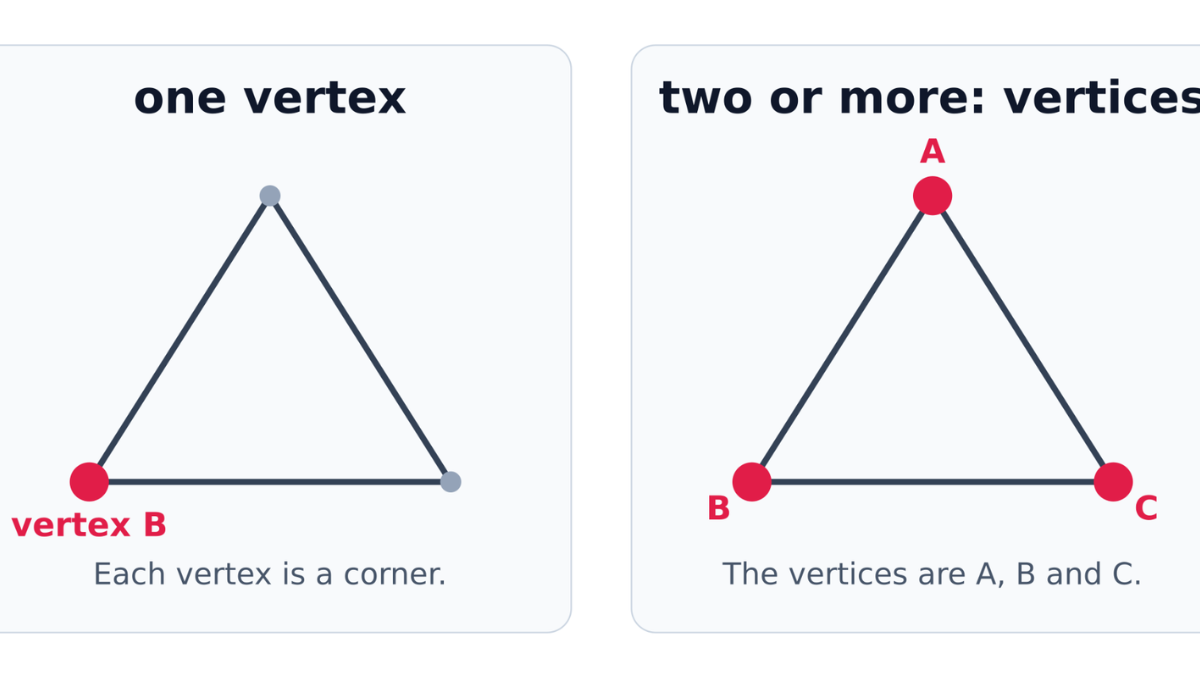
Vertex vs vertices comes down to one question: how many points are you describing? Vertex is the singular, one corner or meeting point. Vertices is the standard plural, two or more. Some dictionaries also list vertexes as a variant, but vertices is the form maths teachers, textbooks and exam boards expect. The word vertice is never correct.
Quick answer: The vertex vs vertices answer is one vertex, two vertices. A vertex is a point where lines, edges or curves meet, like the corner of a cube. The pair works like index and indices or vortex and vortices.
In this guide: the vertex vs vertices rule, what a vertex means in geometry, how many vertices common shapes have, Euler’s formula, vertices in graph theory and 3D graphics, pronunciation, vertices vs vertexes, the Latin plural pattern, vertex vs apex, example sentences, common mistakes and a short FAQ.
Vertex vs vertices: the simple rule
To settle any vertex vs vertices doubt, count the points you are talking about.
| If the sentence has… | Use | Example |
| a, an, one, each, every, this, that | vertex | Each vertex of the cube joins three edges. |
| two, three, both, all, these, those, several, many, no | vertices | The vertices of the triangle are A, B and C. |
Two details trip people up. Each and every stay singular even when you mean many points: every vertex lies on the circle. And zero takes the plural: a circle has no vertices.
What does vertex mean?
A vertex is a point where two or more lines, rays, edges or curves meet. In everyday geometry you can think of it as a corner, but the exact meaning shifts a little with the subject.
Vertex of an angle
In an angle, the vertex is the point where the two rays start. When an angle is written ∠ABC, the middle letter, B, is the vertex. An angle has exactly one vertex, and the vertex is a point, not the whole angle.
Vertex of a polygon
A polygon is a closed shape made of straight sides. Every point where two sides meet is a vertex. For a simple polygon, the number of vertices equals the number of sides, so a hexagon has six sides and six vertices.
Vertex of a polyhedron
A polyhedron is a solid with flat faces. Its vertices are the corner points where three or more edges meet. When you count vertices on a solid, count corners only, not points along an edge. A square pyramid has four corners on its base plus the tip, so it has 5 vertices.
Vertex of a parabola
For a parabola, the vertex is the turning point: the lowest point of a U-shaped curve or the highest point of an upside-down one. There are two standard ways to find it.
- Vertex form: y = a(x − h)² + k has its vertex at (h, k). So y = (x − 2)² + 3 has its vertex at (2, 3).
- Standard form: for y = ax² + bx + c, the vertex sits at x = −b / 2a. For y = x² − 4x + 7, that gives x = 2, and putting it back in gives y = 3. Same point, (2, 3).
The sign of a tells you what kind of vertex it is. If a is positive, the parabola opens upward and the vertex is a minimum. If a is negative, it opens downward and the vertex is a maximum. For y = −x² + 6x − 5, the vertex is at x = 3, y = 4, so the maximum is (3, 4).
Don’t confuse the vertex with the x-intercepts. The vertex is where the curve turns. The intercepts are where it crosses the x-axis, and a parabola can have a vertex without any intercepts at all.
Vertices of other conic sections
A parabola has one vertex. A hyperbola has two, one on each branch. For an ellipse, many textbooks call the two ends of the major axis its vertices and the ends of the minor axis co-vertices, while others call all four endpoints vertices. Follow the convention in your own course.
What does vertices mean?
In the vertex vs vertices pair, vertices is simply the plural of vertex. It has no separate definition: it names the same kind of point, only more than one of them. The three corners of a triangle are its vertices. So are the eight corners of a cube, the points of a star-shaped polygon, and the dots in a network diagram.
How many vertices do common shapes have?
Flat shapes (polygons)
| Shape | Sides | Vertices |
| Triangle | 3 | 3 |
| Quadrilateral (square, rectangle, rhombus) | 4 | 4 |
| Pentagon | 5 | 5 |
| Hexagon | 6 | 6 |
| Heptagon | 7 | 7 |
| Octagon | 8 | 8 |
| Nonagon | 9 | 9 |
| Decagon | 10 | 10 |
Solid shapes (polyhedra)
| Solid | Vertices | Edges | Faces |
| Tetrahedron | 4 | 6 | 4 |
| Square pyramid | 5 | 8 | 5 |
| Triangular prism | 6 | 9 | 5 |
| Octahedron | 6 | 12 | 8 |
| Cube | 8 | 12 | 6 |
| Icosahedron | 12 | 30 | 20 |
| Dodecahedron | 20 | 30 | 12 |
Curved shapes
A circle, sphere and cylinder are usually given 0 vertices, because they have no corners where straight edges meet. A cone is the awkward case. Many textbooks give it one vertex, the tip, which is also called the apex, while others say a cone has none. Cones and cylinders are treated differently from book to book, so use whatever your course says.
Euler’s formula: a quick way to check your count
For any convex polyhedron, vertices − edges + faces = 2. This is Euler’s formula, named after the mathematician Leonhard Euler. It is a handy way to catch a counting mistake.
- Tetrahedron: 4 − 6 + 4 = 2
- Square pyramid: 5 − 8 + 5 = 2
- Cube: 8 − 12 + 6 = 2
- Octahedron: 6 − 12 + 8 = 2
- Dodecahedron: 20 − 30 + 12 = 2
If your numbers do not come to 2, recount. The formula also holds for many non-convex solids, as long as they have no holes.
Vertex vs vertices in graph theory
In graph theory, a graph is a set of vertices joined by edges. Vertex and node are interchangeable in many texts. The vertices can stand for cities, people, websites, computers or tasks, and the edges stand for the connections between them.
Suppose four cities A, B, C and D are linked by roads A–B, B–C and C–D. The graph has four vertices and three edges.
Two useful terms:
- Degree: the number of edges meeting at a vertex. In the example above, A and D have degree 1, and B and C have degree 2.
- Isolated vertex: a vertex with no edges at all. Unlike the corner of a polygon, a graph vertex can have fewer than two edges.
The degrees always add up to twice the number of edges. Here, 1 + 2 + 2 + 1 = 6, which is 2 × 3. Computer scientists use the same idea for networks, maps, social graphs and routing problems.
Vertex vs vertices in 3D graphics and computer science
In a 3D model, a vertex is a point in space that also carries data: position, colour, texture coordinates and the direction the surface faces (its normal). A mesh is a collection of vertices joined into triangles. A vertex shader is the program a graphics card runs on each vertex.
One quirk surprises beginners. A cube with sharp edges may be stored with 24 vertices instead of 8. Each corner is duplicated for every face it touches (6 faces × 4 corners), so each face can carry its own surface direction.
If a codebase or engine already uses the spelling vertexes, match it. Most graphics and maths libraries use vertices.
Vertex in anatomy and everyday English
In anatomy, the vertex is the highest point of the skull. Doctors also use the term vertex presentation for a baby lying head-down before birth. In ordinary English the word is rare outside maths and science, and people say top, peak or summit instead.
How to pronounce vertex and vertices
- Vertex: VUR-teks. UK /ˈvɜː.tɛks/, US /ˈvɝːtɛks/.
- Vertices: VUR-tuh-seez, /ˈvɜː.tɪ.siːz/. The last syllable rhymes with keys, not sizes.
In vertex vs vertices, the stress falls on the first syllable of both words. Don’t say vertex-es. The plural has three syllables and changes the ending completely.
Plural of vertex: vertices or vertexes?
Both appear in major dictionaries. Merriam-Webster and Cambridge Dictionary list vertices and vertexes, and the NIST Dictionary of Algorithms and Data Structures gives vertices with vertexes as an alternative. So vertexes is not an error in general English.
In maths, the vertex vs vertices question has a clear answer: teachers and textbooks use vertices, so use it for homework, exams, papers and formal writing. Use vertexes only if a style guide or codebase you are working in already does, and never mix both forms in one document.
| Form | Correct? | Best for maths? |
| vertex | Yes, singular | Yes |
| vertices | Yes, plural | Yes, the standard form |
| vertexes | Yes, variant plural | Acceptable, less common |
| vertice | No | Never correct |
Why the plural is vertices: the Latin pattern
Vertex is a Latin word. Its stem is vertic-, which is where the c in the plural comes from, and the Latin plural is verticēs. The word meant a whirl or whirlpool, the crown of the head, or a summit, and comes from the verb vertere, “to turn.” Its relative vortex shares the same root, which is why both follow the same plural pattern.
English kept the Latin plural for many nouns ending in -ex or -ix, and several also accept a regular -es ending:
| Singular | Latin-style plural | Variant plural |
| vertex | vertices | vertexes |
| vortex | vortices | vortexes |
| matrix | matrices | matrixes |
| index | indices | indexes |
| apex | apices | apexes |
| appendix | appendices | appendixes |
This also explains the common error vertice. The -ice is only the middle of vertices, not a word on its own. Not every Latin loanword follows the pattern, so check each one.
Vertex vs apex, corner, node, edge and face
| Word | What it is | How it differs from a vertex |
| Corner | A point where two sides meet, in everyday speech | Less precise than vertex in a maths class. |
| Apex | The highest vertex, opposite a base | Every apex is a vertex, but a cube has eight vertices and no apex. |
| Node | A point in a network | Interchangeable with vertex in many graph-theory texts. |
| Edge | A line segment joining two vertices | A line, not a point. |
| Face | A flat surface of a solid | A surface, not a point. |
A simple way to keep them apart: vertices are the points, edges are the lines between them, and faces are the flat surfaces they enclose.
Vertex vs vertices grammar rules
Agreement. Vertex takes a singular verb and vertices takes a plural verb.
| Singular | Plural |
| The vertex is visible. | The vertices are visible. |
| This vertex connects to B. | These vertices connect to B. |
| Each vertex has a label. | All vertices have labels. |
Possessives. One vertex: the vertex’s coordinates. Many vertices: the vertices’ labels.
Numbers. Any number other than one takes the plural, including zero and fractions of a count: zero vertices, 1.5 vertices (rare, but plural).
Vertex vs vertices example sentences
With vertex
- In ∠PQR, the vertex is Q.
- Each vertex of the square is a right angle.
- The parabola’s vertex sits at (2, 3).
- Vertex C has three neighbouring vertices.
- This vertex joins three edges of the cube.
With vertices
- A tetrahedron has four vertices, six edges and four faces.
- The graph contains 25 vertices and 40 edges.
- A cube that looks like it has 8 vertices may store 24 in the model file.
- The polygon’s vertices are labelled A through F.
- A circle has no vertices.
Common vertex vs vertices mistakes
| Mistake | Correct | Why |
| A cube has eight vertex. | A cube has eight vertices. | Eight needs the plural. |
| Point A is one of the triangle’s vertices. | Point A is a vertex of the triangle. | One point is a vertex. |
| The vertice of the angle is B. | The vertex of the angle is B. | There is no singular vertice. |
| The three vertices is joined. | The three vertices are joined. | A plural noun takes a plural verb. |
| A circle has one vertex. | A circle has no vertices. | A circle has no corners. |
| The vertex is where the parabola crosses the x-axis. | The vertex is the turning point. | Crossing points are intercepts. |
| Every vertices is labelled. | Every vertex is labelled. | Every is always singular. |
How to remember vertex vs vertices
- One corner, one vertex. Many corners, many vertices.
- Match it to a word you already know: index becomes indices, so vertex becomes vertices.
- The ending sounds like keys: vur-tuh-SEEZ.
- Picture a triangle: point at one corner and say vertex, then sweep across all three and say vertices.
Frequently asked questions
Is vertex singular or plural?
Vertex is singular. It means one point where lines or edges meet.
Is vertices singular or plural?
Vertices is plural. It refers to two or more vertices.
What is the plural of vertex?
The standard plural is vertices. Vertexes is a variant some dictionaries list, but vertices is what maths expects.
Is vertexes correct?
It is listed in major dictionaries, so it is not wrong in general English. In maths and academic writing, use vertices.
Is vertice a word?
No. Vertice is a common mistake. The singular is vertex and the plural is vertices.
How many vertices does a triangle, square or cube have?
A triangle has 3 vertices, a square has 4, and a cube has 8.
How many vertices does a circle have?
None. A circle has no corners where edges meet.
What is the vertex of a parabola?
It is the turning point of the curve. For y = a(x − h)² + k, the vertex is (h, k).
What is a vertex in graph theory?
A vertex is a node of a graph, a point that can be joined to other vertices by edges.
What is the difference between a vertex and an edge?
A vertex is a point. An edge is the line segment that joins two vertices.
What is the difference between a vertex and an apex?
Every apex is a vertex, but not every vertex is an apex. An apex is the single highest vertex opposite a base, as in a triangle or a pyramid. A cube has no apex.
How do you pronounce vertices?
VUR-tuh-seez, with the stress on the first syllable and an ending that rhymes with keys.
Final Thought
The vertex vs vertices rule is simple: use vertex for one point and vertices for two or more. Vertexes is a variant plural that appears in some dictionaries, and vertice is always wrong. In geometry a vertex is a corner, in a parabola it is the turning point, in graph theory it is a node, and in 3D graphics it is a point that stores data. The rule stays the same in every field.