Slub Meaning: What It Is in Yarn, Fabric and Clothing
A slub is a thick, soft, uneven section in yarn or thread. It can be a deliberate design feature or a flaw, depending on whether the maker planned it. In fabric, slubs show up as small bumps and faint streaks.
This page covers the textile slub meaning, not the Polish word “ślub” (wedding) or the SLUB memory allocator in the Linux kernel.
If you just met the word on a clothing tag, here is the practical version: slub describes the texture of the yarn. It does not describe the quality of the garment, and it does not name the fiber. Below you will find what slub means, how slub yarn is made, how to tell good slub from a defect, and what to check before you buy or wash a slub piece.
Slub pronunciation, word forms and synonyms
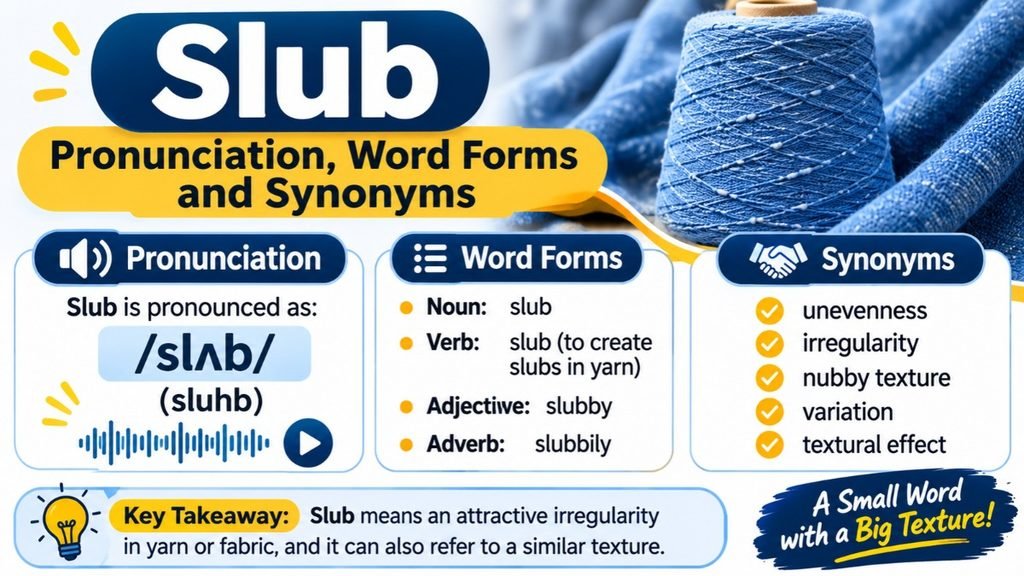
Say it /slʌb/, rhyming with “club”. It works as a noun (a slub in the yarn) and as a verb, and the forms you will meet are slub, slubbed and slubby. Burl and knot are the nearest synonyms, though neither covers every use.
The textile slub meaning is the same in every dictionary that treats it. Merriam-Webster describes a soft, thick, uneven section in yarn or thread. Collins gives a lump or thickened spot in yarn. CottonWorks, the fabric resource run by Cotton Incorporated, says it in seven words: “A short, thick place in a yarn.”
The two adjectives split the work. Slubbed describes yarn or cloth that has slubs in it or was made with them, as in slubbed cotton. Slubby describes the finished look, a surface with slubs showing, as in a slubby linen. Merriam-Webster’s textile sense is simply “having slubs.”
The verb and the word’s history
Most shoppers only ever meet the noun, but the verb is the older working sense in the trade. In spinning, to slub means to draw out a sliver of wool, cotton or similar fiber and give it a slight twist so it can be spun. Merriam-Webster records that sense, and Collins describes the same fiber-preparation use. The loose, lightly twisted roll that results is called slubbing.
A sentence such as “the wool was slubbed before spinning” is therefore about preparing fiber, not about how finished cloth looks. That is the one place where the verb and the clothing-tag meaning part ways.
On origin, the sources disagree. Merriam-Webster treats the word as a back-formation from “slubbing” and dates the verb to 1834 and the noun to 1851. Oxford Learner’s Dictionaries lists the origin as unknown. Treat the etymology as open.
What slub fabric looks and feels like
Slub in fabric is easiest to spot at a window, where the pattern becomes obvious: thin and thick lines running unevenly across the cloth, faint streaks, and small raised spots where a thick section sits on the surface. Tilting the fabric under side light, or stretching it slightly, makes the effect easier to see.
How strong the effect is depends on how far the thick sections differ from the base yarn. A subtle slub is barely visible until you look closely. A strong one gives obvious streaks, and a heavily slubbed cloth can look almost hand-spun. The structure matters too. In knits, slubs usually read as faint horizontal lines. In woven cloth they can look like short ridges or tiny raised flecks.
Hand feel is a separate question, and the word slub does not answer it. Feel comes from the fiber, the yarn, the fabric weight and the finish. A light cotton slub jersey can feel soft and airy; a heavy slub weave in coarse yarn can feel scratchy. Touch it before you decide.
How slub yarn is made
Ordinary yarn is spun to a steady thickness. Slub yarn is spun with controlled variation. At set intervals the amount of fiber entering the drafting stage changes, so some stretches of yarn collect more fiber and come out thicker. Then the process returns to normal and the yarn thins again. Both ring spinning and open-end spinning can do this.
The useful part is the control. CottonWorks notes that modern spinning equipment can produce slubs on a predetermined plan, with chosen lengths and chosen spacing, and can even change the yarn count along the strand. Three variables set the look.
Length is how far each thick section runs along the yarn: short ones make small interruptions, long ones make visible streaks. Thickness is how much larger the slub is than the base yarn: a small difference gives a quiet texture, a large one a loud texture. Spacing is the gap between slubs: tight spacing reads as heavily textured, wide spacing as restrained. Fiber type, yarn count, the weave or knit, and the dyeing and finishing then decide how all of that finally appears on the cloth.
Why makers add slubs
The main reason is character. Smooth yarn gives a clean, precise surface. Slub yarn builds variation into the cloth itself, which reads as casual, rustic or vintage-leaning and gives a plain colour some depth without a printed pattern. Instead of printing stripes on a basic tee, the mill changes the yarn and the texture arrives with the fabric.
That is a small trick, but it explains why slub turns up so often in everyday basics.
Slub: defect or design choice?
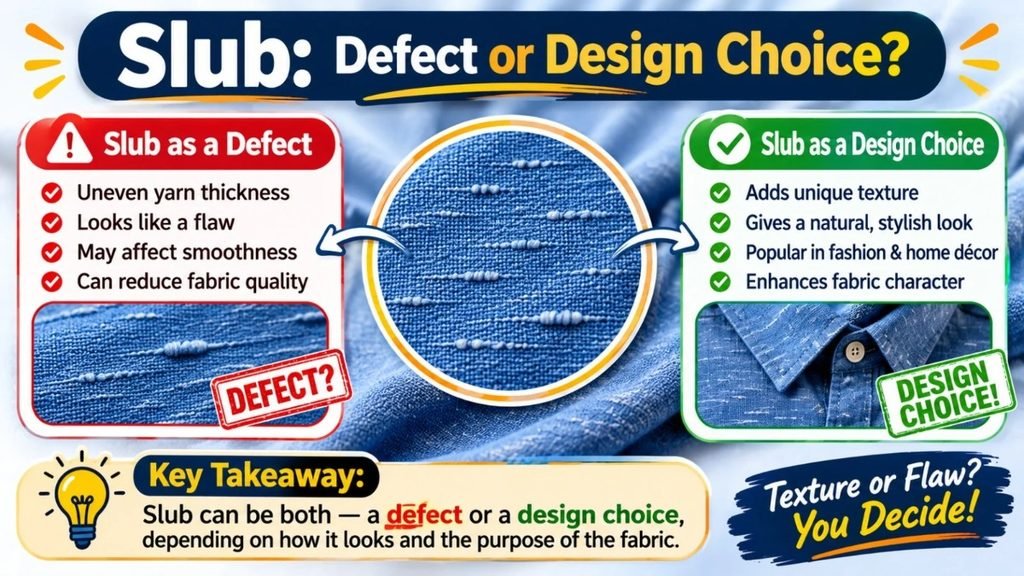
Honestly, it depends on what the fabric was supposed to be.
If the texture is deliberate and looks consistent across the garment, it is a design choice. If the lumps are random, the cloth should be smooth, or the thick spots feel weak, snagged or patchy, it is a defect. The slub meaning shifts with that context: the same lump is a feature on a casual tee and a flaw on a formal poplin shirt.
On a real garment, planned slubs look planned. The pattern is similar from panel to panel, and the thick spots feel firm rather than loose or fuzzy. Heavy clumps in one patch and nothing in the next point to a production problem.
Textile quality control draws the same line. CottonWorks classes slub yarn as a novelty effect in which the slubs are put in on purpose, and it separately lists an unwanted slub, a short thick or heavy place in the yarn, as a fabric defect. An inspector checking slub yarn therefore cannot reject every thick section. The job is to compare the yarn against its specification: slub size, frequency, length, position and distribution, and whether the yarn is still strong enough.
Where thick places are not wanted at all, mills use slubcatchers, inspection devices that catch slubs and thickenings so they can be removed from the yarn.
Slub vs plain fabric
The slub meaning is easiest to grasp side by side. Neither column wins by default; they answer different needs.
| Feature | Slub fabric | Plain fabric |
| Yarn thickness | Varies along the yarn | Even along the yarn |
| Surface | Textured, with bumps and streaks | Smooth and uniform |
| Look | Casual, relaxed, a little rustic | Clean, sleek, uniform |
| Feel | Set by fiber, weight and finish; often more lively to the touch | Set by fiber, weight and finish; often smoother |
| Durability | Set by fiber, yarn quality and construction; loosely twisted thick spots may wear or pill sooner | Set by fiber, yarn quality and construction |
| Price tendency | Can cost slightly more, about the same, or less; fiber and weight matter more than the effect | Varies by fiber and weight |
| Best use | Casual tees, relaxed shirts, linen-look pieces, home textiles | Dress shirts, formal wear, anything that needs a polished surface |
Slub vs nep vs nubby
A slub is a thick section running along a length of yarn. A nep is different: a small, tangled knot of fibers, usually unwanted, that shows up as a tiny dot rather than a stretch of thickness. Nubby is the loosest of the three. It describes any surface that looks or feels bumpy, whatever caused the bumps. So slub fabric can be nubby, but nubby fabric is not always slub. A label that only says “textured” tells you even less.
Where you will see slub
Slub in clothing is mostly a casual-wear story, with home textiles close behind.
Slub jersey, slub knit and T-shirts
Slub jersey is the version most people already own: the cotton or cotton-blend knit used for many casual tees and tops. A knit is made of interlocking loops, so a change in yarn thickness shows across the surface, usually as faint horizontal streaks. That is why a slub T-shirt looks relaxed next to a smooth one in the same colour. Slub knit also appears in sweatshirts, dresses and light knitwear, for the same reason: it adds interest without a print.
Casual shirts and linen
In woven shirts, slub cotton gives a soft, slightly irregular face. Linen is a natural neighbour. Flax yarn is uneven by nature, so linen often looks slubby even when nobody added slubs on purpose.
Slub denim
The slub meaning in denim comes down to direction. Warp slub puts slub yarn in the warp, the lengthwise yarns, so the texture runs vertically. Filling slub puts it in the filling (weft) yarns, so it runs across the cloth. Cross-hatch has slub in both directions and gives a faint grid-like surface. CottonWorks describes all three, and the effect is part of the vintage-inspired look some jeans aim for.
Curtains, cushions and upholstery
Home textiles use slub for the same reason clothing does. A plain curtain or cushion cover can look flat; a slub one looks layered. Some interior fabrics imitate naturally slubbed materials purely for that effect.
Read the fiber line separately
Slub is an effect, not a fiber. A 100% cotton slub top and a cotton-polyester slub top can look identical on the hanger and behave differently in the wash. The words “slub cotton” on a label mean cotton plus texture. They say nothing about weight, softness or how long the garment will last.
Is slub fabric good quality? Buying checklist
Slub is not a quality grade. A carefully made slub yarn is a deliberate design feature, and a sloppy one is a defect, so the word on the tag cannot rank a garment. It is also worth knowing that not every lump is slub. Pilling, neps, loose fibers and weaving faults create bumps that look similar and mean something else. Knowing the slub meaning helps, but these checks do the real work:
- Fiber content. Read the label before anything else. Cotton, linen, a blend and a synthetic behave differently.
- Weight and feel. Online, look for fabric weight, often given in grams per square metre (GSM). In a shop, rub the cloth between your fingers and ask whether you would wear it for hours.
- Pattern. Apply the consistency test from the defect section to the whole garment: front, back and sleeves.
- Stitching. Check seams and hems. Straight, tight stitching matters more than any yarn effect.
- Stretch and recover. On a knit, stretch a small section gently and let go. It should spring back rather than stay baggy.
- Reviews after washing. Look for comments from people who have washed the piece a few times. That is where shrinkage, pilling and fading show up.
If a shop will not let you touch the fabric, reviews with photos taken after a few washes are the next best thing.
How to wash and care for slub fabric
Start with the care label, because blends and finishes change the rules. For most slub cotton, a gentle cycle in cool or warm water is a safe default, and turning the garment inside out protects the surface.
Keep heat low. Cotton can shrink in hot water or a hot dryer, and slub does not change that. Air drying or a low tumble setting is kinder to the cloth.
Expect some pilling over time, especially on lower-quality yarn where the thick spots are loosely twisted. Wash with similar fabrics and keep rough items such as zips and Velcro out of the load. If the garment needs ironing, use the setting the care label suggests and iron on the reverse side.
Pros and cons
The best thing about slub is character. It makes a plain colour more interesting without print or pattern, and it gives basics a lived-in, relaxed look. In summer-weight cotton the uneven surface can also feel light and airy against the skin.
The downsides are practical. Slub can imitate quality problems, so a badly made garment can pass as intentionally textured. It reads casual, which rules it out for formal dressing. Lower-quality slub yarn may pill or wear unevenly, and the texture can look tired after repeated hot washes.
Slub in a sentence
Seeing the slub meaning in use is the quickest way to lock it in. Each example below uses a different sense.
Clothing: “This tee is made from soft slub cotton.” Here slub describes the texture of the yarn in the fabric.
Yarn: “The slub yarn gives the cloth a streaky surface.” The word names yarn with thick and thin sections.
Fabric: “The curtains have a subtle slub texture.” It points to visible irregularity in the material.
Denim: “These jeans use filling slub for a horizontal texture.” The direction of the slub is part of the description.
Manufacturing: “The inspector found a slub in the yarn lot.” In a factory this may be an unwanted thick place, not a planned effect.
Adjective: “The linen has a slubby surface.” Slubby describes how the finished cloth looks.
Verb: “The sliver was slubbed before spinning.” This is the fiber-preparation sense from earlier.
Looking for the slub meaning in Urdu? That lives on its own page: slub meaning in Urdu.
FAQs
What does slub mean?
A slub is a thick, soft, uneven spot in a yarn. When that yarn is woven or knitted, the spot shows up as a small bump or streak on the cloth. Makers sometimes add slubs on purpose for texture, and sometimes they appear by accident as a flaw.
Is slub a defect?
Not by default. Slub yarn is made on purpose to give fabric a textured, slightly irregular look. It becomes a defect when the lumps are random, the fabric was meant to be smooth, or the thick spots are weak and snag easily. Even, repeated texture is design; messy, patchy lumps are not.
Is slub cotton real cotton?
Usually, yes, but slub only describes the texture, not the fiber. A tag reading 100% cotton means the slub fabric is all cotton. A tag showing cotton and polyester means it is a blend with a slub effect. Always read the fiber content line, because the word slub will not tell you.
Is slub fabric soft?
Often, but not automatically. Softness comes from the fiber, the yarn, the fabric weight and the finish. A light cotton slub jersey tends to feel soft and light, while a heavy slub weave can feel coarse. The word slub on the label tells you about texture, not comfort, so touch it first.
Is slub fabric stretchy?
Slub itself adds no stretch. Stretch comes from how the fabric is built and what it contains. A slub jersey knit stretches because knits are loopy and flexible, and elastane adds more. A woven slub shirt or slub linen will have little give unless the label lists a stretch fiber.
What does slubby or slubbed mean?
Both describe cloth or yarn that has slubs. Slubby usually describes the look and feel, a fabric with a lumpy, streaky surface. Slubbed is the verb form turned adjective, as in a slubbed yarn or slubbed cotton. In shops you will mostly see slub or slubby on the tag.
What is the difference between slub and jersey?
They are different kinds of things. Jersey is a knit construction, the familiar T-shirt fabric. Slub is a yarn effect. Put them together and you get slub jersey, a jersey knit made from slub yarn. So a slub tee is jersey with texture, while a plain jersey tee uses an even yarn.
Does slub shrink?
Slub does not cause shrinkage; the fiber does. Cotton slub can shrink in hot water or a hot dryer, like other cotton. Polyester blends shrink less. Wash cool or warm, go easy on the dryer, and follow the care label, since finishes and blends vary.
What is a slub T-shirt?
A slub T-shirt is a tee made from slub yarn, usually in cotton jersey. The surface has faint horizontal streaks and small raised spots, which give it a relaxed, lived-in look. It reads more casual than a smooth tee, though quality still varies a lot by fiber and weight.
What is the difference between slub and nep?
A slub is a thickened stretch along a yarn, while a nep is a small tangled knot of fibers sitting in one spot. Slubs are often planned as a texture effect. Neps are usually unwanted. On a garment, a slub looks like a short streak or ridge, and a nep looks like a tiny dot.
What is the opposite of slub fabric?
There is no strict dictionary opposite. The closest practical contrast is smooth, even yarn and the plain fabric made from it, where thickness stays consistent along the length. In shops you will see words like plain or smooth, though neither is a formal antonym.
Final Thought
Slub is worth buying when you want a casual garment with some texture and the basics check out: honest fiber content, decent weight, an even pattern and clean stitching. For T-shirts, relaxed shirts, linen-look pieces and home textiles, it is a good call.
Skip it when you need a smooth, polished surface, or when the lumps look random and the cloth feels thin or weak. Once the slub meaning is clear, the decision is about the garment in front of you, not the word on the tag.
Next time you see “slub” on a label, read the fiber line, then rub the fabric between your fingers. Ten seconds of touch will tell you more than any product description.