
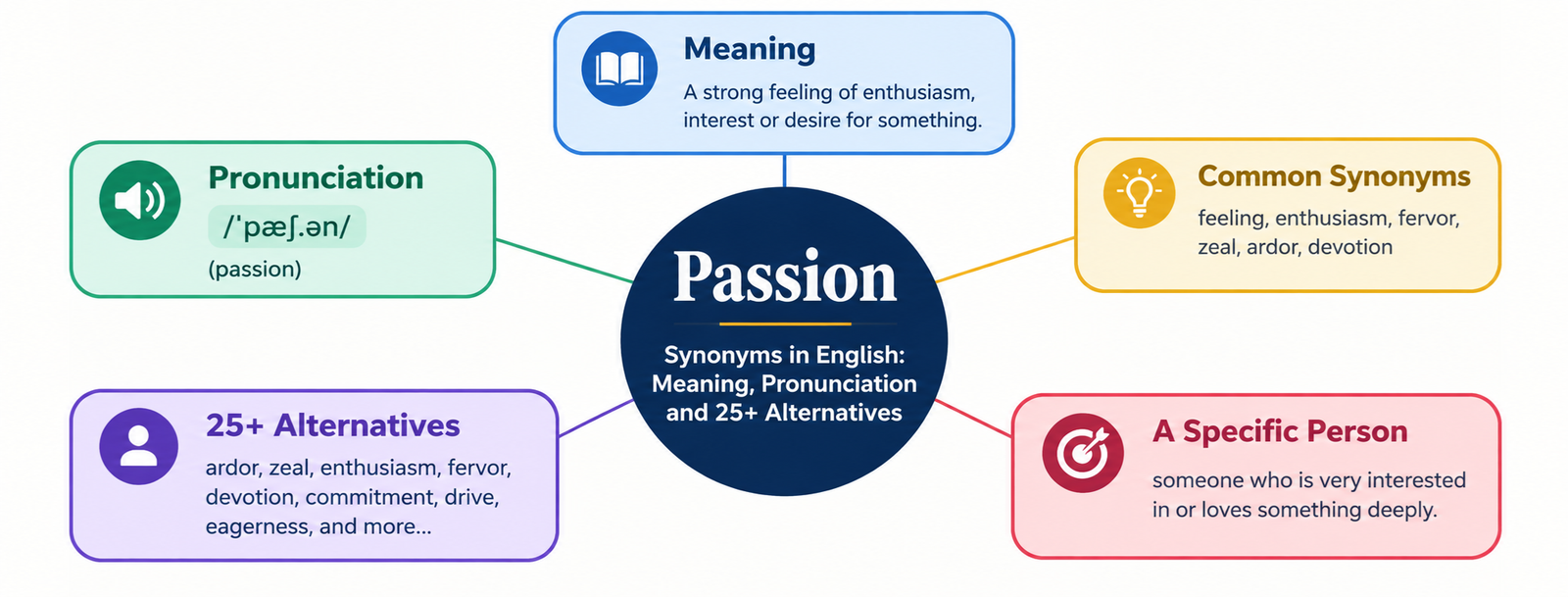
Passion Synonyms in English: Meaning, Pronunciation and 25+ Alternatives
Searching for passion synonyms in English? You will find plenty of lists, but many treat every alternative as if it meant the same thing. Here is the short answer first, then a teacher’s guide to choosing the right word for love, interest, hard work or anger.
Quick Answer: Another Word for Passion
Passion is a strong, powerful feeling or enthusiasm, such as deep love for a person or an intense interest in an activity. Its closest synonyms are enthusiasm, zeal, ardor, fervor, devotion and drive. Choose the word by meaning: love, interest, hard work, or anger each call for a different synonym.
What Does “Passion” Mean in English?
In simple English, passion is a feeling so strong that it moves you to act. It can be a love for a person, a deep interest in a subject, or a burst of strong emotion such as anger. The common thread is intensity: a mild liking is not passion, but a feeling that fills your thoughts and drives your choices is.
That intensity is why synonyms for passion can be tricky. Enthusiasm is warm and light. Obsession is heavy and often unhealthy. Passion sits in the middle: strong, but usually positive.
The four everyday senses of passion
- A strong interest or hobby. “Photography is her passion.” This is the sense you meet in phrases like “follow your passion.”
- Romantic or physical desire. “The film is a story of love and passion.”
- A sudden outburst of strong emotion, especially anger. “He flew into a passion.” This use appears in British dictionaries and is uncommon in modern writing.
- The Passion (capital P). In Christian usage, the suffering of Jesus before and during the crucifixion. Bach’s St Matthew Passion is a musical work on this theme.
Is passion a positive or negative word?
It is neutral in itself. “Passion for teaching” sounds positive, while “a crime of passion” does not. The words around it tell you which way it leans.
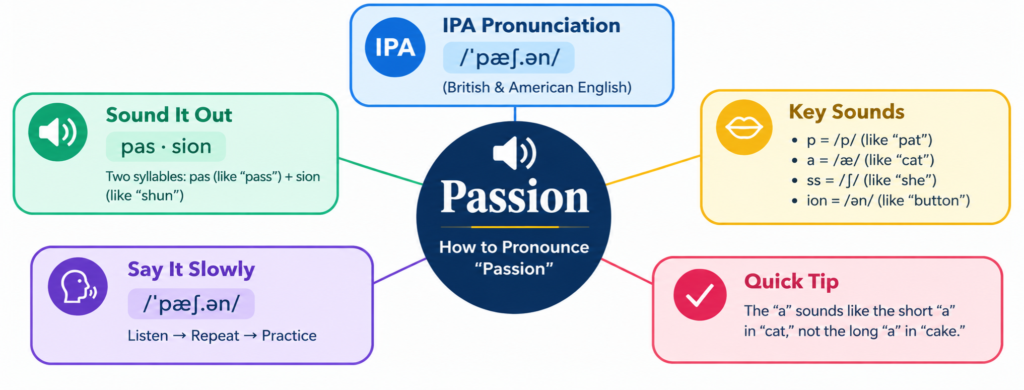
How to Pronounce “Passion” (IPA and Simple Phonetics)
- Simple phonetics: PASH-un
- IPA (US and UK): /ˈpæʃ.ən/
- Syllables: 2, with the stress on the first (PASH-un, not pash-UN)
The first vowel is the same short “a” as in cat and flash. The -ssion spelling makes a “sh” sound, and the last syllable is weak, so it sounds like “un” (or a very short “uhn”). Some learners are tempted to say “pa-SEE-on” because of the spelling. Avoid that.
Related forms: passions /ˈpæʃ.ənz/ (PASH-unz) and passionate /ˈpæʃ.ə.nət/ (PASH-uh-nut).
Part of Speech and Grammar: How to Use “Passion”
Part of speech
Passion is a noun. It is not used as a verb in everyday modern English. If you need an adjective, use passionate; for an adverb, use passionately.
Countable or uncountable?
Both, depending on the meaning.
- Uncountable (the quality or feeling in general): “Passion is what keeps her going.” “He speaks with great passion.”
- Countable (a specific interest or love): “Teaching and gardening are his two great passions.”
A quick test: if you can put a or many before it, you mean a specific interest. If you are talking about the feeling itself, it stays uncountable.
Prepositions that go with “passion” (for, about, in, with)
- passion for (most common): “a passion for languages.”
- passion about (also heard, but less common than for): “She talks with real passion about local history.” Some editors prefer for when naming the object of the interest.
- passion in (the quality shown in something): “There is real passion in her voice.”
- with passion (the manner): “He argued with passion.”
- in a passion (British, dated, meaning in a fit of anger): “She left in a passion.”
Common collocations
burning passion, lifelong passion, true passion, pursue a passion, follow your passion, passion project, passion for life, lack of passion.
Related word forms
| Word | Part of speech | Meaning in short |
| passion | noun | strong feeling or enthusiasm |
| passionate | adjective | showing or feeling strong emotion |
| passionately | adverb | in a way that shows strong feeling |
| dispassionate | adjective | calm and not influenced by emotion |
| compassion | noun | sympathy for another person’s suffering |
Example Sentences with “Passion”
Here are original examples showing different contexts. Notice how the register changes the feel of the word.
- Casual: Baking isn’t just a hobby for Mina; it’s her passion.
- Written, workplace: The panel praised her passion for accurate data and her patience in teaching others to use it.
- Formal speech: He defended the proposal with quiet passion, never raising his voice.
- Romantic: Their passion cooled slowly over the years, though their friendship stayed strong.
- Plural, countable: Teaching and gardening are his two great passions.
- Review or creative writing: You can hear the passion in every bar of the second movement.
- Informal, British: Football is basically my whole personality; it’s a proper passion.
- Dated, anger: In a passion, he threw the letter into the fire.
- Business: The museum began as a passion project and became a full-time job.
Synonyms for Passion, and How Each One Differs
Many word lists just give you a string of words. That is not enough, because passion means different things in different sentences. Below, the synonyms are grouped by meaning, with one line on how each one differs.
1. Another word for passion as strong interest
- Enthusiasm: the everyday, friendly word; lively interest without the heat of passion.
- Zeal: energy poured into a goal or cause, often with a campaigning spirit.
- Keenness: a milder word that suggests willingness and eagerness.
- Eagerness: impatience to begin something; it is about looking forward, not about depth.
2. Words similar to passion as deep commitment
- Devotion: loyal, steady love or loyalty toward a person, cause or practice.
- Dedication: consistent time and effort; it describes actions more than feelings.
- Drive: an inner push to achieve; professional and goal-focused, with little romance.
- Commitment: a promise you keep; reliable and calm, with low emotion.
- Calling: the feeling that a certain work is what you are meant to do; it carries a moral or spiritual weight.
3. Words for passion as intense feeling
- Ardor (ardour in British English): warm, glowing intensity, often literary.
- Fervor (fervour in British English): deep, steady feeling, usually about beliefs or causes; the person truly means it.
- Fire: informal and figurative; “fire in her voice” suggests energy and spirit.
- Intensity: a neutral word that describes how strong a feeling is, not what kind it is.
4. Synonyms for passion as love or desire
- Love: the plain word; warmer and calmer than passion.
- Desire: a strong wanting; romantic or general, and milder than lust.
- Longing: wanting something absent or far away; it carries an ache.
- Infatuation: intense attraction that is often short-lived or unrealistic.
- Lust: strong physical desire; blunt, and often negative in tone. It can also mean greed, as in “lust for power.”
5. Words for passion as anger
- Rage: hot, hard-to-control anger.
- Fury: rage at its fiercest, often literary or dramatic.
- Wrath: formal, biblical or literary anger, often connected with punishment.
- Ire: a short, formal word for anger, used mostly in formal or journalistic writing.
6. Passion as obsession
- Obsession: a constant, hard-to-stop focus; usually unhealthy.
- Fixation: attention stuck on one thing, often to the point of narrowness.
- Mania: wild, excessive enthusiasm (as in Beatlemania). In medicine it is a technical term, so avoid it for casual use.

The intensity ladder: from interest to obsession
Use this to match the strength of the word to the strength of the feeling. It is a rough teaching guide, not a scientific scale, so some native speakers may rank a word one step higher or lower.
| Level | Word | How it feels |
| 1 (mild) | interest | curious, light |
| 2 | enthusiasm | warm, lively |
| 3 | dedication | steady, hard-working |
| 4 | passion | strong, personal, driving |
| 5 | zeal, fervor, ardor | very strong, almost burning |
| 6 (extreme) | obsession | excessive, hard to control |
Formal vs casual: which synonym fits which register?
| Register | Good choices | Example |
| Formal or literary | ardor, fervor, zeal, devotion | “He spoke with great fervor.” |
| Neutral | passion, enthusiasm, drive, commitment | “She shows real drive.” |
| Casual | love, fire, obsession (playful), “bug” | “She caught the travel bug.” |
Antonyms of Passion (Opposite Words)
- Apathy: no interest or feeling at all. “Apathy spread through the team after the third delay.”
- Indifference: you simply do not care either way. “He answered with polite indifference.”
- Coldness: a lack of warmth, usually toward people. “There was a coldness between them.”
- Boredom: the tired feeling of having no interest. “Boredom set in after the first hour.”
- Detachment: a calm distance from a person or situation. “She watched the argument with detachment.”
- Calm: a peaceful, steady state; the opposite of a heated emotion. “He kept his calm throughout.”
A useful warning: dispassion does not mean coldness. It means being fair and not ruled by emotion, as in “a dispassionate judge.”
Word Origin of Passion (Etymology)
The word comes from Latin passion, meaning “suffering,” which comes from the verb pati, “to suffer.” It entered English through Old French in the Middle English period, around the 1100-1500CE start of the 12th century.
Early uses are tied to the suffering of Christ, which is why the capitalised Passion still exists today. Over the centuries, the meaning broadened from “suffering” to “strong emotion,” and then to “strong enthusiasm.
That history also explains compassion, which literally means “suffering with” someone. A related fact: passion fruit has nothing to do with romance. The name is traditionally said to refer to the Passion of Christ, because of religious symbolism seen in the flower.
Common Mistakes with “Passion” and Its Synonyms
- Wrong preposition. Not “passion on football” or “passion to music.” Say “a passion for football.”
- Noun and adjective mix-up. Not “I am very passion.” Say “I am very passionate” or “I have a great passion.”
- Confusing passion and compassion. Passion is strong feeling; compassion is sympathy for someone’s pain.
- Spelling slips. Watch for spellings such as pasion or passon. Remember: double s, then -ion.
- Overusing it for small likes. “I have a passion for tea” may sound exaggerated in formal writing. Use a love of or an interest in.
- Using lust when you mean desire or love. Lust is much more physical and can sound rude.
- Treating every synonym as equal. Rage is not a replacement for enthusiasm, and zeal is not a gentle word. Check the nuance lines above.
- The CV trap. “Passionate about…” is such a common phrase in applications that it can sound generic (see below).
Other Ways to Say “I’m Passionate About…” (CVs and Interviews)
In job applications, show evidence instead of announcing a feeling. A teacher’s rule: the adjective is a claim; the example is proof.
| Instead of | Try |
| passionate about teaching | committed to helping students understand difficult ideas |
| passion for data | strong interest in data, shown by two years of weekly reporting |
| passionate leader | leader who gets energy from developing people |
| passionate about design | driven by clear, user-friendly design |
| passion for customer service | dedicated to solving customer problems quickly |
| passionate team player | reliable colleague who enjoys shared goals |
FAQs
What is the closest synonym for passion?
In most contexts, enthusiasm is the safest, closest match for strong interest, and ardor or fervor for strong feeling. The best choice depends on whether you mean interest, love, work drive or anger.
What can I say instead of “passionate about” on a CV?
Try committed to, driven by, dedicated to, deeply interested in or energised by, and follow it with a real example.
Is passion the same as love?
No. Love can be calmer and longer-lasting, while passion often suggests more intensity. Love can include passion, but it does not have to.
What is the opposite of passion?
The most common opposites are apathy and indifference. For emotional coldness, coldness or detachment fit better.
Why is “the Passion” capitalised?
It is a proper noun in Christian usage, meaning the suffering and death of Jesus. It is also used in titles such as The Passion of the Christ or Bach’s St Matthew Passion.
Final Thoughts
Choosing the right passion synonyms in English depends on the meaning you want to express. Use enthusiasm for strong interest, devotion for lasting commitment, ardor for intense emotion, and drive for professional ambition. Understanding these differences will help you choose the right word for everyday conversations, academic writing, and CVs.



One Comment