
Gynecology vs Gynaecology: Meaning, Difference and Which Spelling to Use
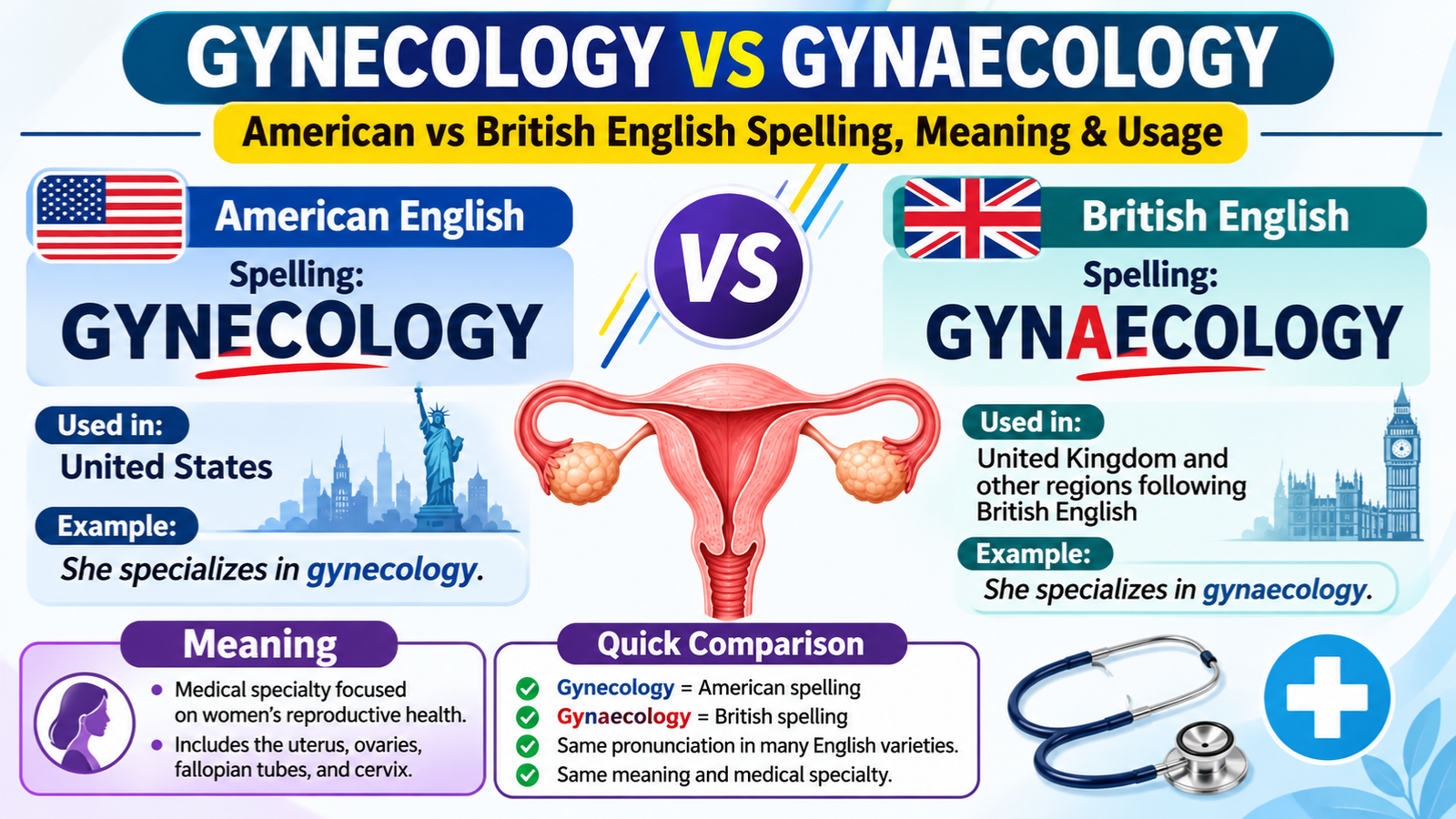
Quick answer: Gynecology is the American English spelling and gynaecology is the British English spelling. Both name the same medical specialty, sound alike, and are correct. Pick the one that matches your readers, such as the US, the UK, Pakistan or India, and then keep it consistent.
Note: this guide is about spelling and language, not medical guidance.
You may have seen the specialty written both ways and wondered whether the extra “a” signals a different field. It does not. The gynecology vs gynaecology question is purely about regional spelling, and once you know where the “ae” comes from, the choice becomes easy. This guide covers the meaning, the word origin, the rule behind the split, pronunciation, official organization names, and the right spelling for clinic websites, students, and journal authors.
Gynecology vs Gynaecology at a Glance
Table: Gynecology vs gynaecology compared
| Question | Answer |
| Do they mean the same thing? | Yes |
| Which is American English? | gynecology |
| Which is British English? | gynaecology |
| Does the extra “a” change the meaning? | No |
| Is one spelling more “medical”? | No |
| Which do dictionaries list as the variant? | American dictionaries label the “ae” form as chiefly British |
| Doctor (US / UK) | gynecologist / gynaecologist |
| Adjective (US / UK) | gynecological / gynaecological |
The spelling tells you which variety of English the writer follows. It does not describe a different branch of medicine.
What Does Gynecology (Gynaecology) Mean?
The term names the branch of medicine that deals with the female reproductive system, including its diseases and its routine care. Merriam-Webster defines it in essentially those terms, and a physician who practices it is a gynecologist (UK: gynaecologist).
In everyday use the specialty sits inside the wider field of women’s health and reproductive health. It includes preventive care, diagnosis, and treatment of conditions affecting the reproductive organs, and it covers different stages of life, from adolescence to menopause. What an individual doctor treats depends on training, certification, and local practice, so questions about care belong with a qualified clinician and with bodies such as ACOG or the RCOG rather than with a spelling guide.
Both spellings carry exactly the same definition.
Word Origin: From Greek to New Latin to English
The word is built from Greek parts. Gynē means “woman,” and the ending -logia means “the study of,” the same ending found in biology and psychology. Merriam-Webster traces the English word to the German Gynäkologie, which was borrowed from New Latin gynaecologia, and it gives 1828 as the first known use of gynecology in English with the meaning defined above.
That Latin form is the key to the spelling. The New Latin word kept the “ae” that came from Greek, so older English spelling kept it too. American English later simplified the pair to “e,” while British English did not.
The Rule Behind the Spelling: The “ae” Ligature
Latin writers often wrote the Greek letter pair ai as ae, and scribes joined the two letters into a single symbol, æ, called a ligature. Many scientific and medical terms entered English in this form. American spelling later reduced “ae” to “e” in most of them, while British spelling kept “ae.” The same pattern appears across medicine:
| American English | British English |
| gynecology | gynaecology |
| pediatrics | paediatrics |
| anesthesia | anaesthesia |
| hemoglobin | haemoglobin |
| orthopedic | orthopaedic |
| leukemia | leukaemia |
| edema | oedema |
| esthetic | aesthetic |
Two cautions prevent over-correcting:
- “Aesthetic” is standard in the US too. Many American writers use aesthetic, so esthetic is not the only American form.
- Some American organizations keep the “ae.” The American Academy of Orthopaedic Surgeons, for example, uses the longer spelling in its name. Always copy an organization’s name exactly.
If you remember that British English keeps the older “ae” and American English trims it, you can predict most of these pairs.
A Short History of the US and UK Split
English spelling was far from fixed for most of its history. In Britain, Samuel Johnson’s 1755 A Dictionary of the English Language helped settle many spellings, and Greek and Latin forms with “ae” generally stayed in place.
In the United States, Noah Webster argued that American spelling should be simpler and more regular. His 1828 An American Dictionary of the English Language promoted forms such as color and center, and the broader American habit of simplifying spellings grew out of that tradition. Over time the “ae” to “e” simplification spread through American writing, including medical writing, and the Merriam-Webster dictionaries carry that tradition forward today.
Britain and most Commonwealth countries kept the older forms. That is why you now see two standard spellings of the same medical term, and why the debate never fully disappears.
Related Forms: US vs UK
The change affects every word built from the stem:
| Form | American English | British English |
| Specialty | gynecology | gynaecology |
| Doctor | gynecologist | gynaecologist |
| Adjective | gynecological | gynaecological |
| Short adjective | gynecologic | gynaecologic |
| Combined specialty | obstetrics and gynecology (OB-GYN) | obstetrics and gynaecology (O&G) |
Merriam-Webster lists the “gynae-” forms as chiefly British variants. Note that obstetrics is spelled the same in both varieties; only the “gyn-” part changes.
If you pick one form, switch all of them together. Using “gynecologist” in one sentence and “gynaecological” in the next is exactly the kind of mismatch editors notice.
Gynecology, Obstetrics and OB-GYN Explained
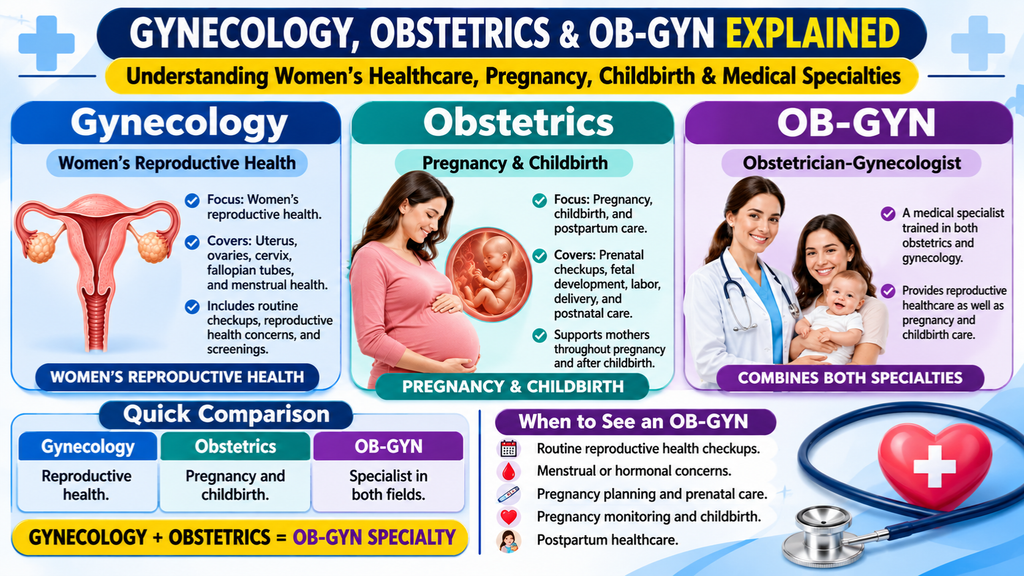
Readers often confuse the three terms, so here is how the words relate:
| Term | What it refers to | Spelling note |
| Gynecology / gynaecology | The health and diseases of the female reproductive system | Spelling changes by region |
| Obstetrics | Pregnancy, childbirth, and the period around birth | Same in US and UK |
| OB-GYN / O&G | The combined specialty, or a doctor trained in both | OB-GYN is the common US shorthand; O&G is widely used in the UK and Commonwealth countries |
The two fields are closely linked, and many doctors train in both, which is why the combined name exists. Merriam-Webster also lists the full term obstetrician-gynecologist, and its shortened form appears as “ob-gyn” in American writing. For anything medical beyond the vocabulary, consult a qualified professional.
Pronunciation
The spelling difference does not create a different word. Most speakers say the first syllable like “guy” and place the main stress on the third syllable. A simplified guide looks like this:
| Variety | Simplified pronunciation |
| American English | gy-nuh-KAH-luh-jee |
| British English | gy-nuh-KOL-uh-jee |
Merriam-Webster’s US pronunciation also puts the stress on the third syllable, with the vowel in “cot.” The British version uses a shorter “o” vowel, which follows ordinary UK and US accent patterns rather than the spelling. These are simplified guides, and individual speakers vary. You do not need to change how you say the word because you changed how you write it.
Organization and Degree Names Keep Their Own Spelling
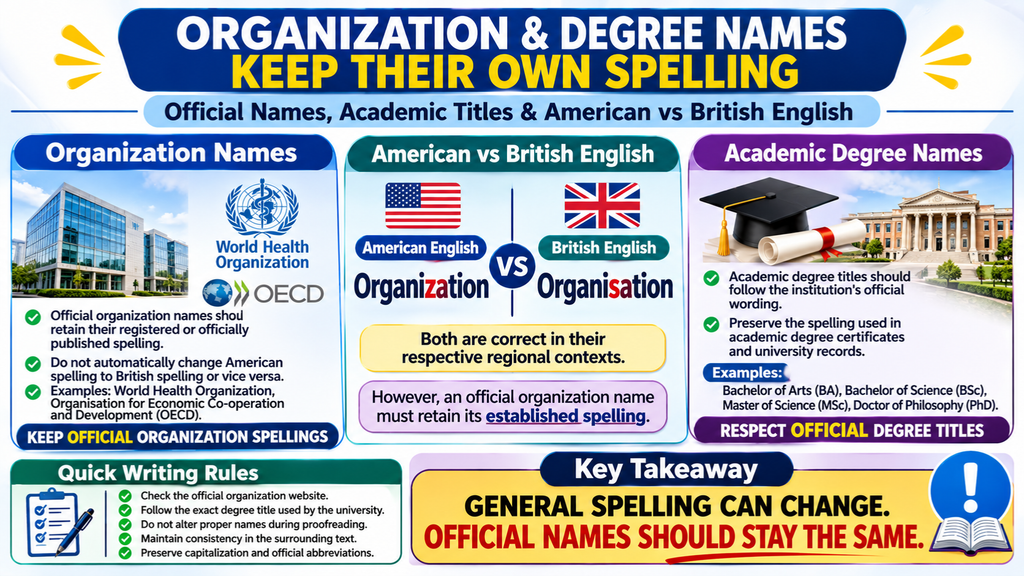
An official name is a proper noun. If an organization spells its name with “ae,” keep the “ae” even in an otherwise American text, and if it uses “e,” keep the “e” even in an otherwise British text. Examples of how real names differ:
- ACOG: the American College of Obstetricians and Gynecologists, a US professional association founded in 1951, uses the American spelling.
- RCOG: the Royal College of Obstetricians and Gynaecologists, the UK body, uses the British spelling.
- SOGP: the Society of Obstetricians and Gynaecologists of Pakistan, whose first constitution dates to 1957, uses the British spelling and is a member of FIGO and SAFOG.
- CPSP: the College of Physicians and Surgeons Pakistan, set up by an act of Parliament in 1962, regulates postgraduate training and awards the FCPS and MCPS qualifications, including in obstetrics and gynaecology.
- SOGC: the Society of Obstetricians and Gynaecologists of Canada uses the “ae” form in its name, although some sources show an alternate “e” form, which shows how much spelling varies in practice.
Verify before use: organization and qualification names can change. Check the exact wording on each official website, and do not “correct” a name to match your own style. International bodies such as FIGO and the WHO also have their own house style, so match the spelling in the specific document you quote.
The same rule applies to degrees, fellowship titles, hospital departments, and journal names.
Which Spelling Should You Use? (By Country)
Your readers decide the right spelling. Use this table as a starting point.
| Country / region | Recommended | Notes |
| United States | American form (“e”) | Standard in US publishing, schools, and health writing. |
| United Kingdom | British form (“ae”) | Standard in British medical and general writing. |
| Canada | Check your style guide | Canadian English mixes both systems. Follow your target publication or institution. |
| Australia | British form (“ae”) | Follows British convention in most professional writing. |
| New Zealand | British form (“ae”) | Follows British convention. |
| India | British form (“ae”) | Indian English follows British spelling in most formal and medical writing. |
| Pakistan | British form (“ae”) | Pakistani English follows British spelling in schools, exams, and professional writing, and national bodies such as the SOGP use it. |
| South Africa and other Commonwealth countries | British form (“ae”) | British-based conventions apply. |
| Global or mixed audience | Either, but stay consistent | Choose the variety of your largest audience and apply it across the whole site. |
Quick rule: US readers get the “e” spelling. UK, Pakistan, India, Australia, and most Commonwealth readers get the “ae” spelling.
Guidance for Different Writers
Medical websites and clinics. Match your patients’ variety of English across the page title, headings, body text, image descriptions, and URL. A US practice should use the American form. A clinic in Karachi, Lahore, or Delhi follows British conventions in formal text, but search behavior can differ from formal spelling, because many people type the shorter form regardless of national convention. Check Google Search Console or Keyword Planner for your own city before you decide, and mention the other spelling once in a natural sentence if your data shows both are searched.
Students and exam candidates. Follow the spelling your institution, textbook, or exam board uses. In many British-style systems the “ae” form is expected, but your examiner’s guidelines come first.
Researchers and journal authors. Follow the journal’s author instructions exactly. Many journals state whether they use American or British spelling, and editors may convert your text to match.
International websites. Choose one variety for the whole site. A translated or regional version may follow its own convention, but each page should stay internally consistent.
What Does the Specialty Cover?
Readers who land on a spelling guide often want a quick sense of the field itself, so here is a plain-language overview. This is general background, not medical advice, and the exact services offered always depend on a clinician’s training, certification, and local scope of practice.
The specialty is usually described as covering care of the female reproductive system across a person’s life. Areas commonly associated with it include:
- Menstrual health and cycle-related concerns
- Contraception and family planning
- Fertility and infertility evaluation
- Menopause and hormonal changes
- Pelvic pain and pelvic floor concerns
- Conditions affecting the uterus, ovaries, fallopian tubes, cervix, and vagina
- Preventive care, screening, and health education
- Surgical care for conditions that need an operation
Professional bodies such as ACOG, the RCOG, and the SOGP publish training standards and patient information for their own countries. If you are writing about any of these topics for the public, quote those bodies accurately and link to their official pages instead of paraphrasing clinical details from memory.
Case Study: Two Clinic Websites, Two Correct Spellings
Consider two fictional clinics. A private clinic in Ohio publishes a page titled “What Is Gynecology?” and uses the American forms in every heading, paragraph, and image description. A hospital in Manchester publishes “What Is Gynaecology?” and uses the British forms everywhere.
Neither site needs to copy the other. Each follows the English variety its patients read, and each stays internally consistent. A third clinic in Lahore faces a slightly different choice: formal writing follows British convention, but patients may type either form into a search box. That clinic is best served by choosing one standard for the page, then checking its own search data to see whether a single natural mention of the other spelling helps.
The lesson is simple. The audience decides the spelling, and consistency is what makes the page look professional.
Why Consistency Matters in Professional Writing
Spelling consistency looks like a small detail, but it affects how a document is judged:
- Credibility. A page that switches between US and UK forms looks unedited.
- Reader expectations. Patients, students, and editors expect the form used in their own country.
- Brand voice. A clinic, publisher, or university should have one house style.
- Search targeting. Titles, headings, and URLs that disagree can send mixed signals.
- Academic and medical publishing. Journals and exam boards often reject or convert inconsistent text.
The easiest fix is to decide the English variety before you start writing, record it in a short style note, and apply it to every page.
Which Spelling Is More Common?
When people compare gynecology vs gynaecology, there is no single global winner. In the United States the “e” spelling is the standard, and in the United Kingdom and most Commonwealth countries the “ae” spelling is the standard. Dictionaries reflect this: American dictionaries such as Merriam-Webster list the “ae” form as a chiefly British variant, and British dictionaries do the reverse.
Because no reliable single statistic covers all English speakers, avoid claims such as “X is used more worldwide.” For your own decision, check what your actual readers type and read, using your site analytics, Search Console, or Google Trends filtered to your country.
Example Sentences
These are neutral language examples only.
| American English | British English |
| She is studying gynecology at a university in Ohio. | She is studying gynaecology at a university in Manchester. |
| The hospital opened a new gynecology department last year. | The hospital opened a new gynaecology department last year. |
| A visiting speaker presented at the community event. | A visiting speaker presented at the community event. |
| The textbook has a chapter on the history of the field. | The textbook has a chapter on the history of the field. |
| He wrote his report on the history of the field. | He wrote his report on the history of the field. |
Only the spelling changes. The structure, meaning, and pronunciation stay the same.
Common Mistakes
The gynecology vs gynaecology choice produces a handful of repeat errors, and most are easy to avoid.
1. Mixing US and UK spellings on one page. Writing the American form in a heading and “paediatrics” in the next paragraph signals a rushed edit.
2. “Correcting” official names. Changing “Royal College of Obstetricians and Gynaecologists” to the “e” spelling, or the reverse, makes the name wrong.
3. Using the wrong spell-checker setting. Word, Google Docs, and Grammarly let you choose English (US), (UK), (Australia), or (Canada). The wrong setting will underline a correct word.
4. Calling one spelling a typo. Both are standard in their own variety.
5. Treating the two as different specialties. The extra letter does not change the field, the training, or the type of doctor.
6. Confusing the specialty with obstetrics. The two overlap in the combined specialty, but obstetrics concerns pregnancy and childbirth.
7. Inconsistent URLs, titles, and body text. If your page title uses one spelling and your URL and headings use the other, readers and editors see an inconsistent page. Decide first, then apply the choice everywhere.
Easy Ways to Remember the Difference
- “Extra A for the UK.” The British version keeps the extra “a.”
- “America trims.” American spelling usually drops the second vowel of an “ae” pair.
- Match the family. If you write paediatrics and anaesthesia, use the “ae” form here too. If you write pediatrics and anesthesia, use the “e” form.
- Check your country. Pakistan, India, the UK, and Australia use “ae.” The US uses “e.”
Other US and UK Spelling Pairs to Watch
The same regional split shows up well beyond medicine. If your document uses one column below, the whole text should follow it.
| American English | British English |
| color | colour |
| center | centre |
| theater | theatre |
| catalog | catalogue |
| defense | defence |
| program (general use) | programme (general use) |
Neither column is a lower-quality version of English. They are two standard conventions, and the right one is the one your readers expect.
Mini Quiz
Choose the correct spelling for the audience in brackets.
- A clinic website in Lahore (Pakistan): which spelling fits formal writing?
- A US university course catalog: which spelling fits?
- The Royal College of Obstetricians and Gynaecologists: should you change its spelling to match American style?
- In a British-style text, which pair is consistent: pediatrics and gynaecology, or paediatrics and gynaecology?
- Which part of “obstetrics and gynaecology” changes between US and UK spelling?
Answers:
- The “ae” spelling (Pakistani English follows British conventions).
- The “e” spelling.
- No. Official names keep their own spelling.
- paediatrics and gynaecology.
- Only the “gyn-” part; “obstetrics” is spelled the same.
Frequently Asked Questions
Is it gynecology or gynaecology?
Both are correct. The “e” spelling is American English, and the “ae” spelling is British English.
Is gynaecology British?
Yes. It is the standard British spelling and is also used in Pakistan, India, Australia, New Zealand, and most Commonwealth countries. American dictionaries label it a chiefly British variant.
Is gynecology a misspelling?
No. It is the standard American spelling and is understood internationally.
Which spelling is used in Pakistan and India?
Both countries follow British conventions in formal writing, so the “ae” spelling is the usual choice in professional documents. Always match the exact wording of the institution you are writing for.
Do gynecology and gynaecology mean the same thing?
Yes. They are one word in two regional spellings, with the same meaning and nearly identical pronunciation.
How do you spell gynecologist in British English?
The British spelling is gynaecologist. The adjectives follow the same pattern: gynaecological and gynaecologic.
What is the difference between a gynecologist and an obstetrician?
This is a vocabulary question. The first word concerns the female reproductive system, and the second concerns pregnancy and childbirth. Many doctors train in both, which is why the combined title “OB-GYN” (or “O&G”) exists. For medical questions, consult a qualified professional.
Is gynecology part of obstetrics?
They are related but distinct areas that are often combined in one specialty and one training pathway.
Is “OB-GYN” American?
It is the common American abbreviation. In the UK and many Commonwealth settings, “O&G” is more usual.
Why does gynaecology have an extra “a”?
The word came into English through New Latin, which kept the “ae” from the Greek-derived spelling. British English preserved it, while American English later simplified it to “e.”
Which spelling should a clinic website use for SEO?
Use the spelling your target patients read and search. Formal convention and search behavior can differ, so check Search Console or Keyword Planner for your own city, and mention the other spelling once where it reads naturally.
Do search engines treat them as the same keyword?
Search engines often recognize spelling variants as related, but results can differ by country and by exact spelling. Do not rely on that overlap. Use the form your local audience uses, and confirm with your own data.
Can I use both spellings in one article?
Only when you are explaining the difference or quoting an official name. Otherwise, choose one and keep it throughout.
What did Merriam-Webster record as the first known use?
Merriam-Webster gives 1828 as the first known use of gynecology in English with its current meaning. Check the entry itself if you plan to cite it.
Final Thoughts
So, gynecology vs gynaecology? Both are correct, and the choice depends on your readers. Use the “e” spelling for American audiences, and use the “ae” spelling for readers in the UK, Pakistan, India, Australia, New Zealand, and other Commonwealth countries. The difference comes from the Latin “ae” ligature, which British English kept and American English simplified, the same pattern behind paediatrics, anaesthesia, and haemoglobin.
Whichever form you choose, apply it to titles, headings, URLs, and body text, and leave official organization names exactly as they are written.

One Comment