

Lag vs Log: What’s the Difference? Meanings, Examples and Uses
The difference between lag and log comes down to their meanings and the contexts in which they are used. Although these two words differ by only one letter, they describe very different things. Lag usually means a delay, a failure to keep up, or a period of waiting. Log commonly means a written record, a piece of wood, or a logarithm in mathematics.
You may encounter lag when discussing slow internet connections, delayed responses, bacterial growth, or time-series data. Log, on the other hand, appears in computer log files, ship records, timber, mathematical calculations, and everyday writing.
The distinction becomes especially important in technical subjects. For example, a computer may experience lag while recording the problem in a log file. In microbiology, bacteria pass through a lag phase before entering the log (exponential) phase.
This guide explains the meanings, definitions, pronunciation, examples, historical uses, and technical applications of lag and log so you can understand when to use each word correctly.
The Short Answer: Lag vs Log
Lag refers to a delay, a period between connected events, or the act of falling behind. It can function as both a noun and a verb.
Log refers to a written record, a large piece of wood, or a mathematical logarithm. It can also function as a noun and a verb.
A simple way to remember the difference is:
- Lag = Late: Something happens slowly, arrives late, or falls behind.
- Log = Record: Something is written down, recorded, or documented.
For example:
- There was a noticeable lag between clicking the button and seeing the result.
- The technician checked the server log to identify the problem.
The first sentence describes a delay; the second describes a record of events.
What Does Lag Mean?
Lag is a noun and a verb that generally describes delay, slowness, or falling behind.
As a noun, it refers to the amount of time between two connected events or the condition of being behind. As a verb, it means to move slowly, remain behind, or fail to keep pace with something else.
1. Lag as a noun
As a noun, lag describes a delay or an interval between related events.
Examples:
- There is a time lag between ordering a product and receiving it.
- The computer experienced a noticeable lag during the update.
- Jet lag made it difficult to sleep after the international flight.
- The project experienced a three-week lag because of supply problems.
In science and technology, lag can describe the delayed response of one process to another.
2. Lag as a verb
As a verb, lag means to fall behind, move slowly, or fail to maintain the same pace as others.
Examples:
- Our team began to lag behind its competitors.
- The production schedule is lagging because of equipment problems.
- Sales lagged behind expectations during the first quarter.
- The runner started to lag near the end of the race.
The verb forms include:
- Base form: lag
- Third-person singular: lags
- Past tense: lagged
- Present participle: lagging
Notice the spelling change: the final consonant is doubled in lagged and lagging.
3. Common expressions with lag
| Expression | Meaning |
| Time lag | A delay between connected events |
| Jet lag | Disruption of the body’s internal clock after crossing time zones |
| Lag behind | Fail to keep up with someone or something |
| Lag time | The interval between an action and its result |
| Lag phase | The initial adjustment period in bacterial growth |
| Lagging strand | A DNA strand synthesized discontinuously during replication |
These expressions appear in everyday English, science, technology, and professional writing.
What Does Log Mean?
Log is a noun and a verb with several established meanings. It commonly refers to a written record, a large piece of wood, or a logarithm.
1. Log as a noun: A written record
One of the most common meanings of log is a record of activities, events, observations, or information.
Examples:
- The engineer reviewed the server log.
- She keeps a daily log of her activities.
- The pilot entered the flight details in the logbook.
- The security team examined the access log.
A log helps people track what happened, when it happened, and sometimes who was involved.
Common examples include:
- Computer log
- Server log
- Error log
- Activity log
- Flight log
- Ship’s log
- Maintenance log
- Travel log
- Laboratory log
2. Log as a noun: A piece of wood
A log can also mean a large piece of a cut or fallen tree, usually with its bark and natural shape still intact.
Examples:
- They placed a large log beside the fireplace.
- The workers transported several logs to the lumber mill.
- A fallen log blocked the forest trail.
This meaning is particularly common in forestry, construction, woodworking, and outdoor activities.
3. Log as a noun: A logarithm
In mathematics, log is a shortened form of logarithm.
A logarithm tells you what power a particular base must be raised to in order to produce a given number.
For example:
[
\log_{10}(100)=2
]
This is because:
[
10^2=100
]
The word log is widely used in algebra, statistics, computer science, engineering, and scientific research.
The meaning of log can depend on the mathematical system or software being used. For instance, R uses the natural logarithm by default, while Excel’s LOG function assumes base 10 when the base is omitted.
4. Log as a verb
As a verb, log means to record information or to cut trees for timber.
Examples:
- Please log the results after every experiment.
- The application logs every failed login attempt.
- The company logged the machine’s operating hours.
- Workers logged the trees before transporting the timber.
Its common verb forms are:
- Base form: log
- Third-person singular: logs
- Past tense: logged
- Present participle: logging
As with lag, the final consonant is doubled before adding -ed or -ing.
Lag vs Log: Pronunciation and Word Forms
Both words have one syllable and end with the same consonant sound, but their vowel sounds are different.
| Feature | Lag | Log |
| Pronunciation (IPA) | /læɡ/ | /lɔːɡ/ in many American dictionaries |
| Syllables | 1 | 1 |
| Word stress | One syllable | One syllable |
| Beginning sound | /l/ | /l/ |
| Middle vowel | /æ/ | /ɑː/ or /ɔː/, depending on accent |
| Ending sound | /ɡ/ | /ɡ/ |
Pronunciation tip: In lag, the vowel sounds like the ‘a’ in cat. In log, the vowel resembles the sound in law for speakers whose accent distinguishes these vowels. Some American accents pronounce the vowel closer to /ɑ/.
Word forms
| Form | Lag | Log |
| Noun | lag | log |
| Verb | lag | log |
| Past tense | lagged | logged |
| Present participle | lagging | logging |
| Third-person singular | lags | logs |
There is no need to memorize complicated rules. Both words follow the regular consonant-doubling spelling pattern when adding these endings.
Lag vs Log in Everyday English
In everyday conversation, lag usually describes a delay or someone falling behind, whereas log describes a written record or a piece of timber.
Consider these examples:
Lag:
- There was a slight lag in the delivery.
- My old laptop tends to lag when I open multiple applications.
- The company is lagging behind its competitors.
Log:
- I maintain a log of my daily expenses.
- We used a log to build the outdoor fire.
- The manager asked us to log our working hours.
A useful question to ask is: Are you describing something being delayed, or are you describing information being recorded?
If it is about delay, use lag. If it is about recording or documentation, use log.
Lag vs Log in Technology and Gaming
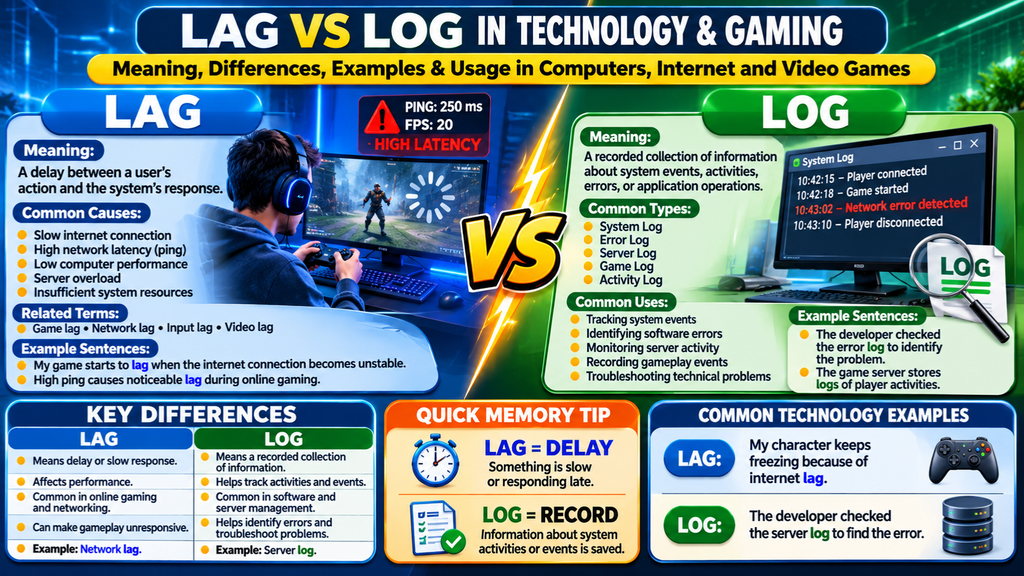
The difference between lag and log is particularly important in computing and online gaming.
Lag describes a performance problem, while a log records information about system activity.
What does lag mean in gaming?
Gaming lag is a noticeable delay between a player’s action and the game’s response.
For example, you press a movement key, but your character moves a moment later. This delay may make the game difficult to control.
Common causes include:
- High network latency
- Packet loss
- Unstable Wi-Fi connections
- Server congestion
- Insufficient system resources
- High CPU or GPU usage
- Background applications consuming resources
Network-related lag can occur even when a player’s internet connection has a high advertised download speed. Bandwidth and latency measure different aspects of network performance.
What is ping?
Ping is commonly used to describe the time taken for a network request to travel to a destination and for the response to return.
It is usually measured in milliseconds (ms).
For example:
- 15 ms: A relatively low response time.
- 60 ms: A longer response time.
- 180 ms: A delay that may be noticeable in fast-paced games.
These values are illustrative rather than universal performance ratings. What counts as acceptable depends on the game, server location, and type of activity.
What is packet loss?
Packet loss happens when data packets fail to reach their intended destination.
In multiplayer games, packet loss may cause:
- Characters to jump between positions.
- Delayed actions.
- Missing game updates.
- Sudden lag spikes.
- Disconnections.
High ping and packet loss are different problems, although both can contribute to a poor gaming experience.
What does log mean in computing?
A log is a record of events generated by a computer program, application, server, or operating system.
A log file may contain:
- Error messages
- Login attempts
- Server requests
- Application activities
- Security events
- System warnings
- Timestamps
For example, an error log might show that an application crashed at 10:42 a.m.
Can a log help diagnose lag?
Yes. A log can help investigate the cause of lag, especially when it includes timestamps and information about system requests.
For example:
- A user sends a request.
- The server receives the request.
- The application processes it.
- The server sends a response.
- The log records relevant events and timestamps.
By examining these entries, an engineer may identify where delays occur.
However, a log does not automatically identify every performance problem. Network measurements, system monitoring, and application profiling may also be necessary.
Lag vs Latency: What’s the Difference?
Lag and latency are related, but they are not exactly interchangeable in technical writing.
Latency is the time required for data or a signal to travel between two points. Lag generally describes a noticeable delay or a process falling behind.
For example:
- Latency measures how long a network packet takes to travel.
- Lag describes the delay a player experiences while controlling a character.
Round-trip time (RTT) measures the time for a request to travel to a destination and for the response to return.
The terms are often used casually as synonyms, especially in gaming conversations. However, latency is the more precise measurement term.
Lag Phase vs Log Phase in Bacterial Growth
In microbiology, lag phase and log phase are two different stages of the bacterial growth curve.
Bacteria grown in a closed culture system commonly pass through four phases:
- Lag phase
- Log phase
- Stationary phase
- Death phase
1. Lag phase
The lag phase is the initial period during which bacteria adjust to a new environment.
During this stage:
- Cells become metabolically active.
- They synthesize proteins and other materials needed for growth.
- Damaged cells may repair themselves.
- The population count generally remains stable.
- Cell division is limited or absent.
The duration depends on factors such as the bacterial species, growth medium, temperature, and starting population.
The important point is that bacteria are not necessarily inactive during the lag phase. They are preparing for growth.
2. Log phase
The log phase, also known as the exponential growth phase, is the stage during which bacteria divide rapidly.
During this stage:
- Cells reproduce through binary fission.
- The population increases exponentially.
- Generation times remain relatively consistent under stable conditions.
- Cells show relatively uniform metabolic activity.
For example, a population that doubles every hour may grow as follows:
| Time | Number of cells |
| 0 hours | 1 |
| 1 hour | 2 |
| 2 hours | 4 |
| 3 hours | 8 |
| 4 hours | 16 |
| 5 hours | 32 |
The numbers increase exponentially rather than by a constant amount.
The log phase is important in microbiology and biotechnology because actively growing cells are useful in many laboratory and industrial processes.
3. Stationary phase
During the stationary phase, population growth levels off.
Nutrients become limited and waste products accumulate. The number of new cells produced becomes approximately equal to the number of cells dying.
As a result, the total number of living cells remains relatively stable.
4. Death phase
During the death phase, the number of dying cells exceeds the number of new cells being produced.
The population of viable bacteria declines, often exponentially in a typical closed culture.
Lag phase vs log phase comparison
| Feature | Lag phase | Log phase |
| Stage | Initial stage | Active growth stage |
| Main activity | Environmental adjustment | Rapid cell division |
| Cell population | Little or no increase | Exponential increase |
| Metabolism | Active preparation | Active growth |
| DNA and protein synthesis | Preparation and adaptation | Supports cell division |
| Growth pattern | Approximately flat population curve | Exponential population growth |
Remember: Lag phase is the adjustment period. Log phase is the period of exponential population growth.
Lagging Strand vs Leading Strand in DNA Replication
Another scientific expression containing the word lag is lagging strand.
During DNA replication, the two strands of a DNA molecule are copied in different ways because DNA polymerase synthesizes new DNA in the 5′ to 3′ direction.
The leading strand is synthesized continuously in the direction of replication fork movement.
The lagging strand is synthesized discontinuously in short sections called Okazaki fragments.
These fragments are subsequently joined together to form a continuous DNA strand.
| Feature | Leading strand | Lagging strand |
| Synthesis | Continuous | Discontinuous |
| Direction relative to replication fork | Same direction | Opposite overall direction |
| DNA fragments | No repeated Okazaki fragments | Okazaki fragments |
| RNA primers | Typically one primer per continuous strand | Multiple primers |
| DNA ligase | Not needed to join repeated fragments | Joins fragments |
Here, lagging describes the delayed and discontinuous pattern of DNA synthesis. It has no connection to the noun log meaning a record or a mathematical logarithm.
Lag vs Log in Mathematics and Statistics

The words lag and log frequently appear together in mathematics, statistics, and data analysis, but they describe different operations.
What does lag mean in statistics?
In time-series analysis, a lag refers to an earlier observation in a sequence of data.
A lag-1 value is the value from the immediately preceding time period.
For example:
| Month | Sales | Lag-1 sales |
| January | 100 | — |
| February | 120 | 100 |
| March | 150 | 120 |
| April | 180 | 150 |
The lag-1 value for March is February’s sales, which were 120.
A lag-2 value refers to the observation from two periods earlier.
Lagged variables are useful in forecasting, regression analysis, economic research, and time-series modelling.
Lag operator in R
The R programming language provides lag functions for working with time-series data.
For example:
library(xts)
x <- xts(1:5, Sys.Date() + 1:5)
lag(x, k = 1)
lag(x, k = 2)
For an xts object, lag(x, k = 1) aligns the previous observation with the current time index.
Be careful: R packages can use different lag conventions. The xts package and the zoo/base methods have different sign conventions for shifting observations.
What does log mean in mathematics?
In mathematics, log represents a logarithm.
A logarithm answers the question: What power must a base be raised to in order to obtain a particular number?
For example:
[
\log_{10}(1000)=3
]
Because:
[
10^3=1000
]
Common logarithm types include:
- Common logarithm: Base 10.
- Natural logarithm: Base e, approximately 2.71828.
- Binary logarithm: Base 2.
Log functions in R
R uses the natural logarithm by default.
log(exp(3)) # 3
log10(1000) # 3
log2(8) # 3
The functions have different bases:
| R function | Meaning |
| log(x) | Natural logarithm |
| log10(x) | Base-10 logarithm |
| log2(x) | Base-2 logarithm |
Log functions in Excel
Microsoft Excel provides LOG, LOG10, and LN functions.
=LOG(100,10)
=LOG10(100)
=LN(100)
LOG returns a logarithm with a specified base; its default base is 10.- LOG10 calculates a base-10 logarithm.
- LN calculates a natural logarithm.
What is a logarithmic transformation?
A logarithmic transformation converts numerical values into logarithms.
Researchers and analysts use it for several reasons:
- To make highly skewed data easier to examine.
- To represent values that span several orders of magnitude.
- To help visualize exponential growth.
- To turn certain multiplicative relationships into additive relationships.
However, a logarithmic transformation is not appropriate for every dataset. The presence of zero or negative values requires particular care, and the statistical assumptions of a model still need to be checked.
Lag vs log in data analysis
| Feature | Lag | Log |
| Main meaning | Earlier observation | Logarithm |
| Main purpose | Represent time relationships | Transform numerical values |
| Common application | Time-series analysis | Statistical analysis |
| Example | Previous month’s sales | Logarithm of monthly sales |
| Related concept | Lag operator | Log transformation |
Both operations can appear in the same statistical model. For example, an analyst may compare the logarithm of a company’s current sales with the logarithm of its sales from the previous month.
Historical and Less-Common Meanings of Lag and Log
Both words have meanings beyond their common modern uses. Some are historical, specialized, or less frequently encountered.
Less-common meanings of lag
1. Lag as an insulating covering
In engineering, to lag a pipe or cylinder means to cover it with insulating material to reduce heat loss.
The noun lagging can refer to the insulating covering itself.
Example:
- The engineers lagged the steam pipes to improve thermal insulation.
2. Lag as a stave or covering section
Historically, a lag could refer to a narrow board or stave used to form the covering of a cylindrical object, such as a barrel or industrial cylinder.
3. Lag as a historical prison term
Older British dictionary sources also record lag as a slang noun for a person transported or imprisoned for a crime, and as a verb meaning to transport someone as a criminal punishment.
These are historical meanings, not the ordinary modern meaning of lag.
4. Lag as a delayed physical response
In physics and engineering, lag can describe one quantity responding later than another. For example, magnetic lag refers to a delay in the response of magnetization to a changing magnetic field.
Less-common meanings of log
1. Log as a nautical measuring instrument
Historically, a ship’s log was also an apparatus used to measure a vessel’s speed through the water.
A traditional device used a log-chip attached to a line. The distance of line released over a measured interval helped determine the vessel’s speed.
2. Log as a historical liquid measure
Historical dictionaries record a Hebrew liquid measure called a log.
This is a specialized historical meaning, not a common modern English use.
3. Log as a weight or block
Some older dictionary entries record log as a weight or block attached near the free end of a hoisting rope to prevent it from passing through a pulley.
4. Log as an activity involving timber
As a verb, log can mean to cut trees for timber or to transport logs.
Examples:
- The company logged the forest for commercial timber.
- Logging operations were restricted to protect the woodland.
These specialized meanings are useful when reading historical dictionaries, nautical records, and older technical texts.
Log In vs Login vs Log-In
These three forms are closely related, but their grammatical functions differ.
Log in
Log in is a phrasal verb that means to access a computer system, website, or online account using credentials.
Example:
- Please log in to your account.
Login
Login is commonly used as a noun or adjective.
Examples:
- I forgot my login details.
- The login page is not loading.
Log-in
Log-in is a recognized hyphenated noun form in some style guides and usage contexts.
Example:
- The website requires a secure log-in.
Quick rule: You log in using your login details. The verb is generally two words.
Lag vs Log: Complete Comparison Table
| Feature | Lag | Log |
| Primary meaning | Delay or falling behind | Record, timber, or logarithm |
| Part of speech | Noun and verb | Noun and verb |
| Pronunciation | /læɡ/ | /lɔːɡ/ in many American dictionary transcriptions |
| Plural | Lags | Logs |
| Past tense | Lagged | Logged |
| Present participle | Lagging | Logging |
| Everyday use | A delay in delivery | A record of daily activities |
| Technology | Delayed response | Computer or server record |
| Gaming | Slow or delayed gameplay | Game activity or error record |
| Biology | Initial bacterial growth phase | Exponential growth phase |
| DNA replication | Lagging strand | Not a corresponding DNA strand term |
| Mathematics | Earlier time-series observation | Logarithm |
| Engineering | Insulation or delayed response | Technical records and timber |
| Common expression | Time lag | Log file |
Common Mistakes When Using Lag and Log
1. Calling a log file a lag file
Incorrect: Please send me the lag file.
Correct: Please send me the log file.
A log file contains recorded system events. Lag describes a delay or slow response.
2. Confusing lag with latency
Latency is a technical measurement of network delay. Lag is commonly used to describe the resulting noticeable delay.
They are related, but not always interchangeable in precise technical writing.
3. Confusing the lag phase with the log phase
The lag phase is the initial adjustment period in bacterial growth. The log phase is the exponential growth period.
They are consecutive stages, not alternative names for the same process.
4. Writing login instead of log in
Incorrect: Please login to your account.
Preferred: Please log in to your account.
Use login as a noun or adjective and log in as a verb.
5. Assuming log always means base 10
The meaning of log depends on the mathematical context and software.
R’s log() function uses the natural logarithm by default, whereas Excel’s LOG function defaults to base 10.
Specify the base when precision matters.
Lag and Log in Example Sentences
10 sentences using lag
- There was a noticeable lag between submitting the application and receiving a response.
- My computer starts to lag when too many programs are running.
- The delivery schedule is lagging behind the original plan.
- The athlete began to lag behind the other runners.
- Jet lag affected her sleep after the long international flight.
- The bacteria remained in the lag phase while adapting to the new environment.
- The lagging strand is synthesized in short DNA fragments.
- The analyst used a lag-1 variable to compare current sales with the previous month.
- A time lag separated the initial treatment from the observed response.
- The engineers added insulation to lag the industrial pipes.
10 sentences using log
- The technician checked the error log after the application crashed.
- She maintained a log of her daily exercise.
- A large log was lying beside the forest path.
- The pilot entered the flight details into the aircraft logbook.
- The application logs every unsuccessful login attempt.
- The researchers calculated the logarithm of the experimental measurements.
- The workers logged the harvested trees before transporting them.
- The server log recorded the time of each incoming request.
- The logarithm of 100 to base 10 is 2.
- Please log in using your registered username and password.
Frequently Asked Questions
1. What is the main difference between lag and log?
Lag means a delay, a period between connected events, or falling behind. Log means a record, a piece of wood, or a mathematical logarithm. The words differ by one letter but have different meanings.
2. Is lag the same as log?
No. Lag describes delay or slowness, whereas log commonly refers to a record or logarithm. Their meanings depend on context, but they are not interchangeable.
3. What does lag mean in gaming?
In gaming, lag is a noticeable delay between a player’s action and the game’s response. High latency, packet loss, server problems, and hardware limitations can contribute to lag.
4. What is a log file?
A log file is a record of events generated by software, a computer system, or a server. It may contain timestamps, warnings, errors, login attempts, and application activities.
5. What is the difference between the lag phase and the log phase?
During the lag phase, bacteria adjust to a new environment and their population generally remains stable. During the log phase, bacteria divide rapidly and their population increases exponentially.
6. What is the lagging strand in DNA replication?
The lagging strand is the DNA strand synthesized discontinuously in short sections called Okazaki fragments. These fragments are later joined to form a continuous strand.
7. What does log mean in mathematics?
In mathematics, log is shorthand for logarithm. It represents the power to which a particular base must be raised to produce a given number.
8. What does lag-1 mean in statistics?
Lag-1 refers to the observation from one period earlier. For example, the lag-1 value for March is February’s value in a monthly dataset.
9. Is log short for logarithm?
Yes. In mathematics, log is a widely used abbreviation for logarithm. However, log also has other meanings, including a written record and a piece of timber.
10. What is the difference between log and logging?
Log can be a noun or verb. Logging is its present participle and can refer to recording information or cutting trees for timber.
11. Is it log in, login, or log-in?
Log in is the verb. Login is generally a noun or adjective, while log-in is a recognized hyphenated noun form.
12. What does lag time mean?
Lag time is the interval between two connected events, such as an action and its response. It is commonly used in science, technology, economics, and everyday English.
13. Can a log file help identify lag?
Yes. Logs containing timestamps and system events can help engineers investigate where delays occur. However, network measurements and performance monitoring may also be needed.
14. What is the difference between lag and a time delay?
A time delay is a specific interval before something happens. Lag can describe that delay, the condition of falling behind, or a delayed relationship between processes.
15. Does log always mean a written record?
No. Log can also refer to a piece of timber, a mathematical logarithm, a historical nautical measuring instrument, or the act of recording or cutting trees.
Final Thoughts
The difference between lag and log is simple once you understand their main meanings and applications.
Lag describes a delay, a slow response, or something falling behind. Log refers to a record, a piece of timber, or a logarithm in mathematics.
In technology, lag is the delay users experience, while a log file records system events that may help explain the problem. In microbiology, the lag phase is the adjustment period, whereas the log phase is the period of exponential bacterial growth. In statistics, lag refers to an earlier observation, while log represents a logarithmic transformation.
Remember this simple rule: Lag = Late; Log = Record.
Although the two words look similar, their meanings are distinct. Using the correct word makes your everyday writing, technical explanations, and scientific communication clearer and more accurate.




4 Comments