Traveled vs Travelled: Which Spelling Is Correct?
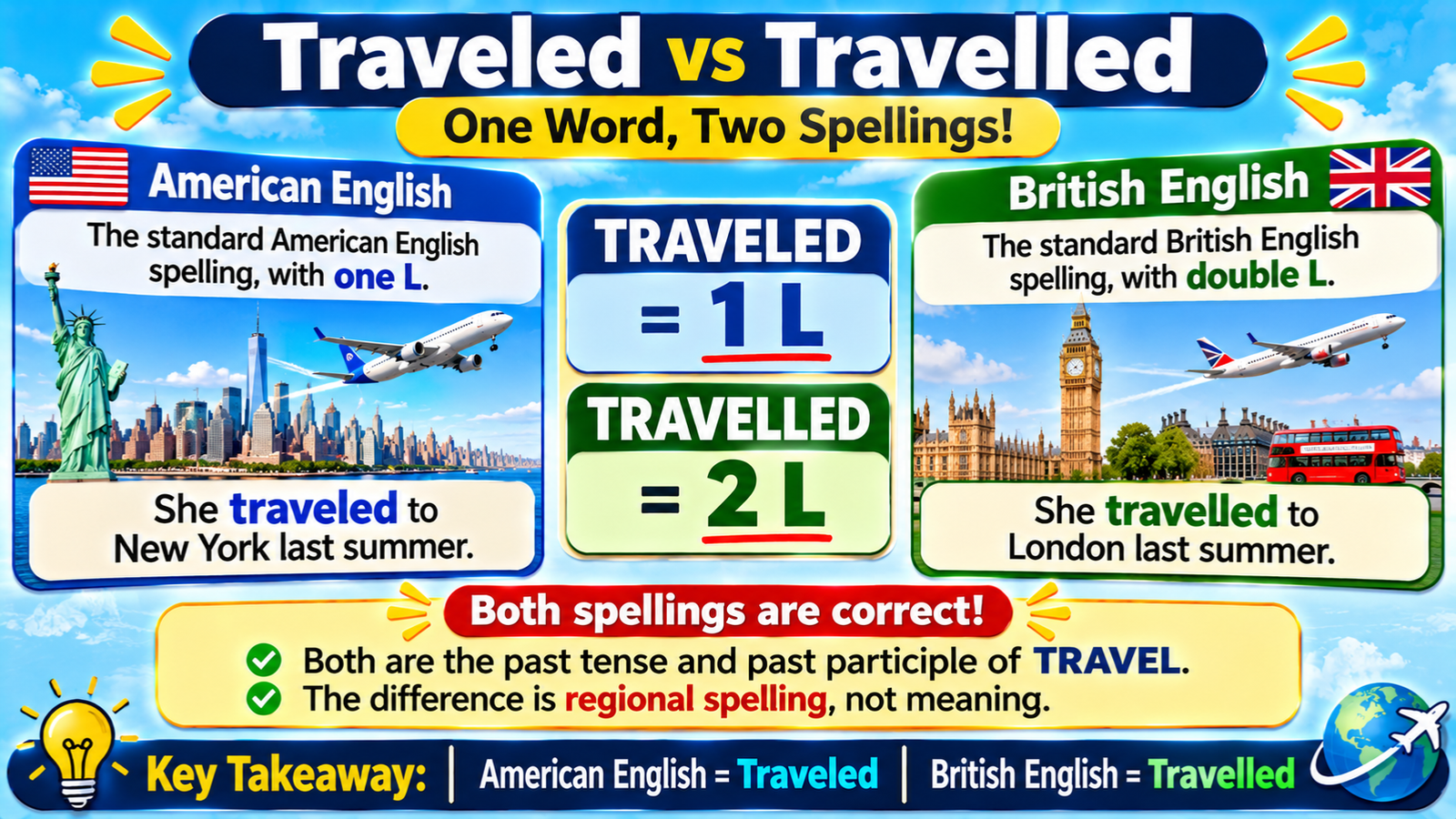
Both are correct. “Traveled” is the standard American spelling; “travelled” is the standard British spelling and the more common choice in the UK, Ireland, Australia and New Zealand, with a slight lead in Canada too. Pick the one your readers expect, then keep it consistent in the whole document.
Quick answer for busy readers: US audience, write traveled, traveling, traveler. UK, Irish, Australian or New Zealand audience, write travelled, travelling, traveller. Canada is the close call, so check your style guide.
The short answer and a simple rule
Settling traveled vs travelled takes about five seconds once you know who is reading.
Writing for Americans? Use traveled, traveling and traveler. Writing for the UK, Ireland, Australia or New Zealand? Use travelled, travelling and traveller. Canada leans toward the double l, but it is the closest call among the major countries in the data below, so follow your style guide. Writing for a mixed or unknown audience? Pick one spelling and hold it through the whole document.
The rule worth remembering: American English keeps one l here because the last syllable of “travel” is unstressed, while British English doubles the final l almost automatically. The full explanation comes after the data.
Traveled vs travelled at a glance
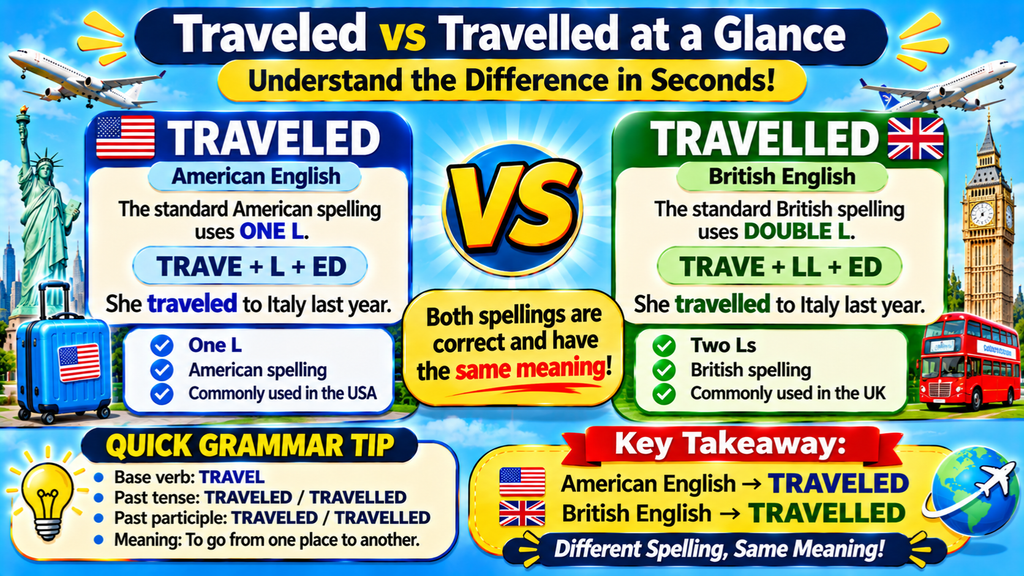
| Question | American English | British English |
| Past tense | traveled | travelled |
| -ing form | traveling | travelling |
| Person noun | traveler | traveller |
| Adjective | well-traveled | well-travelled |
| Number of l’s before -ed | one | two |
| Used in | United States, partly the Philippines | UK, Ireland, Australia, New Zealand, India, mostly Canada |
The verb itself, travel, is spelled the same everywhere. The difference only appears when you add -ed, -ing or -er.
Which countries use which spelling
The traveled vs travelled split is mostly a map question. Sapling, a writing-tool company, publishes usage estimates by country. The table shows its split out of 100, traveled : travelled. These are corpus-based estimates from one source, not official rules.
| Region | More common spelling | Note (Sapling split, traveled : travelled) |
| United States | traveled | 86 : 14 |
| United Kingdom | travelled | 24 : 76 |
| Ireland | travelled | 26 : 74 |
| Australia | travelled | 22 : 78 |
| New Zealand | travelled | 30 : 70 |
| India | travelled | 14 : 86 |
| Canada | travelled | 44 : 56, a lean, not a rule |
| Philippines | traveled | 53 : 47, nearly even |
Two things stand out. The Philippines is almost a coin flip, and it is the only country in Sapling’s list besides the United States that tips toward traveled. And Canada is not a clean double-l country. Some guides say Canada simply follows British spelling, but a 44 : 56 split is much closer than that claim suggests. Oxford Learner’s American English entry does mark the double-l forms as the usual Canadian choice, so the lean is real. It just isn’t a rule.
If you publish for several countries at once, the table also shows why a single “correct” answer does not exist. Each regional audience has its own habit, and readers notice a spelling that does not match theirs.
Writing for the US and other Tier 1 markets
If your main audience is the US and your secondary audience is other Tier 1 markets, write the body in American English (traveled) and make sure travelled is visible where UK, Canadian and Australian readers will look for it. Tier 1 usually means the US, UK, Canada and Australia, often with Ireland and New Zealand; teams define it differently, so adjust the list to your own analytics.
| Market | Main spelling | Sapling split (traveled : travelled) | What to do |
| United States | traveled | 86 : 14 | Use traveled, traveling, traveler throughout |
| United Kingdom | travelled | 24 : 76 | Use travelled, travelling, traveller |
| Canada | travelled (a lean) | 44 : 56 | Follow the client or publisher style guide; travelled is slightly more common |
| Australia | travelled | 22 : 78 | Use travelled, travelling, traveller |
| Ireland | travelled | 26 : 74 | Use travelled, travelling, traveller |
| New Zealand | travelled | 30 : 70 | Use travelled, travelling, traveller |
Canada is the market to treat with care. The split is close, and Oxford Learner’s American English entry marks the double-l forms as the usual Canadian choice, but a lean is not a rule. If Canada is a major source of traffic, check your own analytics and any style guide your client uses before you decide.
To serve several Tier 1 markets from one site:
- Pick one primary variety, here American English, and use it in every form on the page.
- Keep the other spelling visible once: in the opening paragraph, the country table and the FAQs, so UK, Canadian and Australian searchers see their own spelling.
- If UK, Canadian or Australian traffic is large enough, publish regional versions written in that market’s spelling and link them with hreflang tags (en-US, en-GB, en-CA, en-AU).
- Never mix spellings inside one page, even when the page speaks to several countries.
Why American English drops the second L
The reason behind traveled vs travelled is a consonant-doubling rule, and British and American English apply it differently.
British English is blunt about it: a final l after a single vowel doubles before -ed, -ing and -er. Travel becomes traveling, travelling, traveller. No stress check needed.
American English adds that check. The final consonant doubles only when the stress falls on the last syllable, so rebel becomes rebelled. Merriam-Webster gives expelled, controlled and patrolled as further examples. When the last syllable is unstressed, as in TRAV-el, the consonant stays single: traveled, traveling. Dictionary.com’s usage note makes the same point with gallop, galloped and travel, traveled.
The rule has two limits. Words with two vowels before the l, such as appeal, do not double in either variety: appealed, appealing. And a handful of words run the other way, with one l in British English and two in American English: fulfil and fulfill, enrol and enroll, skilful and skillful. Don’t stretch the travel pattern over those.
A short history: Noah Webster and the single L
Merriam-Webster credits Noah Webster for the American choice. Webster, the lexicographer behind An American Dictionary of the English Language (1828), argued for simpler, more regular spellings, and he decided that travel needed only one l in its participle forms. The same reasoning gave American English cancellation, and it sits alongside his other well-known changes, such as color for colour and center for centre.
British English kept the older doubled form. That is why the traveled vs travelled difference is best understood as a split in convention, not a mistake on either side. Two spelling traditions grew apart, and both are now fully established in dictionaries, newspapers and schools.
All the forms, side by side
| Form | American English | British English |
| Past tense and past participle | traveled | travelled |
| Present participle and gerund | traveling | travelling |
| Person noun | traveler | traveller |
| Adjective | well-traveled | well-travelled |
| Base verb | travel | travel |
Past tense and past participle share one form in both varieties, and the adjective follows the participle. That leaves you one decision per variety, not five.
Pronunciation is no help in choosing. Oxford Learners shows the same transcription, /ˈtrævld/, for traveled and travelled. Nobody can hear the second l.
What the major style guides say
If you write for a publisher, the style guide settles traveled vs travelled for you. The table below shows the general position of the best-known guides. Check the current edition before you rely on it, since guides are updated.
| Style guide or dictionary | Variety | Spelling it points to |
| AP Stylebook | American | traveled, traveling, traveler |
| Chicago Manual of Style | American | traveled, traveling, traveler |
| Merriam-Webster | American | traveled first, travelled listed as a variant |
| Oxford Learner’s Dictionaries | British, with US labels | travelled, with traveled marked as the US form |
| The Guardian style guide | British | travelled, travelling, traveller |
When your client or employer has no guide, treat their country as the guide. A London agency gets travelled; a Chicago newsroom gets traveled.
Related words with the same pattern
Travel is not alone. Many verbs ending in an unstressed -el, -al or -le-type syllable follow the same split.
| Base word | American English | British English |
| cancel | canceled | cancelled |
| label | labeled | labelled |
| level | leveled | levelled |
| model | modeled | modelled |
| signal | signaled | signalled |
| marvel | marveled | marvelled |
| quarrel | quarreled | quarrelled |
| fuel | fueled | fuelled |
| counsel (noun: counselor) | counseled, counselor | counselled, counsellor |
| jewel (noun) | jeweler | jeweller |
In each case it is one l in American English and two in British English. Once you know the travel pattern, you know the whole family.
If you are sorting out one of these, see our guides on canceled vs cancelled and labeled vs labelled. For the person noun and the -ing forms, see traveler vs traveller and traveling vs travelling. The bigger picture sits in American vs British spelling.
Traveled and travelled in a sentence
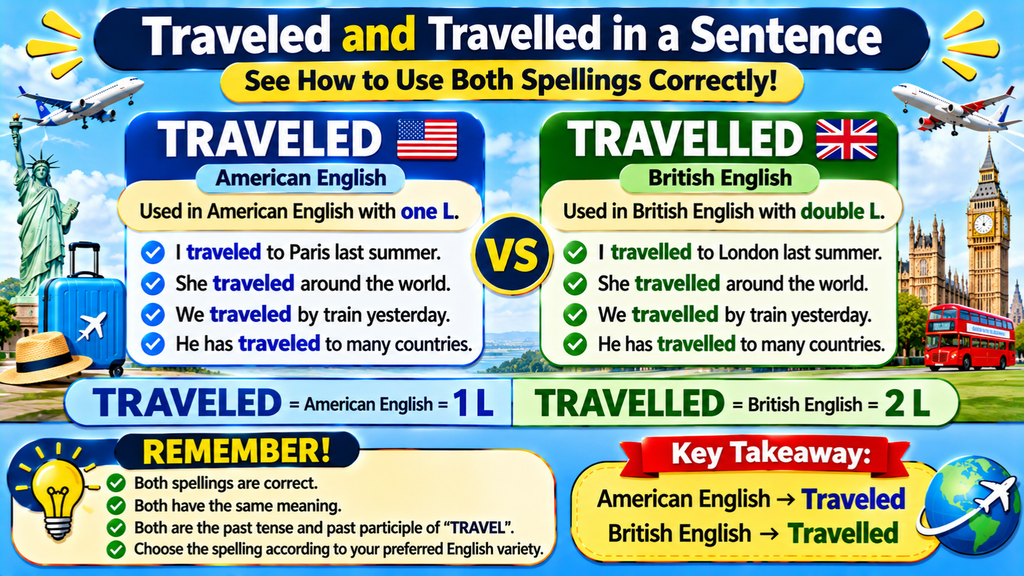
Here is traveled vs travelled in use, with each sentence written in one spelling only.
American English:
- She traveled to Chicago twice a month for client meetings.
- Our well-traveled neighbor has a story for every airport.
- Every seasoned traveler knows that traveling light beats checking a bag.
- The report shows how far the average commuter traveled in 2025.
British English:
- The sales team travelled to Manchester for the quarterly review.
- My aunt is the most well-travelled person I know.
- She has always been a nervous traveller, but travelling by train calms her.
- The delegation travelled overnight to reach Edinburgh before the conference.
How to remember traveled vs travelled
A simple memory trick: Americans save an L. One l for the United States, two l’s for the rest of the English-speaking world, with Canada leaning to the double l.
Another way to hold it: if the word is in an American document, scan it for single-l forms across the board (traveled, canceled, labeled). If the document is British, scan for the doubled forms (travelled, cancelled, labelled). One quick scan catches almost every slip.
Which spelling to use in different situations
The right choice in the traveled vs travelled question depends on where your writing goes.
- Business emails: match the recipient’s country. A US client gets traveled; a UK client gets travelled.
- Resumes and CVs: follow the country of the employer. A “well-traveled” candidate in New York is “well-travelled” in London.
- Academic papers: follow the journal’s style or the university’s guidance. Many journals state a preferred English variety in their author instructions.
- Websites and blogs: choose the variety of your main market and use it everywhere. If you serve several markets, consider separate pages for each, for example with US and UK versions marked up with hreflang.
- SEO and search: search engines generally treat the two spellings as variants of the same word, but people search in their own spelling. If you want to rank in the UK, writing travelled in your title and headings matches what readers type.
- Fiction: follow your setting and your publisher. A novel set in Dublin reads more naturally with travel.
- Mixed or unknown audience: pick one spelling, apply it to every form, and do not switch.
How to set your spell checker
Most wrong spellings in the traveled vs travelled debate come from a spell checker set to the wrong variety. A two-minute fix:
- Microsoft Word: open the Review tab, choose Language, then Set Proofing Language, and pick English (United States) or English (United Kingdom).
- Google Docs: open the File menu, choose Language, and select the English variety you need.
- Grammarly and similar tools: choose American, British, Canadian or Australian English in the dictionary or language settings.
Set the language first, then trust the red underline. If the setting is wrong, the tool will flag the correct spelling and wave through the wrong one.
Common mistakes
- Mixing forms in one document. Traveled next to travelling is the classic slip, and readers notice it faster than they notice which variety you picked.
- Doubling the l in some forms and not others. If you wrote traveled, then traveling and traveler follow. Same for traveling, travelling and traveller.
- Treating traveled vs travelled as right versus wrong. Merriam-Webster lists both, and Oxford Learner’s labels traveled as the US form, not a mistake. You will get corrected by someone checking their own dictionary.
- Applying the one-l habit to every word. The pattern has exceptions: fulfill, enroll and skillful keep the double l in American English.
- Letting the spell checker’s language setting decide. If it is set to the wrong variety, it will flag the right spelling and wave through the wrong one. Set the language first, then trust the red underline.
- Copying a spelling from a source in another variety. A quote or a heading pasted from a British site can bring travel into an American document. Check pasted text before you publish.
Quick practice: traveled or travelled?
Choose the right spelling for each sentence. Answers are below.
- A US travel blog: “She has ____ to forty countries.”
- A UK newspaper: “The prime minister ____ to Brussels on Monday.”
- An Australian company newsletter: “Our most experienced ____ joins the team.”
- A New York recruiter’s note: “A well-____ candidate with languages.”
- A Delhi university essay: “Pilgrims have ____ these roads for centuries.”
Answers: 1. traveled. 2. travelled. 3. traveller. 4. well-traveled. 5. travelled.
FAQs
Is travelled a correct spelling?
Yes. Travelled is the standard British spelling and the dominant form outside the United States, according to Merriam-Webster. It is not a typo. It signals British, Irish, Commonwealth or similar usage, so it suits readers in those places.
Is traveled wrong in British English?
Not wrong, but it reads as American. Oxford Learner’s labels traveled as the US form, and Sapling’s UK split is 24 : 76 in favor of travelled. For British readers, use the double-l spelling and keep it consistent.
Which is more common worldwide?
There is no clean worldwide count. Merriam-Webster says travelled dominates outside the US, but the US is a large market, so any overall lean toward traveled is an inference, not a measurement. In a travelled vs traveled contest, audience matters more than global totals.
Do Canadians use traveled or travelled?
Mostly travelled, though not by a wide margin. Sapling’s Canadian split is 44 : 56 in favor of the double l, which is a lean rather than a rule. Check your style guide or publisher before choosing for a Canadian audience.
Do Americans ever write travels?
Sometimes. Sapling’s US figures are 86 : 14 in favor of traveled, so travelled does appear in American text. In US copy, though, traveled is the safer choice, since it is the standard American spelling.
Which should I use in a work document: traveled or travelled?
Match your readers and your company style guide. US clients and colleagues get traveled; UK, Irish, Australian, New Zealand and Indian ones get travelled. With no style guide, choose your main audience’s variety and apply it to every form.
Is it traveling or travelling?
Same split as the past tense: traveling in American English, travelling in British English. Merriam-Webster lists both forms for the verb. Whichever you choose, match it to traveled or travelled elsewhere in the document so the spelling stays consistent.
Is it traveler or traveller?
The traveler is American and the traveler is British. The person noun follows the same doubling rule as the verb forms, so keep it matched: traveler goes with traveled and traveling, traveller with travelled and travelling.
Is it well-traveled or well-travelled?
The adjective follows the participle. Use well-travelled in American English and well-travelled in British English. Oxford Learners lists the adjective as travelled, with traveled as the US form, so the same pattern holds here too.
How is travel pronounced?
Oxford Learner’s gives the same transcription, /ˈtrævld/, for traveled and travelled. The second l changes nothing in speech, so the difference only shows up on the page, never in conversation.
Which spelling do Australians and New Zealanders use?
Both follow the British pattern: travelled, travelling and traveller. Sapling’s figures are 22 : 78 for Australia and 30 : 70 for New Zealand, both in favor of the double l.
Does traveling vs traveling affect SEO?
Search engines generally recognize the two spellings as the same word, but readers search in their own variety. Use the spelling of your target market types, and keep it consistent across the title, headings and body text.
Is it a traveler’s check or a traveler’s cheque?
The two phrases follow two different spelling systems. “Traveler’s check” is the American form, and “traveller’s cheque” is the British form, with both the l and the noun spelling changing.
Can I use both spellings on one website?
Only if the pages are clearly separated by audience, such as a US section and a UK section. Inside any single page or article, use one spelling only.
Final Thoughts
On traveled vs travelled, my recommendation is simple: choose by reader, not by taste. The American audience traveled. British, Irish, Australian or New Zealand audiences travelled. For Canada, check the style guide, because the data leans one way but the call is close. Then apply your choice to every form in the document.
One l for American readers, two for most everyone else, and never both in the same document.
Before your next draft, set your spell checker to the right English variety. It takes ten seconds and settles the argument for good.