
Lyed or Lied? The Correct Past Tense of Lie
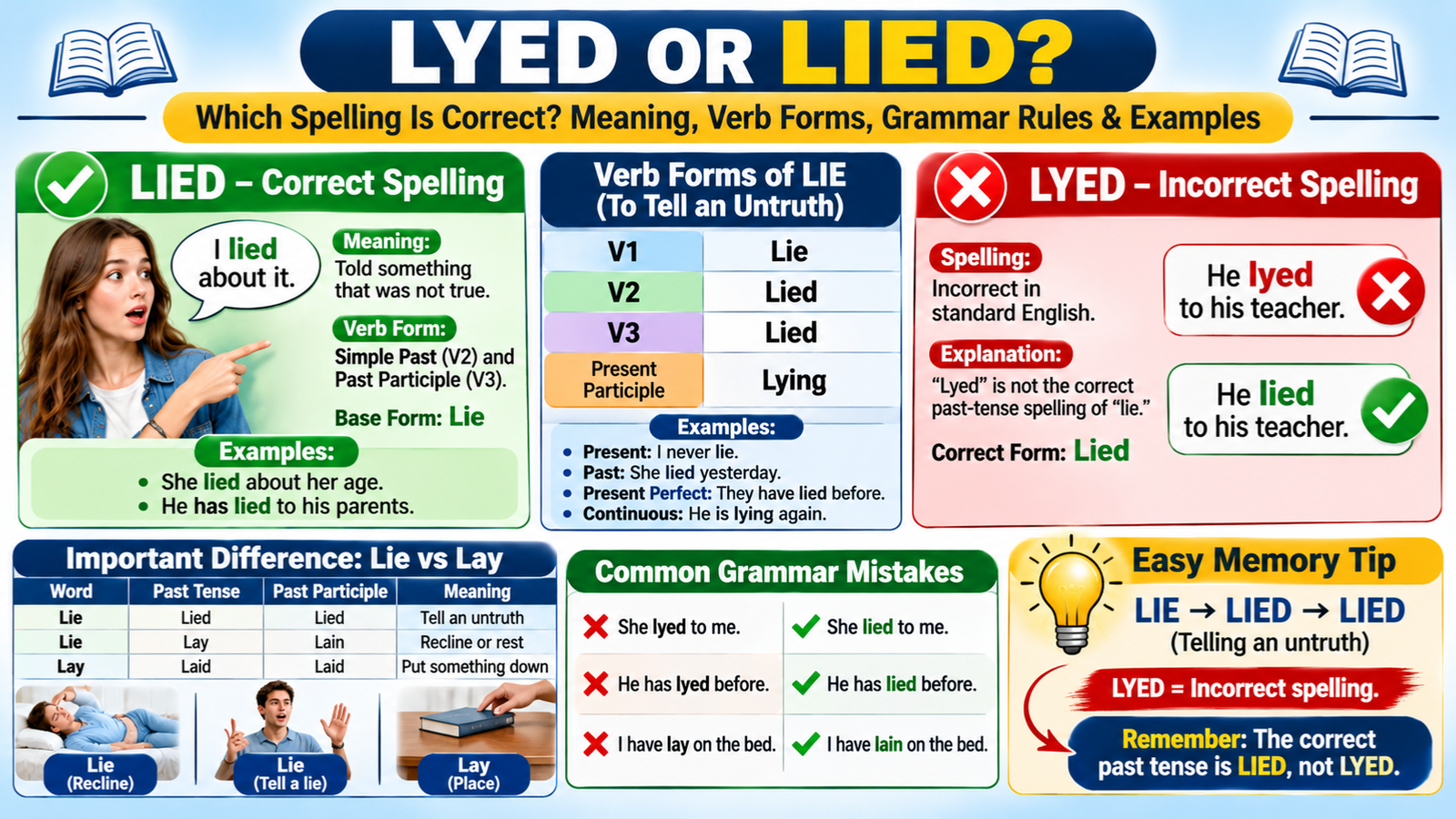
“Lied” is the correct spelling. When you tell an untruth, the past tense and past participle of lie is lied: “He lied about the time.” “Lyed” is not a past tense of lie. Spell it lie + d, and keep the y for “lying.”
Lyed or Lied: The Quick Answer
Lied. That’s it.
If your spellchecker just underlined something, this is the fix. “She lied to me” is right. “She lyed to me” is not. The same goes for the participle: “He has lied before,” never “he has lyed before.”
So the lyed or lied question takes about two seconds to answer. The rest of this page covers what sits behind it: why the spelling works this way, why lie causes so much trouble, and how to tell lied, lay, laid and lain apart without a headache.
Here is the version worth keeping:
Lie + d = lied. The y only shows up in lying.
Why Is It “Lied” and Not “Lyed”?
Most regular English verbs form the past tense by adding -ed. Walk becomes walked. Ask becomes asked. Lie is a regular verb too, when it means “to say something untrue.” Its base form already ends in -e, so you only add a -d.
That gives you lied. No letter changes, nothing swapped out.
The y appears somewhere else entirely. When you add -ing to a verb that ends in -ie, the -ie turns into -y. So lie becomes lying, not “lieing.” You don’t need the history behind it. You need the rule: -ed keeps the i, -ing swaps it for y.
People write “lyed” because they have seen lying a thousand times and carried that y over to the past tense. It is a reasonable mistake, and it is still a mistake.
One honest footnote. “Lyed” does exist as a rare word, but it isn’t a verb form of lie. QuillBot describes it as an uncommon adjective meaning “prepared with lye,” and Wiktionary-style entries list “lyed corn” as a chiefly American use, with citations from the nineteenth century. Lye is a strong alkaline substance, and grain soaked in it to loosen the husks was called lyed corn. If you are writing about food history, you might need that word. If you are writing about someone who didn’t tell the truth, you don’t.
So when someone asks “is lyed a word?”, the fair answer is: sort of, but not the one you wanted.
Why Does “Lyed” Look Correct?
Honestly, it looks fine until you stare at it. Run through the usual pattern:
- walk → walked
- call → called
- jump → jumped
- open → opened
Add -ed to the end and you have a past tense. Apply that habit to lie and “lyed” feels like the natural result. The y makes it look even more natural, because you have been typing lying your whole life.
Here’s the catch. The y in lying is not a part of lie. It is a spelling adjustment that only happens before -ing. Past-tense -ed doesn’t trigger it. So the base keeps its i, and you get lied.
Quick check you can run on any verb that ends in -ie: write the -ed form without changing the vowels. Tie becomes tied. Die becomes died. Lie becomes lied. If the -ed version looks right, it is.
What Does “Lied” Mean?
Before going deeper into Lyed or Lied, it helps to pin down the meaning.
Lied is the past tense and past participle of lie when the verb means to say or write something you know isn’t true.
“Daniel lied about where he had been” says Daniel gave false information about his whereabouts. The verb covers every kind of dishonesty: lying about your age, your qualifications, your intentions, or what you knew and when you knew it.
It does not change with the audience. A child who lied about homework and a company that lied about its results both use the same word.
Lie, Lied and Lying: Telling a Falsehood
Let’s take the simplest verb first. When lie means to say something untrue, it is regular, with these forms:
- Present: lie (I lie, they lie), lies (he lies)
- Past: lied
- Past participle: lied
- -ing form: lying
A liar lies. Yesterday the liar lied. The liar has lied many times, and is lying right now.
Notice that the past tense and the past participle are the same word, which makes your life easier. You use “lied” after have, has and had (“I have lied”), and you use it on its own for the simple past (“I lied”).
Here it is across the main tenses:
- Present: “I don’t lie to my friends.”
- Past: “I lied to my friend yesterday.”
- Present perfect: “I have lied before.”
- Past perfect: “I had lied about my whereabouts.”
- Present progressive: “I am lying to you.”
Synonyms like fib or deceive follow their own patterns. For telling an untruth, lie, lied, lied is the one to remember. There is no “lied down” in this family, and that matters in a moment.
Why Is It “Did He Lie?” and Not “Did He Lied?”
This is a mistake that survives even for people who know the lyed or lied rule. It involves did.
When you use did, the helping verb already carries the past tense. The main verb goes back to its base form. So you write:
- “Did he lie to you?” (not “Did he lied to you?”)
- “Why did she lie?” (not “Why did she lied?”)
- “He did not lie to me.” (not “He did not lied to me.”)
Compare the pair:
- “He lied to me.” Simple past, one verb does everything.
- “Did he lie to me?” Did carries the past, so lie stays in its base form.
And with have, has and had, the participle comes back: “He has lied to me before.” “He had lied before I found out.”
Rule of thumb: after did, use lie. After have, has or had, use lied.
Lied To Someone, Lied About Something
Two small prepositions change what the sentence says, and they’re worth knowing because most real sentences about lying use one of them.
Lied to names the person who received the false statement:
- He lied to his mother.
- The witness lied to the investigators.
- I think she lied to me.
Lied about names what the false statement was about:
- He lied about his age.
- They lied about the results.
- She lied about where she had been.
You can use both in one sentence: “He lied to his parents about where he had been.” His parents are the audience, and where he had been is the subject of the lie.
The Other Lie: Lay and Lain
Here is where the real trouble starts. English has a second verb that is also spelled lie. It means to rest in a flat position, as in “I’m going to lie down.” It is a different word with a different history, and it is irregular:
- Present: lie
- Past: lay
- Past participle: lain
- -ing form: lying
So the past tense of “lie down” is “lay down,” and the participle is “lain.” In practice:
- Present: “I lie on the couch after work.”
- Past: “I lay on the couch all afternoon yesterday.”
- Past participle: “The papers have lain on that desk since Monday.”
- -ing: “I am lying on the couch.”
Yes, lay in that second sentence is the past of lie, not the present of the putting verb lay. That coincidence is exactly why this topic never goes away. Both verbs also share the -ing form, so lying can mean telling untruths or resting flat, and you work out which from the sentence.
Britannica points out the most common slip: people write “lied” where they need “lain.” “I had lied there for an hour” says you told untruths, not that you rested. If you mean resting, you want “I had lain there for an hour.”
QuillBot is blunt on the same point: “lied down” is never correct. And “layed” is always wrong as a form of lie.
Lied vs Lay: What’s the Difference?
The easiest way to choose between lied and lay is to ask what the person is doing.
If the person is telling an untruth, use lied. “She lied about the meeting.”
If the person is resting, the past tense is lay. “She lay on the sofa after dinner.”
One letter apart, completely different meanings. Look at these two:
- “He lied on the couch.” Normally means he told an untruth while he happened to be on the couch.
- “He lay on the couch.” He rested there.
That is also why replacing words mechanically creates new errors. Context decides the verb, not how similar the spelling looks.
Lay vs Lie: The Simple Test
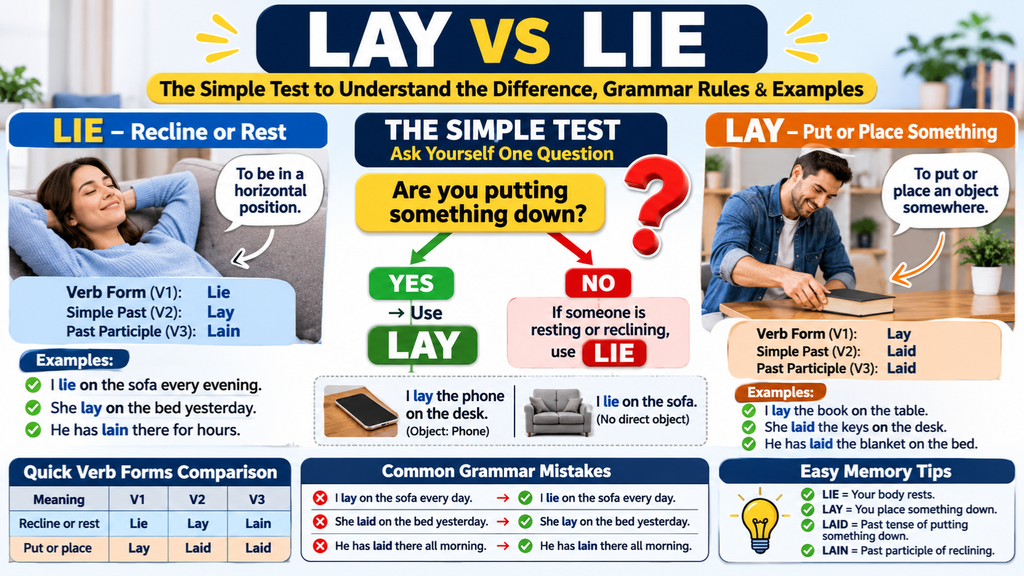
The third verb is lay, which means to put or set something down. It has its own forms: lay, laid, laid, laying.
How do you pick between lay and lie? Ask one question: is something being put somewhere?
Lay takes a direct object. Lie does not. That is the whole rule, according to Britannica. Grammarians call these transitive and intransitive verbs, but you can skip the labels.
- “Lay the blanket on the floor.” You are putting the blanket somewhere. Blanket is the object, so lay.
- “Lie down on the floor.” Nobody is putting anything anywhere. You are the one resting, so lie.
Two shortcuts from Espresso English help. First, lay is usually followed by a noun, and lie is usually followed by “down.” Second, if the sentence has no object, you want lie.
Try it on a real sentence. “She laid the keys on the table.” What did she lay? The keys. There is an object, so it is the putting verb, laid. Now: “She lay on the sofa.” What did she lay? Nothing. She is the one resting, so it is lay, the past of lie.
Put it together with tense:
- “Right now I lay my keys on the counter.” (put, present)
- “Yesterday I laid my keys on the counter.” (put, past)
- “Yesterday I lay on the couch.” (rest, past)
- “I have lain here since noon.” (rest, participle)
- “He lied to me about it.” (untruth, past)
The object test won’t solve every unusual idiom, but for everyday sentences about physical position it works very well.
All the Forms in One Table
Everything above, side by side. Bookmark this one.
| Verb | Meaning | Present | Past | Past participle | -ing |
| Lie | tell an untruth | lie | lied | lied | lying |
| Lie | rest flat | lie | lay | lain | lying |
| Lay | put or set down | lay | laid | laid | laying |
Two things jump out. First, “lay” appears twice, once as the present of the putting verb and once as the past of the resting verb. That overlap is the trap. Second, the untruth verb is the only regular one on the table, which is why it is the easiest to get right.
“I Lay Down” or “I Laid Down”?
Both can be correct, but they don’t mean the same thing.
“I lay down” is for reclining. Lay is the past tense of lie here: “I lay down for an hour.”
“I laid something down” is for placing an object. Laid is the past of lay: “I laid my phone down.”
Side by side:
| Sentence | What it means |
| I lay down. | I reclined. |
| I laid the book down. | I placed the book. |
| She lay on the bed. | She rested on the bed. |
| She laid the blanket on the bed. | She placed the blanket there. |
If you want to talk about yourself resting, “I lay down for a nap” is the careful standard form. “I laid down for a nap” is very common in speech, and you will see it in print, but strictly speaking laid needs an object. In an essay or an exam, go with lay.
Is “I Lied Down” Correct?
No, not for reclining. If you mean you rested, the standard form is “I lay down.” “I lied down” says you told an untruth while lowering yourself, which is probably not what you meant.
The forms for the resting verb are:
- Present: I lie down.
- Past: I lay down.
- Past participle: I have lain down.
- -ing: I am lying down.
For example: “I lie down after lunch.” “I lay down for a short nap yesterday.” “They were lying down when the phone rang.” Nobody in those sentences is being dishonest, so lied has no place there.
Other Verbs That Follow the Same Pattern
Lie isn’t the only verb that ends in -ie. A few others behave the same way, and learning them together makes the rule stick:
- tie → tied → tying
- die → died → dying
- vie → vied → vying
Each one adds -d for the past tense and swaps -ie for -y before -ing. So you wouldn’t write “tyed” for the past of tie or “dyed” for the past of die. Careful with the second one: “dyed” is a real word, but it is the past tense of dye, the verb for changing the colour of cloth or hair. “He died” means he stopped living. “He dyed his shirt” means he coloured it.
It’s the same story as lyed or lied: one spelling is a real word with a different meaning, the other is the verb form you actually need.
How to Pronounce Lied
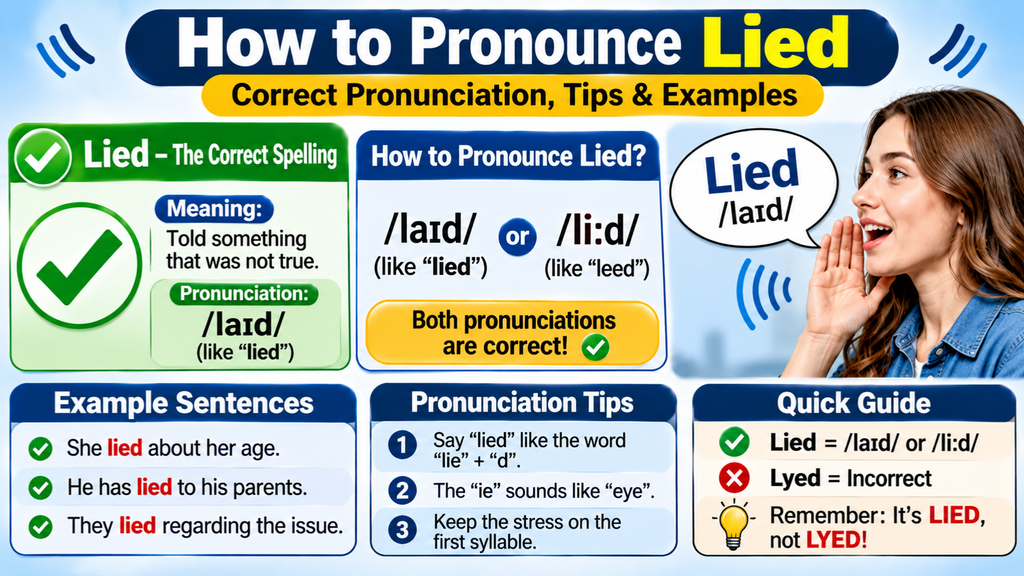
Pronunciation won’t settle Lyed or Lied, since both are spoken the same way, but it matters for the other meanings.
As a verb, lied sounds like “lide,” rhyming with side, ride and tide. Dictionary.com gives the American pronunciation as “lahyd.”
The two verbs sound the same when they take the same form, so the confusion lives in writing and in choosing the right word, not in how you say it. “I lied” in the sense of an untruth always rhymes with “side.” The word lay, on the other hand, rhymes with “day,” and lain rhymes with “rain.”
The noun is another matter, and it is next.
Lied in Music: The German Word
If you landed here from a music page, there is a second, unrelated word spelled lied. In English it names a German art song, usually from the nineteenth century, that sets a poem to music for one singer and piano. The plural is lieder.
Dictionary.com says English borrowed the word from German around 1850 to 1855. The noun is pronounced “leed” (or “leet” in some American renderings), nothing like the verb. So “lied” the verb rhymes with “side,” and “lied” the song rhymes with “need.”
Same letters, different word. Context makes it obvious: a singer performs a lied, and a witness lied under oath.
Example Sentences
Past tense and participle of lie (untruth):
- He lied about where he had been all evening.
- I have never lied to you.
- She lied so smoothly that nobody noticed.
- The witness admitted he had lied under oath.
- They lied to protect a friend.
- Why would you have lied about something so small?
- I’m sorry I lied. I should have told you the truth.
- If she had lied, someone would have found out by now.
Lie (rest), lay (put), and their past forms:
- She needed to lie down for a few minutes.
- I lay awake until three in the morning.
- The papers have lain on that desk since Monday.
- Lay your coat on the bed.
- He laid the tools out in a neat row.
- By the time we arrived, she had laid the table.
Three Almost Identical Sentences
Seeing the three verbs in one small scene makes the difference stick.
| Sentence | Verb | Meaning |
| Sarah lied to Mark. | lie | She told an untruth. |
| Sarah lay beside Mark. | lie | She rested there. |
| Sarah laid the blanket beside Mark. | lay | She placed something there. |
Three sentences, three verbs, three meanings. If you can say why each one uses a different past form, you have the whole topic.
Common Mistakes
The Lyed or Lied slip is only one of several. Here are the ones that show up most.
Writing “lyed.” The y belongs only in lying. For the past tense, it is lied.
Writing “lieing.” Wrong the other way round. The -ie turns into -y: lying.
“Did he lied to you?” After did, use the base form: “Did he lie to you?”
“I lied down.” This says you told an untruth while lowering yourself. To describe resting, you need “I lay down.”
“I had lied there.” Same problem. You want “I had lain there.”
“I layed on the bed.” Layed isn’t a correct word for either verb. The past of the resting verb is lay; the past of the putting verb is laid.
“I laid down for a nap.” Everywhere in speech, and common in print. Strictly, laid needs an object, so for yourself the careful form is “I lay down.” Judge by your audience.
“I lay the book there yesterday.” Putting something somewhere in the past needs laid: “I laid the book there yesterday.”
“She lay to me.” Not if you mean she told you something untrue. Say “She lied to me.”
Mixing up lyed or lied with dyed or died. Dyed (colour) and died (stopped living) are both real. They are different words, not spelling variants.
Lyed vs Lied in a Sentence
Here are the common wrong forms next to the right ones.
| Wrong | Right |
| He lyed to me. | He lied to me. |
| She lyed about her age. | She lied about her age. |
| They lyed about the incident. | They lied about the incident. |
| I knew he lyed. | I knew he lied. |
| She has lyed before. | She has lied before. |
| Why did he lyed? | Why did he lie? |
The last row is the did rule again. When did is in the sentence, the verb goes back to lie.
How to Remember It
A few short rules are enough to settle Lyed or Lied for good.
Three short rules cover everything on this page:
- Lied = told a lie.
- Lay = rested.
- Laid = placed.
And the spelling trick: lie + d = lied. The y only comes in lying.
If you want a one-line test for any sentence, ask what is happening. Someone telling an untruth? Lied. Someone resting? Lay in the past, lain with have. Someone putting something somewhere? Laid.
Quick Practice
Pick the correct word. Answers follow.
- He ___ about his age on the form. (lied / lyed / layed)
- I was tired, so I ___ down for an hour. (lied / lay / laid)
- She has ___ in bed all morning. (laid / lain / lied)
- Please ___ the book on the table. (lie / lay / lied)
- The company had ___ about its results. (lyed / lied / lain)
- The ship’s cargo ___ at the bottom of the sea for years. (lay / laid / lied)
- Why did he ___ to you? (lie / lied / lay)
- She ___ her keys on the shelf before she left. (lay / laid / lied)
Answers: 1. lied. 2. lay. 3. lain. 4. lay. 5. lied. 6. lay. 7. lie (after did). 8. laid.
How did you do? If you missed 2, 3 or 6, the resting verb is the one to revisit. If you missed 1 or 5, remember the trick: lie + d. If you missed 7, go back to the did rule.
FAQs
These are the questions people ask most often about Lyed or Lied.
Is it lied or lyed? It’s lied. Add -d to lie when you mean telling an untruth. “Lyed” is not the past tense of lie, even though it looks like it should be.
Is “lyed” a word? Only as a rare adjective meaning treated with lye, mostly American, as in “lyed corn.” It’s not a form of the verb lie, so it doesn’t belong in a sentence about someone telling untruths.
Is “lyed” ever the standard spelling? For telling an untruth, no. Lied is the standard form. The rare adjective “lyed” is a different word that has nothing to do with dishonesty.
Why isn’t the past tense “lyed”? Because the -ed ending attaches to lie as lie + d. The -ie only changes to y before -ing, which is why you get lying but not lyed.
What is the past tense of lie? It depends on the meaning. If you mean tell an untruth, the past tense is lied. If you mean rest flat, the past tense is lay. So “He lied” and “He lay down” are both correct, for different verbs.
What is the past tense of lie (to tell an untruth)? Lied. Both the simple past and the past participle use the same form: “she lied” and “she has lied.”
What is the past participle of lie? Also depends on the verb. For telling untruths, it’s lied. For resting flat, it’s lain. For lay (to put something down), the past participle is laid.
Is it “I lied” or “I lay”? Use “I lied” if you said something false. Use “I lay” if you rested in a flat position, as in “I lay on the grass.”
What is the difference between lie and lay? Lay needs an object, the thing you put down. Lie doesn’t take one. You lay a book on a table, and you lie down yourself.
What is the difference between lied and laid? Lied means told an untruth: “She lied to me.” Laid means put something somewhere: “She laid the book on the table.”
What is the past tense of lie down? Lay down. “He lay down on the sofa.” The participle is lain: “She has lain down.” Never “lied down,” since that is the untruth verb.
Is “He lied on the bed” correct? It is grammatical if you mean he told an untruth while on the bed. If you mean he rested there, use “He lay on the bed.”
How do you spell lying? L-Y-I-N-G. The -ie in lie turns into -y before -ing, so “lieing” is wrong.
What does lied mean in German or music? It is a German word for song, and English uses it for a nineteenth-century art song for voice and piano. The plural is lieder, and it’s pronounced “leed,” not like the verb.
Final Thoughts
Told an untruth? Lied. Resting flat? Lay. Putting something down? Laid. And “lyed” stays out of all three.
If you remember only one thing from this page, make it the quick fix: lie + d = lied. The y only comes in lying. When you want the past tense of resting, reach for lay (or lain with have), and when you are putting something somewhere, use laid. After did, go back to the base form: “Did he lie?”


3 Comments