Happened vs Happend in English: Correct Spelling, Grammar and Pronunciation
If you are unsure about happened vs happend in English, use happened; happend is a misspelling. This guide shows why the e goes missing, how to say the word, and how happen works in questions and tenses.
Quick answer: The correct spelling happened. Happend is a misspelling and not a word. Happened is the past tense and past participle of happen: just add -ed, with no extra n. Say it as two syllables: HAP-und. Example: Nothing happened after the meeting.
Is “Happend” a Word? Why “Happened” Is the Only Correct Spelling
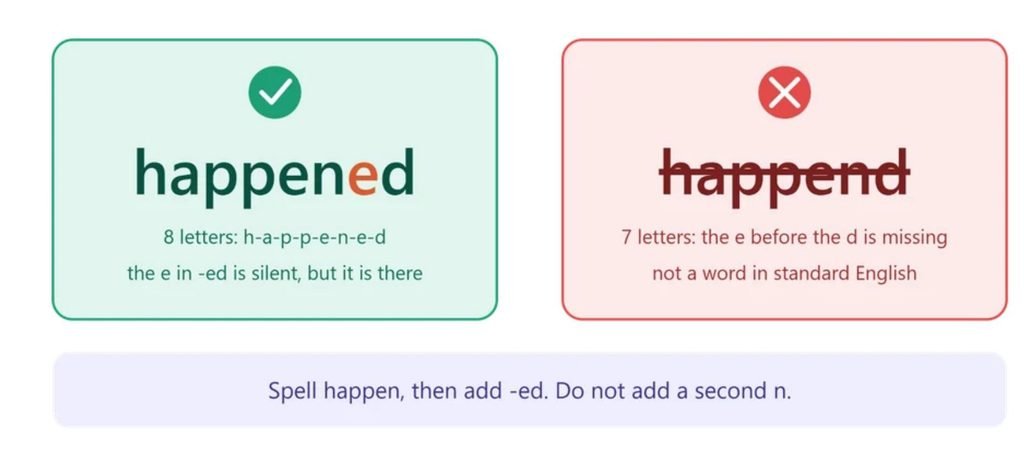
Happend is not a word in standard English. The correct spelling is happened: take the verb happen and add -ed. Nothing else changes.
Why People Write “Happend”: The Missing E
Say the word out loud: HAP-und. It has only two syllables, and the -ed ending adds just a d sound. Because you never hear a separate “eh” before the d, the e in -ed is silent, which may be why it is easy to drop when typing fast. The result is happend. The fix is to spell by structure, not by sound: happen + ed.
Why “Happened” Has One N: The Doubling Rule
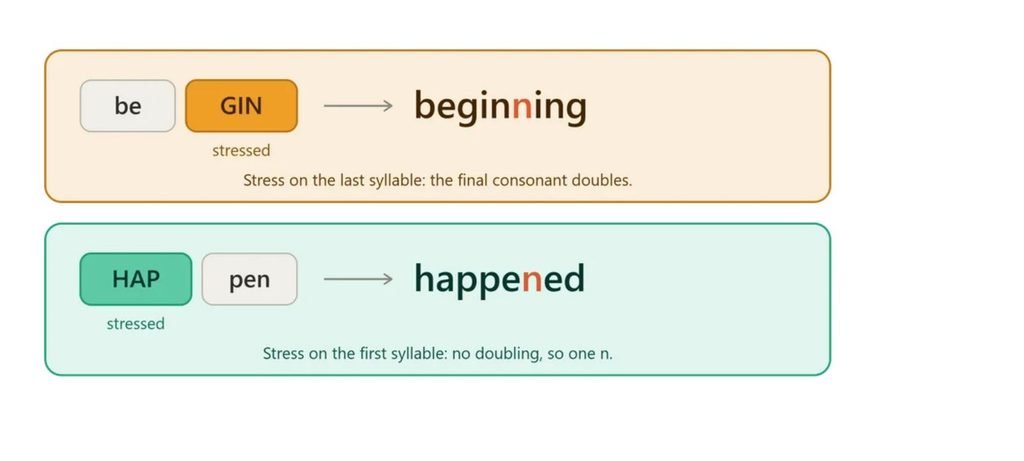
Many learners expect happenned, because begin becomes beginning and admit becomes admitted. The rule behind those words is: in longer words, you generally double the last consonant when the stress falls on the last syllable, with a few exceptions such as travelled in British English.
- Stress on the last syllable → double the consonant: be-GIN → beginning, ad-MIT → admitted, oc-CUR → occurred
- Stress earlier → no doubling: HAP-pen → happened, O-pen → opened, LIS-ten → listened
Happen is stressed on its first syllable, so its n stays single.
Other Misspellings of Happened
- happend: drops the e before the d.
- happenned: doubles the n.
- hapened / hapend: loses a p. Happen needs two.
How to Spell Happened: A Two-Second Check
Spell happen (h-a-p-p-e-n), then add e-d. The finished word has eight letters: h-a-p-p-e-n-e-d. If you count seven, you have written happend.
What Does “Happened” Mean in English?
Happened is the past simple and past participle of happen. In plain terms, it means that something took place or came about. It has three common senses.
1. Something Took Place
The accident happened just after noon.
2. By Chance (Happen To + Verb)
I happened to find the old photo while tidying. The idea is “it turned out that” or “by chance”.
3. Something Befell Someone (Happen To + Person)
What happened to her? asks what became of her, or what took place that affected her.
How to Pronounce Happened
- happen: /ˈhæpən/, say “HAP-un”
- happened: /ˈhæpənd/, say “HAP-und”
Pronunciation note: happened has two syllables, with the stress on the first, and it is said the same way in American and British English .English has three ways to say -ed:
- /t/ after a voiceless sound: looked
- /d/ after a voiced sound: played, happened
- /ɪd/ after t or d: wanted
Happened ends in a voiced n, so it takes the plain d, exactly like opened and listened. That is why no extra syllable appears.
Part of Speech: Is Happened a Verb? Forms of Happen
Happen is a regular verb.
- Base form: happen
- Third person: happens
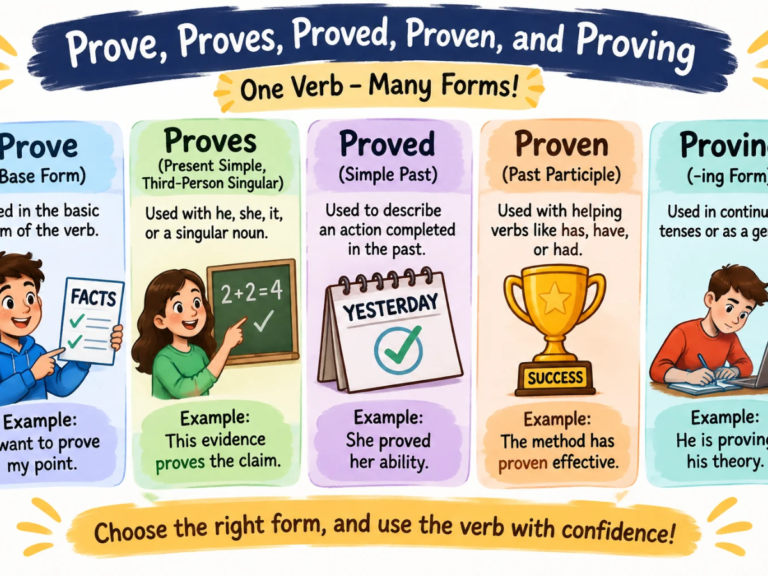
- Past simple: happened
- Past participle: happened
- -ing form: happening
It is also intransitive, which means it takes no direct object. In modern English, that has a practical result: happen has no passive form. You can say The accident happened, but not The accident was happened.
How to Use Happened in a Sentence: Grammar Rules
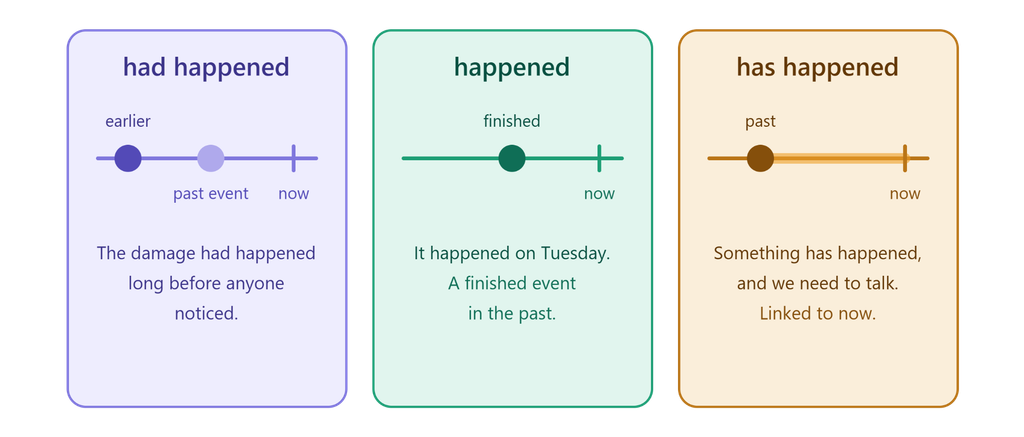
Happened, Has Happened and Had Happened
- happened (a finished past event): It happened on Tuesday.
- has happened (a link to now): Something has happened, and we need to talk.
- had happened (earlier than another past event): The damage had happened long before anyone noticed.
- happens (a general truth): Accidents happen.
- happening (in progress): What is happening outside?
Questions: “What Happened?” vs. “What Happen?”
In a question where the subject is, the past tense sits on the verb itself: What happened? You do not add did. If you do add did for emphasis, the verb returns to its base form: What happened to the report? Never write What did happened? and avoid What happened? in writing.
Why “It Was Happened” Is Wrong
A passive sentence needs a verb that can take an object, and happen cannot. Rephrase with the same verb (It happened by accident) or choose another verb (The delay was caused by a fault).
Patterns and Prepositions with Happen
- happen to + person: What happened to Dana?
- happen to + verb (by chance): Do you happen to have a charger?
- happen on / upon / across (find by chance): We happened upon a tiny café.
- happen along / by (turn up by chance): A neighbor happened by while I was painting.
- in / at / during (time and place): It happened in 2019, at the station, during the storm.
- as it happens: As it happens, I know the owner.
Example Sentences with Happened
| Sentence | Tense or pattern | Register |
| Wait, what happened to the Wi-Fi? | simple past | casual spoken |
| You won’t believe what happened at lunch. | simple past | text message |
| The fire happened in the early hours of Tuesday, officials said. | simple past | news style |
| The incident happened outside normal working hours, according to the report. | simple past | formal written |
| Has anything happened since I left? | present perfect | neutral question |
| By the time I woke up, everything had already happened. | past perfect | narrative |
| I happened to find the old photo while tidying. | happen to + verb | written, chance |
| We happened upon a tiny café down a side street. | happen upon | travel writing |
| As it happens, I know the owner. | as it happens | polite spoken |
Synonyms for Happened: Occurred, Took Place and More
These words overlap, but they are not always interchangeable.
- occurred: more formal, and often used in reports: The error occurred at 3 p.m. Note the spelling: it doubles the r because the stress falls on the last syllable (oc-CUR).
- took place: best for planned or scheduled events: The ceremony took place on Friday. It can sound less natural for accidents.
- transpired: formal; it can also mean “became known”, and some careful writers keep it for that meaning.
- came about: focuses on how something arose: How did that come about?
- arose: for problems, questions and issues that appear: A problem arose during testing.
- befell: literary, usually something bad happening to someone: Misfortune befell the family.
Opposites of Happened: Antonyms and Contrasts
Happen has no true antonym. These contrasts help in everyday use:
- did not happen / never happened: The meeting never happened.
- was prevented: The flood was prevented by the new barrier.
- stayed the same: Nothing happened, and the schedule stayed the same.
Where Does “Happen” Come From? (Etymology)
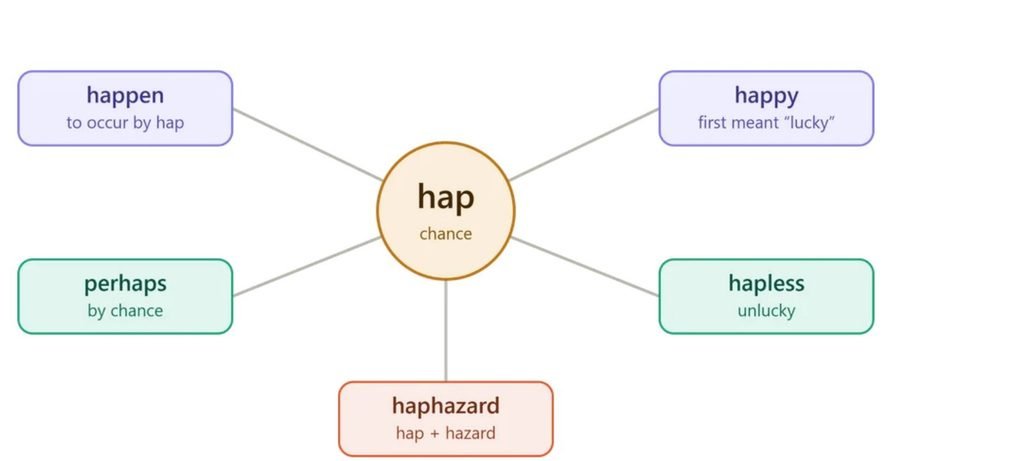
The root is hap, an old word for “chance” or “luck”. Etymonline records it around 1200, from Old Norse happ, “chance, good luck”. Happen appears in the late 14th century as happenen, literally “to occur by hap”: hap plus a verb ending. Wiktionary notes that the exact route to the verb is uncertain, perhaps through Old English hæppan and/or Old Norse. Etymonline reconstructs hap back to a Proto-Indo-European root meaning “to suit, fit, succeed”.
The word has a large family. Happy first meant “lucky” (late 14th century), perhaps meant “by chance” (late 15th century), hapless meant “unlucky” (around 1400), and haphazard comes from the same root. That family connection is a handy memory hook: happen is hap plus a verb ending.
Common Mistakes with Happened and Happend
Some mistakes are about spelling and some are about grammar, and each needs a different fix.
| Wrong | Right | Why |
| What happend yesterday? | What happened yesterday? | The e in -ed is silent in speech, so it is easy to drop. |
| It happenned last night. | It happened last night. | The stress is on the first syllable, so the n does not double. |
| It was happened by accident. | It happened by accident. | Happen is intransitive and has no passive. |
| What happen to him? | What happened to him? | A finished event needs the past tense. |
| What did happened? | What did happen? | After did, use the base form. |
| Something has happen. | Something has happened. | The present perfect needs the past participle. |
| What is happened? | What has happened? / What is happening? | Choose the perfect or the continuous form. |
FAQs
Is it happened or happend?
It is “happened.” “Happend” is a misspelling and is not a word in standard English. Spell the verb “happen” and add -ed: h-a-p-p-e-n-e-d. The past simple and the past participle are both “happened.” Say it as two syllables, HAP-und. Example: “Nothing happened after the meeting ended.”
Why isn’t “happened” spelled with a double n?
In longer words, English generally doubles a final consonant when the stress falls on the last syllable, as in “begin → beginning.” “Happen” is stressed on the first syllable, HAP-pen, so the n stays single: “happened.” The same logic gives “opened” and “listened,” while “occur” and “admit” do double: “occurred,” “admitted.”
How do you pronounce what happened?
“Happened” is /ˈhæpənd/, said HAP-und. It has two syllables, with the stress on the first. The -ed adds only a d sound, not an extra syllable, exactly as in “opened” and “listened.” Because you do not hear a separate vowel before the d, it is easy to leave out the e and write “happend.”
Is it “what happened” or “what happen”?
Use “What happened?” for something that is already over. “What happened?” is not standard written English, because the verb needs the past tense. Add “did” only for emphasis, and then use the base form: “What happened to the report?” Never write “What did happened?”
Can you say “it was happened”?
No. “Happen” is an intransitive verb, so it takes no object and cannot be made passive. Write “It happened by accident,” not “It was happened by accident.” If you want to stress who or what caused something, switch to a different verb: “She caused the delay,” or “The delay was caused by a fault.
Final Thought
The choice between happened vs happend comes down to one habit: spell the base verb, then add -ed. Happen + ed gives happened, with a single n because the stress sits on the first syllable. Hear it as two syllables, HAP-und, and the quiet e in -ed stops hiding.
Keep two grammar points in mind as well. Happen has no passive, so write It happened, never It was happened. And after that, go back to the base form: What happened? Get those right and this word will stop catching you out.