
Families or Familys? The Correct Spelling, Plural Rule and Examples
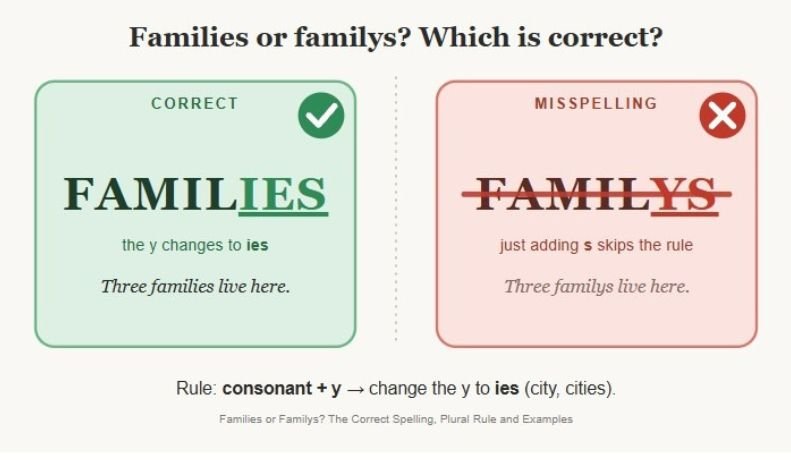
Families or familys? The correct plural is families. When a noun ends in a consonant plus y, change the y to ies: family becomes families. “Familys” is a misspelling. Say it “FAM-uh-leez” (/ˈfæm(ə)liz/). Don’t confuse it with family’s (possessive) or families’ (plural possessive).
Families or familys? If you’ve ever stopped mid-sentence over this, the answer is families. “Familys” looks natural because most English plurals just add -s. But family is trickier than most words that end in y. It can mean a household, a bloodline, a group of friends or a group of languages. It can take a singular or a plural verb. It has look-alike forms (family’s, families’), and it stays singular in phrases like family members. This guide covers all of it.
Spelling graphic showing the correct plural families with a check mark and the misspelling familys crossed out
Families or Familys? Which Spelling Is Correct
| Form | Status | What it means | Example |
| families | Correct | More than one family | Three families live here. |
| familys | Misspelling | Not a word | |
| family’s | Correct | Belonging to one family | The family’s car is old. |
| families’ | Correct | Belonging to several families | The families’ cars are parked outside. |
The Spelling Rule: Why “Family” Becomes “Families”
Consonant + y: change the y to ies. Look at the letter directly before the final y, not at the sound. In f-a-m-i-l-y, that letter is l, a consonant, so the y becomes ies. The same happens in city → cities, baby → babies and story → stories. (For more words like these, see our guide to the plural of words ending in y.)
Vowel + y: just add s. If a vowel comes before the y, keep it: day → days, key → keys, boy → boys.
Surnames keep the y. You write the Murphys, not the Murphies. Surnames ending in s usually take -es: the Joneses. That is where the idiom keeping up with the Joneses gets its plural.
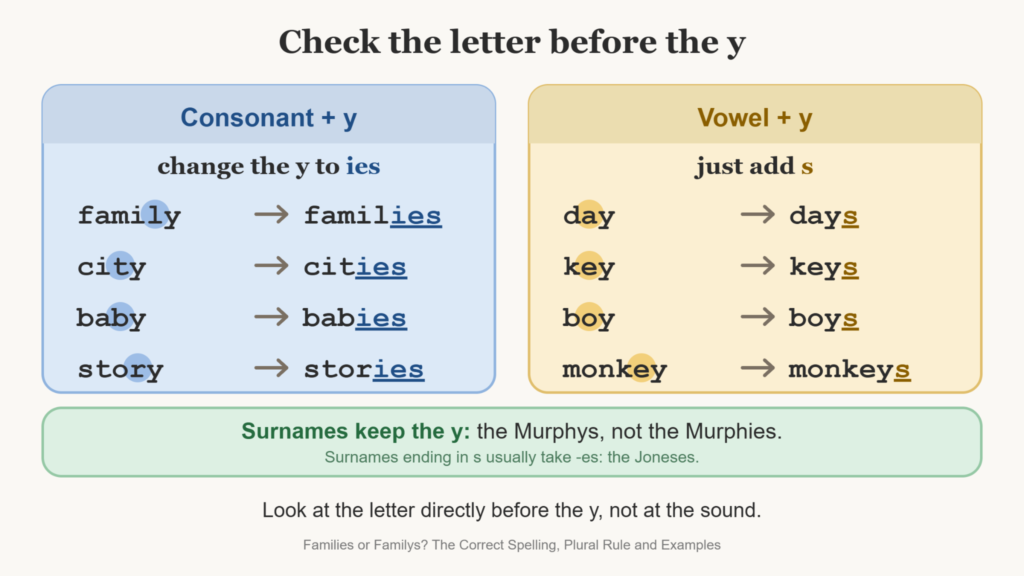
Chart comparing the plural rule for words ending in y: consonant plus y becomes ies, vowel plus y just adds s
A mechanical way to spell it
Break the plural into three chunks: fam – il – ies. There’s one l, and the ending is always -ies. If you catch yourself writing familes, famillies or familiys, check the chunks.
Quick spelling test
Cover the right-hand column and try these.
| Singular | Plural |
| party | parties |
| key | keys |
| lady | ladies |
| toy | toys |
| hobby | hobbies |
| valley | valleys |
| Murphy (surname) | the Murphys |
| family | families |
What Does “Families” Mean?
“Families” is the plural of family, and family has more senses than most people expect. Two families can mean very different things depending on which one the writer has in mind.
A household or a parent-and-child unit. Merriam-Webster’s first sense is the basic unit in society, traditionally two parents rearing their children, and it also covers other social units regarded as equivalent, such as a single-parent family. It lists a household (people living under one roof) as a separate sense. In policy writing, families often means households.
Just the spouse and children. Merriam-Webster also records the sense “spouse and children,” as in want to spend more time with my family. That’s why a headline about families can leave out grandparents and cousins.
Descent and clans. Both Merriam-Webster and Dictionary.com list a group of people with a common ancestor, as in the Tudor family of England.
Chosen families and fellowships. Dictionary.com includes a sense for a group of people who aren’t generally blood relations but share attitudes, interests or goals, as in my friends are my family. Merriam-Webster has our church family, and Dictionary.com has a sense for people united in an occupation, as in our hospital family.
Groups of related things. The word has spread well beyond people. Dictionary.com’s examples include language families (Indo-European, Sino-Tibetan and Austronesian), the halogen family of elements, and a manufacturer’s family of cars. Merriam-Webster also lists families of chemical compounds and of soils.
Biology. In taxonomy, a family ranks above a genus and below an order. Dictionary.com’s scientific entry explains that family names end in -ae, a Latin plural ending. Animal family names end in -idae (Canidae, the dog family), and plant family names usually end in -aceae (Rosaceae, the rose family).
Animals and their young. Dictionary.com even lists a sense for an animal or animals with their young, as in a duck family crossing the road.
Ordinary people in the news. You’ll often read about low-income families or working families. In these uses, “families” means households sharing money, housing and responsibilities.
Family Terms and Their Plurals
When family is part of a longer term, the plural goes on the main noun, not on family itself.
| Term | Plural | What it means |
| nuclear family | nuclear families | Parents and their children |
| extended family | extended families | A wider group that includes relatives such as grandparents, aunts, uncles and cousins |
| single-parent family | single-parent families | One adult raising children |
| blended family | blended families | A family formed when parents bring children from earlier relationships |
| foster family | foster families | Adults who care for children who aren’t their own, usually for a limited time |
| family of four | families of four | A household of four people |
| family member | family members | One person in a family |
| family tree | family trees | A chart of family relationships |
| immediate family | usually singular | Close relatives; the exact definition varies by context |
Notice the pattern: it’s families of four (the plural is on families), but family members and family trees (the plural is on the second noun).
How to Pronounce “Families”
- Simple phonetics: FAM-uh-leez (stress on the first syllable)
- IPA: /ˈfæm(ə)liz/
The singular has two normal pronunciations. Dictionary.com’s American entry lists a three-syllable version (fam-uh-lee) and a two-syllable version (fam-lee), and the British entry in Collins gives the same split. The plural adds a “z” sound to either one: FAM-uh-leez or the shorter FAM-leez. The last syllable rhymes with ease and please, and the ending is always a “z,” never an “s.”
Families Grammar: Forms, Verb Agreement and Prepositions
Noun, countable
Families is a plural noun: one family, two families, many families. In everyday English, family is a countable noun.
“Family” before another noun stays singular
When family describes another noun, it stays singular, even if you mean several families: family members, family restaurants, family rooms, family-friendly hotels. Dictionary.com lists adjective senses for this use (a family trait, a family automobile, a family amusement park), while other dictionaries treat it as a noun used as a modifier. Either way, it doesn’t take a plural ending: families members is a mistake.
Compounds are usually hyphenated before a noun: single-family homes, a two-family house. Style guides differ, so follow yours.
Family, families, family’s and families’: the apostrophe test
The apostrophe changes the meaning, not just the spelling. Ask two questions. First, is it more than one family? Second, does something belong to the family or families? If you can rewrite the phrase with “of the family” or “of the families,” you need an apostrophe.
| Form | Meaning | Example |
| family | one family | Our family is large. |
| families | more than one family | Both families are invited. |
| family’s | belonging to one family | The Patel family’s garden won a prize. |
| families’ | belonging to several families | Both families’ children go to the same school. |
The most common slip is leaving the apostrophe out when something is owned: the families house is large should be the family’s house is large (one family) or the families’ houses are large (several).
With a surname, you have two ways to say the same thing: the Patel family’s garden (singular possessive of “family”) or the Patels’ garden (plural possessive of the surname). The first sounds a little more formal. (See also our guide to apostrophes with plural nouns.)
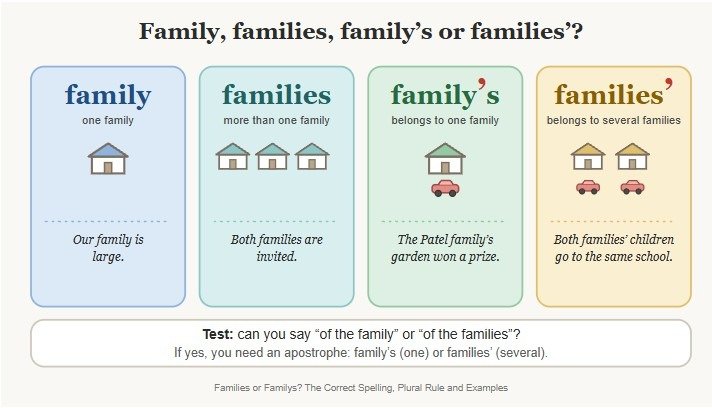
Diagram of family, families, family’s and families’ showing one family, several families, and ownership by one or several families
The family is” or “the family are?
“Family” is a collective noun, so the verb depends on whether you’re picturing a unit or its members. WordUp’s dictionary notes that British English can treat it as singular (the family as a unit) or plural (the members as individuals), while American English prefers the singular.
- The family is selling its house. (one unit)
- The family are selling their house. (individual members; mostly British)
A teaching shortcut: if you could swap “the family” for “it,” use the singular verb. “Families” is always plural: the families are, never the families is. (More in our guide to collective nouns and verb agreement.)
“A family who” or “a family that”?
Both are common. TextRanch describes the two phrases as interchangeable, depending on preference and context.
Prepositions and common phrases
- a family of four: They are a family of four.
- families with (young children): Families with young children get priority.
- for families: The park is designed for families.
- among families: The scheme is popular among families.
- start a family / raise a family: WordUp explains that “start a family” means to begin having children.
- family of languages: Spanish and Italian belong to the same family of languages.
Families in Different Contexts
- News and policy: families usually means households. The scheme helps low-income families.
- Housing and law: the singular modifier appears in set terms. The zone allows single-family homes only.
- Medicine: runs in the family means your own family, while runs in families means families in general. The condition runs in families, so doctors ask about relatives.
- Research writing: the possessive is common. Families’ access to services varies by region.
- Casual speech: fam is friendly and informal, so keep it out of formal writing.
Example Sentences with “Families”
- Formal: Several families were relocated after the flood.
- News: The scheme is aimed at low-income families with young children.
- Casual: Both our families are coming for the holidays.
- Possessive: The Patel family’s garden won first prize.
- Plural possessive: Both families’ children attended the same school.
- Surname plural: The Murphys and the Hills are neighbours.
- Science: Lions and house cats belong to the same family, Felidae.
- Language: French and Spanish belong to the same family of languages.
- Modifier: The clinic runs classes for family members of new patients.
- Medical: The condition runs in families, so doctors ask about relatives.
Synonyms for “Families” and How They Differ
Each synonym picks out a different feature of a family: the roof, the blood, the money or the warmth.
- Households: people living under one roof, related or not. It’s the best fit for statistics and policy.
- Relatives / relations: people connected by blood or marriage, whether or not they live together.
- Kin / kinfolk: warm and slightly old-fashioned; it stresses the bond of blood.
- Clans: large groups claiming shared ancestry.
- Folks: casual and warm; it can mean relatives or people in general.
- Loved ones: emotional rather than structural; it can include close friends.
- Dependants: formal and legal; people who rely on someone’s income.
- Parents and children: the plain, structural version, with no extra feeling.
- Fam (slang): casual and affectionate, so best kept out of formal writing.
| Word | Emphasis | Register | Watch out for |
| Households | Shared home | Formal / neutral | Can include unrelated people |
| Relatives | Blood or marriage | Neutral | Doesn’t imply closeness |
| Kin | Blood bond | Literary | Sounds old-fashioned in speech |
| Clans | Shared ancestry | Neutral | Suggests a large group |
| Folks | Warmth | Casual | Vague about who is included |
| Loved ones | Emotional bond | Neutral | Vague about who is included |
| Dependants | Financial reliance | Formal / legal | Can sound cold |
| Fam | Affection | Very casual | Not for formal writing |
Rule of thumb: counting homes means households, counting blood ties means relatives, and talking about warmth means families or loved ones.
Antonyms and Contrasts
“Families” has no true opposite, but some words contrast with it:
- Strangers: people with no tie to you. WordUp’s entry lists “stranger” as the contrast for “family.” The shelter helps both families and strangers.
- Outsiders: people who don’t belong to a group. The village rarely welcomed outsiders.
- Individuals: single people, not groups. The survey counted families and individuals separately.
- Single-person households: people living alone. She lives in a single-person household.
- Non-relatives: a neutral, formal term. Non-relatives may not claim the allowance.
Where “Family” Comes From
Dictionary.com records the word as first appearing in English between 1350 and 1400, as Middle English familie, from Latin familia. In Latin, familia meant “a household,” including the slaves and domestic workers of a household, and it is built on famulus, “attendant, servant, slave,” plus a noun-forming ending. Wiktionary adds that the word displaced the native Old English word hīred.
So the earliest sense was closer to “household” than to “blood relatives,” which is still visible in the modern household sense.
Common Mistakes with “Families”
- Writing “familys.” Change the y to ies after a consonant: families.
- Other misspellings, such as familes, famillies and familiys. Spell it in three chunks: fam-il-ies.
- Using an apostrophe to make a plural. The family’s are coming is wrong. Use families.
- Writing “families’s.” A plural possessive ending in s takes only an apostrophe: families’.
- Leaving out the apostrophe when something is owned. The families house should be the family’s house or the families’ houses.
- Pluralising the modifier. Families members and families restaurants are wrong. Use family members and family restaurants.
- Writing “the Kennedies” or “the Murphies.” Surnames keep the y: the Murphys.
- Mixing the verb and pronoun. In The family are happy and it is moving, the verb and pronoun disagree. Choose one.
- Mispronouncing the ending. The plural ends in a “z” sound, so say FAM-uh-leez, not FAM-uh-lees.
| Mistake | Fix |
| three familys | three families |
| the family’s are here | the families are here |
| both families’s cars | both families’ cars |
| the families house | the family’s house |
| families members | family members |
| the Murphies | the Murphys |
Frequently Asked Questions
Is it “families” or “familys”?
The correct plural is “families.” “Familys” is a misspelling. Family ends in a consonant plus y, so the y changes to ies in the plural, just like city becomes cities and baby becomes babies. Surnames are the usual exception: they keep the y, as in the Murphys.
Why does “family” change to “families”?
Words that end in a consonant plus y change the y to ies in the plural: family becomes families, city becomes cities. If a vowel comes before the y, you simply add s, as in day and key. So check the letter before the y. That one letter tells you which spelling pattern to use.
What is the difference between “family’s,” “families” and “families’”?
“Families” is the plural: two families. “Family’s” shows that one family owns something: the family’s car. “Families’” shows that several families own something: the families’ cars. An apostrophe doesn’t make an ordinary plural. If you can say “of the family” or “of the families,” you need an apostrophe.
Should it be “the family is” or “the family are”?
In American English, “family” usually takes a singular verb: “The family is moving.” British English also allows a plural verb when you mean the members as individuals: “The family are arguing.” A useful test is whether you could replace the family with “it.” “Families” is always plural: “the families are.”
How do you pronounce “families”?
Say “FAM-uh-leez,” with the stress on the first syllable. In IPA it’s /ˈfæm(ə)liz/. The middle vowel is often reduced or dropped, so some speakers say it as two syllables, “FAM-leez.” The word ends in a “z” sound, not an “s” sound.
Is it “family members” or “families members”?
Say “family members.” When “family” comes before another noun, it stays singular: family members, family trees, family restaurants. Use “families” only when the plural is the main noun, as in “families with children.” So “families members” is a mistake. Ask which noun is the main one.
Is it “the Smith families” or “the Smiths”?
Both are correct, but they differ slightly. “The Smiths” is the surname made plural and usually refers to one household. “The Smith families” means two or more separate families that share the surname. The surname itself stays singular before “families.” Use whichever matches your meaning.
What does “families” mean?
“Families” is the plural of “family.” It most often means more than one household or group of relatives, as in “several families attended.” It can also mean groups of related things, such as language families, chemical families or animal families in biology. The context tells you which sense is meant.
Final Thought
If you ever stop mid-sentence wondering “families or familys?”, remember that the correct plural is families. “Familys” is simply a spelling mistake. The rule is easy: when a word ends in a consonant plus y, change the y to ies, as in city → cities, baby → babies and family → families. If a vowel comes before the y (day, key), just add s.
Two more points are worth keeping in mind. First, an apostrophe shows ownership, not a plural: family’s belongs to one family, and families’ belongs to several. Second, when “family” comes before another noun, it stays singular, as in family members, never “families members.” Surnames are the exception to the y-to-ies rule and keep the y: the Murphys.
If the spelling still slips your mind, break it into three chunks: fam-il-ies. One “l,” and the ending is always “-ies.” That small trick will help you get it right every time.
I can also make this shorter or give it a more casual tone if you’d like.


One Comment