
Existence vs Existance In English: Correct Spelling, Meaning and Pronunciation
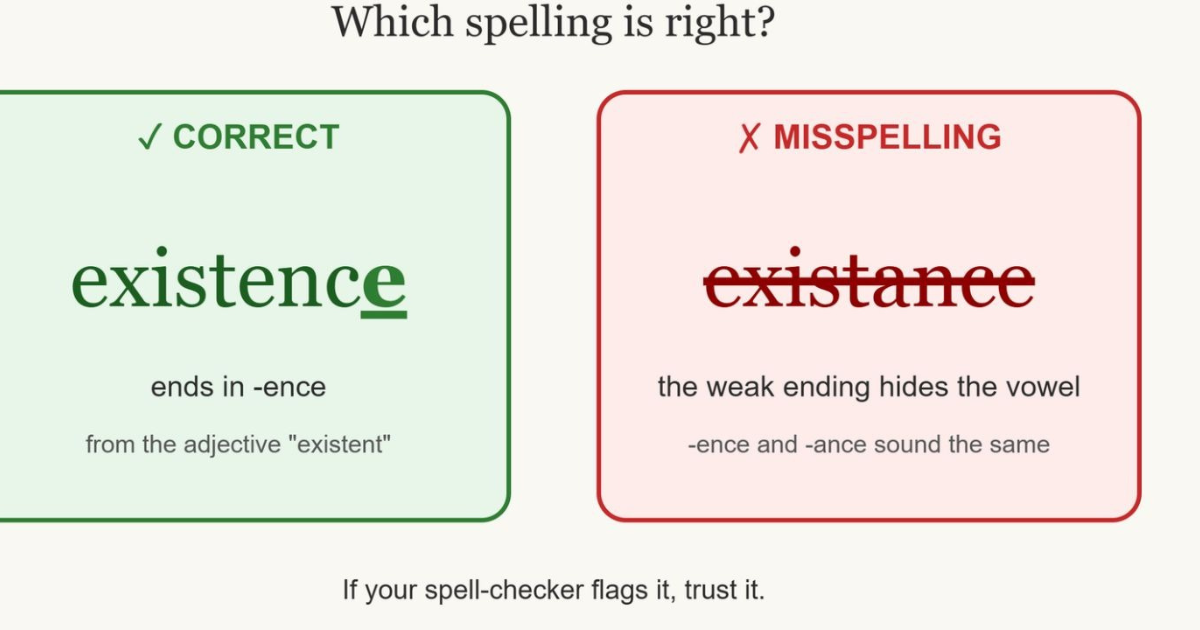
If you typed existance and a spell-checker underlined it, the checker was right. In the existence vs existance question, existence is the only standard spelling. It ends in -ence, it means the state of being real or alive, and it’s pronounced ig-ZIS-tuhns. The wrong spelling is common for a good reason, and the fix takes about ten seconds. This page also covers where the fix stops working, what the word means in everyday, legal, scientific and philosophical writing, and which phrases it keeps company with.
Why Existence Is Spelled With -ence
Existence is a noun built from the adjective existent. Adjectives ending in -ent usually give nouns ending in -ence, so existent gives existence. English borrowed the word from Middle French, which took it from Late Latin existentia, and that Latin ending is the source of the -ence.
Why People Write “Existance”
The last syllable is the problem. It’s unstressed, so English softens its vowel to a quick “uh”, and -ence and -ance come out sounding identical. Your ear can’t tell you which one to write.
Familiar words like distance, importance and appearance all end in -ance, so that ending looks right on the page. And you rarely meet existent in everyday reading, which means the adjective that would protect the spelling isn’t there to help.
The misspelling isn’t new either. Merriam-Webster lists existance among the Middle French spellings of the word. That explains the mistake without making it acceptable in modern English.
How to Remember the Spelling of Existence
Route 1: go through the adjective. If the adjective ends in -ent, the noun ends in -ence.
| Verb | Adjective | Noun |
| exist | existent | existence |
| persist | persistent | persistence |
| insist | insistent | insistence |
| consist | consistent | consistency |
| assist | assistant | assistance |
| resist | resistant | resistance |
All of these grow from Latin sistere, “to stand”. Most take -ent/-ence. Assist and resist are the familiar exceptions, so if you can spell those two, the others follow. Watch consistency, which ends in -ency.
Route 2: use a rhyme in your head. Existence and presence both mean “it’s there”, and both end in -ence.
Where the trick fails. It only works when a matching adjective exists. Maintenance and performance have no maintenant or performant to check against, so those spellings have to be learned separately.
What Does Existence Mean?
Existence is the fact of being real: being there rather than not being there. It has four main senses.
- The state of being. Scientists still debate the existence of other universes. The word claims only that something is real.
- A way of living. He led a lonely existence in the hills. This sense often suggests a life that is narrow or hard.
- Everything that exists. Philosophers have long asked why there is anything at all, and the mystery of existence is where they start. This one is formal.
- Actual occurrence. Lawyers must show the existence of a binding agreement.
Existence, Existent, Existing and Extant
These four are easy to mix up.
- Existence is the noun: proof of its existence.
- Existing is the everyday adjective: existing customers, existing laws.
- Existent is a formal adjective that rarely stands alone in ordinary prose. It’s more common in the negative, nonexistent.
- Extant is for things that have survived to the present, usually old documents or species: extant manuscripts.
Existence in Philosophy, Math, Biology and Law
The word changes its tone depending on who’s using it.
Philosophy. Kant famously argued that existence is not a real predicate: saying a thing exists doesn’t add a new property to your description of it. Sartre’s slogan “existence precedes essence” gave existentialism its name.
Mathematics. An existence theorem proves that a solution exists, though it doesn’t always show you how to find it. The symbol ∃ is read “there exists”.
Biology. The Struggle for Existence is the title of a chapter in Darwin’s On the Origin of Species, and the phrase is still used in writing about natural selection.
Law and business. Existence is a fact to be proved: the existence of a contract, the existence of a conflict of interest.
Everyday speech. It’s often playful: the bane of my existence.
How to Pronounce Existence
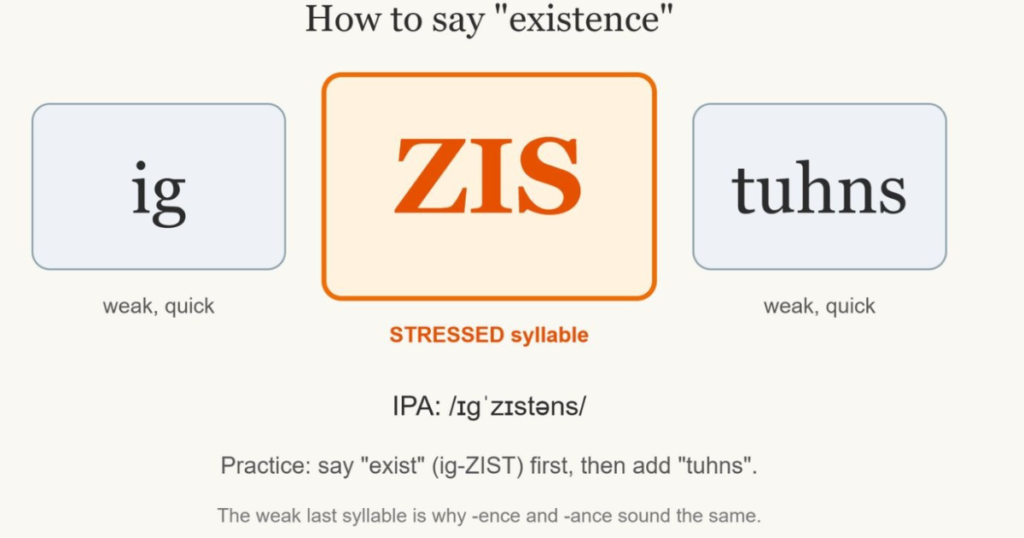
- Respelling: ig-ZIS-tuhns
- IPA: /ɪgˈzɪstəns/
- Stress: on the second syllable.
- The x: it usually sounds like “gz” in exist, exam and exact, where a stressed vowel follows. In exercise it sounds like “ks”.
- The ending: “-tuhns” is quick and weak, which is why the spelling is hidden.
Say exist first (ig-ZIST), then add “tuhns”.
Grammar: Is Existence a Noun? Countable? Which Prepositions?
Part of speech. Existence is a noun. The verb is exist, which is regular (exist, exists, existed, existing) and intransitive, so there’s no passive. You can’t write if it existed.
Tense. Because existence describes a state, the simple tense is usually more natural: The village exists sounds better than The village is existing.
Countable or not. It’s uncountable in its usual senses (the existence of life). It becomes countable, nearly always in the singular, when it means a way of living: a quiet existence. The plural existence is possible but rare, and you would normally write lives.
Common phrases:
- the existence of a second contract
- in existence: often follows a superlative, as in the oldest tree in existence
- come into existence: The company came into existence in 1998.
- go out of existence or drop out of existence: Some old words slowly drop out of existence.
- eke out an existence: to scrape a living, as in They eked out an existence on a small farm.
- bring into existence: The treaty brought the agency into existence.
Word family: exist, existing, existent, existential, nonexistent, nonexistence, coexist, coexistence.
Existence in a Sentence
- The inquiry found no evidence for the existence of a second contract.
- Honestly, I forgot that the old website was still in existence.
- After years of travel, she wanted a quiet existence by the sea.
- That printer has been the bane of my existence all week.
- Early microbes lived a precarious existence, competing for scarce food.
- The republic came into existence after a long and bitter war.
Synonyms and Antonyms: How Existence Differs
Close in meaning:
- Being is more abstract, and also means a living creature (human being).
- Life applies only to living things. A rock has existence but not life.
- Reality is the whole world of real things. Existence is a fact about one thing.
- Presence names a place: the presence of lead in the water says where it is, while the existence of lead says only that it’s real.
- Subsistence is bare survival, as in subsistence farming. It’s narrower than existence.
- Survival implies a threat. Existence doesn’t.
Opposite or contrasting:
- Nonexistence is the plain opposite and the most formal.
- Nothingness is abstract and philosophical.
- Absence means not being present somewhere.
- Oblivion is literary: being forgotten, or ceasing to be.
Where Does the Word Existence Come From?
Merriam-Webster traces existence to Middle English, borrowed from Middle French existence (also spelled existance), from Late Latin existentia (also exsistentia). The verb exist comes from Latin existere, “to come into being”, from ex (“out”) and sistere (“to take a stand”). That sistere is the root of the whole -sist- family in the table above.
Common Mistakes With Existence
| Mistake | Better | Why it happens |
| existance | existence | The weak ending hides the vowel. |
| existense, existanse | existence | Writing by sound alone. |
| exsistence | existence | Copying the Latin exsistentia. |
| the exist of life | the existence of life | Exist is a verb. |
| Aliens existence. | Aliens exist. | Existence is a noun. |
| the oldest tree in the existence | the oldest tree in existence | The phrase takes no article. |
| existent customers | existing customers | Existing is the everyday adjective. |
| The existence of the files are unclear. | The existence of the files is unclear. | The subject is existence, which is singular. |
FAQs
Is it existence or existance?
Existence is the only correct spelling. Existance is a common misspelling, usually caused by the unstressed ending, which sounds the same whether you write -ence or -ance. For a quick check, start from the adjective existent: it ends in -ent, so the noun ends in -ence.
Why do so many people write existance?
Because the last syllable is weak. English reduces unstressed vowels to a soft “uh”, so -ence and -ance sound identical and your ear can’t help. Familiar words like importance and distance end in -ance, which makes that ending feel natural. The correct spelling has to be learned, not heard.
Is existance ever acceptable?
Not in modern standard English. Standard dictionaries list only existence, and spell-checkers, teachers and editors will mark existance as an error. Merriam-Webster does record existance as a Middle French form of the word, but that history explains the mistake without making it correct.
How can I remember existence vs existance?
Start from the adjective. Existent ends in -ent, so the noun ends in -ence, just like persistent and persistence or insistent and insistence. A second hook: existence and presence both mean something is there, and both end in -ence. Assist and resist are the usual exceptions in this family, taking -ance.
Is existence countable?
Mostly no. In its usual senses, such as the existence of life, it is uncountable. It becomes countable, usually singular, when it means a way of living: a quiet existence. The plural existence is possible but uncommon, and writers would normally say lives instead.
give me conclusion for the article
Conclusion
The correct spelling is existence, with -ence at the end. Existance is a common slip, and it happens because the last syllable is so weak that -ence and -ance sound the same. When you’re unsure , go back to the adjective: existent ends in -ent, so the noun ends in -ence. The trick isn’t perfect (words like assistance and resistance are the familiar exceptions), but it settles the question for this word.
Existence means the fact of being real. It can also mean a way of living (a quiet existence), everything that is (the mystery of existence), or the actual occurrence of something (the existence of a binding agreement). Remember that it’s a noun, it’s usually uncountable, and it takes off: the existence of life. If you need the verb, use exist.



2 Comments