Standardize vs Standardise: Which Spelling Is Correct?
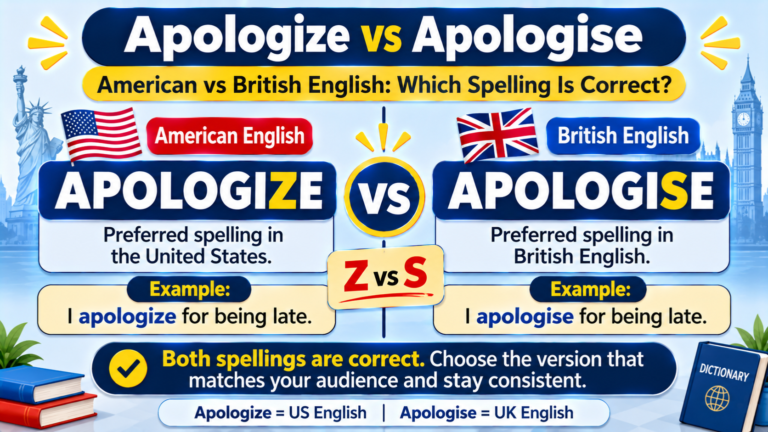
The standardize vs standardise decision comes down to who is reading. Writing for the US or Canada? Use standardize. Writing for the UK, Ireland, Australia or New Zealand? Use standardise. Writing for a mixed audience? Follow your style guide, and if you don’t have one, pick a spelling and apply it to the whole document.
Consistency is what matters. Readers forgive either spelling, but a page that says “standardize” in paragraph two and “standardised” in paragraph nine looks careless.
What standardize means
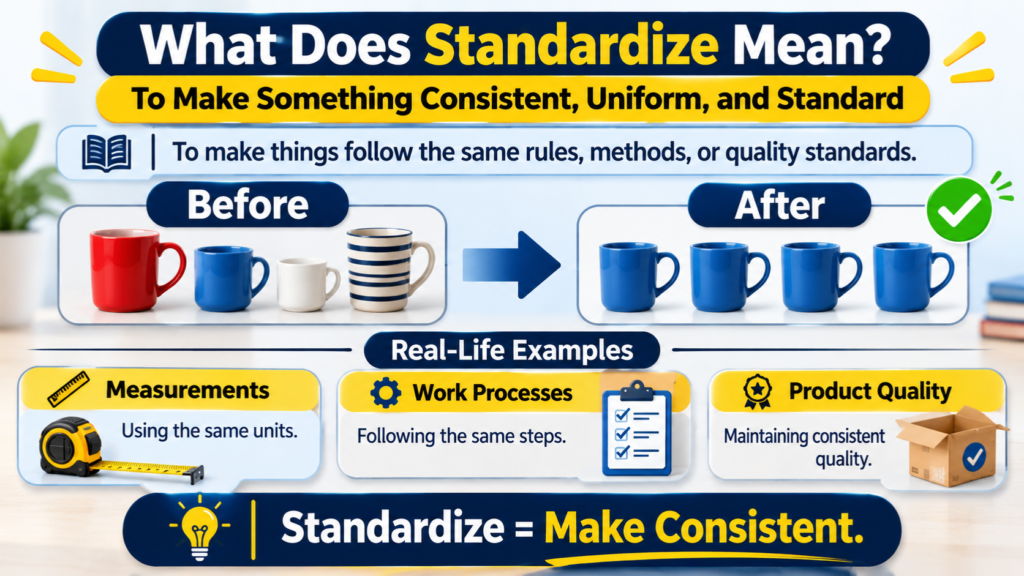
The meaning is the same in both spellings: to make things conform to a standard, so that similar things share the same rules, sizes or formats. Etymonline records the sense as comparing something with a standard or regulating it by one. You’ll meet the verb most often with procedures, measurements, data, terminology, testing and product sizes.
Which countries use which spelling
Sapling publishes usage data drawn from large text collections, and its numbers for standardize vs standardise make a handy sanity check. Treat them as one source’s estimates of what people write, not as official rules.
| Region | More common spelling | Note (Sapling’s split, -ize : -ise) |
| United States | standardize | Nearly universal (99 : 1) |
| Philippines | standardize | Almost as lopsided (98 : 2) |
| Canada | standardize | Clear lead (93 : 7) |
| India | standardize | Leans -ize (69 : 31) |
| United Kingdom | standardise | Closer than most people expect (32 : 68) |
| Australia | standardise | Moderate lead (35 : 65) |
| New Zealand | standardise | Moderate lead (39 : 61) |
| Ireland | standardise | Narrowest lead (40 : 60) |
The UK row surprises people. Plenty of writers assume -ise is the only British spelling, yet about a third of British usage in Sapling’s data is still standardize. Australian English leans toward -ise, and Canadian English sits firmly with the z.
Why there are two spellings
Etymonline dates “standardize” to 1854 and calls it a hybrid of “standard” plus “-ize”. The suffix is much older. World Wide Words says the original -ize form came from Greek via Latin, which is why the z is not an American invention. British English has used -ize for centuries, and Oxford University Press still does. That variety is Oxford spelling: British in every other respect (colour with a u, for instance), but with -ize endings and -yse in words like analyse.
Newspapers and magazines in the UK normally go with -ise, which is why that spelling feels so British. Most British dictionaries list both forms, with -ize first. For the wider pattern, see American vs British spelling.
Is either spelling wrong?
Whether you write standardise or standardize, neither one is an error. Each just belongs to a different audience.
Is standardize wrong in British English?
No. Oxford University Press uses it as house style, British dictionaries list it first, and roughly a third of UK usage in Sapling’s data is the z form. Oxford Learner’s Dictionaries and the Britannica Dictionary both give standardize as the main entry and note standardise as the British alternative.
Is standardise wrong in American English?
Not wrong, just British. US readers will take it as a British spelling, so an American editor will probably change it. For a US audience, use standardize.
All the forms, side by side
The same split runs through every form of the verb.
| Form | American English | British English |
| Base verb | standardize | standardise |
| Third person singular | standardizes | standardises |
| Past tense and past participle | standardized | standardised |
| Present participle and gerund | standardizing | standardising |
| Noun | standardization | standardisation |
| Adjective | standardized (a standardized test) | standardised (a standardised test) |
The past tense and the past participle share one form: “The team standardized the format” and “The format was standardized last year.” That participle doubles as an adjective, as in a standardized test. The noun is usually uncountable: “The industry needs more standardization.”
So standardized vs standardised, standardizing vs standardising and standardization vs standardisation are really one decision, made once.
How to pronounce it
Oxford Learner’s Dictionaries give two transcriptions: /ˈstændədaɪz/ for British English and /ˈstændərdaɪz/ for American English. The stress falls on the first syllable. The only difference is the r, which is a matter of accent, not spelling. Both end in the same “-dize” sound, so nobody can hear whether you write an s or a z.
Common mistakes
Most trouble with standardize vs standardise isn’t about picking the “wrong” spelling. It’s about inconsistency and a few easy mix-ups.
Mixing spellings. A writer pairs a z verb with an s participle and ends up with two systems on one page. Keep the whole family together: “The company will standardize its procedures while standardizing its reports” in American English, or “The company will standardise its procedures while standardising its reports” in British English.
Trusting the wrong spell checker setting. Spell checkers follow the language variety you select, so check that setting before you accept every suggestion.
Confusing standard with standardize. Standard is a noun or adjective (a high standard). Standardize is the verb that makes things match one.
Assuming standardize means improve. It promises sameness, not quality. A standardized process can be better or worse than the one it replaced.
Changing a proper name. The International Organization for Standardization spells its official English name with a z, so keep it even in a document that uses -ise everywhere else.
Related words and the exceptions
The same decision shows up in organize vs organise, realize vs realise, recognize/recognise, finalize/finalise and customize/customise. Choose a side once and they all follow. The -ize vs -ise rules explain the pattern in more detail.
Some verbs end in -ise in American English too, because the ending isn’t the suffix at all: advertise, advise, compromise, devise, exercise, improvise, revise, supervise, surprise.
Then there’s analyze vs analyse. Americans write analyze. British English writes analyse, and so does Oxford spelling, which keeps -yse even while it uses -ize elsewhere.
Standardize in practice
Here is the standardize vs standardise split in real sentences, each one written in a single spelling:
- (US) The team wants to standardize naming conventions across every repository.
- (UK) The council voted to standardise its recycling rules across all districts.
- (US) Before training the model, we standardize each feature to mean zero and unit variance.
- (UK) The firm plans to standardise its invoicing process by the end of the year.
- (US) The retailer standardized its store layouts to cut staff training time.
Standardization vs normalization
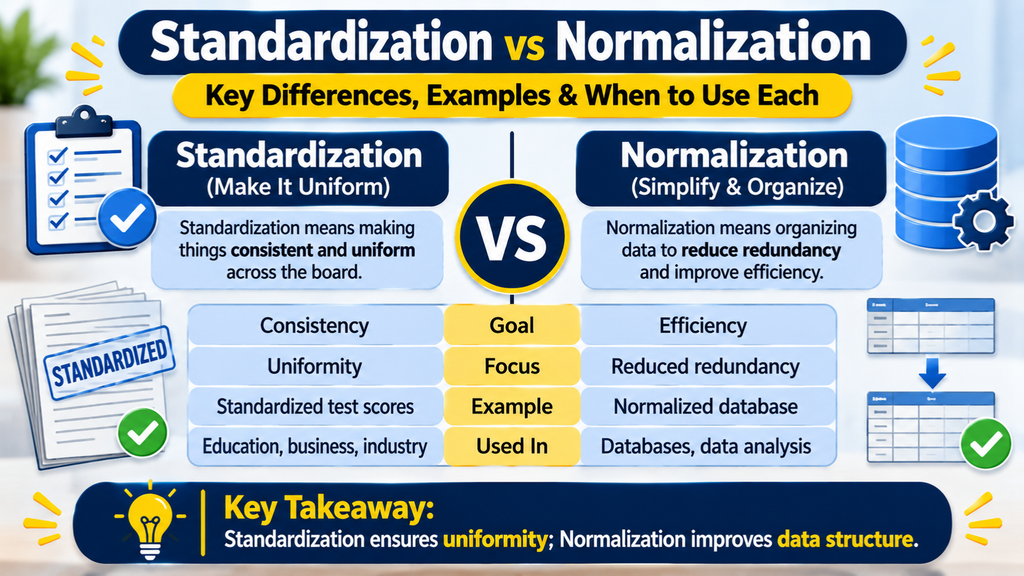
Some readers land here from data science. In statistics, to standardize a variable is to subtract the mean and divide by the standard deviation, which gives a z-score with a mean of 0 and a standard deviation of 1. Normalizing usually means rescaling values into a fixed range such as 0 to 1, though some authors use the two words loosely, so check the definition in your source. For more, see standardization vs normalization.
FAQs
Is “standardise” a real word?
Yes. The Britannica Dictionary lists it as the British form of standardize. Same word, same meaning.
Which is more common worldwide?
I don’t know of a clean worldwide count I’d trust. By country, standardize leads in the US, Canada, India and the Philippines, and standardise leads in the UK, Australia, New Zealand and Ireland. The US is a huge market, so -ize probably leads overall, but that’s my inference, not a measurement.
Do Canadians use standardize?
Overwhelmingly. It’s 93 to 7 in Sapling’s data, much closer to the US figure than the UK one. For a Canadian audience, use the z.
What do Australians and New Zealanders use?
Mostly the s. Sapling’s data puts standardise ahead 65 to 35 in Australia and 61 to 39 in New Zealand. Unless a style guide says otherwise, go with standardise for those readers.
Which should I use in a work document?
Whatever your company’s style guide says about standardize or standardise. With no guide, match your readers: US customers get standardize, UK customers get standardise. Internal document? Use the variety your spell checker is set to, and check that setting.
What is the past tense of standardize and standardise?
Standardized in American English and standardised in British English. The past participle is the same word in each, so there’s only one form to remember per spelling.
Is it “standardized test” or “standardised test”?
Standardized test in American English, standardised test in British English. The adjective simply follows whichever spelling the rest of your document uses.
Is standardisation spelled with s or z in the UK?
Either, depending on the publisher. Most UK newspapers write standardisation with an s; Oxford spelling writes standardization with a z. Proper names keep their own spelling, such as the International Organization for Standardization.
Do standardize and standardise sound different?
No. Accent changes the vowels and the r, but the spelling doesn’t change how the word sounds.
Final Thought
Use standardize for readers in the US, Canada or India, standardise for readers in the UK, Australia, New Zealand or Ireland, and never mix the two in one document. The standardize vs standardise argument only gets annoying when a document uses both. Set your spell checker to the right English variety before you write your next report, and the argument settles itself.