
Ignorant vs Stupid: What’s the Difference? Meaning, Examples and a Simple Test
A plain-English guide to ignorant vs stupid, with dictionary-backed definitions, real-life examples, a workplace case study and neutral alternatives.
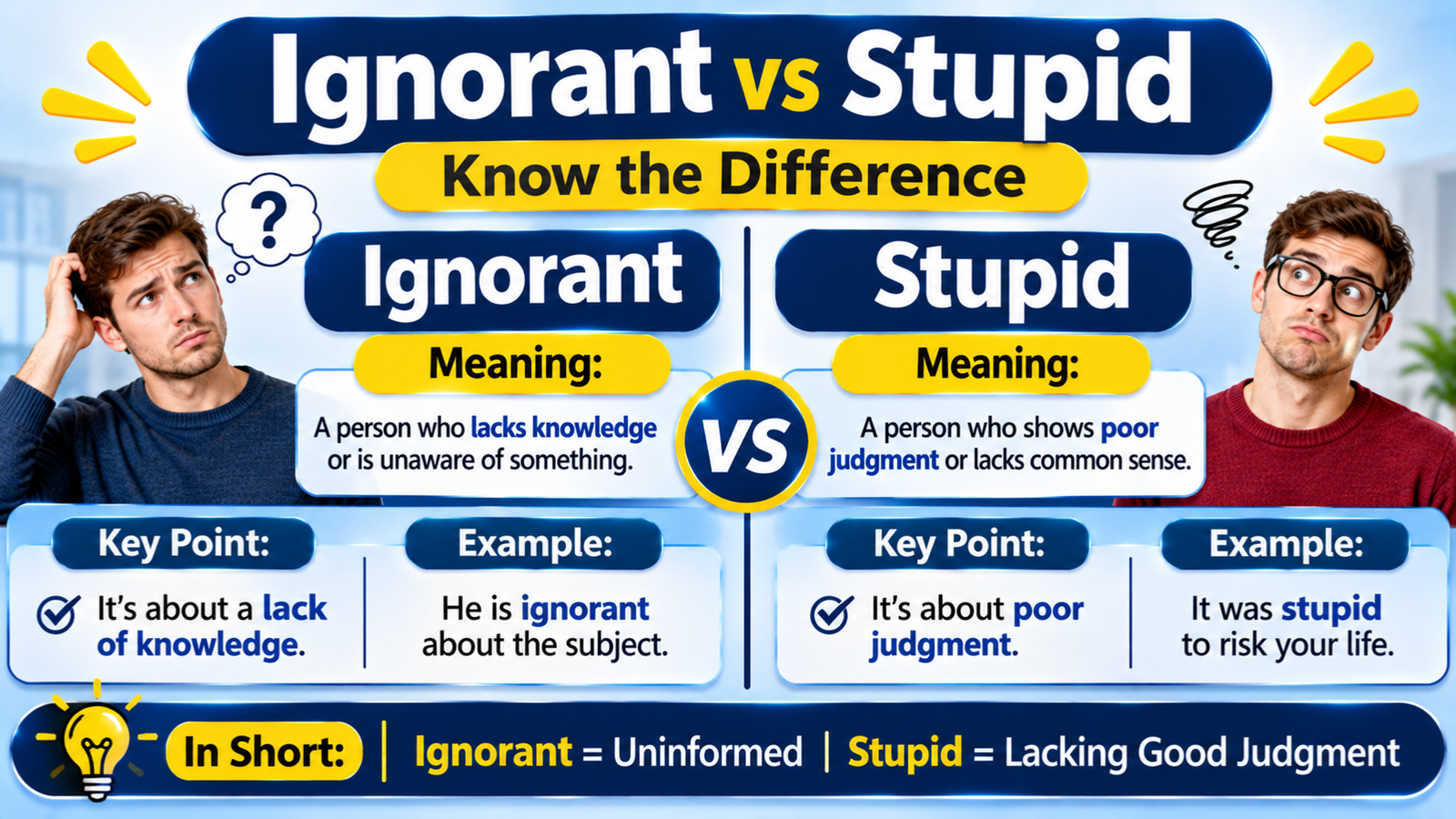
Ignorant means lacking knowledge or information. Stupid means lacking intelligence or good sense. The core of the ignorant vs stupid question is simple: ignorance can be fixed by learning, while stupid points to how a mind works or how a choice was made. This guide gives you a quick test, clear examples and safer words to use when you don’t want to insult anyone.
The short answer and the repair test
Here is a rule of thumb that does most of the work: could the person fix it by being told or taught? If yes, that is ignorance. If they had the facts and still chose badly, that is the everyday sense of stupid, aimed at a decision. It is not a dictionary rule, just a test that holds up in most arguments about ignorant or stupid.
One honest caveat. Strictly, stupid describes low intelligence. Merriam-Webster’s first sense is “slow of mind,” and its usage note says the state can be lasting or temporary. The looser everyday use, a stupid mistake or a stupid plan, is what people actually argue over, and that is the use the repair test covers. Dictionary.com adds the other half: in its usage note, none of ignorant, illiterate, unlettered or uneducated means lacking intelligence.
Easy memory trick: ignorance is not knowing. Stupidity is not thinking (or not using what you know).
What ignorant means
Ignorant is an adjective for missing knowledge. Merriam-Webster gives overlapping senses: having no knowledge or education, having no knowledge of one particular thing, and being uninformed or unaware. It also covers things that show the gap, such as an ignorant mistake.
The usual pattern is ignorant of or ignorant about: ignorant of the schedule, ignorant about modern phones. The noun is ignorance, a lack of knowledge, education or awareness. Neutral synonyms include uninformed, unaware and unfamiliar with.
Etymonline traces ignorance to Old French and the Latin ignorantia, “want of knowledge.” Ignorant reached English in the late 1300s by the same route.
Here is the part people forget: everyone is ignorant of almost everything. You are ignorant of most languages, most trades and the plot of any show you haven’t watched. Merriam-Webster’s own example is being ignorant of nuclear physics, which is hardly an accusation. The ignorant meaning describes a gap, and gaps are normal.
What stupid means
The stupid meaning does three jobs, which is why it is harder to pin down. Merriam-Webster’s senses include being slow-witted, making unintelligent decisions or acts, and lacking reason.
- Aimed at a person, it points at intelligence or sense.
- Aimed at an action, it labels a poor call: a stupid mistake, a stupid plan.
- Aimed at an object, it becomes plain annoyance, as in “the stupid printer jammed again.” That use is informal and has nothing to do with intelligence. Nobody is grading the printer.
Dictionaries date the English word to the 1540s, from Middle French stupide and Latin stupidus, built on stupere, to be numb or astonished. The root idea is closer to dazed than to unlearned, which fits the note that stupid can describe a temporary state.
Ignorant vs stupid side by side
| Feature | Ignorant | Stupid |
| Core meaning | Lacking knowledge or information | Lacking intelligence or good sense |
| What is lacking | Facts, training, awareness | Judgment, reasoning, quick understanding |
| Does a missing fact explain it? | Yes | No, the facts were available or the reasoning failed anyway |
| Can being told fix it? | Usually, yes | Not by a fact alone; it points at judgment or ability |
| Usual target | A person’s knowledge of a subject | A person, an action or an idea |
| Tone | Neutral in strict use, can sound rude in conversation | Almost always harsh |
| Example | “She is ignorant of tax law.” | “Skipping the safety check was a stupid decision.” |
| Neutral alternative | Uninformed, unaware, unfamiliar with | Unwise, ill-advised, poorly judged |
The learning test
A second way to tell ignorant vs stupid apart is to watch what happens after new information arrives.
- Ignorance: the person takes the new fact in, adjusts and does better next time.
- The everyday sense of stupid: the person has the fact, or is handed it, and still repeats the error.
This is a pattern in behavior, not a verdict on a human being. One bad decision does not make someone stupid, and the word fits a choice far better than it fits a person.
Real-life examples of ignorance
- The new driver. A teenager doesn’t know a specific traffic rule because nobody has taught it yet. A missing fact, not a reasoning problem.
- A foreign culture. A visitor breaks a local custom by accident. They were unaware, and a quiet word from a host fixes it.
- New technology. An older relative can’t find a feature on a new smartphone. They are uninformed about the device, not unintelligent.
- A new job. A new hire files a form the wrong way because the process was never explained. The gap sits in the training, not in the person.
- A new subject. A beginner cook confuses baking soda with baking powder. Both look alike, and nobody has shown the difference.
Common theme: the person lacks information, not reasoning ability.
Real-life examples of stupidity
- Ignoring safety rules. A worker removes protective equipment after repeated warnings. The rule was known, and the choice was still poor.
- Spending without thinking. Someone spends the rent money on things they don’t need, fully aware the rent is due.
- Repeating the same mistake. A person keeps making the same avoidable error despite knowing what it costs.
- Texting while driving. The danger is common knowledge. The decision, not the information, is the problem.
Common theme: the information exists, but it isn’t being used wisely.
Case study: same mistake, different cause
Two employees send a client the wrong pricing sheet.
Employee A joined last week and was never shown where the current price list lives. Ignorance caused the mistake. The fix is training: a checklist, a walkthrough, a link to the right folder.
Employee B has done this task for a year, was reminded about the new price list in writing, and still grabbed the old one without checking. Poor judgment caused the mistake. The fix is a conversation about care, accountability and process, not another training session.
The error is identical. The cause is not, so the solution isn’t either. Asking “was a fact missing?” before assigning blame leads to fairer and more effective answers.
Why people confuse the two words
The confusion happens because both can lead to the same outcome: errors, problems and bad results. From the outside, a mistake made out of ignorance and a mistake made out of poor judgment look alike. Only the cause differs, and the cause is not always visible.
There is also a social reason. In heated online arguments, “ignorant” and “stupid” are both thrown as insults, so they blur together in everyday speech. Treating them as interchangeable costs you accuracy, and it often costs you the argument too.
Can someone be ignorant, stupid, both or neither?
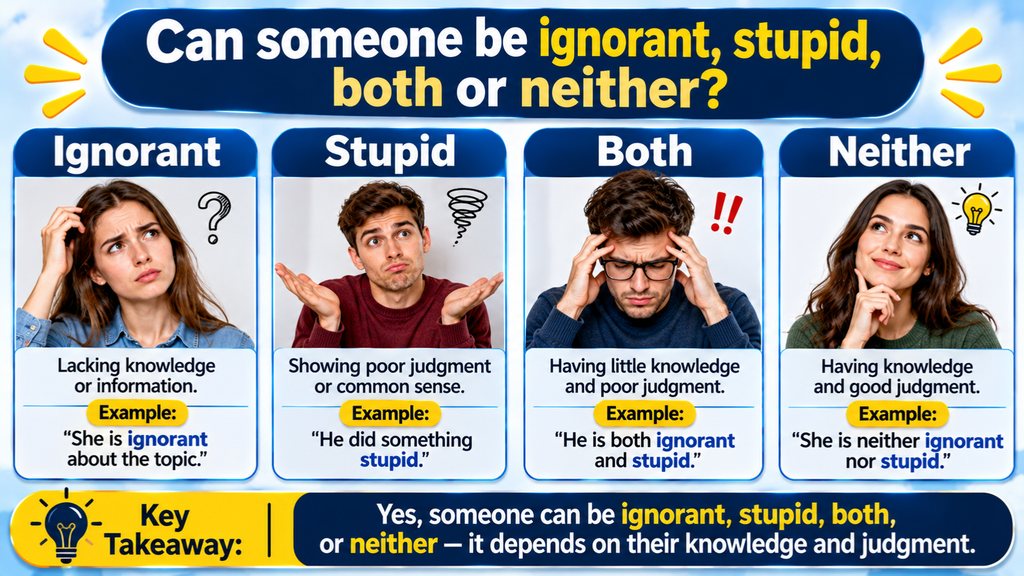
All four combinations are possible, which is why people keep swapping the words.
| Knows the relevant facts | Doesn’t know the facts | |
| Decides well | Informed and sensible | Ignorant but sensible (asks questions, proceeds carefully) |
| Decides badly | Poor judgment despite knowing (the everyday sense of stupid) | Ignorant and unwise (acts boldly without checking) |
A brilliant structural engineer can be ignorant of cooking. Their intelligence is not in question; they never learned. That is smart but ignorant, and it describes most of us in most rooms.
The reverse happens too. Someone can know the rules, know the risks and ignore both, like a hiker who read the weather forecast and set off in sandals anyway. No information was missing. The trouble was in the choosing.
A person can also be both. Someone shares a false claim online without checking it, which starts as ignorance. After being shown reliable evidence, they keep sharing it anyway. At that point, the behavior has moved from not knowing to not caring to know.
Willful ignorance
Willful ignorance means choosing not to learn something, often because the facts would be inconvenient. Legal writers call a version of it deliberate ignorance or willful blindness: deliberately avoiding a fact you have good reason to suspect, so you can claim you never knew.
People disagree about where it belongs. One side says the person truly lacks the fact, so it is ignorance. The other says refusing to learn is a bad decision, so it leans toward stupid. The dictionaries I checked do not settle it, so the fairest description is that willful ignorance sits on the border between the two words.
Is “ignorant” an insult?
Strictly, no. The dictionary meaning is about missing knowledge, and careful writers use it that way. In conversation, though, it often lands as an insult. Oxford Learner’s Dictionaries lists an informal, disapproving sense meaning very bad manners, as in a rude, ignorant person. Dictionary.com notes that people sometimes get called ignorant just for being rude or inconsiderate, and Merriam-Webster has a note on the polite and not-so-polite uses of the word.
So the neutral meaning exists, but your listener may hear the rude one. You will not win that argument by quoting a dictionary.
Which word is more offensive? Stupid, by a clear margin. Calling someone ignorant focuses on what they don’t know. Calling someone stupid attacks their ability to think. Compare “You’re ignorant about this topic” with “You’re stupid.” The second feels far more personal.
Usage guides add a separate caution. Paul Brians, in Washington State University’s Common Errors in English Usage, treats “ignorant idea” for “stupid idea” as a mistake, since a person can be ignorant of a fact without being stupid.
For professional writing, pick a neutral word. “The team is unfamiliar with the new system” says everything “the team is ignorant of the new system” does, and nobody has to reread the sentence for tone.
Ignorant vs naive, uneducated, illiterate, foolish and dumb
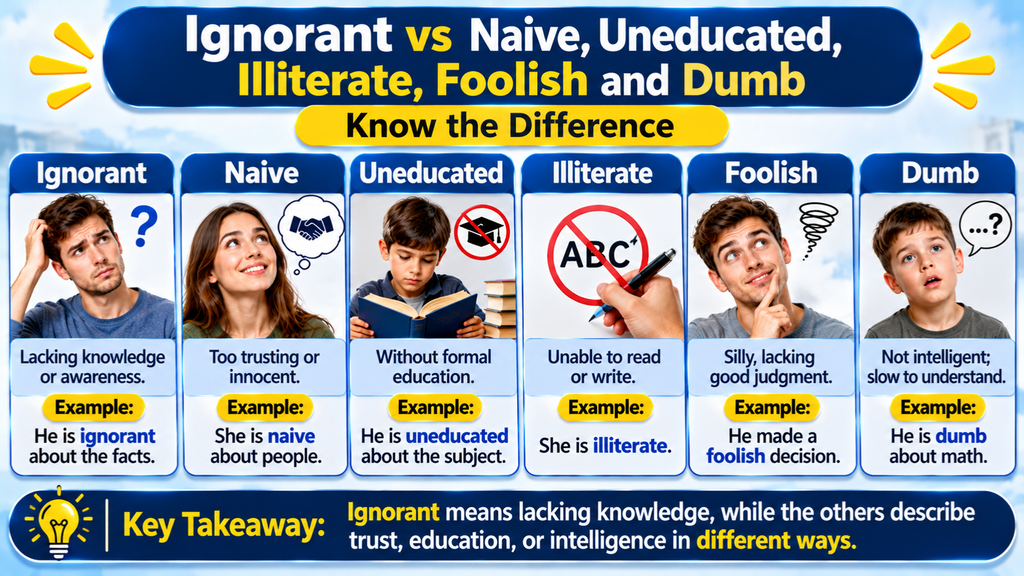
Several neighboring words get mixed up with ignorant and stupid. Here is how each one differs.
- Naive: lacking worldly wisdom or informed judgment, often too ready to trust (Merriam-Webster). It is about experience, not intelligence. A newcomer who hasn’t learned how contracts work is ignorant of contracts; one who believes every promise from a stranger is naive.
- Uneducated: lacking schooling or training. Dictionary.com groups it with ignorant as a word for missing knowledge, not missing intelligence.
- Illiterate: strictly, unable to read and write. It is not a general stand-in for ignorant.
- Foolish: showing a lack of good sense, judgment or discretion. It is the closest neighbor to the everyday sense of stupid for a decision, with less of the low-intelligence charge.
- Unaware: simply not informed. It is also one of Merriam-Webster’s senses of ignorant, and the most neutral word on this list.
- Dumb: Merriam-Webster lists lacking intelligence as a sense, the same ground as stupid, but also a dated, offensive use for people who cannot speak. Many writers avoid it for that reason, and it appears here only as a word.
| Word | Main idea | Best used when |
| Ignorant | Missing knowledge | A specific fact or subject is unknown |
| Stupid | Low intelligence or poor sense | You mean a choice or ability, and accept the harshness |
| Naive | Too trusting, lacking experience | Someone is easily fooled |
| Uneducated | Lacking schooling | Formal training is the gap |
| Foolish | Lacking good sense | A decision was unwise |
| Unaware | Not informed | You want the most neutral option |
Better alternatives to use
Both words can sound harsh. These alternatives are usually more professional and more accurate.
| Instead of | Try |
| Ignorant | Uninformed, unaware, unfamiliar with, new to, not yet trained on |
| Stupid | Unwise, careless, reckless, ill-advised, poorly thought out |
A good habit in feedback and reviews: describe the gap or the decision, not the person. “This plan overlooked the deadline” works better than “this plan is stupid,” and “I wasn’t aware of that policy” works better than “I was ignorant.”
Common mistakes
- Using the words interchangeably. They have different meanings. Decide first whether the issue is knowledge or judgment.
- Assuming ignorance means low intelligence. Many intelligent people are ignorant about topics they’ve never studied. No one can know everything.
- Assuming a stupid decision proves low IQ. A highly intelligent person can still make a stupid choice. Knowledge, intelligence and judgment are related but not identical.
- Labeling a person instead of an action. “That was a stupid decision” is narrower, and fairer, than “you are stupid.”
- Using ignorant to mean rude. The informal sense exists, but it confuses readers in careful writing.
Quick decision guide
When you are unsure whether to say ignorant or stupid, ask these questions in order:
- Did the person have the information? No → ignorant (or better, uninformed).
- Did they have it and decide badly anyway? Yes → the everyday sense of stupid applies to the decision. Consider unwise or careless instead.
- Were they avoiding the information on purpose? Yes → willful ignorance.
- None of the above? Then neither word fits, and the mistake may simply be an honest error.
Simple formula: lack of knowledge = ignorant. Poor judgment = stupid.
Ignorance vs stupidity
The nouns split the same way. Ignorance is a lack of knowledge, education or awareness, and it shrinks every time you learn something. Stupidity is a lack of intelligence or good sense, and it is a heavier thing to say about anyone.
Etymonline records a line from Bertrand Russell, paraphrasing the French philosopher Helvétius, that people are “born ignorant, not stupid.” You do not have to accept the whole claim to find the first half useful. Ignorance is where everyone starts.
Ignorant and stupid in a sentence
- I was ignorant of how sourdough starters work until I fed one for a week.
- The guide assumes readers are ignorant of basic spreadsheet formulas, so it starts at the beginning.
- They were blissfully ignorant of the road closure until they reached the detour sign.
- Leaving the oven on overnight was a stupid mistake, and I knew better.
- He felt stupid after locking his keys in the car.
- The stupid zipper jammed again.
Frequently asked questions
Is ignorant the same as stupid?
No. Ignorant means lacking knowledge or information, while stupid means lacking intelligence or good sense. A person can be ignorant of a subject and perfectly sharp, which is why dictionaries and usage guides keep the two words apart.
Is ignorant an insult?
Not by strict definition, but it often sounds like one. Some dictionaries record a rude, ill-mannered sense, so listeners may hear contempt. In neutral writing, use uninformed, unaware or unfamiliar with instead.
Is being ignorant a bad thing?
Not necessarily. Everyone is ignorant about some topics, and admitting it is the first step to learning. It becomes a problem when someone refuses to learn after the gap is pointed out.
Can a smart person be ignorant?
Yes, constantly. Intelligence is about how you reason; ignorance is about what you have been exposed to. An expert in one field is ignorant of countless others, which is simply what limited time looks like.
Can ignorance be fixed?
Usually, yes. Being told, taught or shown the missing information closes the gap, and that is the main thing separating it from stupid in everyday use. The catch is that the person has to be willing to look.
Does stupid mean low intelligence?
Strictly, yes, that is its first dictionary sense. In everyday speech it is usually aimed at a decision, as in a stupid mistake, and even clever people make those.
Which is worse, ignorant or stupid?
Neither is flattering, and ranking them is not very useful. Ignorance is common and curable, while stupid is a harsher claim about ability or judgment. For any given mistake, first ask whether a fact was missing.
What is the opposite of ignorant?
Informed, knowledgeable or aware, depending on the sense. The “not informed” meaning points toward informed, while the “no education” meaning points toward educated or learned.
Ignorant vs naive: what’s the difference?
Ignorant means missing facts, while naive means missing worldly experience, so the person trusts too easily.
What is willful ignorance?
Choosing not to learn something, often because the facts would be inconvenient. Legal writers call a version of it deliberate ignorance or willful blindness.
Final Thought
The gap between ignorant vs stupid is the gap between a missing fact and a failed judgment. Ignorance is a hole in what someone knows, and it closes as soon as they learn, while stupid describes low intelligence or a poor choice made with the facts in hand, which is why it is the harsher word and the one to use with care. Next time you reach for either word, ask what caused the mistake: if a fact was missing, say uninformed or unaware and supply the answer, and if the decision was the problem, describe the decision, not the person. Being precise about ignorant or stupid makes your writing more accurate and your feedback fairer.
Keep the repair test in your pocket, and the stupid vs ignorant question will mostly answer itself. If this settled an argument in your comments or your inbox, pass it along, and have a look at our other guides to words that look alike but mean different things.


One Comment