Moat vs Mote: What’s the Difference?
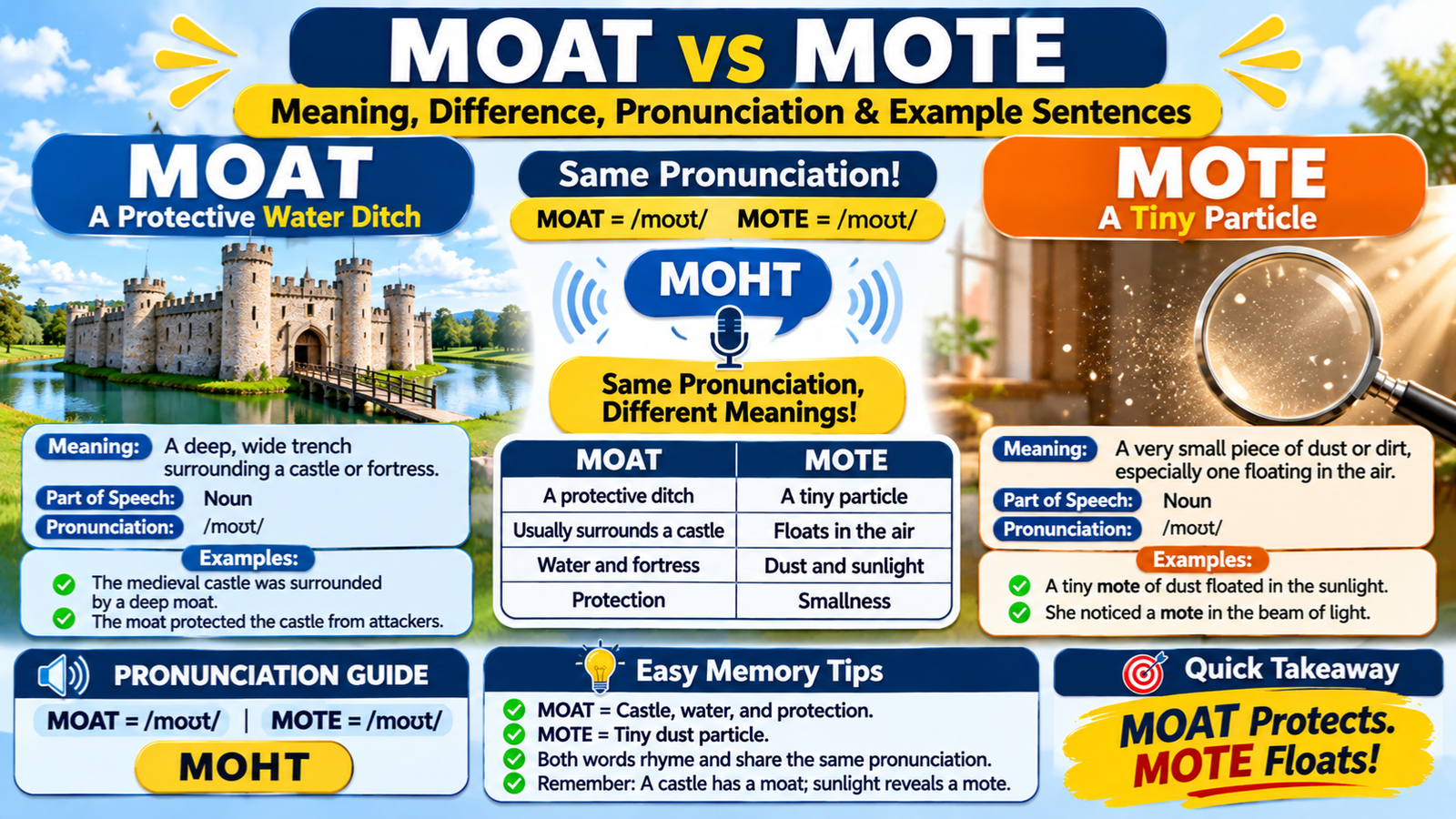
A moat is a deep, wide ditch around a castle, usually filled with water. A mote is a tiny particle, like a speck of dust floating in a sunbeam. They are pronounced the same way, which is exactly why people mix up the spelling.
Moat vs Mote: The Quick Answer
Water around a castle? Moat. A speck in the air? Mote.
The two words are homophones. They sound identical, they are spelled differently, and they mean completely different things. Merriam-Webster gives the same pronunciation for both, ˈmōt, so you cannot rely on your ear to pick the right one. You have to rely on meaning.
A quick sorting rule:
- Something that protects, surrounds or separates, like a ditch around a fortress or an advantage around a business? Moat.
- Something tiny that floats, drifts or sits in an eye? Mote.
The rest of this page covers what each word means, where each comes from, two famous phrases (economic moat and mote in your eye), and a third word, moot, that gets dragged into the confusion.
Why People Confuse Moat and Mote
The mix-up isn’t a sign of poor English. Three things work against you.
First, the words sound identical. Merriam-Webster gives the same pronunciation, so your ear offers no help.
Second, they differ by one letter. Moat has an a, mote has an e, and at reading speed the eye fills in whichever looks plausible.
Third, mote is rare. Most people meet moat in castle stories and business news, while mote mostly lives in descriptions of light and in one old Bible phrase. If you rarely see a word, you rarely get to practise its spelling.
There’s a fourth reason hiding in the history. Merriam-Webster says moat comes from Middle English mote, so the spelling mote once belonged to the castle ditch, long before modern English settled on moat for it and kept mote for the speck. Modern spelling separated them. Your hand just hasn’t caught up.
What Does Moat Mean?
Half of the Moat vs Mote puzzle is easy once you picture the castle.
Merriam-Webster defines a moat as a deep, wide trench around the rampart of a fortified place, such as a castle, usually filled with water. If you have seen a drawbridge in a film, you have seen what a moat is for: a barrier that attackers had to cross before they reached the wall.
The word has a second, wider sense: a channel that looks like a moat. Merriam-Webster gives examples such as a channel around a seamount, or one used to keep animals in a zoo from getting out. Its example sentence says it plainly: “A Bengal tiger stared at me from across the moat.”
There is also a related adjective. A moated castle is one that has a moat. Merriam-Webster lists moated (ˈmō-təd) as an adjective meaning “having a moat.”
And there’s a figurative meaning that has become very common, which gets its own section below: a moat as a competitive advantage that protects a business.
A picture helps. Imagine a stone fortress on a hill, with a wall, a drawbridge and a ring of dark water at the foot of the wall. Anyone who wants in has to get across the water first. That ring is the moat. In every sense of the word, a moat is about protection and distance: it keeps something out, or keeps something in, as with the zoo channel.
On the history, Merriam-Webster says moat comes from Middle English mote, from Anglo-French mote or motte, meaning “mound” or “moat.” The first known use in the castle-trench sense is from the 15th century. Yes, mote was once the old spelling of moat. That detail makes the modern confusion a little easier to forgive, since the same letters once did the work of both.
What Does Mote Mean?
Mote is a noun that means a tiny particle, which is another word for a speck. Merriam-Webster’s synonyms are speck, particle, fleck, bit and grain.
It turns up most often in descriptions of light. Merriam-Webster’s examples include “there’s not a mote of dirt in that woman’s house” and a Margaret Kennedy line, “motes danced in the shafts of sunlight.” The phrase “dust motes” is the classic pairing: the tiny bits you see floating in a sunbeam.
According to Merriam-Webster, the noun comes from Middle English mot, from Old English, related to a Middle Dutch and Frisian word meaning “sand.” The word is recorded from before the 12th century.
Picture it like this. You open a window on a bright morning, and a beam of sunlight cuts across the room. Tiny bits drift through the beam, invisible everywhere else. Those are motes. Whatever else the word means, it is about smallness.
A side note. Merriam-Webster also lists mote as an archaic auxiliary verb meaning “may” or “might,” from Old English mōtan, “to be allowed to,” and it cross-refers to must. You won’t need this in modern writing. You might meet it in older poetry.
Are Moat and Mote Pronounced the Same?
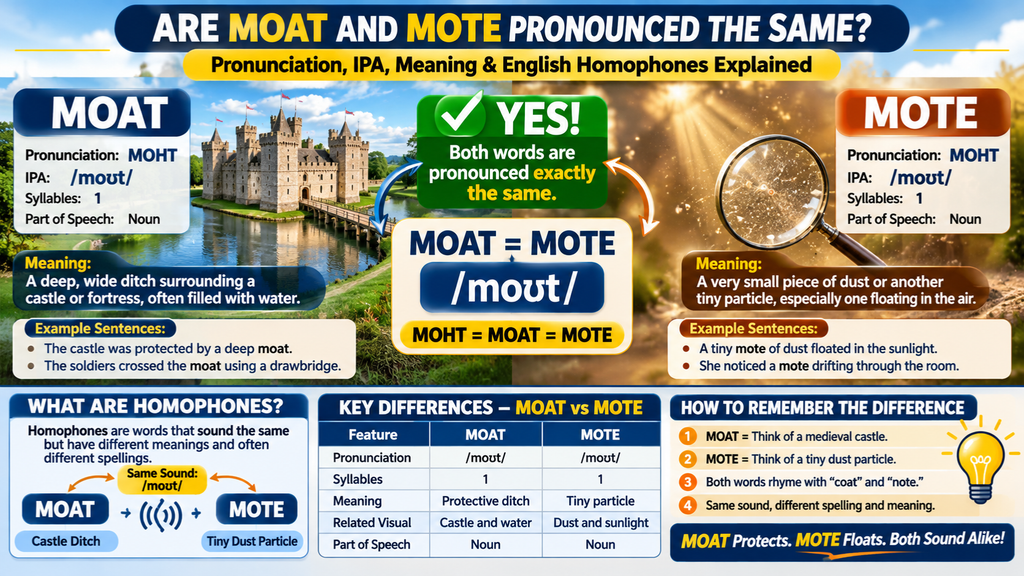
Yes. Merriam-Webster gives ˈmōt for both words. They rhyme with boat, coat and note.
That is why spoken English never tells you which one is meant, and why the error shows up mainly in writing. If someone says “a mote of dust” out loud, nobody mishears it. Typing “a moat of dust” is where the mistake sneaks in, and a spellchecker won’t catch it, because both are real words.
A useful trick: moat has an a, and so does boat. Boats cross a moat.
Moat vs Mote: Side-by-Side Table
| Moat | Mote | |
| Meaning | A deep, wide trench around a castle or fort, usually filled with water | A tiny particle, a speck |
| Part of speech | Noun | Noun (also an archaic verb, “may/might”) |
| Sounds like | ˈmōt (rhymes with boat) | ˈmōt (rhymes with boat) |
| Typical setting | Castles, forts, zoos, business | Sunbeams, dust, the eye |
| Example | The moat can be crossed by a drawbridge. | Motes danced in the shafts of sunlight. |
| Related word | moated (adjective) | dust mote |
If you remember only one row, remember the second: big barrier or tiny speck.
Economic Moat: The Business Meaning
Moat has a second life in business and investing, where it describes a company’s lasting advantage over its competitors.
MoneyWeek defines an economic moat as a company’s ability to withstand competition for its products and services, much as a moat protected a castle. The wider the moat, the greater the firm’s edge over rivals. The Motley Fool describes a competitive moat as a distinctive advantage that helps a company hold off rivals and “keep your competition at arm’s length and your sales strong.” It adds that the advantage has to be unique to the business. A claim like “great service” doesn’t count.
Merriam-Webster’s moat entry also notes that recent web examples use the word for a competitive advantage that protects a business, such as loyal customers or a strong market position.
Warren Buffett is the name tied to the phrase. MoneyWeek says he first coined “economic moat.” The Motley Fool says only that he calls these advantages economic moats, without saying he invented the phrase. So the safe way to say it is that the term is associated with Buffett.
Common kinds of moat, according to those two sources:
- Low-cost production, where a company is the cheapest producer of something
- Patents or other protected resources
- Strong brands that customers stay loyal to
- Switching costs, which make customers reluctant to leave
- Network advantages, from relationships and information
MoneyWeek’s simple example is Coca-Cola and Pepsi, which it describes as, in effect, flavoured fizzy water that remain dominant and highly profitable because their brands act as the moat. The Motley Fool names Patagonia and Starbucks as examples of cultural, brand-based moats.
A mini scenario shows how it works. Imagine a small software company in a crowded market. Its customers have years of data inside its product, and moving that data elsewhere is painful. Rivals can copy the features, but they can’t easily copy the cost and effort of switching. That switching cost is the company’s moat. Likewise, a patent can act as a legal moat, since rivals can’t copy what it protects, and a loyal brand can act as a moat because customers keep choosing it.
The picture holds together: a castle uses water to keep attackers away, and a company uses something hard to copy to keep rivals away.
“A Mote in Your Eye”: The Idiom
The other famous phrase belongs to mote.
It comes from the Bible. According to the Wikipedia article on the topic, the image appears in Matthew 7:1 to 5, in the Sermon on the Mount, with a similar passage in Luke 6:37 to 42. It contrasts a small object in someone else’s eye with a large beam in your own. The lesson is about hypocrisy: noticing a tiny fault in other people while ignoring a huge one in yourself.
The King James Version, and Wycliffe before it, use the words mote and beam. Other translations pick different words: the New International Version says “speck” and “plank,” and the New Revised Standard Version says “speck” and “log.” The Greek word behind mote, karphos, meant any small dry body, according to the same article.
In modern English, mote usually means a particle of dust floating in the air, not a splinter of wood. That is why the idiom sounds slightly old-fashioned today. “Speck in your eye” is the plain-language version.
In a sentence: “He criticised her for a typo while his own report was full of errors. Talk about the mote and the beam.”
Moat vs Moot: A Third Word People Mix Up
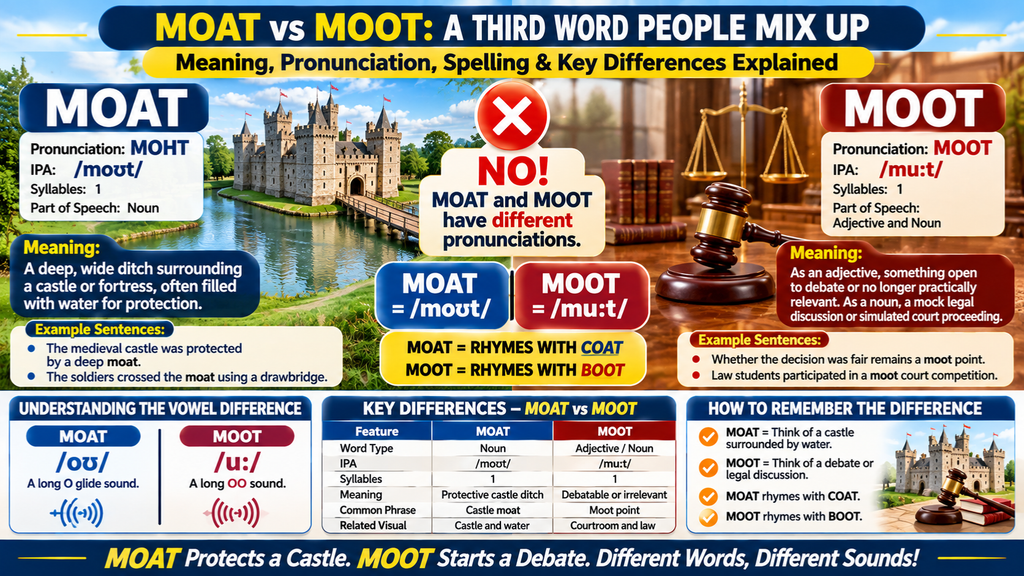
Moot looks like the other two but sounds different. Oxford Learner’s gives its pronunciation as /muːt/, which rhymes with boot, not boat.
It means something else entirely. Oxford defines a moot point or moot question as a matter people may disagree about, or may not fully understand. It adds that the word comes from Old English mōt, “assembly” or “meeting.”
There’s a regional wrinkle. Grammarphobia notes that in the United States the predominant meaning is “irrelevant,” while in Britain it is “debatable,” and suggests making sure your context shows which sense you mean.
| Word | Sounds like | Means |
| moat | ˈmōt (boat) | a ditch around a castle |
| mote | ˈmōt (boat) | a tiny speck |
| moot | /muːt/ (boot) | debatable (or, in the US, often irrelevant) |
Remember: moot rhymes with boot, and the other two rhyme with boat.
Example Sentences
With moat:
- The moat can be crossed by a drawbridge.
- Archers watched from the wall above the moat.
- The old fort was moated on three sides.
- A Bengal tiger stared at me from across the moat.
- The castle’s moat was drained during the winter.
- Nobody could reach the keep without crossing the moat.
- Its loyal customer base is the company’s moat.
- Strong patents gave the business a wide moat.
- Swans floated on the moat at the edge of the castle grounds.
- For many software firms, customer data is the real moat.
With mote:
- A single mote of dust drifted across the window.
- Motes danced in the shafts of sunlight.
- There’s not a mote of dirt in that kitchen.
- She blinked, trying to clear a mote from her eye.
- Dust motes hung in the air of the old library.
- He couldn’t see a mote of doubt in her face.
- The beam of light lit up every mote in the room.
- A mote in his eye kept him from reading.
- She noticed a mote floating in her coffee.
- Not a single mote disturbed the still room.
Common Mistakes
Most Moat vs Mote errors happen in writing, where the two words look so alike.
Writing “a moat of dust.” Dust floats in the air as motes. A moat is a ditch.
Writing “a mote around the castle.” The ditch is a moat. Remember that mote was once an old spelling of moat in Middle English, but modern English keeps them apart.
Using “mote” for a business advantage. The phrase is economic moat or competitive moat, not “economic mote.”
Mixing both up with moot. “Moat point” and “mote point” are not phrases. The idiom is moot point, and it rhymes with boot.
Trusting spellcheck. Moat, mote and moot are all real words, so a spellchecker will flag none of them. Proofread for meaning.
Spelling “moated” as “moted.” The adjective for a castle with a moat is moated.
How to Remember the Difference
Moat: the “a” in moat is in boat. Boats cross a moat. It is big, wet and built to keep people out.
Mote: tiny and light. Think of one small speck floating in a sunbeam.
Another pair of hooks is size. Moat starts with the M of massive, and mote with the M of minute. Both start with m, so use the rest of the word: a big structure or a tiny speck?
And if you want one line to carry around: castle and company, moat. Dust and eye, mote.
Quick Decision Guide
A short checklist settles any Moat vs Mote doubt.
When you’re stuck mid-sentence, run through this in five seconds:
- Is it about a barrier, a defence, or an advantage? Moat.
- Is it about a tiny particle or speck? Mote.
- Does it rhyme with boot and mean “up for debate”? Moot.
- Still unsure? Ask whether the thing is big and protective, or tiny and floating.
Key Facts to Remember
If you skim the whole Moat vs Mote topic, keep these.
- Moat and mote sound the same, and Merriam-Webster gives ˈmōt for both.
- A moat is a deep, wide ditch around a castle, usually filled with water, and also a business advantage.
- A mote is a tiny particle, usually of dust, and the old word in “mote in your eye.”
- Moat comes from Middle English mote, which is why the old spelling overlapped.
- Moot rhymes with boot and means debatable (or, in the US, often irrelevant).
- Context decides. Size and function will almost always tell you the word.
Quick Practice
Choose the right word. Answers follow.
- The soldiers crossed the ___ by drawbridge. (moat / mote)
- A ___ of dust floated past the lamp. (moat / mote)
- The brand’s loyal following is the company’s ___. (moat / mote)
- In the idiom about hypocrisy, the small thing in the eye is a ___. (moat / mote)
- The castle is ___ on all sides. (moated / moted)
- Whether the rule applies is now a ___ point. (moat / moot)
- Which of the three rhymes with “boot”? (moat / mote / moot)
- A fort with a water-filled ditch is called a ___ fort. (moated / moot)
Answers: 1. moat. 2. mote. 3. moat. 4. mote. 5. moated. 6. moot. 7. moot. 8. moated.
FAQs
Here are the questions people ask most often about Moat vs Mote.
What is the difference between moat and mote? A moat is a deep, wide ditch around a castle, usually filled with water. A mote is a tiny particle, a speck. They sound the same but are spelled and used differently.
Is it moat or mote? Use moat for a ditch around a castle, or for a business advantage. Use mote for a speck of dust or similar tiny particle.
What does mote mean? It means a tiny particle, such as a speck of dust. Merriam-Webster lists speck, particle, fleck, bit and grain as synonyms.
What does moat mean? A deep, wide trench around a fortified place, usually filled with water. It can also mean a similar channel, like the one that keeps zoo animals in.
Are moat and mote homophones? Yes. Merriam-Webster gives the same pronunciation, ˈmōt, for both.
What is a mote of dust? A single tiny particle of dust, often one you can see floating in a beam of light. The phrase dust mote is common.
What does “mote in your eye” mean? It comes from the Bible and refers to a small fault in another person, set against a much larger one in yourself. It is a warning against hypocrisy. Modern translations often say “speck” instead of “mote.”
What is an economic moat? A lasting advantage that protects a company from competitors, like a moat protects a castle. Common examples include low costs, patents and strong brands.
Is it moat or moot? They are different words. A moat is a ditch around a castle, and it rhymes with boat. Moot rhymes with boot, and a moot point is one people can argue about.
What is a moated castle? A castle surrounded by a moat. Merriam-Webster defines moated as “having a moat.”
Is “mote” still commonly used? It’s less common than moat, but it is alive. Merriam-Webster’s examples include a 2026 Mercury News line about tiny bugs floating in the sun like dust motes. You will mostly see it in descriptions of light and in older or literary writing.
Is “moat” only related to castles? No. Merriam-Webster covers channels around seamounts and zoo enclosures, and the business sense is now very common. The Motley Fool and MoneyWeek both explain a moat as a company’s lasting advantage over rivals.
Why do moat and mote sound the same? They simply ended up with the same pronunciation, ˈmōt, in Merriam-Webster’s listing. History adds a twist: Merriam-Webster says moat comes from Middle English mote, so the ditch word once carried the spelling we now use for the speck.
Final Thoughts
Water around a castle, or an edge around a business? Moat. A speck in the air or in the eye? Mote. The two sound alike, so only the meaning can guide you, and the boat trick helps: boats cross a moat.
If you remember one thing from this Moat vs Mote guide, make it the quick sort: big barrier, moat. Tiny speck, mote. And if the word you want rhymes with boot, you’re after moot.