Splendor vs Splendour: Which Spelling Is Correct?
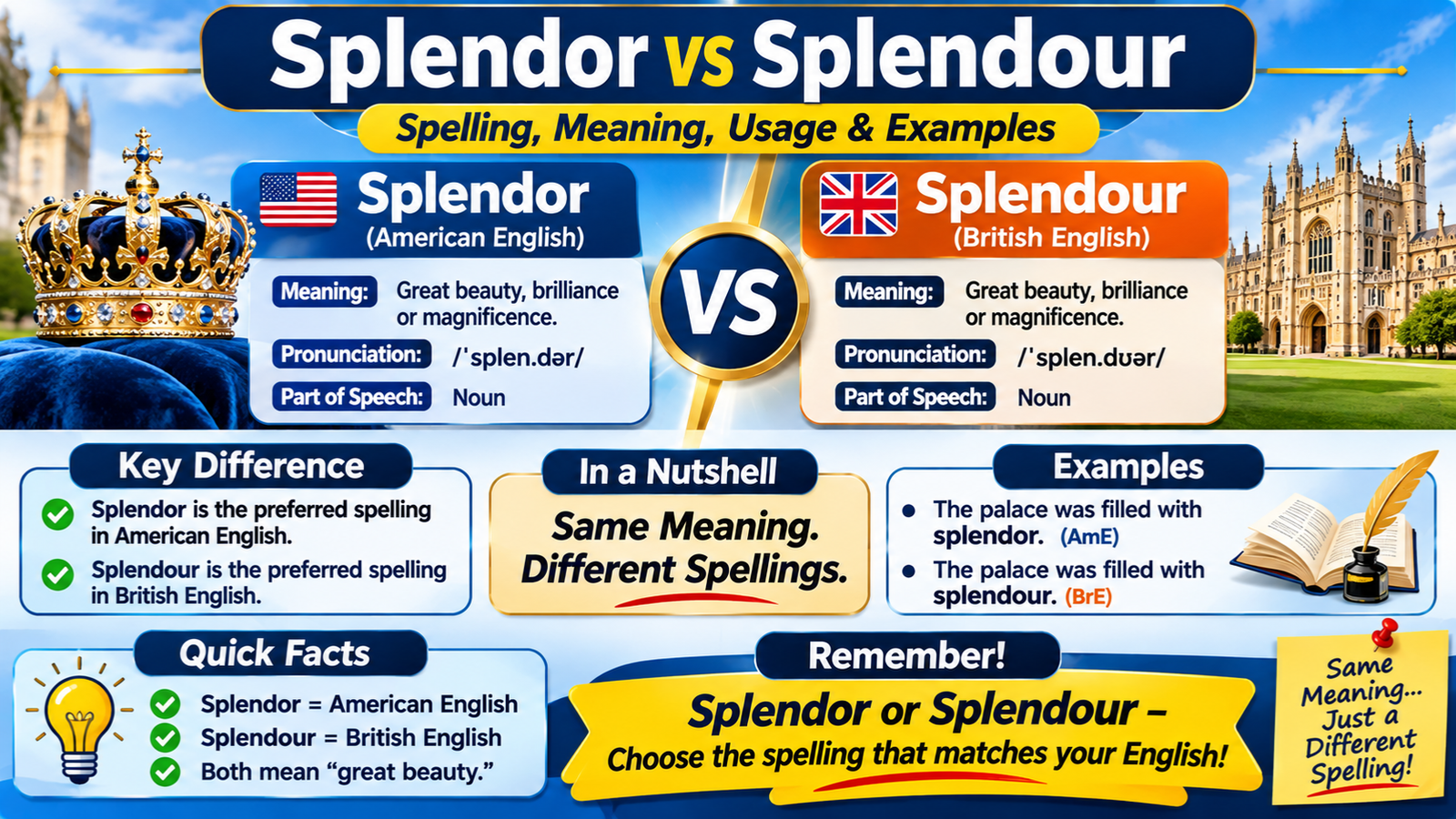
Both are correct. “Splendor” is the American spelling, and “splendour” is the British one. They are the same word with the same meaning: great and impressive beauty. Choose the spelling that suits your audience, then use it consistently throughout the document.
Splendor vs Splendour: The Quick Answer
Same word, two spellings. Nobody is wrong.
Splendor, without the u, is the American spelling. Splendour, with the u, is the British spelling. Britannica’s dictionary and Learner’s Dictionary both list splendour as the British form of splendor, and Sapling puts it plainly: they are the same word, spelled differently by region.
The meaning doesn’t change. The pronunciation doesn’t change either, since the u is silent in speech. What changes is the reader you are writing for.
So if your spellchecker underlined one of them, it is probably set to the other region. Switch the language setting, or switch the letters, and carry on. The one rule that matters is consistency: don’t write “splendor” in your first paragraph and “splendour” in your fifth.
What Does Splendor Mean?
Splendor is a noun. Britannica defines it as great and impressive beauty. Learner’s Dictionary separates two uses:
- The uncountable use, meaning dazzling, impressive beauty in general: “the splendor of the palace.”
- The plural use, splendors, meaning specific things that are highly beautiful or striking, usually followed by “of”: “the splendors of ancient Rome.”
Wiktionary adds the older senses. It lists radiant light, sheen or brightness; impressive display, grandeur or magnificence; and widespread fame or glory. That first sense is the root of the word. Wiktionary says splendor comes from Latin splendor, from splendere, “to shine,” with Anglo-Norman influence.
So splendor began as a word about shining. A sunrise over mountains has splendor. A golden palace has splendor. And when a person’s reputation shines, the older sense of fame or glory comes into play.
Splendor and Splendour in Different Contexts
The word turns up in a handful of settings again and again. Here is how it works in each, with both spellings.
Architecture. Old buildings combine scale, decoration and craftsmanship, so splendor fits them naturally. “The restoration returned the theater to its former splendor.” British version: “The restoration returned the theatre to its former splendour.”
Nature. Here the word suggests a striking, powerful kind of beauty, not just prettiness. “We were amazed by the natural splendor of the mountains.” British: “…the natural splendour of the mountains.”
Luxury. Hotels, palaces and ceremonies use it for richness and display. “The hotel lobby was decorated in luxurious splendor.” Sapling’s own examples include “luxurious splendor” and “Victorian splendor.”
Light. This is the oldest sense. Wiktionary lists radiant light, sheen or brightness as a meaning, and the Latin root means “to shine.” “The splendor of the morning sunlight transformed the garden.”
In every one of these, nothing but the u changes between the American and British versions.
Splendor or Splendour: Which Region Uses Which?
The Splendor vs Splendour split follows geography more than any rule of grammar.
Here is how usage divides, based on Sapling’s regional data.
| Region | More common spelling | Sapling’s score (splendor / splendour) |
| United States | splendor | 94 / 6 |
| India | splendor | 98 / 2 |
| Philippines | splendor | 90 / 10 |
| Canada | splendor | 83 / 17 |
| Ireland | splendor | 53 / 47 |
| New Zealand | splendour | 48 / 52 |
| United Kingdom | splendour | 37 / 63 |
| Australia | splendour | 23 / 77 |
Treat those numbers as a rough direction, not exact statistics. I can’t tell you how Sapling measures them.
A few things stand out. The United Kingdom prefers splendour, but only by about 63 to 37. Ireland and New Zealand are close to an even split. And Canada leans toward splendor, which fits the usual pattern of Canadian spelling sitting closer to American.
One source disagrees. Difference Wiki says splendour is “commonly found in countries like the UK, Canada, and Australia.” Its own article contradicts itself in places, so I’d trust the Sapling figures more for Canada. Still, the disagreement is real, and it is a good reason to check your own style guide instead of relying on one rule.
What About Canada and Pakistan?
Canada is the odd one out, because it doesn’t sit neatly on either side. Sapling’s figures lean toward splendor (83 to 17), while Difference Wiki says splendour is common in Canada. The two sources disagree, and I could not settle it from the pages I was able to open.
The practical lesson is the same one that runs through this whole topic: for Canadian readers, check the publication’s own style guide instead of assuming a rule.
About Pakistan: none of the sources I checked list it. Sapling shows India at 98 to 2 in favour of splendor, but that is India’s number, not Pakistan’s. If you write for Pakistani readers, the “Which Spelling Should You Use?” section below is the practical guide.
Why the -or vs -our Split?
Splendor and splendour belong to a big family of words that differ between American and British English only in the ending: -or in the US, -our in the UK.
The family is long. Writing Explained gives odour, colour and honour as examples, along with humour and labour. In each pair, the British spelling keeps the u and the American spelling drops it.
Difference Wiki describes splendour as reflecting “the traditional use of the ‘ou’ ending in many words,” and splendor as the simplified American form. That’s a fair summary of the pattern, though the same page gives no more detail about the history, and I wouldn’t lean on it for that.
Two cautions before you apply the rule everywhere.
First, not every word follows it. Writing Explained points out that glamour is the standard spelling in both American and British English. Glamor exists as an alternative, mostly in the US, but it is less popular than glamour in either place, and the advice there is to stick with glamour. So “drop the u for Americans” works for splendor, color and honor, and fails for glamour.
Second, the rule only affects the ending. The word splendid, for example, has no -or or -our variant at all. It is spelled the same everywhere.
All the Forms in One Table
Here are the forms people look for, based on Learner’s Dictionary, Britannica and Sapling.
| Form | US spelling | UK spelling |
| Singular noun | splendor | splendour |
| Plural noun | splendors | splendours |
| Adjective (related) | splendid | splendid |
| Adjective (related) | resplendent | resplendent |
The first two rows swap the u in and out. The last two stay the same in both varieties.
The plural is worth a note. Learner’s Dictionary says the plural splendors (or splendours) refers to specific things that are highly beautiful or striking, and it is usually followed by “of.” So “the splendors of the Alhambra” refers to its particular beautiful features, while “the splendor of the Alhambra” refers to its overall impressive beauty.
Which Spelling Should You Use?
For your own writing, settling Splendor vs Splendour is mostly a question of audience.
Think about your audience. American, Canadian and Indian readers are more likely to expect splendor, according to Sapling’s figures. British, Australian and New Zealand readers lean toward splendour.
Follow the style guide. If a publisher, school or client gives you a style sheet, that settles it. The sheet wins over personal taste.
Match the rest of your text. If you write colour, honour and neighbour, then splendour belongs with them. If you write color, honor and neighbor, use splendor.
Set your spellchecker first. Choose English (US) or English (UK) before you start, and the red lines will agree with you.
Be consistent. Honestly, this matters more than the choice itself. A reader will forgive either spelling, but a mix looks careless.
With no audience and no style guide in sight, pick the one that matches the rest of your spelling and stick to it.
Common Phrases With Splendor and Splendour
Learning Splendor vs Splendour is easier when you see the words in the phrases people actually use.
Some combinations show up so often that they are worth learning as units:
- in all its splendor / splendour
- former splendor / splendour (“restored to its former splendor”)
- natural splendor / splendour
- the splendors / splendours of Rome
- in solitary splendor / splendour (a lone castle on a hill, say)
- scenic splendor / splendour
Sapling quotes “every imaginable effect of scenic splendour” as a British-spelling example, which is a good reminder that the word has a slightly literary feel in both varieties. It suits travel writing, history and descriptions of places more than casual chat.
Splendor vs Glory vs Grandeur vs Magnificence

Splendor has several close neighbours, and they overlap more than they differ.
Britannica defines splendor as great and impressive beauty. Wiktionary’s senses include brightness, grandeur or magnificence, and fame or glory. That gives you a rough map:
- Splendor leans toward a shining or striking beauty, especially in places, buildings and displays.
- Grandeur and magnificence lean toward size, scale and impressiveness.
- Glory leans toward fame and honour, though it also overlaps with shining beauty.
For writing, here’s a simple rule. If the thing shines, dazzles or looks richly beautiful, splendor fits. If it is huge and imposing, grandeur may be the better word. If it is about reputation, glory is the closer fit.
Other near-synonyms you will meet are brilliance, majesty, opulence and radiance. Radiance works best for light. Opulence stresses wealth and luxury. Majesty stresses dignity and scale. Splendor can cover several of these ideas at once, which is why it is so popular with writers who want a single, rich word.
Don’t spend too long on the distinctions. Dictionaries treat these words as near-synonyms, and in most sentences you could swap them without anyone noticing.
Splendid and Resplendent: Related Words
Two relatives show up beside splendor in Learner’s Dictionary and Britannica: splendid and resplendent.
Splendid is the adjective most people know. In everyday use it means impressive or very good, as in “a splendid view” or “a splendid idea.” It has no spelling variants between the US and the UK, so there’s no “splendid versus splendid” problem.
The key difference is grammar. Splendor and splendour are nouns. Splendid is an adjective. Compare “The palace has remarkable splendor” (noun) with “The palace looks splendid” (adjective). You can’t swap them: “The palace was splendor” is not a sentence English speakers would write.
Resplendent means shining brilliantly or impressively beautiful, as in “resplendent in a golden gown.” It is a rarer and more formal word, and it too is spelled the same on both sides of the Atlantic.
All three share the Latin root. Wiktionary traces splendor to splendere, “to shine,” which is why the whole family has to do with brightness and display.
How to Pronounce Splendor

Britannica gives the US pronunciation as /ˈsplɛndɚ/, which is roughly “SPLEN-der.” The stress is on the first syllable.
The spelling doesn’t change the sound. Whether you write splendor or splendour, you say it the same way. Difference Wiki makes the same point: neither spelling affects the word’s pronunciation.
Accent changes the ending slightly. In many American accents the final r is clearly pronounced, while in many British accents it is softer or silent, so the last syllable sounds a little different. That is an accent difference, not a spelling difference. I could not confirm a UK phonetic transcription from the sources I could open, so I haven’t printed one.
So you can’t hear the difference between the two spellings. You can only see it, which is why the choice shows up in writing and not in speech.
Example Sentences
With splendor:
- The hotel lobby was decorated in luxurious splendor.
- Visitors came from far away to see the palace in all its splendor.
- The sunrise lit the valley with golden splendor.
- They described the splendor of the old library.
- The splendors of ancient Rome still attract tourists.
- The mountains rose in quiet splendor above the lake.
- She wore her wedding dress with natural splendor.
- The Victorian splendor of the building was restored.
With splendour:
- The hotel lobby was decorated in luxurious splendour.
- Visitors came from far away to see the palace in all its splendour.
- The sunrise lit the valley with golden splendour.
- They described the splendour of the old library.
- The splendours of ancient Rome still attract tourists.
- The mountains rose in quiet splendour above the lake.
- The garden was at the height of its summer splendour.
- Every imaginable effect of scenic splendour was on display.
A Practical Case Study
Imagine you are writing two travel articles about the same historic palace.
The first is for American readers: “The palace has been carefully restored to its former splendor. Its ornate ceilings, marble floors and vast gardens reveal the wealth and craftsmanship of an earlier era.”
The second is for British readers: “The palace has been carefully restored to its former splendour. Its ornate ceilings, marble floors and vast gardens reveal the wealth and craftsmanship of an earlier era.”
Both are correct. Only one letter changed. Now imagine a lazy edit that leaves “splendour” in the first paragraph and “splendor” in the third. The meaning survives, but the page looks unedited. That is the real cost of the Splendor vs Splendour choice: not a wrong answer, just a sloppy impression.
Common Mistakes
The Splendor vs Splendour choice rarely causes errors. The slips below do.
Mixing both spellings in one document. The most frequent slip. Pick a spelling and search the page before publishing.
Calling one spelling wrong. Splendor is not a mistake in British writing, and splendour is not a mistake in American writing. Britannica and Learner’s Dictionary list both as forms of the same word.
Writing “splender” or “splendar.” Neither is a standard spelling. The ending is -or or -our, never -er or -ar.
Dropping the u from the plural only. If the singular is splendour, the plural is splendours. If it is splendor, the plural is splendors.
Applying the -or rule to every -our word. Glamour is spelled with a u in both American and British English, so “glamor” is not an automatic Americanisation.
Using splendor as an adjective. “The palace was splendor” doesn’t work. Say “The palace was splendid” or “The palace displayed remarkable splendor.”
Mixing spelling systems. “The color of the building added to its splendour” mixes American and British spelling in one sentence. A reader will understand it, but it looks inconsistent. Keep to one system: “color … splendor” or “colour … splendour.”
Forgetting the spellchecker’s language. A document set to US English will flag splendour even if you meant it. Fix the setting before you change the word.
How to Remember It
UK keeps the u, US drops it.
That short rule covers splendor, color, honor, humor and a large share of the family. If you write for a British audience, keep the u. If you write for an American audience, drop it. And remember the exception: glamour keeps its u in both.
If you want a picture, think of the u as luggage. British English carries it, and American English travels light.
Quick Practice
Choose the spelling that fits the situation. Answers follow.
- You are writing for a US travel magazine. (splendor / splendour)
- You are writing for a British newspaper that keeps the u. (splendor / splendour)
- The plural for an American audience is ___. (splendors / splendours)
- The plural for a British audience is ___. (splendors / splendours)
- Which of these has no spelling variant? (splendid / splendor)
- Which is the standard spelling in both US and UK English? (glamour / glamor)
- Which means “shining brilliantly”? (resplendent / splendid)
- Which is not a standard spelling? (splendar / splendour)
Answers: 1. splendor. 2. splendour. 3. splendors. 4. splendours. 5. splendid. 6. glamour. 7. resplendent. 8. splendar.
FAQs
These are the questions people ask most about Splendor vs Splendour.
Is it splendor or splendour? Both are correct. Splendor is the American spelling, and splendour is the British spelling. Choose by your audience and keep the same one throughout the document.
Is splendour a word? Yes. Britannica and Learner’s Dictionary list splendour as the British spelling of splendor. It means the same thing.
Is splendour British or American? British. The American spelling is splendor. Sapling says splendour is used in the UK, Australia and New Zealand.
What is the difference between splendor and splendour? Only the spelling. The meaning, pronunciation and grammar are the same.
What does splendor mean? Great and impressive beauty, according to Britannica. Older senses include radiant light and brightness, grandeur or magnificence, and widespread fame or glory.
What is the plural of splendor? Splendors, or splendours in British English. It refers to specific beautiful or striking things and is usually followed by “of,” as in “the splendors of Venice.”
Is it splendors or splendours? Both, following the same rule as the singular. Use splendors with splendor and splendours with splendour.
Is “splendid” spelled with -our? No. Splendid has no -or or -our variant. It is spelled the same in American and British English.
What is the difference between splendor and glory? Splendor leans toward shining, impressive beauty, while glory leans toward fame and honour. Wiktionary lists fame or glory as one sense of splendor, so the words overlap, and in many sentences they are interchangeable.
Which spelling should I use in Pakistan or India? No source I checked lists Pakistan. Sapling shows India at 98 to 2 in favour of splendor, but that is not a rule for Pakistan. Follow your audience or your employer’s style, and stay consistent.
Is splendour old-fashioned? Not at all. It is a standard British spelling, and Sapling’s figures show it as the more common spelling in the UK and Australia. The word itself has a slightly formal, literary tone, but that applies to both spellings.
Can I use splendor in British English, or splendour in American English? Readers will understand either. But the conventional choices are splendour for British writing and splendor for American writing, so follow the convention if you want a polished result.
Is splendor related to splendid? Yes. Wiktionary traces splendor to the Latin splendere, “to shine,” and the adjective splendid belongs to the same family of words about brightness and display. One is a noun and the other is an adjective.
Final Thoughts
Both are correct. Splendor is American, splendour is British, and the meaning is the same. Look at your audience, pick one spelling, and keep it from the first paragraph to the last.
If you remember one thing from this Splendor vs Splendour guide, make it the short rule: UK keeps the u, US drops it.