
Synonyms for Include in English: Alternatives, Meanings and When to Use Each
Looking for synonyms for include in English? The right one depends on what you mean: naming some parts, covering a range, adding something in, or welcoming people. Below, each alternative is sorted by purpose and register, followed by meaning, grammar, origin and common mistakes.
Quick answer: Common synonyms for include are contain, comprise, consist of, cover, encompass, incorporate, involve and feature. They are not interchangeable: contain and consist of describing what is inside something or what it is made of, cover and encompass describe range, and incorporate means working something in. Example: The course covers grammar and writing.
Synonyms for Include: Which Word Fits Your Sentence?
A thesaurus hands you a pile of words. The better question is what the word has to do in your sentence, so start with the chooser and read the nuance notes under it.
Another Word for Include: Quick Chooser by Purpose
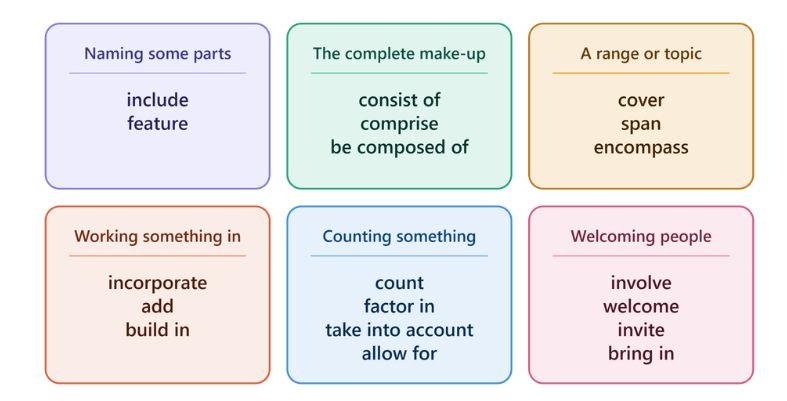
| You mean… | Try | Register |
| naming some of the parts | include, feature | neutral; feature often sounds promotional |
| the complete make-up | consist of, comprise, be composed of | formal |
| a range or topic | cover, span, encompass | cover neutral, encompass formal |
| working something in | incorporate, add, build in | incorporate formal, build in casual |
| counting something | count, factor in, take into account, allow for | neutral to professional |
| welcoming people | involve, welcome, invite, bring in | neutral |
Synonyms for Include: Parts of a Whole
- contain: holds something inside, often literally: The box contains six cables.
- consist of: names the full make-up, so nothing is left out: The panel consists of five judges.
- comprise: formal; traditionally the whole comprises its parts: The museum comprises three galleries.
- feature: includes something as a selling point or highlight: The hotel features a rooftop pool.
Other Words for Include: Range or Scope
- cover: takes in a topic, area or risk: The policy covers theft and fire.
- span: stretches across a period or distance: The collection spans three centuries.
- encompass: formal; takes in a wide range: The review encompasses every department.
- embrace: Merriam-Webster’s usage note says it gathers separate items into one whole: Her essay embraces both art and science.
- comprehend: Merriam-Webster notes it means something falls within the scope of a statement or definition.
- take in: casual; includes something along a route or itinerary: The tour takes in three castles
Words to Use Instead of Include: Adding Something In
- incorporate: works something into a whole that already exists: She incorporated his notes into the final draft.
- add: puts in something extra: Add a summary at the end.
- insert: places something into a gap or sequence: Insert a page break here.
- build in: casual; makes something part of the design: We built in a spare day for delays.
- throw in: casual; adds something extra, often free: They threw in a spare cable.
- enclose: puts something inside an envelope or boundary: Please find enclosed a copy of the invoice.
Include Synonyms for Counting or Taking Into Account
- count: treats something as part of a total: Count the tip in the total.
- factor in: brings something into a calculation or plan: Factor in the delivery fee.
- take into account: a little more formal, with the same meaning: The budget takes inflation into account.
- allow for: leaves room for something in advance: Allow for traffic.
Synonyms for Welcoming People (Social Inclusion)
- involve: brings someone into an activity: The teacher involved every student in the discussion. Merriam-Webster adds that it can also mean inclusion by the nature of the thing: The job involves a lot of travel.
- welcome: adds warmth: The club welcomes new members.
- invite: makes a direct offer: She invited the whole class.
- bring in: casual: Bring Sam in on the planning.
- admit / let in: these suggest someone controls the door, so use them only when that is the point.
Formal vs. Casual Words for Include
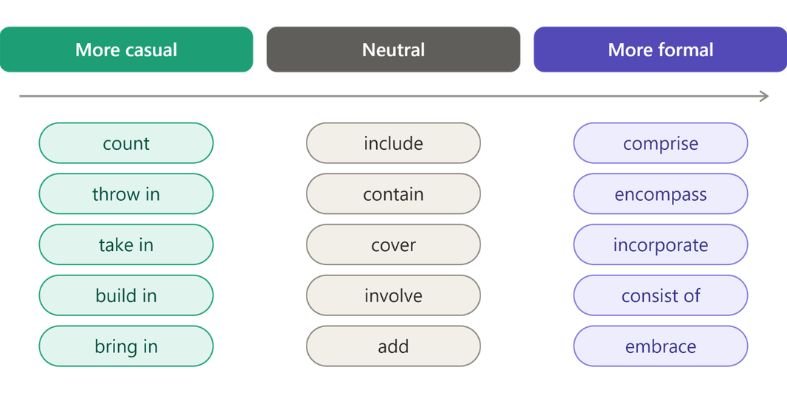
- More formal: comprise, encompass, incorporate, consist of, embrace
- Neutral: include, contain, cover, involve, add
- More casual: count, throw in, take in, build in, bring in
Another Word for “Including”: Such As, For Example and More
Sometimes the better swap is the whole phrase, not the verb.
- including: names part of a group already mentioned: Several rooms, including the attic, were flooded.
- such as: gives examples of a type: fruits such as apples and pears.
- for example: introduces an illustration of a point: Some fruits keep well. Apples, for example, last for months.
- among them: points back to a group you just named.
- namely: introduces the complete list.
Commas around including follow the usual rule for extra information: use them when the phrase can be removed.
What Does “Include” Mean in English?
Include means to contain something as one part of a larger whole, or to count something as part of a group. It has these senses:
- To contain as a part: The ticket includes a free return trip.
- To place in a group: Please include me in the group chat.
- To count in a total: The price includes tax.
- To shut in (older sense): in the early 1400s, include also meant to enclose or confine something physically. That is no longer the usual sense.
Include also has a technical life outside everyday English. In languages such as C, the line #include pulls the contents of another file into a program.
How to Pronounce Include
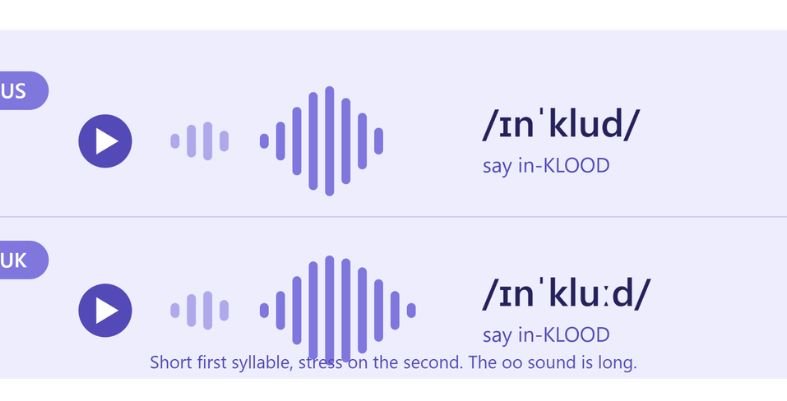
- include: American /ɪnˈklud/, British /ɪnˈkluːd/, say “in-KLOOD”
- included: /ɪnˈkludɪd/, say “in-KLOO-did”
- including: /ɪnˈkludɪŋ/, say “in-KLOO-ding”
Pronunciation note: the stress falls on the second syllable, and -clude rhymes with food. It sounds like the end of conclude, exclude and preclude.
Part of Speech: Is Including a Verb? Forms of Include
Include is a transitive verb, which means it needs an object.
- Base form: include
- Third person: includes
- Past: included
- -ing form: including
Related words: inclusion (noun), inclusive (adjective), and includable (adjective, listed by Merriam-Webster). Including also works as a preposition in everyday use: everyone, including the manager
How to Use Include in a Sentence: Grammar Rules
Include + Object
The thing that is contained is the object: The package includes a charger. The passive turns it around: A charger is included in the package.
Include Introduces Examples, Not a Complete List
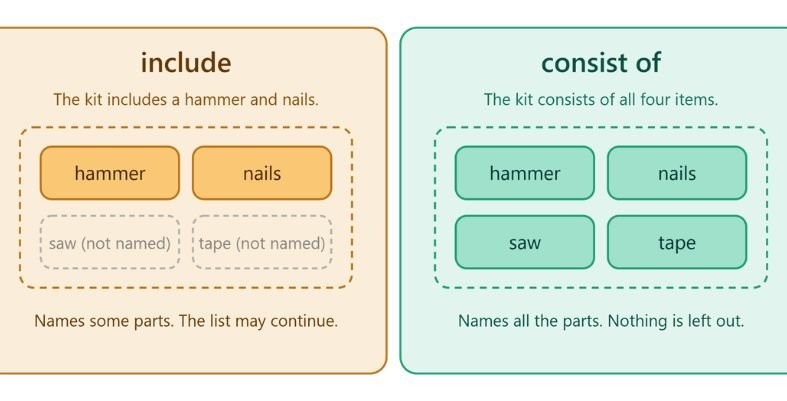
Include signals that the list is partial. If you want to say the list is complete, use consist of: The team consists of five people. In contracts, including but not limited to makes the partial meaning explicit.
A Fixed Fact Usually Takes the Simple Present
For a fixed fact, use the simple present: The price includes dessert. The progressive (is including) sounds odd for a fact like this .
Prepositions with Include
- include in: Include your name in the subject line.
- include on: Include the date on the form. Also on a list, on the agenda.
- include among: She was included among the finalists.
- include within: Storage is included within the monthly fee.
- include with: Include a receipt with your return.
Example Sentences with Include and Its Synonyms
| Sentence | Sense or word | Register |
| The appendix includes the full survey data and the sampling method. | include, parts | formal report |
| Does the ticket include lunch, or is that extra? | include, counting | casual spoken |
| The fee covers all services, including but not limited to filing and consultation. | including but not limited to | legal |
| The kit includes six spice packets and a steel whisk. | include, parts | product listing |
| Please include your order number when you reply. | include, add | |
| She made sure to include the new student in the game. | include, people | narrative |
| The course covers grammar, and it also involves a lot of group work. | cover, involve | neutral |
| Don’t forget to factor in the delivery fee. | factor in | casual to professional |
| Please find enclosed a copy of the invoice. | enclose | formal letter |
Opposites of Include: Antonyms with Nuance
- exclude: to keep something out on purpose: The survey excludes children under twelve.
- omit: to leave something out, by choice or by oversight: The author omitted the footnotes.
- leave out: the everyday version: Don’t leave anyone out.
- rule out: to remove something as a possibility: The committee ruled out a fee rise.
- bar / shut out: to keep people out, usually by a rule: Non-members were barred from voting.
Where Does “Include” Come From? (Etymology)
Etymonline dates include to the early 1400s, when it meant to shut something in, enclose it, imprison it, or confine it, and also to have something as a constituent part. It comes from Latin includere, “to shut in”, built from in-, “in”, and claudere, “to shut”. That is the same root behind close.
Related words from the same family include inclusion (about 1600) and inclusive. Other -clude verbs, such as conclude, preclude and seclude, share the claudere root . Related words from the same family include inclusion (about 1600) and inclusive. Other -clude verbs, such as conclude, preclude and seclude, share the claudere root.
Comprise also dates to the early 1400s with the sense “to include”, from Old French comprendre and Latin comprehendere, “to take together”. Etymonline also records the joke “Include me out,” attributed to Sam Goldwyn, from 1937.
Common Mistakes with Include and Its Synonyms
| Wrong or risky | Better | Why |
| The kit includes a hammer, nails and a saw, and nothing else. | The kit consists of a hammer, nails and a saw. | Include does not say the list is complete. |
| The team is composed of five people. | The team consists of (or is composed of, or comprises) five people. | Many guides object to “comprised of”. |
| Fruits including apples, pears, etc. | Fruits including apples and pears. | Including already signals a partial list, so etc. repeats it. |
| The package is also including a case. | The package also includes a case. | A fixed fact takes the simple present. |
| The list include three names. | The list includes three names. | A singular subject needs includes. |
| Please include in the form your name. | Please include your name in the form. | Put the object right after the verb. |
| Tax is include in the price. | Tax is included in the price. | A passive needs the past participle, included. |
FAQs
What is another word for include?
Common alternatives are contain, comprise, consist of, cover, encompass, incorporate, involve and feature. Pick by meaning: contain, comprise and consist of describe what is inside something or what it is made of, cover and encompass describe range, and incorporate means to work something in. For people, try involve or welcome. No single word fits every sentence.
What is the difference between include and comprise?
“Include” introduces some of the parts and does not say the list is complete: “The kit includes a hammer and nails.” “Comprise” traditionally covers all the parts of the whole: “The kit comprises a hammer, nails and a saw.” For a complete list, “consist of” is the clearest choice.
Is “comprised of” correct?
Many usage guides prefer “consists of” or “is composed of,” because traditionally the whole comprises its parts, not the other way around. “Comprised of” is widely used, though, so you will see it often. In formal writing, choose “consists of,” “is composed of” or “comprises” to avoid the objection.
What is the opposite of include?
The usual opposite of “include” is “exclude,” meaning to keep something out on purpose. “Omit” means to leave something out, by choice or by accident. Everyday choices are “leave out” and “rule out.” To keep people out, use “bar” or “shut out.” Which word you pick depends on whether the leaving-out was deliberate.
What is a more formal, and what is a more casual word for include?
More formal choices are “comprise,” “encompass,” “incorporate” and “consist of.” More casual choices are “cover,” “count,” “throw in” and “take in.” For everyday writing, “include” itself is already neutral and works almost anywhere, so replace it only when another word is more precise, not just to sound different.
Final Thoughts
Choosing the right synonym for include depends on the meaning and context of your sentence. Words such as contain, involve, comprise, incorporate, and cover can replace include in different situations, but each has a slightly different meaning. For example, use contain when referring to what something holds, involve when describing participation or necessary actions, and incorporate when adding something to a larger whole. Understanding these differences will help you improve your vocabulary, avoid repetition, and write more clearly and naturally in English.


One Comment