

Reckon vs Value: The Difference Most Learners Get Wrong (With Real Examples)
A student once sent me this sentence: “I value it will rain tomorrow.” The grammar was fine. The vocabulary was fine. The meaning was somewhere else entirely, because she had grabbed the wrong verb for the job.
She wanted “reckon.” She wrote “value.” And honestly, I understood why. Both words live in the neighbourhood of estimating, judging and putting a number or an opinion on something. They just walk through that neighbourhood in completely different directions.
This guide settles the reckon vs value question once, with example sentences you can steal, the regional quirks that trip people up, and a short test at the end.
The Quick Answer
Reckon is mostly about thinking, supposing or calculating. “I reckon we’ll be late” means “I think we’ll be late.” “She reckoned the cost at fifty pounds” means she worked it out.
Value is about worth. As a verb it means to estimate what something is worth or to hold it dear. As a noun it is the worth itself, or a principle you live by.
If you are giving an opinion or a rough guess, you want reckon. If you are talking about what something is worth, in money or in importance, you want value. That one rule clears up most reckon vs value confusion before it starts.
What “Reckon” Actually Means
Reckon has two lives, and learners usually meet only one of them.
The first is the older, plainer sense: to count or calculate. You can reckon the days until a deadline, reckon the total of a bill, reckon a distance. This use is a bit old-fashioned now, though you still see it in phrases like “by my reckoning.”
The second is the everyday one. To reckon is to suppose or believe, and it is wonderfully casual. “I reckon it’ll rain.” “What do you reckon?” “Do you reckon he’ll show up?” Nobody speaking this way is sitting at a desk with a calculator. They are guessing, and they are comfortable admitting it.
That comfort is the whole flavour of the word. Reckon sounds like a person leaning on a fence. It is relaxed, a little opinionated, and not at all interested in sounding official.
Reckon With vs Reckon On
Two small prepositions change everything here, and they trip up even confident writers.
Reckon with means to deal with or take into account. “A force to be reckoned with” is the famous one: someone you cannot ignore. “We had to reckon with the fact that half the team had quit.” It also works for facing something difficult: “The company is finally reckoning with its past.”
Reckon on means to count on or expect. “I didn’t reckon on the traffic.” “Don’t reckon on getting a refund.” It is about planning around something, usually something that turned out different from the plan.
There is also reckon without, meaning to fail to allow for something. “They reckoned without her stubbornness.” It is rarer, and it sounds slightly literary, but it is perfectly correct.
I have a soft spot for “reckon on” because it comes up in the saddest little sentences. Nobody says “I reckoned on that going well.” It always arrives after the surprise.
Less Common Senses of Reckon
Dictionaries still list several older meanings, and they explain phrases you will meet in print.
The oldest sense is counting and settling accounts: to reckon is to make up accounts and strike the balance of what is owed. That is where “day of reckoning” comes from. Today it means the moment someone finally faces the consequences, but the picture underneath is a ledger being closed.
Another older sense is to regard or rate: “She is reckoned to be one of the best coaches in the league.” You will still see this in newspapers, usually in the passive.
Then there is reckon as a reporting verb, which is everywhere in news writing: “Analysts reckon the bank will cut rates before spring.” The writer is passing on someone’s opinion or estimate without vouching for it. That small signal, this is a view, not a fact, is why journalists like the word.
What “Value” Actually Means
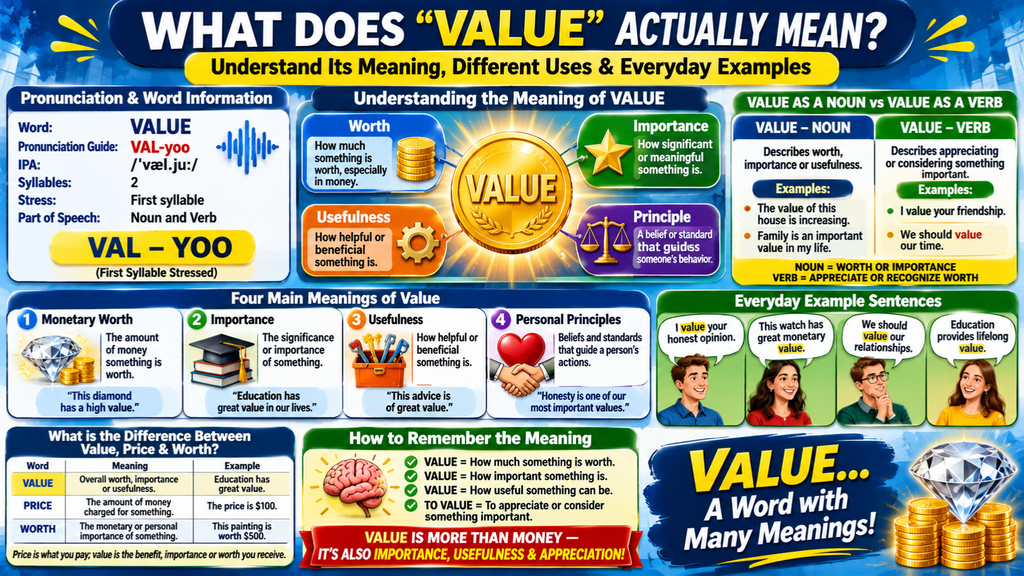
Value is a double agent. It works as a verb and as a noun, and the two jobs feel different enough that learners sometimes treat them as separate words.
Value as a Noun vs a Verb
As a noun, value is worth. It can be financial (“the value of the house has doubled”), practical (“this tool has real value on a building site”), or moral. When we talk about someone’s “values,” we mean the principles they live by: honesty, family, hard work.
It has a technical life too. In maths and programming, a value is the number or data that a variable holds. If your spreadsheet shows an error, the culprit is often a bad value in one cell.
As a verb, value has two main meanings. First, to estimate how much something is worth: “The surveyor valued the property at £400,000.” Second, to think something is important or precious: “I value your honesty.”
That second meaning is where it gets confused with reckon in the minds of learners, because both involve an assessment. But valuing something is a judgement of worth. Reckoning something is a judgement of fact or likelihood. “I value that it will rain” makes no sense, because rain has no worth to you in that sentence. You want “I reckon it will rain.”
Less Common Meanings of Value
Value has a wider family than most learners expect, and some of its meanings sit far away from money.
In music, a note’s value is its length: a quarter note has the value of two eighth notes. In art, value means how light or dark a colour or tone is, which is why painters talk about getting the values right. In maths and programming, a value is the quantity a variable holds, as in the spreadsheet example above.
Then come the phrases. “Value for money” means getting a fair return for what you paid. “Face value” is the worth printed on something, and taking a claim “at face value” means accepting it without questioning. A “value judgement” is an opinion about what is good or bad, rather than a statement of fact.
None of these overlap with reckon, which is useful to know. When the sense of value is musical, artistic, numerical or moral, reckon and value are not even competitors.
Quick Comparison at a Glance
| Reckon | Value | |
| Part of speech | Verb | Verb and noun |
| Core meaning | To think, suppose or calculate | To estimate worth, or to hold dear (noun: worth, principle) |
| Register | Informal in the “think” sense | Neutral to formal |
| Typical regions | British, Irish, Australian, Southern US | All varieties of English |
| Takes a that-clause? | Yes: “I reckon (that) he’s right” | Rarely, and with a different meaning: “I value that you came” |
| Example | “I reckon the meeting will run late.” | “The auditor valued the stock at $2 million.” |
Where the Two Words Overlap
They do overlap, and that is exactly why people search for the difference between reckon and value.
Take estimating a price. “She reckoned the repairs at about £800” and “She valued the repairs at about £800” can both be said, and both are understandable. The difference is subtle. Reckon sounds like a quick mental sum. Value sounds like a more considered estimate, closer to what a professional would do.
So a plumber standing in your kitchen says, “I reckon that’ll cost you around eight hundred.” An insurance assessor writing a report says the damage “has been valued at £800.”
The overlap also shows up in finance and accounting, which matters if you are a learner working in that world. In everyday speech you might reckon what a company is worth. On paper, you would value it, and the result is called a valuation. Reckon rarely makes it into a formal report, though “reckon” survives in the older phrase “day of reckoning,” which began life as a literal settling of accounts.
My rule for spotting the overlap safely: if a person is estimating something that already has a price or worth, either word may fit, and register decides. If they are estimating an opinion, a time, a probability or an event, only reckon fits.
Reckon, Value and Their Closest Neighbours
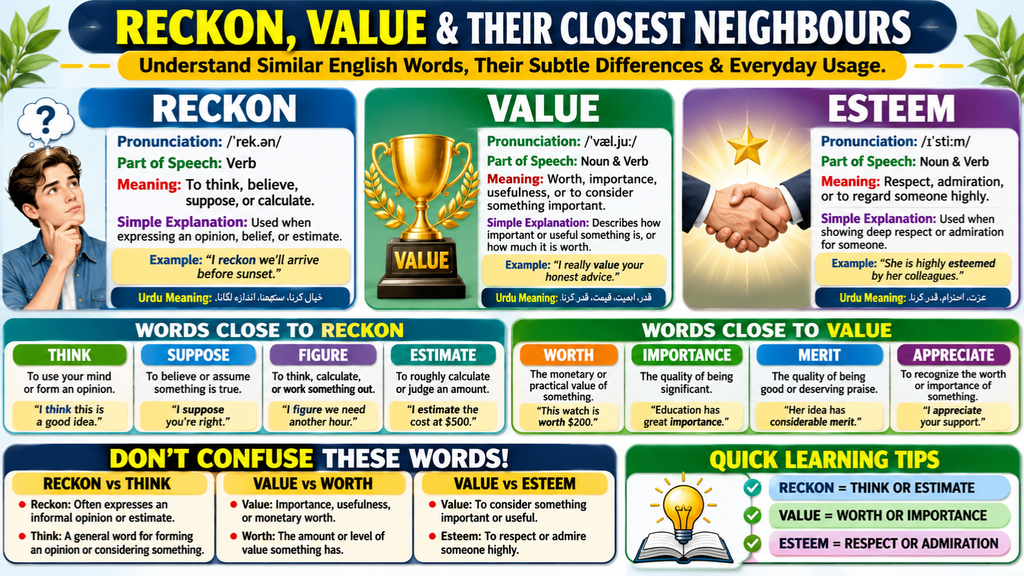
Part of what makes the difference between reckon and value confusing is that each word has near-synonyms pulling in different directions. Sorting those out helps.
For the “think” sense of reckon, the closest neighbours are suppose and assume. Suppose is softer and more tentative. Assume carries the idea of taking something for granted, which reckon does not. “I reckon he’s right” is a judgement. “I assume he’s right” is a starting point.
For the “calculate” sense, use estimate when the figure is rough and calculate when it is exact. Estimate is the safest formal replacement for reckon in business writing.
Value sits next to regard, esteem and prize when it means holding something dear, and next to appraise and assess when it means judging worth. Appraise usually points to a professional pricing something such as property, jewellery or art. Assess is broader: it covers tax, damage, risk and quality.
The noun worth is value’s plainest partner. A house has a worth, a value and a price, and the three can differ. We unpack that trio in our guide to value vs worth vs price.
In accounting and finance, assets are valued, not reckoned. The process is a valuation, and the number it produces is the value. If you work in that world and still want a word for a quick, rough sum, “estimate” is what a finance reader expects to see.
Regional and Register Notes
Here is where reckon vs value stops being a vocabulary question and becomes a question of who is talking.
The “I think” sense of reckon is common in British, Irish and Australian English, and in the American South. Plenty of other American speakers will understand it perfectly but would say “I figure” or “I guess” instead. Neither is wrong. Usage varies from person to person, so treat the region labels as tendencies rather than rules.
Register matters more than region. Reckon in the “think” sense is informal. It is at home in conversation, emails to colleagues you know well, and relaxed blog writing. It looks out of place in a legal contract, an academic paper or a formal business proposal, where “believe,” “estimate” or “consider” would do the job.
Value has no such problem. “We value our customers” is as natural on a corporate website as “I value your time” is in a note to a friend. It travels across registers without changing clothes.
If you are preparing for IELTS or TOEFL, this is useful. In a speaking test, “I reckon” can make you sound natural and relaxed, as long as you do not overdo it. In a writing task, swap it for “I believe” or “it seems likely that.” Graders are looking for a consistent, appropriate register, and a stray “reckon” in an academic essay can read as a slip.
Practical Rules for ESL Learners and Workplace Writers
If you are learning English or writing it at work, a few short rules carry you through almost every case.
- Treat reckon vs value as a register question first. Reckon belongs to relaxed speech and informal writing. Value works everywhere.
- Use “I reckon” in chat with colleagues, in friendly emails and in speaking tests where a natural tone helps. Switch to “I believe,” “I expect” or “I estimate” in reports, proposals and academic essays.
- Use value for anything about worth, whether money, importance or principles: “We value clear communication.”
- Check the preposition. Reckon with means face, reckon on means count on, and value takes no preposition at all in the verb sense.
- Do not use a that-clause after value to express a belief. “I value that he is honest” means you appreciate his honesty. “I reckon he is honest” means you think it is true.
That last rule is worth memorising. Learners often write the first sentence hoping to say the second, and the reader quietly adjusts without telling them.
Example Sentences Side by Side
Seeing reckon versus value in matching situations makes the difference stick faster than any definition.
Giving an opinion “I reckon the new design looks better.” (Natural.) “I value the new design looks better.” (Wrong.)
Estimating a cost “I reckon it’ll set us back about two grand.” (Casual guess.) “The jeweller valued the ring at two thousand dollars.” (Professional appraisal.)
Predicting something “Do you reckon he’ll get the job?” (Natural.) There is no sensible value version of this sentence, and that is the point.
Talking about importance “I value my sleep more than I used to.” (Natural.) “I reckon my sleep more than I used to.” (Wrong.)
Dealing with a problem “We’ll have to reckon with the budget cuts.” (Face them.) “We’ll have to value the budget cuts.” (Means something else entirely, and probably not what you meant.)
Expecting something “I didn’t reckon on so many people turning up.” (Natural.) Again, value does not fit this meaning at all.
Notice how often one of the two simply refuses to work. That is the good news. Most of the time you do not have to agonise, because the sentence itself rules one word out.
Common Mistakes (and How to Spot Them)
Most reckon vs value errors come from a few repeatable habits, which makes them easy to catch once you know what to look for.
Using value to mean “think.” This is the big one, and it is the one my student made. If you can swap in “think” or “suppose” and the sentence still works, you want reckon.
Using reckon in formal writing. A report that says “We reckon the project will be completed in Q3” will make some readers wince. Use “we estimate” or “we expect.”
Confusing reckon with and reckon on. “Reckon with” is about facing something. “Reckon on” is about expecting something. Mix them up and the sentence turns into nonsense.
Treating value as only a money word. It can mean importance, as in “I value your advice,” which has no price tag attached.
Adding a preposition that does not belong. You reckon something, or reckon that something is true. You do not “reckon about” a thing in standard English.
One more thing from my editing days. I once cleaned up a company handbook that said, “We reckon our people.” The author meant “we value our people.” It sounded like a very cold sentence about headcount, which I suspect was not the intended message.
Mini Practice Test
Choose reckon or value (in the right form) for each gap. Answers follow.
- “I ______ we should leave before the storm hits.”
- “The auction house ______ the painting at £15,000.”
- “She ______ her independence above everything.”
- “Don’t ______ on getting a seat on the train.”
- “Do you ______ the shop is still open?”
- “Our company’s core ______ include honesty and respect.”
Answers: 1. reckon. 2. valued. 3. values. 4. reckon. 5. reckon. 6. values (the noun, meaning principles).
If you got five or six right, you have the difference. If you got three or fewer, read the quick answer again and keep one test in your head: is this a guess or opinion (reckon), or is this about worth (value)?
FAQs
What does reckon mean? Mostly “think” or “suppose” in everyday speech, and “calculate” in the older sense. “I reckon it’ll rain” and “reckon the total” are both correct.
What does value mean? As a verb, to estimate worth or to treat something as important. As a noun, the worth itself, or a principle you live by. It also means a number held by a variable in maths and coding.
Can reckon and value be used interchangeably? Rarely. They overlap when someone is estimating a price, but even then reckon sounds like a quick guess and value sounds like a considered estimate. Everywhere else they are not swappable at all.
Is reckon formal? No. The “think” sense is informal. Keep it for conversation and friendly writing, and use “believe” or “estimate” in formal work.
Is reckon British or American? Both, with different intensity. It is very common in British, Irish and Australian English and in the American South. Many other American speakers understand it but prefer “I guess” or “I figure.”
Is “I reckon” grammatically correct? Yes. It is standard English, just informal. Nobody needs to apologise for it.
Can I use reckon instead of think? In casual speech, yes: “I reckon it’s fine” and “I think it’s fine” mean nearly the same thing. In an essay, stick with think or believe.
What is the difference between value and worth? Worth is usually the amount something is considered to be worth, while value is the broader idea and can be used as a verb. “The house is worth £300,000” and “The house was valued at £300,000” say similar things from different angles. We cover this in more detail in our guide to value vs worth vs price.
Is “value” always about money? No. “I value your friendship” has nothing to do with money, and neither do “family values.”
Which should I use in a business email? Value, almost every time, for anything about worth or appreciation. If you need to make an estimate, “estimate” or “expect” is safer than reckon.
What is the difference between reckon and value in one line? Reckon is for guessing, supposing or calculating. Value is for worth, whether in money, importance or principles.
What does “day of reckoning” mean? The moment when someone has to face the consequences of what they did. The phrase comes from the old sense of reckon as settling accounts.
Is value a verb? Yes, and a noun too. As a verb it means to estimate worth or to hold something dear: “The surveyor valued the flat” and “I value your help.”
What is the difference between reckon and estimate? Estimate is the formal choice for a rough figure or judgement. Reckon says nearly the same thing in a casual, conversational voice.
Final Thoughts
Here is the reckon vs value verdict, with no hedging.
Use reckon when you are guessing, supposing or giving an informal opinion, or when you are dealing with or counting on something (reckon with, reckon on). Keep it for relaxed settings.
Use value when you are talking about worth: what something costs, how much it matters, or what you stand for. It works in any setting, formal or not.
When the two collide over an estimate of price, pick by tone. Reckon is the plumber in your kitchen. Value is the surveyor with a clipboard.
The cleanest test I know is this: if you can say “think” in the same spot, it is reckon. If you can say “worth” or “important,” it is value. I have given that test to nervous students for years, and it has not failed yet.
If this guide to reckon and value cleared something up, go further with our related guides: reckon meaning and examples, reckon vs think, reckon with vs reckon on, value vs appraise vs assess, and British vs American informal verbs. Pick the one that matches your next stumbling block, and bookmark this page for the next time these two words land in the same sentence.


2 Comments