Facesitting vs Sit: What’s the Difference? Meaning, Grammar and Examples
Quick answer: Sit is an everyday English verb meaning to rest your weight on your lower body, with a dozen other senses besides. Facesitting is a different, much narrower word: an adult term for a specific intimate practice, listed in dictionaries as a noun. The two share the word sitting, and that shared ending is the only reason people confuse them.
Note: this guide is about language, vocabulary and usage. The word facesitting belongs to adult vocabulary, so the article is written for readers aged 18 and over, in plain, non-graphic terms.
If you searched for facesitting vs sit, you probably landed on a page that gave you a long list of dictionary entries for one word and an empty box for the other. That is a frustrating way to learn anything. This guide fixes that. Whatever sent you here, you get a clean definition of each word, a side-by-side comparison, the grammar behind both, plenty of real sentences, and a straight answer to the questions people actually ask.
Facesitting vs Sit: The Quick Answer in Plain English
The shortest way to explain facesitting vs sit is this:
- Sit is a general verb. It describes a posture or an action, and it can be used in almost any setting: a chair, a courtroom, a nest, a portrait studio.
- Facesitting is a compound noun. It names one specific adult practice, so it only makes sense in an adult context.
One word is a loose tool you use hundreds of times a week. The other is a precise label you will rarely need, and when you do need it, you want to use it correctly.
Here is the side-by-side view.
| Facesitting | Sit | |
| Part of speech | Noun (uncountable); also the -ing form of a rarely used verb | Verb (irregular); also appears inside nouns such as sit-in and sit-up |
| Meaning | A specific adult intimate practice | To rest the body on the buttocks, and many other senses |
| How general is it? | Very narrow | Very broad |
| Register | Adult, informal, specialist | Neutral, usable anywhere |
| Related words | Queening, kinging, facesitter, face-sitting | Sat, sitting, seat, set, sitter |
| Spelling | One word, with face-sitting as an accepted variant | Always one word |
| Where you will see it | Adult-oriented writing and adult communities | Everywhere: news, law, cooking, medicine, daily speech |
| Safe for general audiences? | No | Yes |
Keep that table in mind. Everything else in this facesitting vs sit comparison expands on it.
What Does Sit Mean? Twelve Senses You Should Know
Before comparing, it helps to see just how big sit is, because the facesitting vs sit question only makes sense once you know how much ground the ordinary verb covers. This is where the verb earns its reputation as one of the most flexible words in English. It is also why a vague phrase like “sit on me” can mean different things depending on who says it.
1. To rest on your lower body. The core meaning. Please sit on the sofa.
2. To perch. Used for birds and some animals. Two sparrows sit on the wire every morning.
3. To stay in one position or condition. The letter sat on his desk for a week.
4. To weigh or press on someone. Mostly figurative. The decision sits heavily on her.
5. To fit. Used for clothes. That jacket sits well across the shoulders.
6. To suit or become. Older and rarer. The title sits oddly on a man so shy.
7. To brood eggs. The hen sat on her eggs for three weeks.
8. To face a direction or hold a position. The village sits to the north of the river.
9. To hold a seat in an official body. She sits in the Senate. British English often says sits as an MP.
10. To be in session. Used for courts and parliaments. The court sits again in January.
11. To pose for a painter, sculptor or photographer. He sat for his portrait in 1892.
12. To keep your seat on an animal. She sits a horse beautifully.
There are a few more senses worth knowing. In British English, you sit an exam, meaning you take it. You babysit or pet-sit when you look after someone’s child or animal. And in reflexive use, sit yourself down is an old-fashioned way to tell someone to take a seat.
The point is simple: sit has many jobs. Facesitting has one.
Where the Word Sit Comes From
Sit goes back to Old English sittan, and close relatives turn up across the Germanic languages, such as German sitzen and Dutch zitten. A word that old has had centuries to pick up new senses, which is exactly why it now covers posture, position, fit, membership and sessions.
Facesitting, by contrast, is a compound: English simply joined face and sitting, a pattern it uses constantly for new terms. The age gap is one more reason facesitting vs sit is not an even match. One word has a long history of stretching its meaning. The other was built to do a single job.
What Does Facesitting Mean?

Facesitting is a noun that names the intimate practice of one person sitting over a partner’s face. Dictionary sources describe it as an uncountable noun, meaning you say facesitting and not a facesitting or two facesittings. It is also known as queening, and sometimes kinging.
Three details matter for writers and learners.
It is a compound. The word is built from face and sitting, stuck together. That is why people see “sitting” inside it and assume it must be a close cousin of the ordinary verb. In form, yes. In meaning, no. Compounds often drift far from their parts. A blackboard is not simply a board that is black, and a butterfly has nothing to do with butter.
It is adult vocabulary. The word belongs to the vocabulary of sexuality and, in some communities, BDSM. You would not use it in a general-audience article, a workplace email or a children’s text, any more than you would use other adult terms in those places.
It has related words. Facesitter names a person who does it. Queening is a near-synonym, mostly used when the person on top is a woman taking a dominant role, though the label itself is flexible. Kinging is the counterpart term. Some dictionaries also list facesit as a verb, with facesitting as its present participle and gerund.
That last point deserves a closer look.
The Grammar: Noun, Gerund and Participle
Here is where facesitting vs sit becomes a proper grammar question, and where most pages on the topic stay silent.
Sit is an irregular verb
The forms of sit are:
- Base form: sit
- Third-person singular: sits
- Past simple: sat
- Past participle: sat
- Present participle and gerund: sitting
Sit does not take -ed for its past tense. If you have ever wondered about irregular forms like this, our guide on lyed or lied walks through a similar problem with another tricky verb.
Sitting does three jobs
The word sitting is flexible in its own right:
- Present participle: She is sitting by the window.
- Gerund (a verb acting as a noun): Sitting for hours makes my back ache.
- Adjective or noun: the sitting president, a sitting duck, a sitting room, a ten-minute sitting. Also in one sitting, meaning in a single stretch of time.
Facesitting is mainly a noun
Dictionaries list facesitting as an uncountable noun. You use it the way you would use swimming or knitting as the name of an activity. As an attributive noun, it can modify another word, as in facesitting content or facesitting terminology.
The related verb facesit is listed in some dictionaries, but it is rare in standard writing. As far as I could find, no mainstream convention has settled a past tense for it, so careful writers sidestep the problem. They use the noun instead and write they tried facesitting rather than inventing a form such as they facesat.
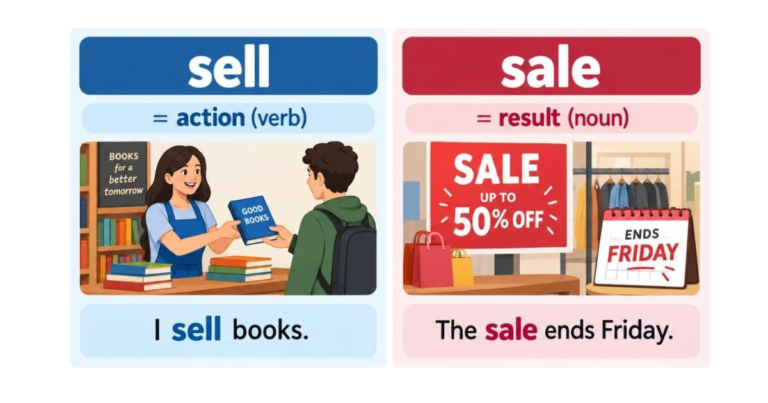
This is the same kind of choice you meet whenever a participle starts acting like a noun. If you want to see how a rare verb’s -ing form behaves, our explainer on within vs withing is a good parallel case. And if the difference between a verb and the noun built from it still feels slippery, sell vs sale shows the same pattern with an everyday word pair.
Spelling and Hyphenation: Facesitting, Face-Sitting or Face Sitting?
Readers often ask which form is correct. The answer is that you will see all three, but they are not equal.
- facesitting (one word) is the main dictionary form.
- face-sitting (hyphenated) is recognised as an alternative form.
- face sitting (two words) is common in casual writing and in search queries, but it is the least standard.
If you are writing, pick one and stay with it. The one-word form matches the dictionary entry, which makes it the safest choice. The same consistency rule applies in all spelling work, which is something we cover across our Vs guides. It matters in any facesitting vs sit write-up, because switching forms makes the term harder to search for.
How to Pronounce Both Words
Sit rhymes with bit. One syllable: /sɪt/.
Facesitting has three syllables, with the stress on the first: FACE-sit-ing. The first part rhymes with place, and the rest sounds exactly like the ordinary word sitting. Say both aloud and the facesitting vs sit overlap is obvious, which is part of why the pair gets confused when you only hear it.
Why People Confuse Facesitting and Sit
A few simple causes explain the confusion, and all of them come down to the shared ending.
The shared ending. Both words contain sitting. Our brains notice repeated chunks and assume a shared meaning.
Informal shorthand. In casual speech and private slang, people shorten phrases. Someone might use sit as a short, vague stand-in for something more specific, and the listener has to guess from context.
Search habits. People type “X vs Y” when they want to know whether two things are the same. Searching facesitting vs sit is a way of asking, “Is the adult word just a version of the ordinary one?” The answer is no. It is a specific term with a narrow job.
Incomplete dictionary pages. Many word-comparison sites auto-generate pages. They pull every sense of the common word and leave the rare word blank. A reader finishes the page knowing a lot about sit and nothing about the term they actually wanted to understand.
Facesitting vs Sit in Context: Example Sentences
Examples show the difference faster than definitions do. A good comparison needs real sentences, not just labels. Below are sentences for sit in many of its senses, followed by neutral, non-graphic examples of how facesitting works as a word.
Sit in real sentences
- Please sit down and take your coat off.
- The cat likes to sit on the warm laptop.
- Two crows sit on the fence every evening.
- The report sat on her desk for three weeks.
- That dress sits perfectly on you.
- The old castle sits on a hill above the town.
- Parliament sits again after the summer recess.
- She will sit for her portrait next Tuesday.
- He sits a horse as if he was born in the saddle.
- Our neighbour sits on the school board.
- I need to sit my driving test again in March.
- Can you babysit on Friday night?
- The hen will sit on those eggs until they hatch.
- The bad news sat heavily on everyone in the room.
- They sat through the whole three-hour film.
- He decided to sit this round out.
- Sit tight, and I will be back in ten minutes.
- The new policy did not sit well with the staff.
Facesitting in neutral sentences
Since this is an adult term, the examples below stay at the level of vocabulary:
- The dictionary lists facesitting as an uncountable noun.
- The article explained that queening is another name for facesitting.
- The style guide advised writers to avoid facesitting terminology in general-audience copy.
- In the glossary, facesitter is defined as a person who engages in facesitting.
- The editor changed face sitting to facesitting for consistency with the dictionary form.
Notice what is missing from the second list: variety. Facesitting does not bend into twelve senses the way sit does. That narrowness is exactly what makes it a precise term.
Common Phrases and Phrasal Verbs with Sit
Since sit does so much work in English, learners meet it inside many fixed expressions. These are all separate from facesitting, but they show how wide the ordinary verb is.
Phrasal verbs
- sit down: take a seat. Sit down and relax.
- sit up: move from lying to sitting, or stay awake late. We sat up all night talking.
- sit back: relax into a seat, or stay passive. Sit back and enjoy the show.
- sit in on: attend as a listener. She sat in on the meeting.
- sit out: skip an activity. He will sit out the next game.
- sit through: endure to the end. We sat through a very long speech.
- sit around: do nothing in particular. Do not just sit around.
- sit on: be a member of; or delay doing something. She sits on the committee. He sat on the news for a week.
- sit for: pose, or take an exam. He sat for a portrait.
Idioms and fixed phrases
- sit tight: wait patiently without changing anything.
- sit on the fence: refuse to take a side.
- a sitting duck: an easy target.
- sit well with someone: be acceptable to them.
- in one sitting: all at once, without a break.
- sit on your hands: do nothing when action is needed.
None of these has anything to do with the adult term. That separation is the point of the whole guide, and it is why these expressions only matter in a facesitting vs sit discussion as proof of how wide the ordinary verb is.
Sit vs Sat vs Set vs Seat: Other Confusions Worth Fixing
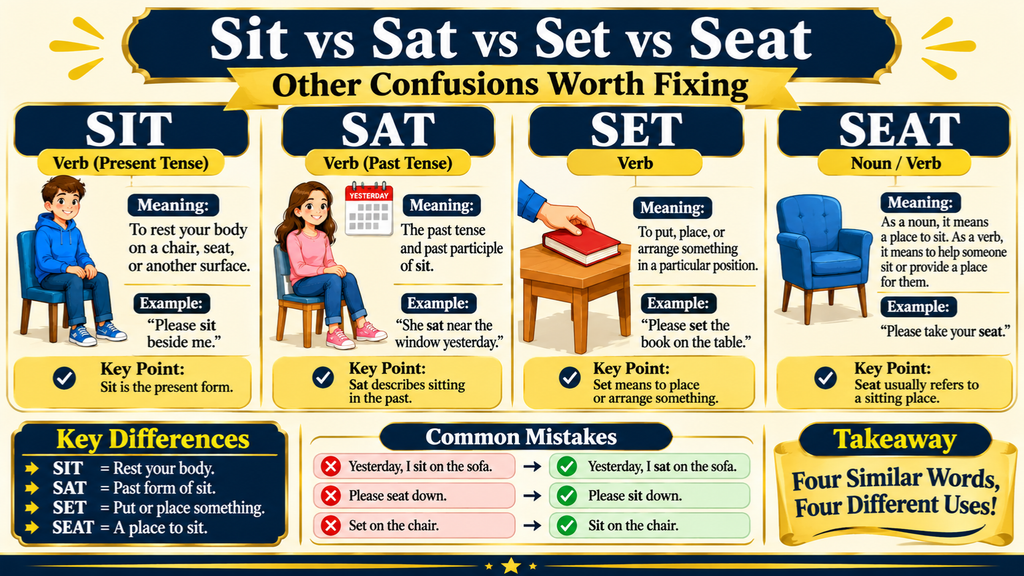
While we are here, four neighbours of sit cause trouble for learners.
Sit vs sat. Sit is the base form, and sat is the past tense and past participle. Yesterday I sat by the river. Writing I have sit is an error. The correct form is I have sat.
Sit vs set. Sit is intransitive in most uses, which means it does not take a direct object. You sit. Set usually needs an object. You set something down. Sit the book on the table is wrong; set the book on the table is right. The one exception is the reflexive sit yourself down, or British phrases like sit an exam.
Sit vs seat. Seat is a noun (a comfortable seat) and a verb meaning to place someone in a chair (Please seat the guests). Sit is the verb for taking a seat yourself. If you enjoy these small word-pair traps, throne or thrown covers another pair where a seat-related word gets confused with its sound-alike.
Sitter vs sitting. A sitter is a person who sits for something: a babysitter, a pet-sitter, a model who sits for a painter. Sitting is the activity.
How Dictionaries Handle Facesitting vs Sit
Open any large dictionary and the imbalance shows up straight away. Sit gets a long entry with numbered senses, usage notes and dozens of example sentences. Facesitting, where it appears at all, gets a line or two. In the facesitting vs sit comparison, that gap is not an accident. It reflects how often each word is used and how many jobs each one does.
Community-edited dictionaries such as Wiktionary do list facesitting, as an uncountable noun built from face and sitting, and they give queening as a synonym. Some entries also record face-sitting as an alternative form and facesit as a verb whose participle is facesitting. Traditional print dictionaries have been slower to include the term, and coverage differs from one publisher to the next. If you cannot find the word on your own shelf, that says more about editorial policy than about whether it is real English.
Two habits follow from this. First, name the dictionary when you quote a definition, because entries differ. Second, check the edition date, since usage-based dictionaries add words over time. It is the same source-checking we do for every pair on the site, and our guide to status vs statuses shows how much plural forms can vary between references.
Facesitting vs Sit for Writers and Editors: A Quick Style Checklist
If you edit copy that touches this topic, run through five questions in order.
- Who is the audience? An adult glossary or reference can carry the term. A general-audience page, a school text or a workplace document should not.
- Is the word necessary? If a plainer phrase does the job, use it.
- Is sit standing in for something else? A silent euphemism leaves readers guessing, so either name the thing or cut the sentence.
- Is the spelling consistent? Choose facesitting, face-sitting or face sitting once, then apply it everywhere.
- Does the platform allow it? Many publishing platforms and ad networks restrict adult vocabulary, so read the rules first.
The facesitting vs sit distinction matters most at step three, because that is where vague writing creeps in. Precision costs nothing, and it keeps the text useful to the reader who arrived with a question.
Facesitting vs Sit: Which One Should You Use?
The answer depends on what you mean.
Use sit whenever you are describing a posture, a seat, a session or any of the general senses above. It is neutral and appropriate everywhere.
Use facesitting only when you specifically mean the adult practice, and only in writing meant for an adult audience. Do not swap one for the other, and do not use sit as a euphemism in writing where precision matters. Vague euphemism confuses readers and, in educational or reference writing, makes the text worse.
For writers, a few practical rules help:
- Match your audience. If your readers include teenagers, a general public or a workplace, leave the adult term out.
- Match your platform. Many publishing platforms and ad networks restrict adult vocabulary. Check the rules before you publish.
- Match the dictionary. If you must use the term, use the standard spelling (facesitting) so your text is consistent and easy to search.
- Define it once. In a glossary or reference, give a short, neutral definition and move on.
A Short Note on Context, Consent and Respect
This is a language guide, not an advice column, but it would be careless to define an intimate term and pretend the context does not exist.
Any intimate practice involves other people, and it depends on clear, willing agreement between adults. That agreement can be withdrawn at any point. Talking openly beforehand, agreeing a way to stop, and checking in during are the basics of consent, and they apply to every adult activity, not only this one.
If you have a health question connected to the topic, a doctor or sexual health clinic is the right place to ask. If you want to understand medical vocabulary better, our guide to gynecology vs gynaecology is a good example of a language-focused look at a health-related word.
Common Mistakes with Facesitting vs Sit
Treating them as the same word. They are not variants of each other. One is a general verb, and the other is a narrow adult noun.
Searching facesitting vs sit and expecting synonyms. The pair is not a synonym pair at all. It is a general-versus-specific pair, and reading it that way saves a lot of confusion.
Using sit as a silent euphemism. If you mean something specific, say it clearly or leave it out.
Saying a facesitting. The noun is uncountable. Say facesitting on its own, or a facesitting session if you need a countable frame.
Writing have sit instead of have sat. This is the classic sit error, and it has nothing to do with the adult term.
Using the adult term in general copy. Context matters. A word that is perfectly correct in an adult glossary can be completely wrong in a school newsletter.
Inconsistent spelling. Switching between facesitting, face-sitting and face sitting in the same document looks sloppy. Pick one.
Forcing a past tense. If you find yourself wanting to write facesat, reword the sentence. Use the noun, or use a different verb.
Quick Memory Tricks
- Sit = a general verb. Think of it as the toolbox word. It does hundreds of jobs.
- Facesitting = a specific noun. Think of it as a label. It does one.
- Sat, not sit, for the past. If you can add yesterday, you want sat.
- Set needs an object; sit does not. You set a cup down, but you sit.
- Facesitting vs sit in one line: a specific noun set against a general verb.
- When in doubt, reword. If a sentence needs awkward verb gymnastics, a plainer sentence almost always works better.
FAQs
What is the difference between facesitting and sit?
Sit is an everyday verb with many senses, from resting in a chair to being in session. Facesitting is a narrow adult noun naming one specific practice. They share the word sitting, but they do not share a meaning. One is general, and the other is specific.
Is facesitting a verb or a noun?
It is mainly a noun, listed as uncountable. Some dictionaries also list facesit as a rare verb, with facesitting as its present participle and gerund. In practice, most writers use the noun and avoid the verb, since no standard past tense has settled.
Is facesitting one word or two?
One word is the standard dictionary form. Face-sitting with a hyphen is accepted as an alternative, and face sitting as two words appears in casual use. Choose one form and use it consistently, whichever side of the facesitting vs sit pair you are writing about.
What does queening mean?
Queening is a near-synonym of facesitting, a community term for the same practice. It is most often used when the person on top is a woman in a dominant role. Kinging is the counterpart term for a man on top.
What is a facesitter?
A facesitter is a person who takes part in facesitting. It is listed as a noun in some dictionaries and is used mainly in adult and BDSM-related contexts.
What is the past tense of sit?
The past tense of sit is sat, and the past participle is also sat. For example: I sat there for an hour. She has sat in that chair for years. The form sitted is incorrect.
What is the past tense of facesit?
There is no widely settled past tense for it. Because the verb is rare, most writers avoid it and use the noun or a different verb instead. If you are unsure, rewrite the sentence.
Why do so many senses of sit exist?
English has used sit for centuries, and it has stretched to cover posture, position, fit, membership, sessions and care duties. Each sense grew from the same root idea of resting or staying in place.
Is sit ever used as slang for facesitting?
In private or informal shorthand, people sometimes use short, vague words as stand-ins, and sit can be one of them. That is context-dependent, not a dictionary sense. If a meaning is unclear, ask the person directly instead of guessing.
Can I use facesitting in formal writing?
Only in the right setting. It suits glossaries, adult-oriented references or sexual-health writing aimed at adults. It does not suit general-audience, workplace, school or most formal writing.
How do I pronounce facesitting?
Say FACE-sit-ing, with the stress on the first syllable. The last two syllables sound exactly like the ordinary word sitting.
Is facesitting vs sit a grammar question or a vocabulary question?
Both. The grammar side is about parts of speech: sit is an irregular verb, and facesitting is mainly an uncountable noun. The vocabulary side is about meaning, since one word is general and the other is narrow. Most people searching facesitting vs sit really want the vocabulary answer.
Why does my dictionary show nothing for facesitting?
Coverage varies by publisher. Community-edited dictionaries list the word, while some traditional print dictionaries leave out adult vocabulary. A missing entry does not mean the word is invented, only that that particular dictionary has not included it.
Is facesitting countable?
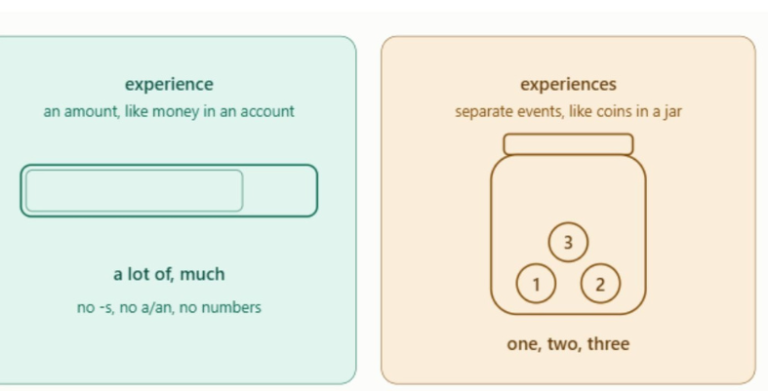
Dictionaries list it as uncountable, so you say facesitting with no article and no plural. If you need a countable frame, write a facesitting session. For a refresher on plural rules in general, see our guide to box vs boxes.
Can I write facesitting versus sitting instead?
You can write the phrase either way in a heading or a search, but the words themselves are different. Sitting is the -ing form of the verb sit, so facesitting versus sitting is still the same general-versus-specific comparison. The difference between facesitting and sit is the one to remember.
Which word is more common, facesitting or sit?
Sit is vastly more common, since it appears in everyday speech, news, law and instructions. Facesitting is a specialist term you will mostly meet in adult-oriented writing.
Where can I find more word comparisons like this?
If this guide was useful, browse our full list of Vs guides for plain-language comparisons of commonly confused words, or head to the blog for broader grammar and spelling help.
Final Thoughts
Strip away the long dictionary lists and the awkward search results, and the answer to facesitting vs sit is short. Sit is a flexible, irregular verb that works in almost any sentence. Facesitting is a narrow adult noun that belongs only in the right context. They look related because they share sitting, but they do different jobs.
Treat facesitting vs sit as a general-versus-specific pair and the rest follows. Use sit freely. Use facesitting carefully, in the right audience, with the standard spelling and without trying to turn it into a verb. And if a sentence starts to feel awkward, reword it.