
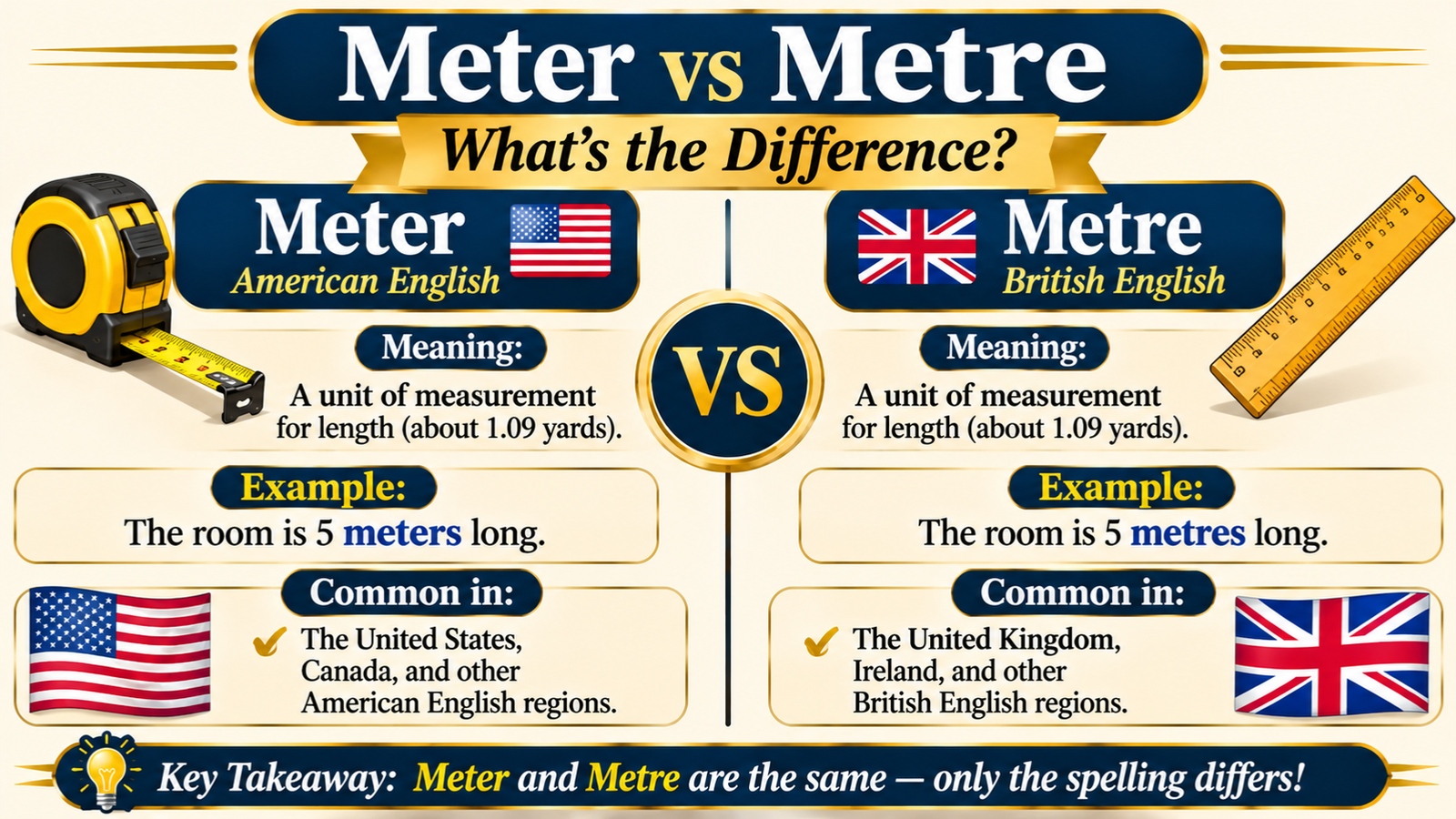
Meter vs Metre: What’s the Difference? Spelling, Meaning and Examples
You are writing a report, a school essay, or a product description, and you type “5 meters” or “5 metres.” Then you stop. Which one is right? The Meter vs Metre question trips up writers, students, and editors every day, because both spellings are correct. The real question is which one fits your audience and your meaning.
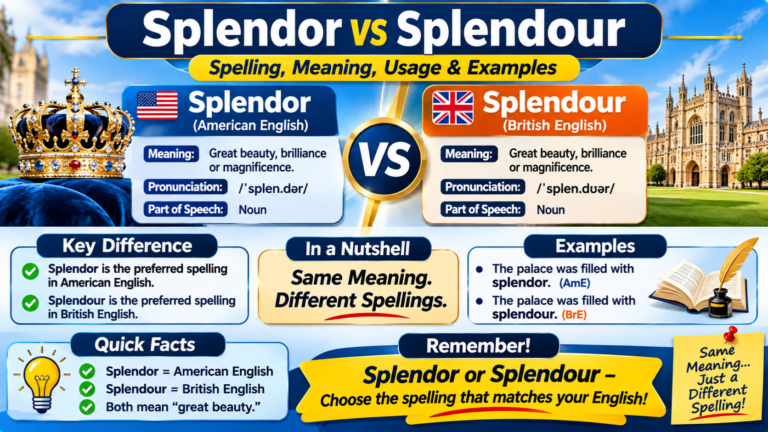
If your readers are in the United States, the answer is simple: use meter. If they are in the United Kingdom, Australia, New Zealand, India, or most of the English-speaking world outside the U.S., use metre for length and for poetry, and keep meter for measuring devices.
This guide explains Meter vs Metre in plain English. You will see when each spelling is correct, how American and British English handle them, what changes for measuring devices and poetry, how the unit was defined over time, and how to pick the right word in seconds. There are examples, tables, and a short quiz at the end.
Meter vs Metre: Quick Answer
Meter is the American spelling of the metric unit of length, and in both American and British English it also names measuring devices such as gas meters. Metre is the British spelling of the unit and of poetic rhythm. In the U.S., use meter for everything. In British English, use metre for length and verse, and meter for devices.
| Your audience | Unit of length | Poetry rhythm | Measuring device |
| United States | meter | meter | meter |
| United Kingdom and most other countries | metre | metre | meter |
That is the whole story in short. The rest of this article gives you the details, examples, and memory tricks.
Meter vs Metre: The Core Difference Explained
The Meter vs Metre difference is about spelling variety, and in British English it is also about meaning.
In American English, one spelling does every job. Meter is the unit, the poetic rhythm, and the device. In British English, the spelling splits: metre handles length and poetry, while meter handles devices. So this is not a question of right and wrong. It is a question of which English you are writing.
Merriam-Webster, an American dictionary, labels metre as a “chiefly British” spelling of meter. Collins Dictionary, a British one, labels meter the “US spelling” of metre for the unit. Both dictionaries agree on the facts. They just describe them from opposite sides of the Atlantic.
A quick test helps:
- Is it a device that measures something? Use meter in both varieties.
- Is it the unit or the rhythm of a poem, and your audience is British? Use metre.
- Is your audience American? Use meter.
What Does “Meter” Mean?
Meter is a noun with several meanings, and one of them is the unit of length.
1. The unit of length (American spelling). The meter is the basic metric unit of length, about 39.37 inches. Americans write meter for this unit.
- The pool is 25 meters long.
- She won the 200-meter dash.
2. A measuring device (American and British). A meter is an instrument that measures, and often records, a quantity such as gas, water, electricity, miles, or time.
- The technician read the water meter.
- I put coins in the parking meter.
- The taxi meter started at zero.
3. The rhythm of a poem or piece of music (American spelling). In American English, meter also means the pattern of stressed and unstressed syllables in verse, or the arrangement of beats in music.
- Shakespeare often wrote in iambic meter.
- The song is in 3/4 meter.
4. A verb. Meter can also be a verb. It means to measure with a meter, to regulate the flow or rate of something, or to stamp mail with a postage meter.
- The office meters all outgoing mail.
- The city meters water use in every home.
What Does “Metre” Mean?
Metre is the British spelling, used in the UK and in most countries that follow British spelling conventions. It has two meanings.
1. The unit of length. One metre equals 100 centimetres, or 1,000 millimetres.
- The wall is three metres high.
- The athlete ran 400 metres.
2. The rhythm of a poem. British writers use metre for the pattern of beats in a line of verse.
- The poem is written in iambic metre.
Notice what metre does not mean in British English: a measuring device. In British English, the device is always a meter. So a British writer uses both spellings, each for a different job.
One more point. Some competing guides claim that British writers keep meter for poetry. That is not accurate. British dictionaries and style guides give metre as the spelling for the poetic term, as in “iambic metre.”
Meter vs Metre Comparison Table
| Feature | Meter | Metre |
| Unit of length (US) | Yes | No |
| Unit of length (UK) | No | Yes |
| Measuring device (US) | Yes | No |
| Measuring device (UK) | Yes | No |
| Poetry rhythm (US) | Yes | No |
| Poetry rhythm (UK) | No | Yes |
| Music beat pattern (US) | Yes | No |
| Part of speech | noun, verb | noun |
| Symbol for the unit | m | m |
| Pronunciation | nearly the same | nearly the same |
The symbol m is the same in every country, so 5 m is correct whichever spelling your reader prefers. This is a useful trick for international writing.
American vs British English: Which Spelling Where?
English has two major spelling traditions, and the Meter vs Metre pair is one of the best-known examples of that split.
| Region | Unit of length | Poetry | Devices |
| United States | meter | meter | meter |
| United Kingdom | metre | metre | meter |
| Australia and New Zealand | metre | metre | meter |
| India and South Africa | metre | metre | meter |
| Ireland | metre | metre | meter |
| Canada | usually metre | usually metre | meter |
Canada is a mixed case. Canadian writers generally use metre for the unit and meter for devices, but American habits also show up in Canadian writing, so check the style guide for your publication.
Two official bodies show the split in action. The International Bureau of Weights and Measures (BIPM), based in France, writes metre in its English-language documents. U.S. government and standards writing generally follows American spelling and uses meter. Neither is wrong. Each follows its own tradition.
Many -re and -er pairs work the same way: centre/center, litre/liter, theatre/theater, and fibre/fiber. Once you learn that pattern, this pair feels like one more spelling variety.
The golden rule is consistency. Choose one variety for the whole document. Do not write “10 metres” in one paragraph and “10 meters” in the next.
Meter vs Metre for the Unit of Length
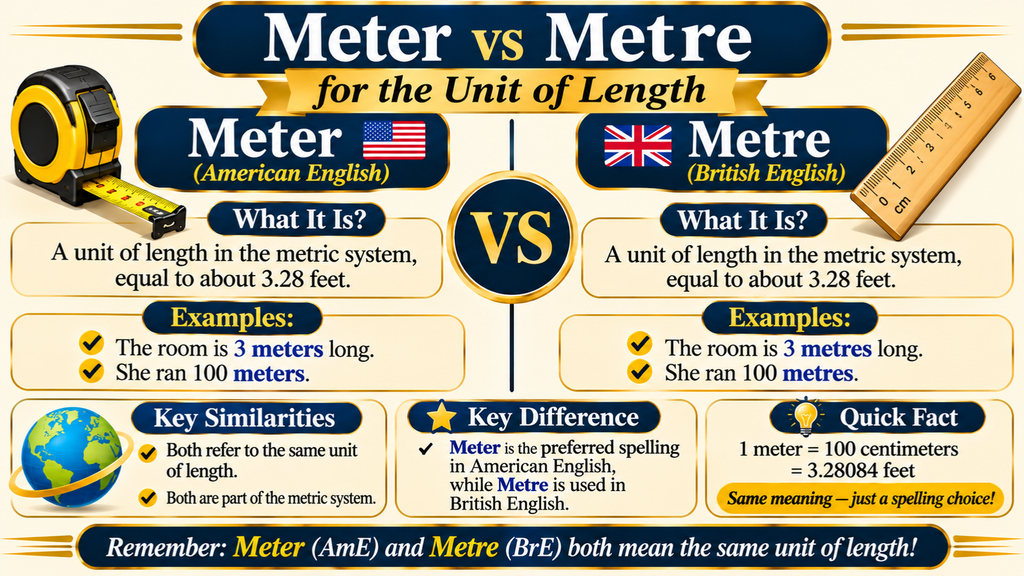
The unit of length is the most common reason people search for this pair.
The metre is the base unit of length in the International System of Units (SI), with the symbol m. Its current definition is based on the speed of light: one metre is the length of the path traveled by light in a vacuum during a time interval of 1/299,792,458 of a second.
You do not need to memorize that definition to write correctly. These everyday facts matter more:
| Unit | Equals |
| 1 meter | 100 centimeters |
| 1 meter | 1,000 millimeters |
| 1 kilometer | 1,000 meters |
| 1 meter | about 39.37 inches |
| 1 meter | about 3.28 feet |
| 1 meter | about 1.09 yards |
A handy way to picture it for American readers: a meter is a little longer than a yard, by about 3.4 inches.
Examples in both varieties:
- American: The room is 4 meters wide and 6 meters long.
- British: The room is 4 metres wide and 6 metres long.
- Either: The room is 4 m wide and 6 m long.
Related unit forms follow the same split. Americans write kilometer, centimeter, millimeter, and square meter. British writers write kilometre, centimetre, millimetre, and square metre. When you pick a side, you pick it for all of these.
How to Write the Symbol Correctly
The symbol m follows a few simple rules in scientific and technical writing:
- Use a lowercase m. A capital M stands for something else, such as mega- or molar.
- Leave a space between the number and the symbol. Write 5 m, not 5m.
- Do not add a period. Write 5 m, not 5 m., unless it ends a sentence.
- Do not add an s. The symbol has no plural: 1 m and 5 m.
- Combine symbols carefully. m² is square meters, m³ is cubic meters, and m/s is meters per second.
Hyphens With Numbers
When a measurement works as an adjective before a noun, use a hyphen and keep the unit singular: a 100-meter dash (American) or a 100-metre dash (British). When the measurement stands alone, use the plural: The race is 100 meters.
Meter vs Metre for Measuring Devices
Here, the choice is easy. A device that measures is a meter in both American and British English.
Common examples:
- water meter
- gas meter
- electricity meter, or electric meter in American English
- smart meter
- parking meter
- taxi meter
- postage meter
- light meter
The device sense is a different word from the unit, even though they sound alike. Dictionaries describe it as “one that measures,” and it also appears as the combining form -meter in instrument names such as thermometer, barometer, and speedometer.
A British example that surprises many learners: The engineer read the gas meter and measured the pipe at two metres. One sentence, both spellings, both correct.
This is the main reason the pair is harder in British English. You need to think about the meaning each time you write the word.
Micrometer vs Micrometre
British English uses the same logic for one more pair of words. A micrometre (symbol µm) is a unit of length equal to one millionth of a metre. A micrometer is a precision measuring instrument used by machinists. American English writes micrometer for both. If you work in engineering or science and your readers are British, this distinction matters.
Meter vs Metre in Poetry and Music
In poetry, meter (American) or metre (British) is the rhythmic pattern of a line, built from stressed and unstressed syllables.
| Term | What it means | Example |
| iambic meter/metre | unstressed + stressed pattern | “To be or not to be” |
| trochaic meter/metre | stressed + unstressed pattern | “Tyger Tyger, burning bright” |
| blank verse | unrhymed iambic pentameter | Shakespeare’s plays |
American: The poem follows a strict iambic meter.
British: The poem follows a strict iambic metre.
A line’s length is counted in “feet.” That is why you see words such as pentameter (five feet) and hexameter (six feet). These words use the combining form -meter in both varieties, so you do not need to choose between spellings for them.
In music, meter describes the organization of beats into groups, such as 4/4 or 3/4 time. American writers use meter for this. British music writers often use metre for the same idea, and you may also see terms like simple meter and compound meter.
Pronunciation: Do Meter and Metre Sound Different?
No. Meter and metre are different spellings of words that sound nearly the same: MEE-ter, often written /ˈmiːtər/. Regional accents change the vowel slightly, but the spelling does not change the sound. This is true for the unit, the poetic term, and the device.
So the difference lies in the written word. This is why the problem appears mostly in writing and editing, not in conversation.
Two small notes:
- The pair meter/metre does not sound like metro (the subway) or metric (the adjective for the system). Those are different words with different endings.
- Words that end in -meter, such as kilometer and thermometer, can be stressed differently in different accents. The spelling stays the same either way.
A Short History of the Metre
The metre is younger than many people expect, and its history is a good example of science moving from objects to nature to physics.
| Year | What happened |
| 1791 | The French Academy of Sciences chooses a natural definition: one ten-millionth of the distance from the North Pole to the equator, measured along the meridian through Paris. |
| 1799 | A platinum bar, the Mètre des Archives, is made as the physical standard. |
| 1866 | The U.S. Congress legalizes the use of the metric system, though it does not make it mandatory. |
| 1875 | The Metre Convention is signed, and the International Bureau of Weights and Measures (BIPM) is established. |
| 1889 | A new international prototype, a bar of platinum-iridium (90% platinum, 10% iridium), becomes the standard. |
| 1959 | The international yard is defined as exactly 0.9144 metre. |
| 1960 | The metre is redefined using the wavelength of light from krypton-86. |
| 1983 | The metre is redefined as the distance light travels in a vacuum in 1/299,792,458 of a second. |
| 2019 | The SI definitions are reworded, and the metre is defined by the fixed value of the speed of light. |
Two details are worth noticing. First, the original idea was to base the unit on the size of the Earth, but the first prototype turned out slightly short because of a miscalculation of the planet’s flattening. Second, even in the United States, where everyday life still uses inches and feet, those customary units are officially defined in terms of the metre. One inch is exactly 2.54 centimeters.
Why does this history matter for spelling? Because the unit traveled from French into English, and each variety of English handled the ending in its own way. Britain kept the French-looking -re. The United States simplified it to -er.
Word Origin
Both spellings come from the same family, which explains why they sound alike.
- Unit of length: Borrowed into English in the late 1790s from French mètre, which came from Greek métron, meaning “measure.”
- Poetic rhythm: From Latin metrum (“poetic rhythm or verse”), from the same Greek métron. Merriam-Webster traces the Middle English metre through Anglo-French and Latin.
- Device: Formed from the verb mete (“to measure”) plus the suffix -er, giving the sense “one that measures.”
- Combining form -meter: From New Latin -metrum, from Greek métron.
The -re ending is the older French-influenced spelling. American English later regularized many -re words to -er, and that is the root of the modern split. The device sense came separately, which is why it kept the -er spelling in Britain.
Related words show the family tree: metric, metrical, metrology (the science of measurement), symmetry, and diameter all share the Greek root for “measure.”
Meter vs Metre in Compound Words
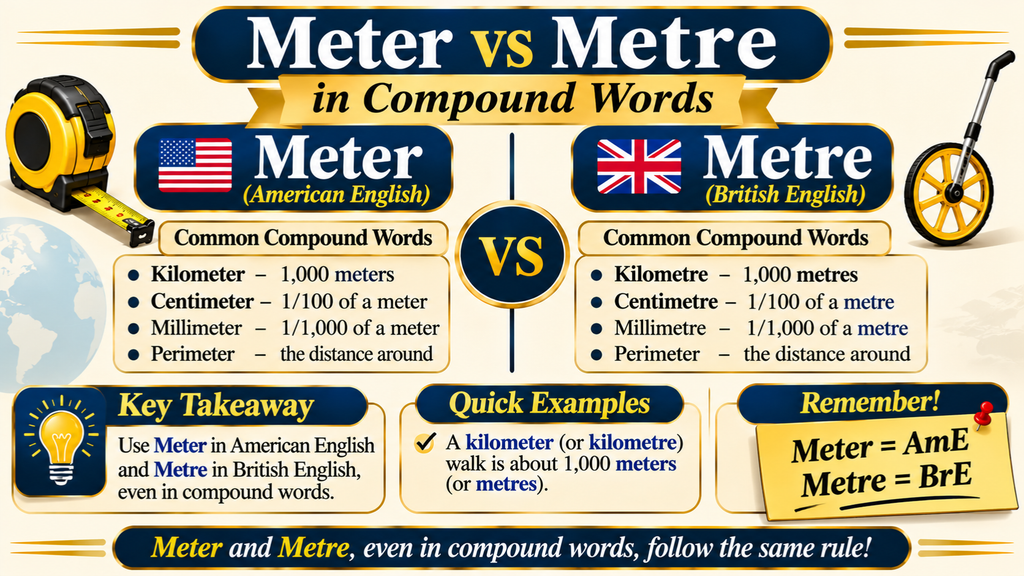
Compound words are a major source of confusion, so here is a clear map.
| Word type | American | British |
| Length units | kilometer, centimeter, millimeter | kilometre, centimetre, millimetre |
| Small units | micrometer, nanometer | micrometre, nanometre |
| Area and volume | square meter, cubic meter | square metre, cubic metre |
| Speed | meters per second | metres per second |
| Instruments | thermometer, speedometer, odometer | thermometer, speedometer, odometer |
| Measuring devices | parking meter | parking meter |
The instruments never change. Thermometer, barometer, speedometer, and odometer use the combining form -meter in both American and British English. Only the unit words and the poetry word change.
Why does this matter? Because writers sometimes “correct” thermometer to thermometre in a mistaken attempt to look British. That is an error in every variety of English.
The Metric Prefixes
The metre is the base for a family of units, formed by adding prefixes:
| Prefix | Meaning | Unit (American spelling) | Symbol |
| nano- | one billionth | nanometer | nm |
| micro- | one millionth | micrometer | µm |
| milli- | one thousandth | millimeter | mm |
| centi- | one hundredth | centimeter | cm |
| kilo- | one thousand | kilometer | km |
Word Forms of Meter and Metre
| Form | Meter | Metre |
| Singular | meter | metre |
| Plural | meters | metres |
| Verb forms | meter, meters, metered, metering | (no verb) |
| Adjective | metric, metered | metric |
| Related | metrical, metrics | metrical, metrics |
Useful notes:
- Metre has no verb in British English. The verb to meter uses the -er spelling in both varieties: The utility meters your usage.
- Metric is the adjective for the system based on the metre: the metric system. Its spelling does not change.
- Metrical describes verse patterns: a metrical line.
- Metered can describe parking, mail, or a regulated flow: metered parking.
Meter vs Metre in Sentences
The best way to master the pair is to see both spellings in matched sentences.
American English
- The swimmer finished the 100-meter freestyle in record time.
- The plank is two meters long.
- The poem has an unusual meter.
- Please read the electric meter before you leave.
- The marathon is about 42,195 meters.
- The new smart meter sends readings automatically.
British English
- The swimmer finished the 100-metre freestyle in record time.
- The plank is two metres long.
- The poem has an unusual metre.
- Please read the electricity meter before you leave.
- The marathon is about 42,195 metres.
- The new smart meter sends readings automatically.
Do you see the pattern? Sentences 4 and 6 have the same device spelling in both lists. Sentences 1, 2, 3, and 5 change with the variety.
Meter vs Metre in Different Contexts
The context usually settles the choice at once.
| Context | American | British |
| Sports (track, swimming) | 100-meter dash | 100-metre dash |
| Construction | 3 meters of cable | 3 metres of cable |
| Science and engineering | meters per second | metres per second |
| Utilities | gas meter | gas meter |
| Taxis and parking | taxi meter | taxi meter |
| School poetry lesson | iambic meter | iambic metre |
| Maps and distances | 500 meters ahead | 500 metres ahead |
| International standards | m | m |
In the United States, the meter appears most in science, medicine, engineering, the military, car and machine specifications, and sports such as track and field and swimming. In everyday life, Americans still use miles, feet, and inches, which is why a quick conversion often helps in writing.
If you write for an international audience, the safest choice is often the symbol m: The tower is 50 m tall. Nobody can argue with it.
Meter vs Metre in Professional Writing
Professionals face this choice in reports, manuals, labels, and websites. A few habits keep your work clean.
- Follow the style guide. If your company or publisher uses American or British spelling, use it everywhere, including units, headings, and captions. When in doubt, verify the rule in the official guide instead of guessing.
- Set your spell checker to the right language. A US English checker will flag metre and a UK English checker will flag meter for length, but neither will always flag the device sense.
- Use the symbol in tables. A column headed Height (m) works for every reader and avoids the spelling question entirely.
- Keep numbers and units together. Write 5 m or 5 meters with a space, never 5meters.
- Check product and place names separately. A brand or company name may keep its own spelling even when your document follows another variety.
- Match the audience in SEO and web copy. If your readers search from the United States, use meter. If they search from the UK or Australia, use metre. Mixing both in one page can look careless and confuse readers.
If you edit for a global audience, keep a short list of your decisions: meter or metre, kilometer or kilometre, liter or litre. That small list prevents most mistakes.
Quick Conversions to Keep in Mind
These approximate values help when you write for readers who use feet and inches.
| Measurement | Approximate value |
| 1 meter | 39.37 inches, or 3.28 feet |
| 2 meters | 6.56 feet |
| 5 meters | 16.4 feet |
| 100 meters | 328 feet, or about 109 yards |
| 1 kilometer | 0.62 miles |
| 1 mile | 1.609 kilometers |
| 1 foot | exactly 0.3048 meters |
| 1 inch | exactly 2.54 centimeters |
| a marathon | 42.195 kilometers (26.2 miles) |
Some quick comparisons make the unit easier to picture. A standard door is a little over 2 meters tall. An Olympic swimming pool is 50 meters long. A 100-yard football field is about 91.4 meters. The values are rounded, so use a calculator for engineering or legal work.
Related Spelling Pairs
This pattern repeats in other American and British word pairs.
| American | British |
| meter | metre |
| liter | litre |
| center | centre |
| theater | theatre |
| fiber | fibre |
| caliber | calibre |
These pairs follow the same rule: Americans prefer -er, British writers prefer -re. If you already know one pair, you can apply the same logic to the rest.
Other spelling guides on this site show similar American and British splits. Compare them in Characterize vs Characterise, Gynecology vs Gynaecology, and Marveled or Marvelled.
Meter vs Metre: A Simple Decision Chart
Run through this chart when you edit a sentence:
| Ask yourself… | Choose |
| Is it a device that measures something? | meter |
| Is it the unit of length for an American audience? | meter |
| Is it the unit of length for a British audience? | metre |
| Is it poetic rhythm for an American audience? | meter |
| Is it poetic rhythm for a British audience? | metre |
| Is it an instrument name like thermometer? | -meter |
| Do you want to avoid the choice? | m |
If the sentence is about a device, always choose meter. If it is about length or verse, let your audience decide.
Common Mistakes With Meter vs Metre
| Incorrect | Correct | Why |
| The thermometre read 20 degrees. | The thermometer read 20 degrees. | Instrument names use -meter everywhere. |
| The gas metre is broken. (UK) | The gas meter is broken. | Devices are meters in British English too. |
| The room is 5 meters and 3 metres wide. | The room is 5 metres and 3 metres wide. | Be consistent within one document. |
| The race is 100 meters. (in a UK style guide) | The race is 100 metres. | Match your audience’s variety. |
| She read a poem in iambic metre. (US edition) | She read a poem in iambic meter. | Match American spelling for US readers. |
| British poets write in iambic meter. | British poets write in iambic metre. | British English uses metre for verse. |
| The poem has a good rythm and meter. | The poem has a good rhythm and meter. | Check the spelling of rhythm too. |
| The rope is 5 m. long. | The rope is 5 m long. | The symbol takes no period. |
| The rope is 5 ms long. | The rope is 5 m long. | The symbol has no plural s. |
Other slips to avoid:
- Writing metres for a device (parking metres).
- Writing meter in a British academic paper for length.
- Confusing meter with metro.
- Treating metre as a verb. The verb is meter.
Memory Tricks and Quick Self-Test
These tricks settle the choice quickly.
Trick 1: -er is for American, -re is for British. Both end in a sound that rhymes with “eater.” Americans write the -er ending, like center, liter, and meter.
Trick 2: Devices are always -er. A meter is the thing that measures. Think of the ME in meter as “measuring equipment.”
Trick 3: Different job, same sound. If it measures something, it is a meter. If it is length or verse and your audience is British, add the re.
Trick 4: When in doubt, use m. The symbol is the same everywhere.
Quick practice test. Choose the correct spelling for each blank. Assume American English unless the sentence says British.
- The pool is fifty ___ long.
- The ___ on the wall showed our electricity use.
- (British) The runner finished the 800 ___ in under two minutes.
- (British) The poem uses a regular ___.
- A parking ___ stood on the corner.
- The cable is two ___ long.
- (British) She read the gas ___ and noted the number.
- (British) The room is five ___ wide.
- The poem is written in iambic ___.
- The ___ of the song was 3/4.
Answers:
| # | Answer | Why |
| 1 | meters | American unit of length. |
| 2 | meter | A device. |
| 3 | metres | British unit of length. |
| 4 | metre | British poetic rhythm. |
| 5 | meter | A device. |
| 6 | meters | American unit of length. |
| 7 | meter | A device, even in British English. |
| 8 | metres | British unit of length. |
| 9 | meter | American poetic rhythm. |
| 10 | meter | Musical beat pattern (American spelling). |
If you got all ten right, you have mastered this spelling pair.
Meter vs Metre: Key Takeaways
If you remember only a handful of points from this Meter vs Metre guide, make them these:
- Meter and metre name the same unit, and they sound the same.
- In the United States, use meter for the unit, for poetry, and for devices.
- In British English, use metre for the unit and for poetry, but meter for devices.
- Instrument names such as thermometer, barometer, and speedometer never change.
- The symbol is m everywhere, with a space after the number, no period, and no plural s.
- Pick one variety for a whole document and stay consistent.
- One meter is about 39.37 inches, a little longer than a yard.
Keep Learning: More Word Guides
Strong spelling comes from reading many examples. These guides on Clear Pen Press build the same skills:
- Marveled or Marvelled covers another American and British spelling split.
- Penality vs Penalty helps you spot a common misspelling.
- Criteria vs Criterion explains a singular and plural pair.
- Forums vs Fora compares two plural forms.
- Die vs Dice clears up another singular and plural pair.
- Browse all Spelling guides, all Vs comparisons, or the full grammar blog.
Frequently Asked Questions About Meter vs Metre
Is it meter or metre?
Both are correct. Meter is the American spelling of the unit of length, and metre is the British spelling. For a measuring device, both varieties use meter.
What is the difference between meter and metre?
For the unit of length, there is none in meaning, only in spelling. In British English, metre is the unit and meter is the device. In American English, meter covers both.
Which spelling is used in the United States?
Americans write meter for the unit of length, for poetry rhythm, and for measuring devices.
Which spelling is used in the United Kingdom?
British writers use metre for the unit and for poetic rhythm, and meter for a measuring device.
Is metre pronounced differently from meter?
No. They sound nearly the same, and accents cause any variation, not the spelling.
What is the abbreviation for metre or meter?
The symbol is m, written without a period and the same in every language, as in 5 m.
Is kilometre or kilometer correct?
Both are correct. Kilometre is the British spelling and kilometer is the American spelling.
Is thermometre ever correct?
No. Thermometer is the standard spelling in all varieties of English. Instrument names with -meter do not change.
What does metre mean in poetry?
It is the pattern of stressed and unstressed syllables in a line of verse, such as iambic metre. American writers spell it meter.
Do British writers spell the poetry term meter or metre?
British writers spell it metre. Some websites claim otherwise, but British dictionaries and style guides list metre for verse.
How many centimeters are in a meter?
There are 100 centimeters in a meter. In British spelling, there are 100 centimetres in a metre.
How many feet are in a meter?
A meter is about 3.28 feet, or about 39.37 inches.
Can I use both spellings in one document?
Only in British English, and only for different meanings: metre for length and meter for a device. For the unit itself, stay consistent.
Which spelling is better for international readers?
The symbol m is the safest choice. If you must write the word, match your audience’s variety.
Why does British English have two spellings?
The device sense developed separately from the French-derived unit and kept the -er ending, while the unit and verse kept the older -re ending.
Is metre ever used for a device in British English?
No. In British English the device is a meter, as in gas meter or parking meter. Only the unit and the poetic rhythm take the -re spelling.
What is the difference between micrometer and micrometre?
In British English, a micrometre (µm) is a unit of length, and a micrometer is a precision measuring tool. American English writes micrometer for both.
Which spelling does Canada use?
Canadian writers generally use metre for the unit and meter for devices, though American habits also appear. Follow your publication’s style guide.
What is a meter in music?
It is the way beats are grouped, such as 4/4 or 3/4 time. American writers spell it meter, and British writers often spell it metre.
Which spelling should a student use in an exam?
Use the variety your school or exam board follows. If your teacher uses British spelling, write metre for length; if American, write meter.
Final Thoughts
The Meter vs Metre question has a short answer. They are two spellings of the same sound, and your audience decides which one you use. Americans write meter for length, verse, and devices. British writers write metre for length and verse, and meter for devices. When you are unsure, remember the symbol m.
Memory tip: Devices are always meters. Length and verse follow your audience: -er for America, -re for Britain.
Sources checked: Merriam-Webster: metre, Dictionary.com: meter, BIPM: the metre, NIST: Time line for the definition of the meter, Britannica: metre, Grammarly: meter vs metre, Proofed: metre vs meter.



One Comment