
Tier or Teir? The Correct Spelling, Meaning and Pronunciation
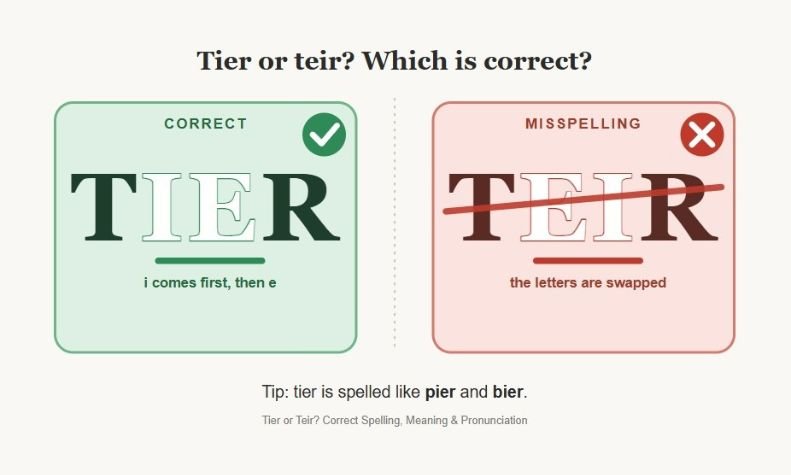
Tier or teir? The correct spelling is tier. A tier is a level, layer or rank in a series, as in a three-tier cake or a premium tier plan. It’s pronounced “teer” (/tɪər/), like ear with a t in front. “Teir” is a common misspelling, not the dictionary spelling.
Few spelling slips are as quiet as this one. “Teir” looks perfectly reasonable on the screen, and the word is short enough that nobody stops to check it. So here is the answer, and then the reasons it’s worth remembering: tier is the spelling, and it hides a few surprises, including a second word that is spelled the same and pronounced differently.
Tier or Teir? Which Spelling Is Correct
It’s t-i-e-r, with the i before the e. “Teir” doesn’t appear as a variant in the dictionaries I checked, so treat it as an error.
People usually land on “teir” because English spelling has trained them to distrust ie and ei. When you type quickly, the two letters also swap easily. The word sounds like “teer,” and nothing in that sound tells you which vowel comes first.
A trick that works for many learners: tier ends the same way as pier and bier, and all three rhyme with ear. If you can spell pier, change the first letter. (That’s a memory aid, not a spelling rule.)
What “Tier” Means
A tier is one level in a set of levels stacked or ranked in order. A wedding cake has tiers. So does a stadium, a pricing page and a company’s chain of command.
The word began with rows. Dictionary.com’s first sense is one of a series of rows or ranks rising one behind or above another, such as seats in an amphitheater, boxes in a theater, guns in a man-of-war, or oars in an ancient galley. That’s a vivid picture: a warship with its guns lined up in stacked rows, each row a tier. Encyclopedia.com’s historical citations include tiers of shipping moored together, of organ pipes, and of theatre boxes, so the word has covered lines of anything arranged one behind another for centuries.
From there it stretched to systems. Oxford Learners gives the modern sense as one of several levels in an organization or system, as in a two-tier system of management. And the word keeps spreading: a Wikipedia disambiguation page lists technology layers in multi-tier architecture, emission standards, ranks of suppliers, cake stands and tiered seating among its uses.
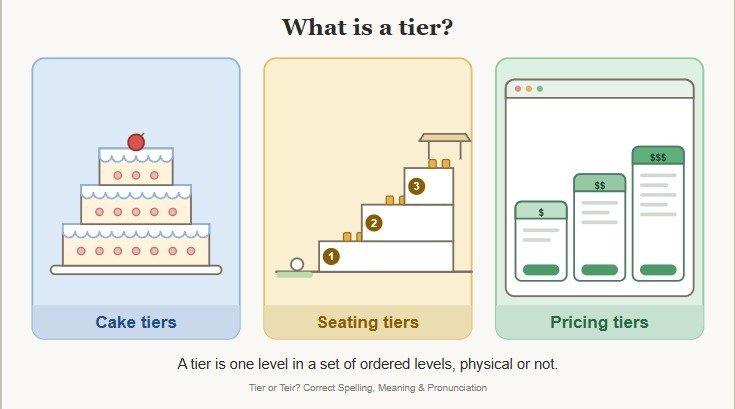
Cake tiers (blue): a three-tier wedding cake with scalloped icing, dots and a cherry on top.
Seating tiers (amber): a side view of stepped stands in three numbered levels (1, 2, 3), with seats along each step and a small canopy.
Pricing tiers (green): a browser window with three plan cards of increasing height, marked $,
Two more things worth knowing:
- Tier lists and “S-tier.” Online, a tier list sorts items (often video-game characters) into groups from best to worst. “S-tier” is the top group, and top-tier has leaked into everyday speech for “very good.”It started from Japan.
- Regional oddities. Dictionary.com also lists a regional Australian sense, “a mountain range,” and a separate entry, “tier” meaning a child’s apron or pinafore in New England. You’ll almost never see either, but they’re real entries.
The “tier 1” numbering trap
Here is the part dictionaries skip. The number attached to a tier does not tell you which end is better.
- In sports leagues, the first tier is normally the top division. Wiktionary’s example has a club playing in the second tier of English football before being promoted to the Premier League.
- In technical support, “tier 1” usually means the first-line, entry-level team, with higher numbers handling harder problems . Merriam-Webster’s recent examples include “tier one security analysts,” which sits far from “top tier.”
- In pricing, the “top tier” is usually the most expensive plan, while “tier 1” on a given page might be the cheapest. Check the page.
So when you see a tier number, look for the definition. The same phrase can mean opposite things in different fie

Chart showing that tier 1 can mean the top level, the entry level or the cheapest plan depending on the field
How to Pronounce “Tier”
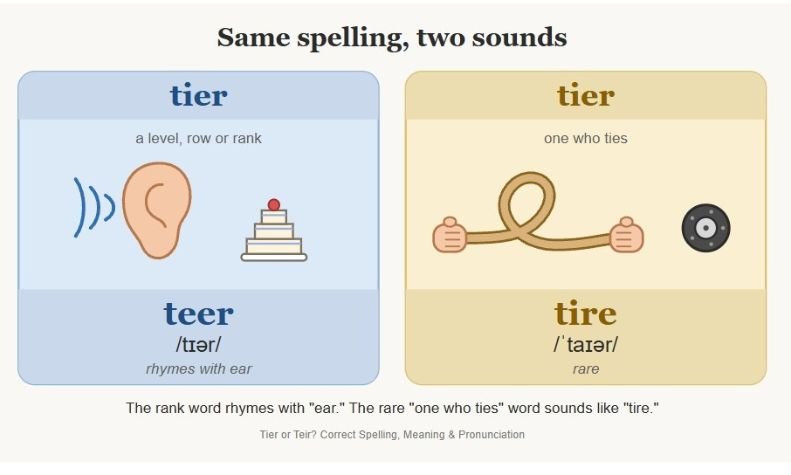
The usual word: teer (rhymes with ear, beer, clear). IPA: /tɪər/. Oxford Learner’s lists /tɪə(r)/ and /tɪr/, which correspond to the British and American forms .
The other word: English also has a second, rarer tier, meaning “one who ties” (a person who ties knots, or a fly tier who makes fishing flies). It’s pronounced like tire, /ˈtaɪər/. Merriam-Webster treats it as a separate entry with its own pronunciation, and Wiktionary notes it shares its sound with tire and tyre. It reads as tie plus -er, which fits the pronunciation.
To tell them apart, ask what the sentence is about. Levels, rows and ranks take “teer.” Someone tying something takes “tire.” In everyday writing, you’ll nearly always want the first.
Grammar of “Tier”
As a noun, tier is countable: one tier, three tiers. The theatre has two tiers of seating.
As a verb, to tier is regular, meaning to arrange in tiers or to rise in tiers.
| Form | Example |
| tier | They tier the shelves by size. |
| tiers | She tiers the cake carefully. |
| tiering | The tiering of fees confused customers. |
| tiered | The pricing is tiered. |
As an adjective, tiered describes things built in tiers: a tiered cake, a tiered pricing plan. Compounds usually take a number or top: a two-tier system, top-tier talent. Whether to hyphenate depends on your style guide.
Prepositions that pair with it:
- in tiers: The seats are arranged in tiers.
- on / at the (top) tier: She plays on the top tier of the league.
- across tiers: Fees vary across tiers.
- of: a tier of management.
Example Sentences
- Physical (written): The bakery’s wedding cake had three tiers, each a different flavour.
- Everyday: Tickets for the upper tier sold out in an hour.
- Business: Our app has a free tier and a paid tier with extra storage.
- Regulation: The council moved the area to a stricter tier of water restrictions.
- Casual / slang: Honestly, that burger is S-tier.
- Verb: The garden is tiered into three terraces.
- Formal: The proposal would create a two-tier system for approving research grants.
- The other word: He’s a fly tier, so his desk is covered in feathers and thread.
Synonyms for “Tier” and How They Differ
The word you choose changes what the reader pictures.
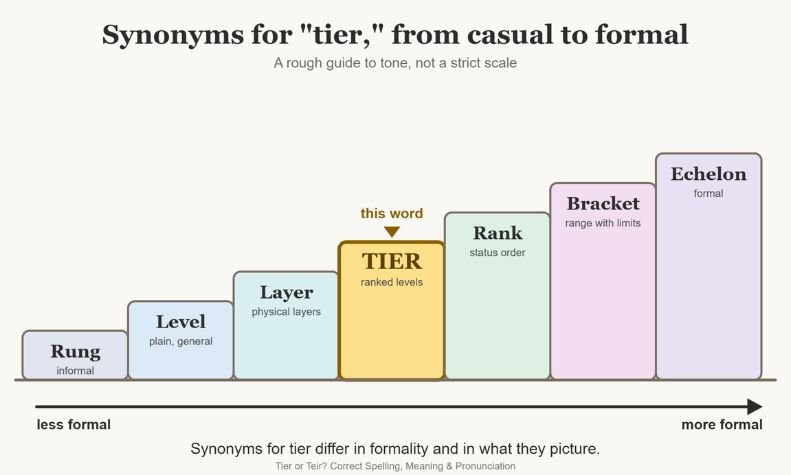
- Level: the plain, general choice. Levels can sit on a smooth scale, while tiers feel like separate, named steps.
- Layer: physical stacking, one thing on top of another.
- Rank: stresses status, and is most natural for people.
- Grade: suggests a measured quality, like grade A eggs or school grades.
- Bracket: a range with limits, as in tax or age brackets.
- Echelon: formal; a position within a command or social structure.
- Rung: informal; one step on a ladder you’re climbing.
- Stratum: formal or technical; a layer within society or rock.
A quick test: if you could number the levels and someone could be “in” one, tier fits. If you’re describing a smooth scale or a single step, the level is usually clearer.
Antonyms and Contrasts
“Tier” has no true opposite, but some ideas work against it:
- Flat structure: no levels. The startup runs a flat structure, with no tiers of management.
- Single level: one layer only. It’s a single-level building.
- Unranked: no order among items. The entries are unranked.
- Non-hierarchical: no ranking at all. They prefer a non-hierarchical team.
Where “Tier” Comes From
The rank word reached English from French. Oxford Learner’s gives the late 15th century, from French tire, “sequence, order,” from tirer, “to draw.” Wiktionary traces it through Middle French to Old French tire, probably from tirer. One reference describes the earlier Romance verb as of unknown origin.
Merriam-Webster dates its first known use to 1654. That’s later than “mid 16th century,” which can happen when one source dates the word’s arrival and another its earliest recorded example. Check the OED before you publish a date .
The “one who ties” word has its own history, so don’t assume the two are related.
Tier vs. Tear, Tire and Tyre
| Word | Sound | Meaning | Mix-up risk |
| tier (rank) | /tɪər/ | level, layer | spelled “teir” by mistake |
| tear (from the eye) | /tɪər/ | liquid from the eye | same sound as tier |
| tear (to rip) | /tɛər/ | to rip | different sound, same spelling |
| tire / tyre | /taɪər/ | wheel covering, or to get weary | sounds like the “one who ties” tier |
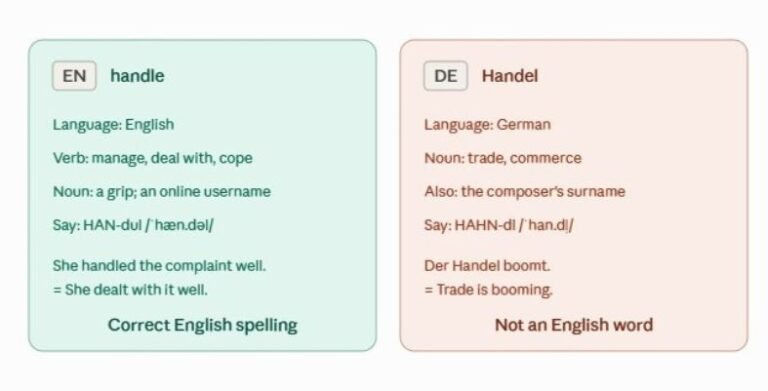
If a search for this word has ever shown you German pages, that’s because Tier is also a German noun meaning “animal” (as German dictionaries define it). It has no connection to the English word.
Common Mistakes with “Tier”
- Writing “teir.” Keep the i first: tier.
- Writing “teer” or “tire” for the rank word. Teer isn’t the standard spelling, and tire is a different word.
- Mixing it up with “tear.” They can sound identical, so spell-check won’t save you. Read the sentence to see whether it’s about eyes, ripping or ranks.
- Pronouncing it like “tire.” Unless someone is tying something, say “teer.”
- Assuming “tier 1” means best. See the numbering trap above.
- Dropping the hyphen before a noun. A two-tier system normally takes one [VERIFY].
| Mistake | Fix |
| the top teir | the top tier |
| a three teer system | a three-tier system |
| a tire of seats | a tier of seats |
Frequently Asked Questions
Is it “tier” or “tier”?
The correct spelling is “tier,” with the i before the e. “Teir” is a common misspelling, and it isn’t listed as a variant in the dictionaries checked for this guide. A simple memory aid is that “tier” is spelled like “pier” and “bier,” which share the same ending and sound.
How do you pronounce “tier”?
Say “teer,” which rhymes with “ear” and “beer.” In IPA it’s /tɪər/. A rarer, separate word spelled “tier” (one who ties) is pronounced like “tire” (/ˈtaɪər/). You’ll meet the “teer” word far more often, so use it unless the sentence is about tying something.
What does “S-tier” or “top-tier” mean?
“Top-tier” means belonging to the highest level of a ranking, so it describes the best examples of something. “S-tier” is used on gaming-style tier lists, where “S” marks the top group, above A, B and lower letters. Both are informal outside business writing, so use them carefully in formal documents.
What is the difference between “tier,” “level,” and “rank”?
“Level” is the most general word for a step or layer. “Tier” suggests ordered levels within a defined structure, such as theatre seating or software pricing. “Rank” stresses status or order, and is most often used for people. Choose “tier” when the levels are part of a set system, and “level” when you simply need a neutral word.
Is it “two-tier” or “two tier”?
Before a noun, writers usually hyphenate the compound: “a two-tier system.” After the noun, many writers drop the hyphen, as in “the system is two tier,” though some keep it. Style guides differ on this, so follow the one your publication uses, and keep your choice consistent throughout a single document.


One Comment