
Entail vs Intail: Which Spelling Is Correct? Meaning, Examples and Origin
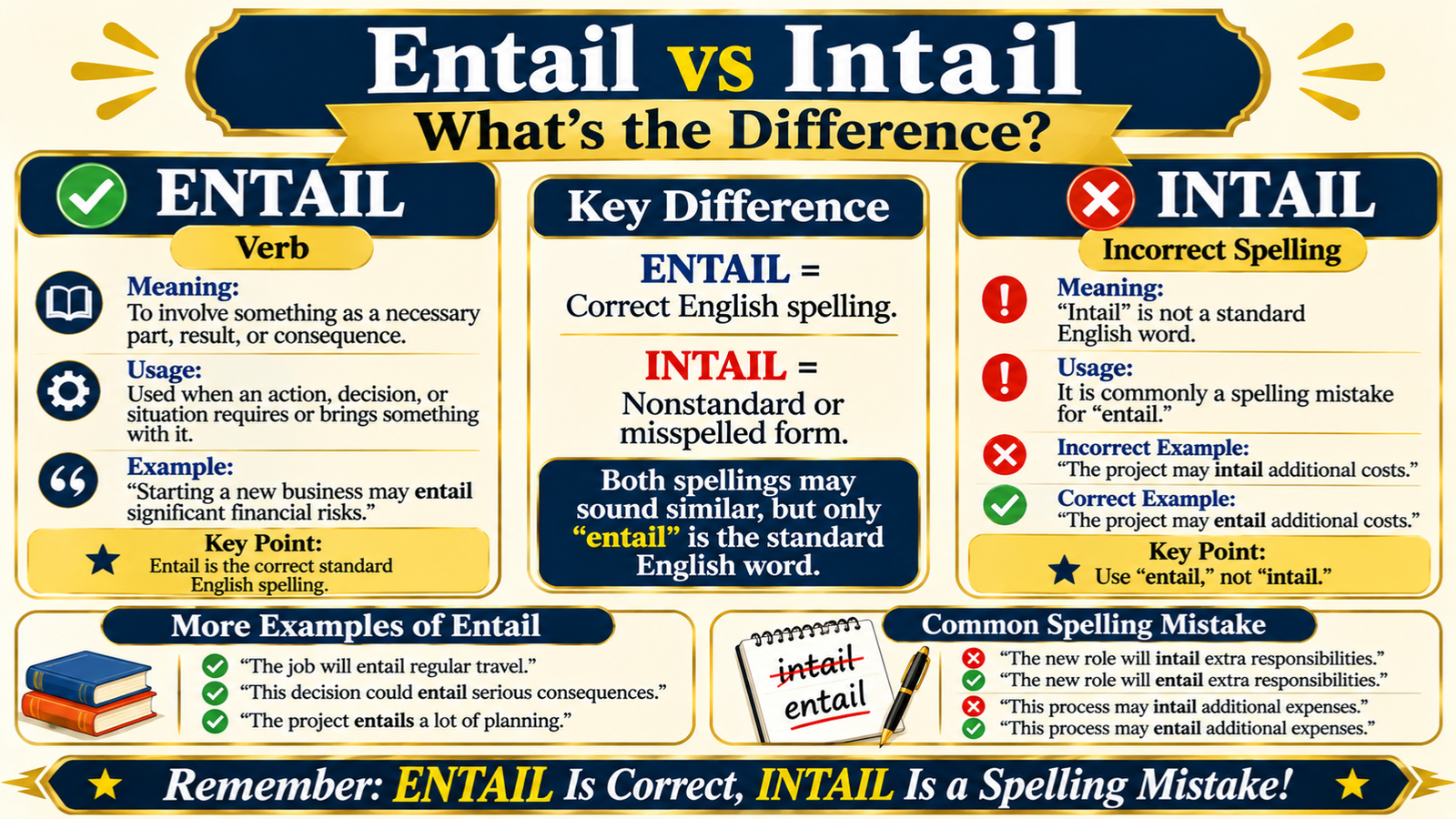
Quick answer: Write entail. In modern English “intail” is a misspelling. The only place it turns up is as an archaic form of entail in Wiktionary, which is not something you should copy into an essay, a report or an email. Entail is a verb meaning to have something as a necessary result or requirement, as in “The job entails a lot of travel.” Start the word with en- and you are right every time.
If you typed entail vs intail into a search bar, your spell-checker probably underlined something in red and you want a straight answer. You have it above. The rest of this entail vs intail guide covers what the word means, where it comes from, why so many people reach for the wrong first letters, how to use it in real sentences, and how it differs from look-alikes such as imply and involve. There is a short self-test at the end if you want to check that it stuck.
I have corrected this slip in more student drafts than I can count, and it is almost never carelessness. It is a reasonable guess that happens to be wrong. Once you see why, the mix-up tends to disappear for good.
Entail vs Intail: The Quick Answer in Plain English
Here is the whole matter in one breath. The verb is spelled e-n-t-a-i-l. The form i-n-t-a-i-l is not part of modern English.
So the entail vs intail question has a one-sided answer. You are not choosing between two spellings of equal standing, the way you would with colour and color. You are choosing between the living word and a leftover from older English that nobody uses today.
Mainstream reference sites agree. Vocabulary.com lists entail as a verb with the forms entailed, entails and entailing. Dictionary.com, when you search for “intail”, simply shows you results for entail and offers no separate entry. If you write “intail” in your own work, a reader will see an error.
The practical rule for entail vs intail is short: whenever you mean “to involve as a necessary result”, write entail.
What Does Entail Mean?
Entail is a formal verb with a small family of related meanings. The core idea is that one thing brings another thing along with it, whether you wanted it or not.
Vocabulary.com gives the main senses as “have as a logical consequence” and “impose, involve, or imply as a necessary accompaniment or result.” In everyday English that means: if X happens, Y comes with it.
Here is how that plays out.
- Requirement. Running a restaurant entails long hours. The long hours are not optional. They come with the job.
- Necessary result. Cutting the budget will entail some painful decisions. The decisions follow from the cut.
- Logical consequence. Accepting that argument entails accepting its conclusion. One cannot be true without the other.
A good test is to swap in “necessarily involve” or “bring with it.” If the sentence still makes sense, entail is the right word.
Entail with a direct object
Entail is a transitive verb. It needs something to act on, and that something is its direct object. You entail something.
- The new rule entails extra paperwork. (object: extra paperwork)
- Becoming a nurse entails years of training. (object: years of training)
- The plan entails moving the whole team. (object: moving the whole team)
You cannot leave it hanging. “The job entails” is an unfinished sentence, in the same way “She bought” is unfinished. Readers wait for the object.
The object can be a noun, as in “extra paperwork”, or a gerund, as in “moving the whole team.” In more formal or logical writing you will also see a that-clause: “This entails that the first claim is false.”
The trailing “that entails” pattern
There is one more pattern worth recognising, because it looks as though the object has gone missing. In sentences like “He has sat through twenty inspections, with all the anxiety that entails,” the object has moved to the front. The thing being entailed is “all the anxiety”, and the verb comes at the end of its clause.
This is a natural, slightly literary construction. It lets a writer say “and everything that comes with it” in two words. You will meet it often in journalism and essays, and it is perfectly correct, even though no noun follows the verb.
Entail in business and academic writing
Because entail sounds formal, it shows up in reports, proposals, essays and documentation more than in casual chat. A few natural uses:
- A project proposal might say that the migration “entails a two-week freeze on new features.”
- A job description might read, “The role entails managing a small team and reporting to the director.”
- An academic paper might note that a certain method “entails significant computing costs.”
In speech, most people reach for plainer words like “involves” or “means.” That is fine. Entail earns its place when you want to stress that something is unavoidable.
Entail in scientific and medical writing
If you read research papers, you will notice that entail is everywhere in methods sections. A procedure “entails” a series of steps, a treatment “entails” certain risks, a finding “entails” further questions. Writers like it there because it signals that each step follows necessarily from the one before.
Some natural examples in that register:
- The protocol entails two rounds of sampling, a week apart.
- This approach entails a trade-off between speed and accuracy.
- Early surgical techniques entailed long recovery periods.
- A rigorous trial entails careful record-keeping from the first day.
You do not have to write like a journal to use the word well, or to get entail vs intail right. Just keep the meaning in mind: the second thing is a necessary part of the first.
Is Intail a Word?
In modern English, no. A mainstream dictionary will not give you “intail” as a current word, and Dictionary.com has no entry for it. If it turns up in a draft, the writer meant entail.
There is one honest footnote. Wiktionary does list “intail” as a verb labelled archaic, with the single definition “archaic form of entail.” So it is not a made-up string of letters. It is an old spelling that fell out of use, the way many older spellings have.
That footnote changes nothing for your writing. An archaic spelling is not a variant you can choose, any more than you can choose “olde” for “old” in a business email. It carries no separate meaning, no regional use, and no modern standing.
So when someone asks “is intail a word?”, the honest answer on entail vs intail is: it was once an old spelling, it is not used now, and in current writing it counts as a mistake. If you ever need to claim that a historical text used “intail”, name the exact source and edition, because a general statement like “it was used long ago” is not something a reader can check.
Where Entail Comes From
The history of the word explains both its meanings and its spelling, and it is more colourful than you might expect.
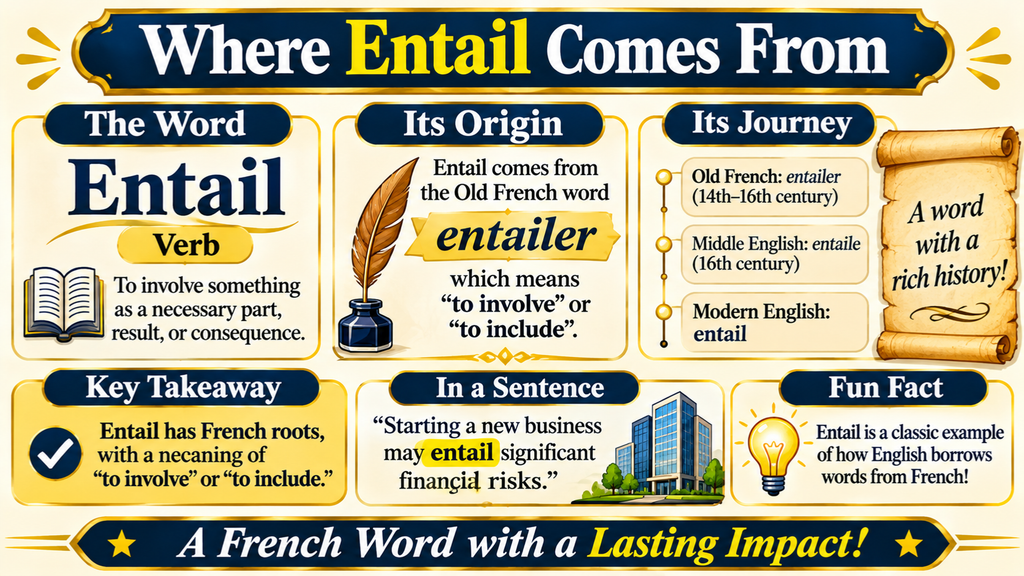
Webster’s 1913 dictionary traces entail to Old French entailler, “to cut”, built from the prefix en- and the verb tailler, “to cut.” The same root gives us tailor, a person who cuts cloth, and the legal sense of tail as a limitation or cut-off point.
That cutting sense explains the oldest uses. Webster’s entry records, as obsolete, a noun meaning “delicately carved ornamental work”, the kind of carving that English also calls intaglio, and a verb meaning “to cut or carve in an ornamental way.” Writers once spoke of carved work as “entailed”, meaning cut into the surface.
The legal sense grew from the same idea. To entail an estate was to cut off the owner’s freedom to sell it or divide it, and to fix it on a particular line of heirs instead. Webster links this to the medieval Latin phrase feudum talliatum, a fee that is “cut” or limited, and that is where the old legal term fee tail comes from.
The modern sense, “to have as a necessary result”, is a later extension. If an estate is entailed, certain things follow from it and cannot be undone. Over time, writers began saying that any action entails its consequences, and the figurative sense took over.
A neat bonus for anyone puzzling over entail vs intail: because intaglio is a different word that also sounds a bit like “in-” plus “tail”, it may add to the confusion. They are distinct. Intaglio is an art term for a design cut into a surface. Entail is the verb you want for consequences.
Why People Write Intail (the En-/In- Trap)
If “intail” is wrong, why does it look so right? Several things are working against you at once.
The sound is nearly identical. In the unstressed first syllable, en- and in- are hard to tell apart in many accents. Say “entail” quickly and the first syllable can sound like “in”. Some pronunciation listings even give /ɪnˈteɪl/ alongside /ɛnˈteɪl/ for the word. Your ear reports “in-tail”, and your hand writes what your ear heard.
“In” is the more familiar prefix. English is full of words that begin with in-: include, inform, insist, invent. Your brain has seen in- thousands of times, so it fills the gap with the familiar option.
The meaning nudges you toward “in”. Entail is about something being contained within a result, a requirement that is built in. That picture of “inside” quietly pulls toward the in- spelling.
An old spelling still lingers. Because “intail” really was written in older English, it still surfaces in old texts and in some word lists, which can make it look more legitimate than it is.
Neighbouring words muddy the water. English has several pairs where en- and in- really do compete, so people reasonably assume entail might be one of them. It is not.
The entail vs intail trap is real, and falling into it says nothing bad about your spelling. It says you are using a reasoning pattern that works often enough to feel trustworthy.
Other en-/in- pairs worth knowing
Because the prefix causes so much grief, here are the pairs that behave differently from each other.
- Ensure vs insure. Ensure means to make certain. Insure usually refers to insurance, especially in American English. Assure means to promise or reassure someone.
- Enquire vs inquire. Both are accepted. British English often uses enquire for a general question and inquire for a formal investigation, while American English leans toward inquire for both.
- Enclose vs inclose. Enclose is the standard form. Inclose appears in some dictionaries as a rare variant.
- Endorse vs indorse. Endorse is standard. Indorse is a rare variant that you may meet in older or specialised financial and legal writing.
Notice the pattern. In every pair, the en- spelling is the common one, and the in- spelling is either a distinct word with a different meaning, as with insure, or an uncommon variant. “Intail” belongs in the second group at best, and that is why none of these pairs gives it a free pass in the entail vs intail debate.
If you enjoy this type of spelling puzzle, our guides on existence vs existance and vacuum vs vaccum walk through two more cases where one version is simply a common misspelling, and proove or prove does the same for a verb that people respell by ear.
Entail vs Intail: Side-by-Side Table
| Entail | “Intail” | |
| Status today | Standard English word | Not used; counts as a misspelling |
| Historical status | Old French entailler, “to cut” | Archaic spelling of entail (per Wiktionary) |
| Part of speech | Verb (also a rare noun for an inherited estate) | Archaic verb form only |
| Forms | entail, entails, entailed, entailing; noun: entailment | None worth using |
| Meaning | To have as a necessary result or requirement; to limit an inheritance | No separate meaning |
| Should you use it? | Yes | No |
| Pronunciation | en-TAIL (stress on the second syllable) | n/a |
| Example | The role entails some travel. | Never write: The role intails some travel. |
One small point on pronunciation before we leave the entail vs intail table. Vocabulary.com marks the verb as /ɛnˈteɪl/, which in plain English is en-TAIL, with the stress on the second syllable. The rare noun sense, meaning land passed down under restrictions, shifts the stress to the first syllable: EN-tail. Most of the time you will only need the verb.
How to Use Entail in a Sentence
Examples teach the word faster than definitions do, and they make the entail vs intail choice feel obvious. Here are original sentences across different settings. Notice how each one has an object right after the verb, except for the trailing pattern.
At work
- The promotion entails managing three more people.
- Launching in a new country entails new tax and legal rules.
- Her job entails a lot of late-night phone calls.
- Switching software will entail retraining the whole department.
- This contract entails a monthly report to the client.
- Being a team leader entails hard conversations as well as good ones.
At school and university
- Writing a thesis entails months of reading before you type a word.
- The course entails two lab sessions every week.
- Learning a language properly entails daily practice.
- The experiment entailed repeating the test five times.
- Getting a scholarship usually entails maintaining high grades.
- Peer review entails waiting, sometimes for months.
In everyday life
- Owning a dog entails early walks, whatever the weather.
- Moving house entails more boxes than you ever thought you owned.
- Hosting a wedding entails dozens of small decisions.
- Training for a marathon entails giving up some weekend lie-ins.
- Running a small shop entails being the cleaner, the cashier and the accountant.
- Learning to drive entails a lot of patience, from the learner and the instructor.
In news and formal writing
- The new law entails stricter safety checks for all vehicles.
- Rebuilding the bridge will entail closing the road for a year.
- The merger entailed the loss of several hundred jobs.
- Any serious climate plan entails changes in how energy is produced.
- The policy shift entails risks that the committee has not fully studied.
- Hosting the tournament would entail building two new stadiums.
In science and medicine
- The protocol entails two rounds of sampling, a week apart.
- This approach entails a trade-off between speed and accuracy.
- Early surgical techniques entailed long recovery periods.
- A reliable trial entails careful record-keeping from day one.
With past, continuous, passive and trailing forms
- The repairs entailed much more work than the owner expected.
- Nobody realised what the decision was entailing until the bills arrived.
- The conclusion is entailed by the two premises. (a logical, passive use)
- She took over the family business, with all the responsibility that entails. (trailing pattern)
Read a few of these aloud, and the entail vs intail question will feel settled. You will also hear that entail is never casual. It has a slightly weighty feel, which is exactly why it suits formal sentences.
Verb Forms: Entails, Entailed, Entailing, Entailment
Once you have settled entail vs intail, the rest is easy, because entail is a regular verb.
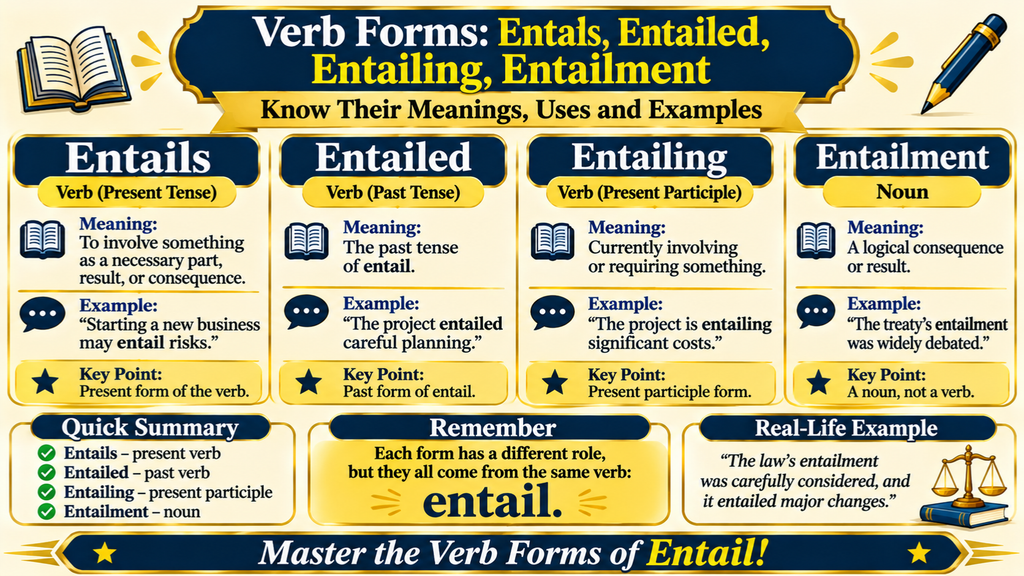
- Base form: entail
- Third person singular: entails
- Past tense: entailed
- Past participle: entailed
- Present participle and gerund: entailing
- Noun: entailment
The past tense is simply entailed. There is no irregular twist to memorise. If you ever feel unsure about irregular past forms in general, our guide on lyed or lied shows how tricky some verbs can get, and why entail is mercifully straightforward by comparison. If you also stumble on how regular past tenses are spelled, happened vs happend covers a common slip with the -ed ending.
Entailment is the noun form. It appears mostly in logic and philosophy, where it describes the relationship between a statement and what must follow from it. In everyday writing, you rarely need it.
A quick note on a useful pair. Entailing works as a participle that adds information to a noun: “a procedure entailing several risks.” Entailed does the same job in the past: “a procedure entailed by the new rules.” Both are natural in formal writing, and both keep the same en- spelling.
Entail vs Imply vs Involve
Three words, three different jobs. People swap them constantly, so this comparison is worth a few minutes.
Entail vs imply
Entail is strong and certain. If A entails B, then B has to follow. There is no wiggle room.
Imply is softer. To imply something is to suggest it or hint at it without saying it outright, and the listener may or may not pick it up. A speaker can imply something. A statement can imply something. Vocabulary.com even lists imply as a synonym of entail in the logical sense, but in ordinary speech the two feel quite different.
- Her silence implied that she disagreed. (A hint. She might simply be tired.)
- Being a bachelor entails being unmarried. (No hint. It is built into the meaning.)
A handy test: can the result be wrong? If yes, use imply. If the result is guaranteed, entail fits.
Entail vs involve
Involve means to include something as part of a situation. It is broader and gentler. Entail says the thing is a necessary consequence or requirement.
- The project involves three teams. (They are part of it.)
- The project entails a fixed deadline. (The deadline comes with it and cannot be avoided.)
If you only mean “includes”, involve is the safer word. Reach for entail when you want to stress that something follows unavoidably.
Entail vs require
Require looks at the situation from the other direction. A thing requires something it needs in order to happen. A thing entails something that comes along because it happened.
- Baking bread requires flour. (Flour is needed first.)
- Baking bread entails a hot, floury kitchen. (The mess comes as a result.)
In many sentences the two are interchangeable, and nobody will mind. In a careful piece of writing, pick the one that points the way you mean.
If you like seeing how near-neighbour verbs split apart, our guide on reckon vs value does the same job for another pair that learners mix up, and odious vs repugnant is a good next read if formal vocabulary is your goal.
Synonyms and Related Words
Entail has plenty of relatives, though none is a perfect match.
- Involve: to include as part of something.
- Require: to need as necessary.
- Necessitate: to make something necessary. More formal than require.
- Demand: to call for strongly.
- Mean: to have as a result. The plainest everyday substitute.
- Result in: to lead to as an outcome.
- Imply: to suggest or have as a logical consequence.
- Call for: to need or deserve.
- Carry with it: a plain-English phrase for the same idea.
Pick the one that fits your register. Whichever you choose, the entail vs intail rule stays the same: start with en-. In a formal report, necessitate or entail sound right. In an email to a colleague, “involves” or “means” is friendlier.
Entail in Law and Logic
Two specialised senses of entail are worth knowing, even if you will rarely use them. Neither changes the entail vs intail answer.
The legal sense of entail
Historically, to entail property meant to fix who could inherit it, so that the estate passed down a set line of heirs and could not be sold or divided freely. Vocabulary.com describes this sense as limiting the inheritance of property to a specific class of heirs, and it lists the old legal term fee tail as a synonym. The noun entail refers to land received this way, or to the act of entailing it. Webster’s 1913 entry for the noun gives it the same two shades: an estate limited in descent to a particular class of heirs, and the rule that fixes how the descent runs.
If you have read classic English novels, you may have met entailed estates. In Jane Austen’s Pride and Prejudice, for example, the Bennet family’s property is entailed away from the daughters, which is why the family’s future feels so uncertain.
Modern law in many countries has abolished or heavily limited entails, so this sense now lives mostly in history, literature and the legal terminology of certain jurisdictions. This is background only, not legal advice. If you have a real question about an inheritance, ask a qualified lawyer.
Entailment in logic
In logic and philosophy, one statement entails another when the second must be true whenever the first is true. The noun for this relationship is entailment.
Here is a simple example:
- “Tom is a bachelor” entails “Tom is unmarried.”
You cannot accept the first statement and reject the second without contradicting yourself. That is the strong, no-exceptions sense of the word, and it is the reason entail feels stricter than imply.
Pronunciation
Say it as en-TAIL, with the stress on the second syllable, rhyming with detail. The first syllable is light, closer to “en” than “in” if you want to keep the spelling clear in your head.
For the noun sense (an inherited estate), the stress moves to the front: EN-tail. If you are speaking, the verb is the one you will use nine times out of ten.
Here is a trick that helps writers who keep tripping on entail vs intail. Deliberately pronounce the first syllable as a clear “en”, just once, while you spell the word. That small exaggeration can cement the correct letters, even if your everyday speech softens the vowel.
Common Mistakes
A few errors come up again and again.
Writing “intail.” The big one in any entail vs intail check. The correct word is entail.
Leaving out the object. “The job entails.” Entails what? Add the object: “The job entails weekend work.” (The only exception is the trailing pattern, “with all the stress that entails.”)
Using “entail” when you mean “imply.” If the result is only suggested and not guaranteed, imply is the better word.
Writing “entails of” or “entail to.” Entail takes a direct object with no preposition. Say “The role entails travel,” never “The role entails of travel.”
Overusing it. Entail is a formal word. Used in every second sentence, it makes writing stiff. Save it for places where “necessarily involves” is exactly what you mean.
Mixing it up with “intaglio.” This is a second trap sitting next to entail vs intail. The two sound faintly alike, but intaglio is an art term for a design cut into a surface, and it has nothing to do with consequences.
Mixing up the noun and the verb stress. Not a spelling error, but worth a note if you speak publicly: the verb is en-TAIL, and the noun for an estate is EN-tail.
If you tend to slip on word endings and plurals in general, our guides to class or classs and experience vs experiences are good next reads, and sell vs sale shows how a verb and its related noun split apart.
Memory Tricks
Entail vs intail advice only helps if you can recall it when you are writing at speed. Here are four tricks, and then my honest pick.
1. Hide “ent” inside “entail”. Say “e-n-t-a-i-l, ent-ail.” The little letter group ent sits at the front, not int.
2. Link it to “entire”. An entailed result comes along with the entire package. Both start with ent-, and both are about something being bundled together.
3. Think “en” for “enforced”. What a thing entails is something you cannot avoid, almost as if it were enforced. En- at the start of both words keeps the connection.
4. Picture “tail”. Imagine the tail of a kite: whatever you attach to the end of the sentence has to follow behind. The -tail ending stays the same, so only the front needs attention. If you know the history, this trick has a bonus: the tail in entail really does mean “cut”, as in tailor.
My own pick is the first one. It is the simplest, and it fixes the exact spot where the mistake happens. A student once told me that she just whispers “e-n-t” every time she writes the word. It sounds silly, but it worked within a week.
Quick Self-Test
Try these entail vs intail questions before you scroll to the answers. Each sentence has a gap or a choice.
- The new job (entails / intails) a long commute.
- Which word is correct: entailed or intailed?
- Fill the gap: “Owning a house __ a lot of repairs.”
- True or false: “Intail” is the British spelling of entail.
- Which is stronger, imply or entail?
- Complete the sentence: “She took the promotion, with all the stress that ____.”
- What is the noun that means a logical consequence relationship?
- Pick the better word: “Baking bread (requires / entails) flour.”
Answers. 1) entails. 2) entailed. 3) entails. 4) False. It is not a British variant, and in modern English it is not used at all. 5) Entail, because the result is guaranteed. 6) entails (the trailing pattern). 7) entailment. 8) requires, since flour is needed first. Entails would reverse the direction.
If you got seven or eight, entail vs intail is no longer a problem for you. If you missed two or three, reread the entail vs imply section and try again.
FAQs
Is it entail or intail?
In the entail vs intail question, it is entail. “Intail” is a misspelling in modern English, and the only place it appears is as an archaic form listed in Wiktionary. The correct word begins with en- and means to have something as a necessary result, as in “The job entails long hours.”
Is intail a word?
Not in modern English. Dictionary.com has no entry for it, and Wiktionary labels it an archaic form of entail. It is a common misspelling, probably because the en- and in- prefixes sound alike. If you spot it in a draft, replace it with entail, entails, entailed or entailing.
What does entail mean?
To entail something is to have it as a necessary result or requirement. If a job entails travel, travel is built into the job. Dictionaries also give a logical sense, “have as a logical consequence”, and an older legal sense about restricting who inherits property.
How do you use entail in a sentence?
Put a direct object right after it: “Owning a car entails paying for insurance.” The object can be a noun or a gerund, as in “The plan entails moving offices.” Do not add a preposition, and do not leave the verb dangling unless you are using the trailing pattern, “all the stress that entails.”
What is the difference between entail and imply?
Entail means the result is certain and necessary. Imply means the result is suggested or hinted, and it might not hold. “Being a bachelor entails being unmarried” is certain. “His tone implied he was unhappy” is only a suggestion.
What is the difference between entail and involve?
Involve means include as part of something. Entail means bring along as an unavoidable result or requirement. “The trip involves two flights” tells you what is part of it. “The trip entails a long layover” tells you what you cannot avoid.
What is the past tense of entail?
The past tense is entailed, and so is the past participle. Entail is a regular verb, so there is nothing irregular to memorise: “The repairs entailed more work than expected.” The present participle is entailing.
What is the noun form of entail?
The usual noun is entailment, mostly used in logic to describe what follows from a statement. Entail itself also exists as a rare noun for land inherited under restrictions, with the stress on the first syllable: EN-tail.
How do you pronounce entail?
Say en-TAIL, stress on the second syllable, rhyming with detail. Vocabulary.com marks it /ɛnˈteɪl/. For the rare noun meaning an inherited estate, the stress shifts forward to EN-tail, but you will almost always need the verb.
What are synonyms for entail?
Common ones are involve, require, necessitate, mean, demand, result in and, in logic, imply. None matches perfectly. Choose by tone: mean and involve for casual writing, necessitate and entail for formal pieces.
Why do people confuse en- and in-?
Mostly because, in entail vs intail and similar pairs, the unstressed first syllables sound alike, and in- is the more familiar prefix. Add the “inside” feeling of entail‘s meaning, and the wrong spelling looks natural. The mix-up says more about how English sounds than about anyone’s skill.
How can I remember the spelling of entail?
For entail vs intail, spell it out loud once: e-n-t, ent-ail. Pairing it with entire also helps, since both start with ent- and both suggest a bundled whole. Pick whichever trick you can recall mid-sentence, because the best one is the one you will actually use.
Does entail need an object?
Yes, with one exception. Entail is transitive, so it needs a direct object, such as a noun or a gerund. “The role entails travelling” works. “The role entails” does not. The exception is the trailing pattern, “with all the stress that entails,” where the object has moved to the front.
What does entailment mean in logic?
Entailment is the relationship where one statement guarantees another. If A entails B, B must be true whenever A is true. “Tom is a bachelor” entails “Tom is unmarried.” It is the strict, no-exceptions cousin of ordinary implication.
What does entail mean in law?
In law, to entail property meant to restrict inheritance to a specific line of heirs, so the estate could not be freely sold or divided. The old term for it is fee tail. Many countries have since limited or abolished it. This is background, not legal advice.
Where does the word entail come from?
Whichever side of entail vs intail you started on, the word comes from Old French entailler, “to cut”, built from en- and tailler, the same root as tailor. Webster’s 1913 dictionary notes older senses to do with ornamental carving. The legal sense of restricting an estate, and later the figurative sense of a necessary result, grew from that idea of cutting.
Is intail ever correct?
In the entail vs intail question, only as a historical curiosity. Wiktionary records it as an archaic form of entail, but no modern dictionary treats it as a spelling to use. In essays, emails, reports and exams, write entail.
Final Thoughts
The entail vs intail question has an easy, one-sided answer: entail is the word, and “intail” is a leftover spelling that counts as a typo today. It starts with e-n-t, it takes a direct object, it means “to have as a necessary result”, and it is a regular verb with no tricks hiding in its past tense.
If you remember only one thing about entail vs intail, remember the front of the word. Hold on to ent-, link it to entire if that helps, and the rest of the word looks after itself. Everything else, from the carving history to the logic sense, is a bonus.
And the next time your spell-checker draws a red line under a word, treat it as a prompt to check, not as an insult. Even confident writers trip over en- and in-.
Entail vs intail sorted? Want to sharpen another pair before you close the tab? Pick your next one from our Vs guides or browse the spelling guides and fix your next mistake in under two minutes.

One Comment