
Clarify vs Verify: What’s the Difference? Meaning, Examples and Uses
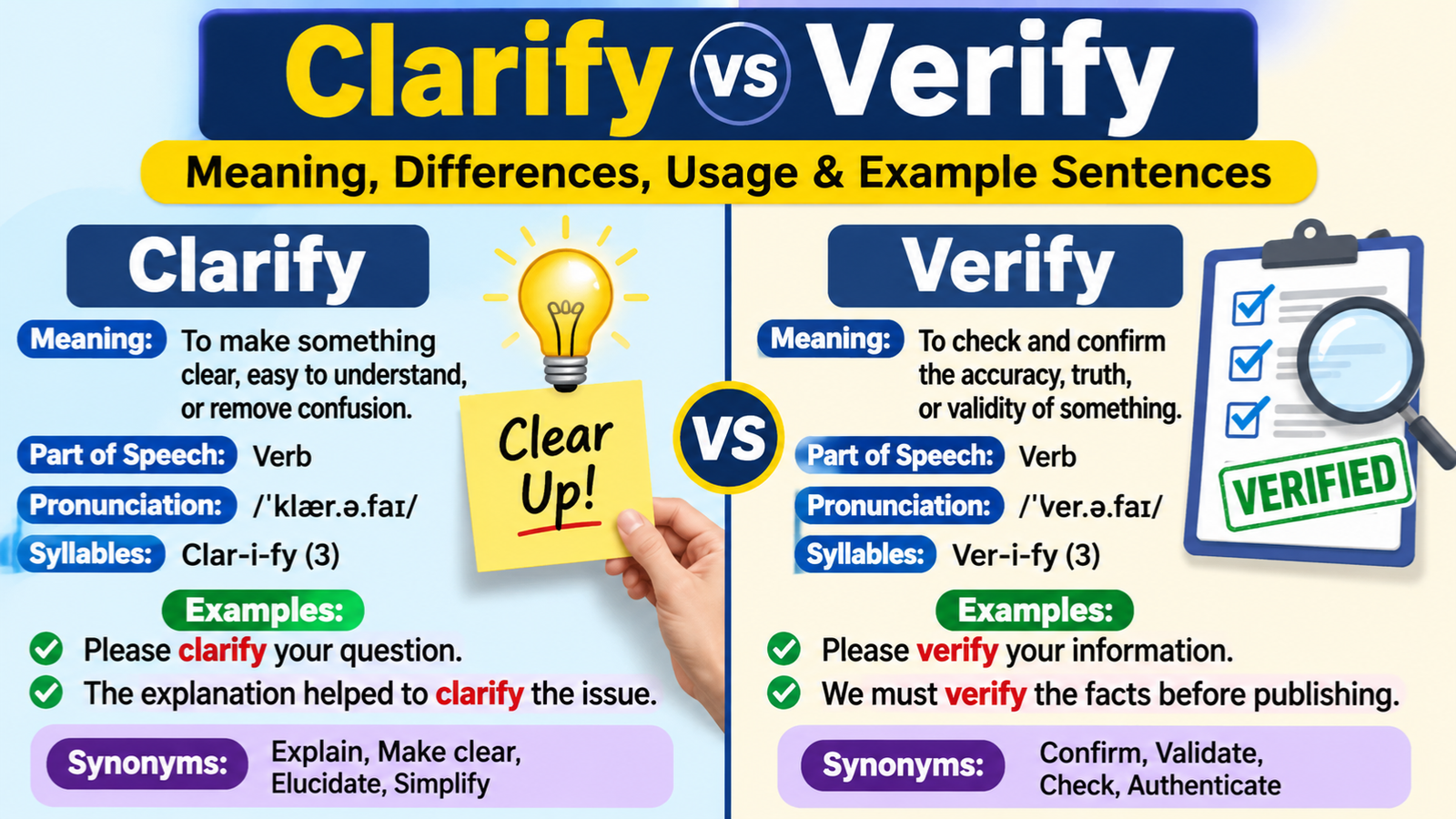
Quick answer: Clarify means to make something clearer when it is confusing or vague. Verify means to check that something is true or accurate. You clarify an unclear instruction and you verify a doubtful claim. One removes confusion, the other removes doubt.
Both words turn up when someone is unsure about something, which is why they get swapped. The fix for that unsureness is different, though, and so is the job your reader walks away to do. The clarify vs verify choice looks small, but it decides whether the other person explains something or checks something.
This guide gives you the definitions, 24 plain-English example sentences, a one-table comparison, a five-second test, the mistakes people really make, and a short practice round at the end.
The difference in one line
Clarify fixes confusion about what something means. Verify fixes doubt about whether something is true.
Say a colleague writes, “The report is due Friday.” Maybe you can’t tell whether that means Friday morning or Friday at midnight. You ask them to clarify. Or maybe the project calendar says Thursday and you suspect the date is wrong. You verify it. Same sentence, two different problems.
So before you pick a word, ask what exactly is bothering you. Not understanding points to clarify. Not trusting points to verify.
What “clarify” means
To clarify is to make something easier to understand by removing vagueness, confusion or ambiguity. The word comes from the Latin clarus, meaning clear, and the family resemblance is still visible: clarify, clarity, clear.
The oldest sense is physical. Older dictionaries list it first: to make a liquid clear by removing impurities. That is why you see clarified butter on a menu, which is butter with the milky solids taken out. Today almost everyone uses the word for meaning rather than liquids.
You can clarify your own words (“Let me clarify what I meant”) or ask someone else to clarify theirs (“Could you clarify the second point?”). Nobody is checking whether the statement is right. The only question is what it says.
Grammar is simple. Clarify usually takes an object (clarify a rule, clarify a misunderstanding) or a clause (clarify that, clarify what, clarify whether). It can also work without an object when something becomes clear on its own: “After the second meeting, the picture clarified.” The forms are clarifies, clarified and clarifying, and the noun is clarification. Watch the spelling. “Clarifyed” is a slip, the same kind of trap that produces “lyed” for “lied” in our guide to lyed or lied.
Common pairings: clarify a rule, clarify your position, clarify the terms, clarify a policy, clarify a statement, clarify the requirements.
What “verify” means
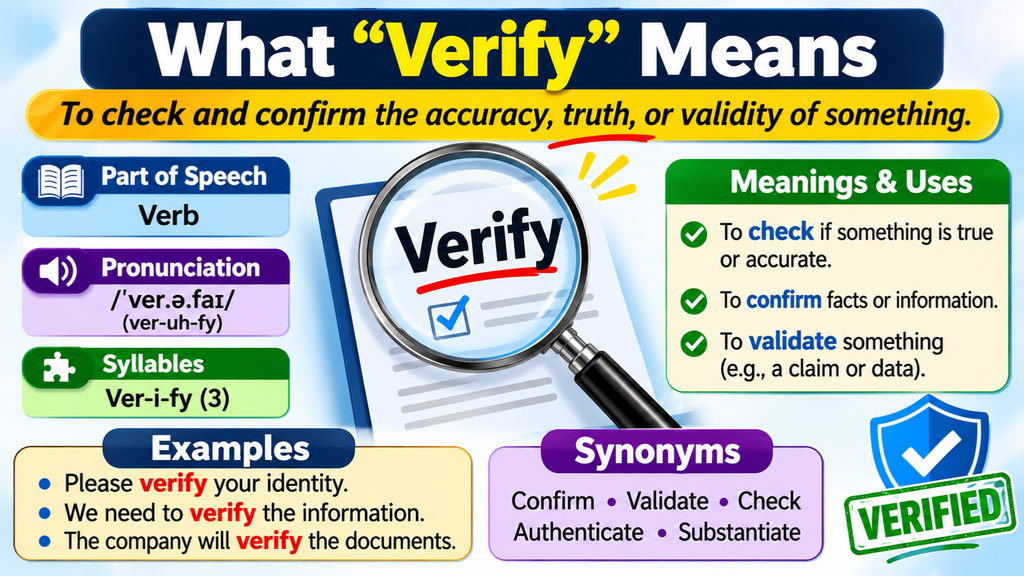
To verify is to check that something is true, accurate or genuine. It comes from the Latin verus, meaning true, the same root hiding inside verdict and veracity.
Verifying is an action with an outcome. You look at evidence, compare sources or run a test, and you end up able to say “yes, that is correct” or “no, it isn’t.” People verify a claim, an address, a quote, a signature, a result. The noun is verification, the past tense is verified, and the -ing form is verifying. “Verifyed” is wrong for the same reason “clarifyed” is.
Typical patterns are verify that, verify whether, verify with a source and verified by. In science and software the word has a precise use: verification asks whether you built something correctly against its specification, while validation asks whether it is the right thing for its users. That split is why verify vs validate keeps showing up in technical writing.
You have met the word on screens too. “Verify your email” means the site wants proof that the address is real and belongs to you. A verified badge next to a name usually means the platform has checked who runs the account. Neither asks you to explain anything. Both are checks.
The two words side by side
| Clarify | Verify | |
| Meaning | Make something clearer | Check that something is true |
| Purpose | Remove confusion | Remove doubt |
| What you do | Explain, rephrase, add detail | Check sources, compare, test |
| Related noun | Clarification | Verification |
| Typical sentence | “Could you clarify what you mean?” | “Please verify the invoice number.” |
| Typical context | Instructions, meetings, unclear messages | Facts, data, identity, accounts |
The table covers most cases. A quick test covers the rest.
A five-second test
Take the sentence “Please ___ the refund policy.” If the reader’s problem is that the policy is confusing, “make it clear” fits, so the word is clarify. Now take “Please ___ the refund amount.” If the worry is that the number might be wrong, “check that it is correct” fits, so the word is verify.
Honestly, the clarify or verify decision rarely needs more than that. If a memory hook helps: clarify has “clar” in it, as in clear. Verify has “ver” in it, as in verdict, a statement about what is true. Silly, but it sticks.
Clarify example sentences
Everyday use:
- Can you clarify whether the party starts at seven or seven-thirty?
- She clarified that the discount applies only to online orders.
- I should clarify: I’m not blaming you, I’m asking what happened.
- After a long phone call, the situation finally clarified.
- Chefs clarify butter by melting it slowly and skimming off the milk solids.
At work and school:
- Could you clarify which version of the file you want me to edit?
- The manager clarified the dress code in a short email.
- The teacher stopped to clarify what “due Friday” meant.
- The company issued a statement to clarify its refund policy.
- Let me clarify the budget before we vote.
- The editor asked me to clarify the third paragraph, because two readers got lost.
- The contract needs a clause that clarifies who pays for repairs.
Verify example sentences
Everyday use:
- Please verify your email address by clicking the link we sent you.
- I’ll verify the delivery date with the warehouse and get back to you.
- You can verify the price on the store’s official website.
- A verified badge next to a name usually means the platform has confirmed who runs the account.
- Before you quote that statistic, verify it against the original source.
- The app asked him to verify his phone number with a six-digit code.
At work, in the news and in research:
- The reporter called two sources to verify the story before publishing.
- The bank needed to verify her identity before opening the account.
- Scientists repeated the experiment to verify the original result.
- Can you verify that the invoice number matches the purchase order?
- Officials could not verify where the video was filmed.
- The inspector verified that every fire exit was unlocked.
Mistakes that actually happen
The most common slip is writing “please verify” when you want an explanation. Picture a manager who emails, “Can you verify the new deadline?” The employee opens the calendar and confirms it says Friday. The manager wanted to know why the deadline moved. Nobody did anything wrong except pick the wrong verb.
The reverse happens too. “Can you clarify that the payment went through?” asks for an explanation when what you need is a check. “Can you verify that the payment went through?” does the job.
Sometimes you need both, in order. “I’d like to clarify what the contract says about renewal, then verify the dates against our records.” Clarify first, because you can’t check what you don’t yet understand.
The nouns trip people up as well. A clarification is an explanation. A verification is a check, or the proof that the check was done.
Pairs like this fool learners constantly, and not only these two. The grammar is fine, the vocabulary is fine, and the meaning wanders off, which is exactly what happens with reckon vs value.
Words people confuse with them
Several neighbours blur the line, so it helps to know where each one sits.
Confirm is close to verify, but it leans toward saying that something is settled. You confirm a booking or confirm you received a file. Verify is the checking, and confirm can be the answer.
Validate usually means checking that something meets a rule or is acceptable, like a form field or a data format. Authenticate is narrower: proving that a person or object is genuine, as when you log in with a password and a code. Double-check and fact-check are plainer ways to say verify, and substantiate is the formal word for backing a claim up with evidence.
On the clarify side, the big neighbour is explain. Explain covers a topic in full, often from scratch. Clarify tidies up something already said. Elaborate adds detail to a point that is already clear.
Near-synonyms overlap, which is why dictionaries often define one word using another. Odious vs repugnant is a good example of two words that sit close together and still aren’t the same.
Clarify and verify at work
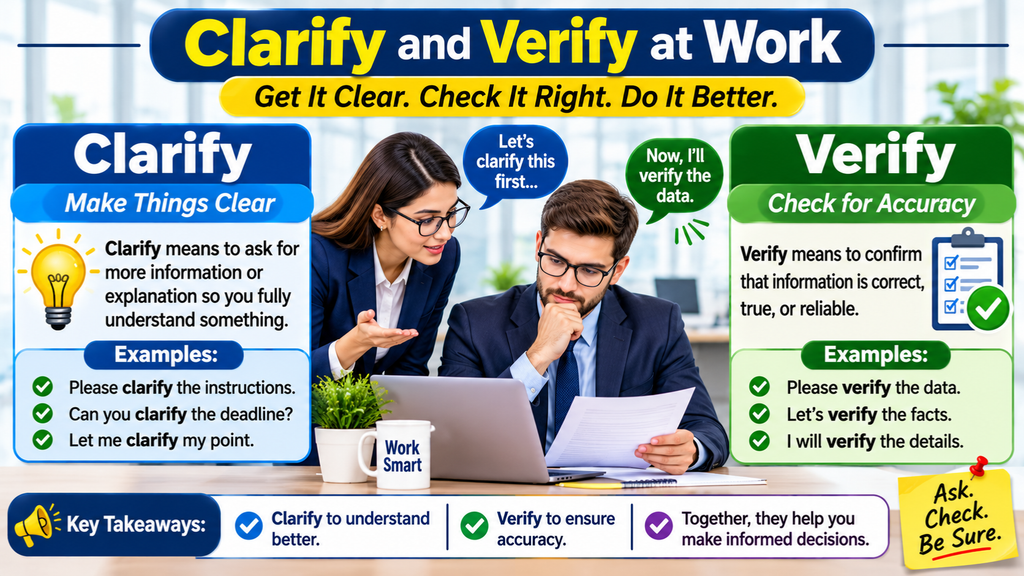
Email is where this matters most. Two lines that work as they stand:
“Could you clarify whether the deadline applies to drafts or only final files?”
“Could you verify the invoice number before I process the payment?”
Replies follow the same split. A clarifying answer sounds like “I meant final files only.” A verifying answer sounds like “I checked, and the number is correct.”
Customer support shows the difference neatly. An agent verifies your identity, and you clarify the problem you are having. Reporters verify claims before publishing, and editors ask writers to clarify sentences that read oddly. Researchers verify results and clarify their methods in the write-up. Security teams talk about verification and authentication when you log in with two-factor codes.
One note on tone: “please clarify” can sound curt on its own. Softening it, as in “Could you help me clarify the second point?”, costs a few words and reads friendlier.
Quick practice
Fill each blank with clarify or verify (in the right form), then check the answers below.
- Could you ___ what you mean by “soon”?
- I need to ___ the delivery address before I ship it.
- The spokesperson tried to ___ the confusing statement.
- Reporters must ___ a claim before they publish it.
- Please ___ that the total on the receipt matches the invoice.
- The new sign ___ the parking rules.
Answers: 1 clarify, 2 verify, 3 clarify, 4 verify, 5 verify, 6 clarifies.
FAQs
What is the difference between clarify and verify?
Clarify means making something clearer when it is confusing. Verify means checking that something is true. If your problem is “I don’t understand this,” you need clarification. If it is “I’m not sure this is right,” you need verification.
What does clarify mean?
It means to make something easier to understand, usually by rephrasing it or adding detail. You can clarify your own statement or ask someone to clarify theirs. “Let me clarify what I meant” is the classic use.
What does verify mean?
To verify is to check that something is accurate, true or genuine. That could mean comparing sources, confirming a number or proving an identity. When a site asks you to verify your email, it is checking that the address is real and yours.
Can clarify and verify be used interchangeably?
No. They solve different problems. Swapping them changes what the reader does: “verify” sends them off to check facts, “clarify” asks for an explanation. Both can appear in the same email, as long as each one has its own job.
Is “please clarify” polite?
It is correct but can read as blunt. A little padding helps. “Could you clarify the second point?” or “Could you help me understand this part?” sounds friendlier, especially with someone senior or someone you don’t know well.
What is the difference between clarify and confirm?
Clarify removes confusion about meaning. Confirm says or shows that something is definitely true or settled. You clarify a vague instruction and confirm a meeting time. If someone asks “Can you confirm?”, they want a yes or no, not an explanation.
What is the difference between verify and validate?
Verify checks whether something is true or accurate. Validate checks whether something is acceptable or follows a rule, such as a form field or a data format. A system can validate that an email address looks right, then verify that it actually works.
What is the difference between verify and authenticate?
Verify is the general word for checking that something is true. Authenticate is narrower: it proves that a person or thing is genuine, like a login or a signed document. Logging in authenticates you. Checking your answer against a source verifies it.
Is clarify the same as explain?
Not quite. Explain covers a topic in full, often from scratch. Clarify tidies up something already said but unclear. If someone missed one point in your talk, you clarify it. If they have never heard of the subject, you explain it.
Is clarification the same as verification?
No. Clarification is an explanation that makes something easier to understand. Verification is a check that shows something is true. A clarification answers “what do you mean?” A verification answers “is that actually correct?”
What does “verify your account” mean?
It means the service wants proof that the account is really yours. You usually click a link in an email, enter a code sent to your phone, or confirm an identity detail. Nobody is asking you to explain anything. The site is checking that you are who you say you are.
Is there a spelling difference between American and British English?
No. Clarify and verify are spelled the same in the US, UK, Canada and Australia, and so are clarification and verification. The only things that change are habits: some workplaces lean on “verify” in formal emails, others prefer “check” or “confirm.”
Final Thoughts
Here is the short version. Clarify when the problem is understanding. Verify when the problem is truth. If you can’t tell which one you need, ask what would end your doubt: a better explanation, or a check against evidence.
Once you start asking that, the mix-up mostly disappears. Choosing between clarify and verify is really a choice about what you want the reader to do next.
Next time you reach for either word in an email, run the five-second test first. Then share this page with the colleague who keeps writing “please verify” when they mean “please explain.”
Want more word pairs explained this plainly? Browse the full list of commonly confused word guides on ClearPenPress. Good places to start are lag vs log, moat vs mote, within vs withing and the sound-alike trap in throne or thrown.




5 Comments