Supersede or Supercede: Which Spelling Is Correct? Meaning, Rules and Examples
You are drafting a contract, updating a policy, or writing a software release note, and you type “this version ___ the previous one.” Then you freeze. Is it supersedes or supercedes? The Supersede or Supercede question is one of the most common spelling doubts in English, and even confident writers get it wrong.
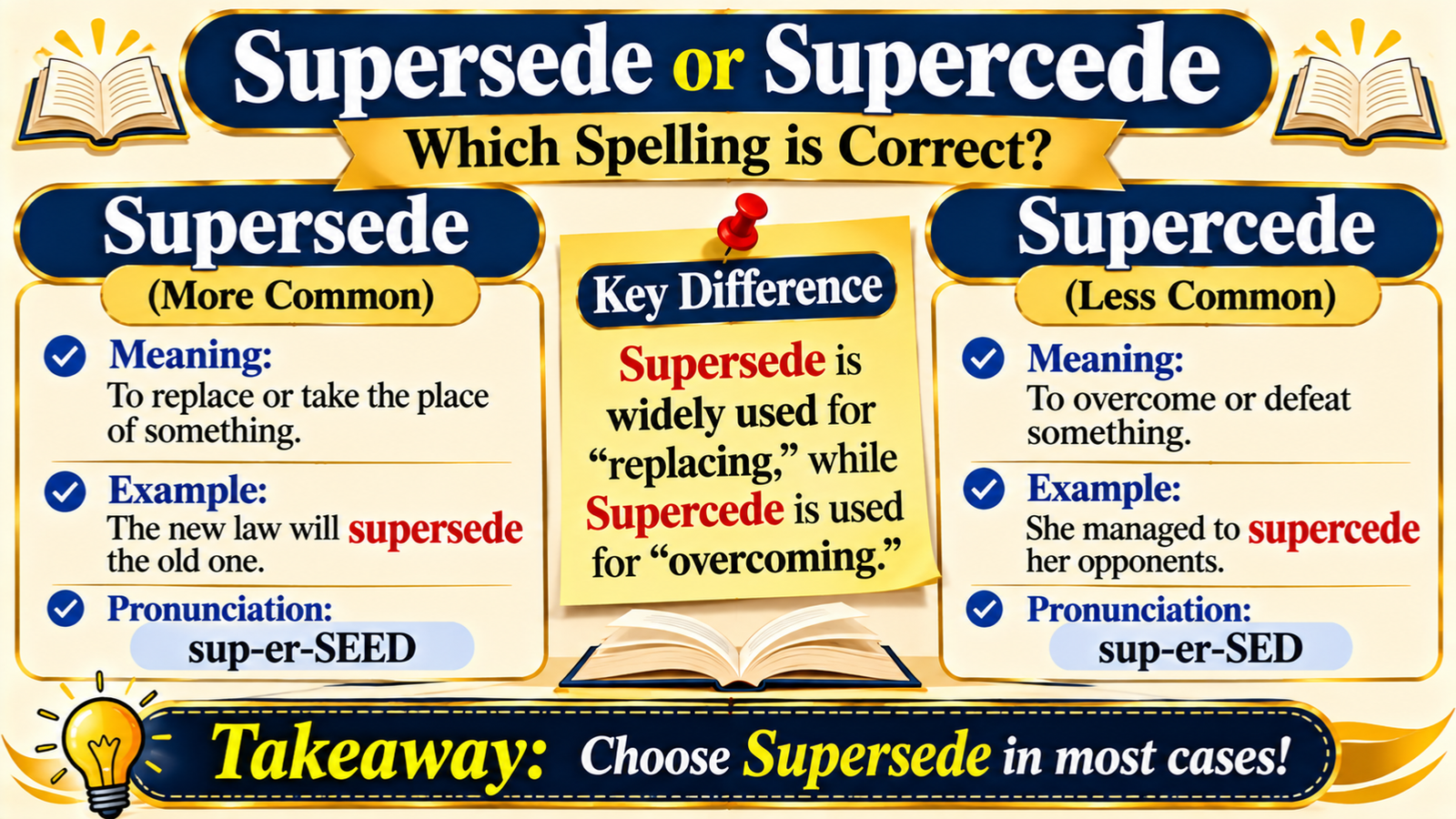
The short answer is that supersede is the standard, safe spelling. Supercede is a disputed variant that many readers still treat as a mistake. This guide explains Supersede or Supercede in plain English: what the word means, why the spelling is so confusing, the memory trick that fixes it, and how to use the word correctly in everyday and professional writing.
Supersede or Supercede: Quick Answer
Supersede is the standard spelling of a verb meaning to replace something older, weaker, or outdated, or to take its place. Supercede is a disputed variant that many readers still regard as an error. It is the only common English verb ending in -sede, so remember it as the odd one out: supersede, with an s.
If you only need a safe choice, use supersede. The rest of this article gives you the meaning, the rule, the history, and plenty of examples.
What Does “Supersede” Mean?
Supersede is a transitive verb, which means it takes an object. Merriam-Webster lists three main senses:
- To set aside or push out of priority. Work shouldn’t supersede our care for our bodies.
- To force something out of use because it is inferior, or to take its place. This edition supersedes the previous one.
- To displace someone or something in favor of another. Former stars were being superseded by younger actors.
In plain words, to supersede something is to replace it, to override it, or to take its place because the new thing is newer, better, or more important.
More examples:
- The new policy supersedes all earlier versions.
- A new indictment supersedes the previous charges.
- Japan’s semiconductor industry was superseded by rivals such as Taiwan and South Korea.
The last two examples come from Dictionary.com’s collection of news sentences, and they show that the word is used in real, current reporting. Notice that being superseded is not always good news for the thing replaced.
What About “Supercede”?
Supercede is a spelling variant of supersede. Merriam-Webster calls it a “disputed spelling variant” and notes three important facts:
- It has appeared in English since the 17th century.
- It is common in current published writing.
- It “continues to be widely regarded as an error.”
That last point matters. Even though supercede is not rare, a large share of editors, teachers, lawyers, and readers treat it as wrong. In formal writing, one visible spelling mistake can cost you credibility.
So the practical rule is simple: always write supersede. You lose nothing by using the standard spelling, and you avoid the risk of looking careless.
Supersede or Supercede: The Core Difference Explained
There is no difference in meaning between the two spellings. Both are meant to represent the same verb. The difference is acceptance.
| Feature | Supersede | Supercede |
| Status | Standard spelling | Disputed variant |
| Meaning | To replace or take the place of | Same meaning, intended |
| Ending | -sede | -cede |
| Accepted in formal writing | Yes | Often marked as an error |
| Safe choice | Yes | No |
So Supersede or Supercede is not a meaning problem. It is a spelling choice problem, and one of the two choices is much safer than the other.
Why Is Supersede or Supercede So Confusing?
The confusion has one main cause: the sound of the word. Most English words that end in the “seed” sound are spelled -cede, as in precede, recede, and concede. So when you hear supersede, your brain says, “Surely it is supercede, like the others.”
Three more things add to the confusion:
- The word is long, and the ending is easy to guess.
- The two spellings sound exactly the same.
- Supercede is common enough in print that it looks normal.
Here is the key idea: supersede does not follow the usual pattern. It is the exception, and that is why it is easy to misspell.
The -Cede, -Ceed and -Sede Rule
English has three spellings for the “seed” sound at the end of a verb. Proofed’s spelling guide explains how they divide:
| Ending | Words | How many |
| -cede | accede, concede, intercede, precede, recede, secede, cede | The large group |
| -ceed | exceed, proceed, succeed | Three words |
| -sede | supersede | One word |
So there are three -ceed verbs, one -sede verb, and the rest are -cede.
Here is a memory line for the rule:
Three words end in -ceed: exceed, proceed, succeed. One word ends in -sede: supersede. All the others end in -cede.
This rule is the heart of the answer. If you remember that supersede is the only one with -sede, you will never misspell it again.
Word Origin: Why Does Supersede Have an S?
The spelling makes sense once you know where the word came from.
Merriam-Webster traces supersede to Middle English (Scots) superceden, “to defer,” from Middle French superceder, from Latin supersedēre, “to sit on top of” or “refrain from.” Dictionary.com gives the same Latin source: from super- (“over”) plus sedēre (“to sit”).
Here is the memory-friendly part:
- super- means “over” or “above”
- sedēre means “to sit”
- So supersede originally meant “to sit above”
That Latin sedēre is the root of the -sede ending. It is the same root found in sedentary (sitting a lot). The “s” in supersede is the “s” in “sit.”
The sources differ slightly on the date. Merriam-Webster gives the first known use in English as 1654, while Dictionary.com says the word was first recorded between 1485 and 1495. Dictionaries use different evidence and methods, so both dates are cited here rather than choosing one.
Interestingly, Merriam-Webster’s own etymology shows the Middle English form spelled with a c (superceden). That helps explain why supercede has been around for centuries, even though the modern standard is supersede.
Supersede or Supercede: Active and Passive Use
Supersede is a transitive verb, so it works in both active and passive sentences.
| Voice | Pattern | Example |
| Active | new thing + supersedes + old thing | The new rule supersedes the old rule. |
| Passive | old thing + is superseded by + new thing | The old rule is superseded by the new rule. |
| Perfect | has/have superseded | The update has superseded earlier versions. |
| Passive perfect | has/have been superseded | Earlier versions have been superseded. |
| Continuous | is superseding | The new format is superseding the old one. |
Two useful notes:
- Use “by” in the passive. Write superseded by, not superseded from.
- Use “supersede” with an object. You supersede something. Avoid sentences like “The old rule superseded,” with no object.
In both voices, the answer is the same: every form keeps the s.
Supersede or Supercede in Dictionaries: What Do They Say?
Dictionaries do not all treat the variant in exactly the same way, so it helps to read the evidence carefully.
| Source | What it shows |
| Merriam-Webster (supersede) | Lists supersede as the entry word, with the forms superseded and superseding. |
| Merriam-Webster (supercede) | Calls supercede a “disputed spelling variant” that has existed since the 17th century and is common in current writing, yet “widely regarded as an error.” |
| Dictionary.com | Lists every form with -sede (supersedes, superseded, supersession) and does not use the -cede spelling. |
| Proofed spelling guide | Treats supersede as the only -sede verb and says it is often misspelled as supercede. |
Some style writers go further and say that supercede has never become an accepted alternative, unlike some other common errors. Merriam-Webster’s wording is a little softer: it records the variant but warns that many readers treat it as a mistake. Either way, the advice for Supersede or Supercede is the same: write supersede.
If you search a dictionary for supercede, you will often be pointed to the correct spelling. That is a quiet signal that the -sede form is the one editors expect.
Word Forms of Supersede
Supersede is a regular verb, so its forms are easy.
| Form | Spelling | Example |
| Base form | supersede | These rules supersede the old ones. |
| Third person | supersedes | The new law supersedes the old one. |
| Past tense | superseded | The new model superseded the old one. |
| Present participle | superseding | The superseding document is attached. |
| Past participle | superseded | The plan was superseded last year. |
| Person or thing that supersedes | superseder | (rare) The superseder of the old system was a cloud service. |
| Noun | supersession, supersedure | The supersession of the old rules was gradual. |
| Adjective | supersedable | (rare) A supersedable rule can be replaced. |
Three of these forms deserve a closer look:
- Supersession is the standard noun. Merriam-Webster defines it as “the act of superseding” or “the state of being superseded,” and gives 1764 as its first known use.
- Superseder names the one who supersedes. It is listed in reputable dictionaries, but you will rarely need it.
- Supersedable is an adjective that Merriam-Webster defines as “capable of being superseded.” It is rare in formal writing, so most editors would choose a plainer phrase such as “can be replaced.”
A useful point: every form keeps the -sede or -sed spelling. If you write the -cede form, you carry the same error into superceded, supercedes, and superceding.
So the correct forms are:
- supersedes, not supercedes
- superseded, not superceded
- superseding, not superceding
Supersede or Supercede in Sentences
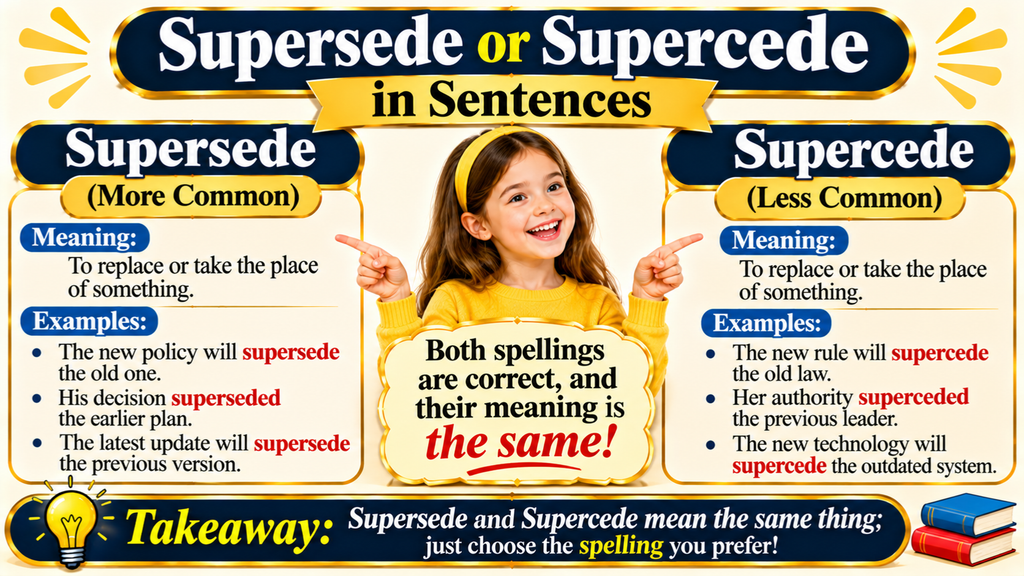
The best way to learn the right spelling is to see it in use. Here are examples in several settings.
Everyday writing
- The new schedule supersedes the one I sent last week.
- Please use the updated form; it supersedes the old one.
- His excitement was superseded by nerves.
- The paper phone book was superseded by online search.
Business and policy
- This agreement supersedes all prior agreements between the parties.
- The revised policy supersedes the 2022 version.
- The new manual supersedes every earlier edition.
Technology
- Version 2.0 supersedes version 1.9.
- The new standard has superseded the older one.
- Older devices are being superseded by faster models.
Law
- A new indictment supersedes the previous charges.
- State rules may be superseded by federal law in some cases.
Notice how each sentence has the same idea: something new takes the place of, or outranks, something old. This is the heart of the word: the verb always involves one thing replacing or outranking another.
Common Collocations With Supersede
Words that often appear with supersede help you use it naturally.
| Collocation | Example |
| supersede a rule | The new rule will supersede the interim one. |
| supersede an agreement | The final contract supersedes the draft agreement. |
| supersede a version | This build supersedes version 4.2. |
| supersede a decision | The court’s ruling superseded the earlier decision. |
| supersede an order | A new order supersedes the previous order. |
| supersede a tradition | Streaming has superseded the old broadcast schedule. |
| supersede in importance | Safety must supersede speed. |
| be superseded by | The old model was superseded by a newer one. |
| supersede all previous | This notice supersedes all previous notices. |
You can also see the idea of generations in the verb. A newer generation can supersede an older one, as when a child takes over the role their parent once held, or when a younger player takes a veteran’s place. In that sense, the word describes a natural order of replacement, not only a paperwork rule.
Supersede or Supercede in a Sample Clause
Here is a hypothetical example of how the word appears in a company document. Imagine a company updates its leave policy and adds this line at the top:
“This policy supersedes all previous leave policies, effective 1 January.”
The sentence does three jobs with one verb. It tells the reader that the old policies no longer apply, that the new policy now governs, and that the change has an effective date. If the writer had typed supercedes, the meaning would be clear, but a careful reader, such as a lawyer or an HR manager, would notice the error and may question the rest of the document.
Other common patterns include:
- This version supersedes all earlier versions.
- These terms supersede any prior agreement.
- This notice supersedes the notice dated 3 March.
In each case, the writer is saying that a newer document replaces an older one.
Supersede or Supercede in Different Contexts
The word appears most often in formal settings, so the correct spelling matters even more.
| Context | Typical use | Example |
| Contracts | the latest version cancels earlier ones | This contract supersedes all prior agreements. |
| Policies and handbooks | a new policy replaces an older one | The new handbook supersedes the old one. |
| Software and manuals | a new version replaces an older one | This release supersedes version 3.4. |
| Law | one rule outranks another | Federal law may supersede state law. |
| Academic writing | one theory replaces another | The new model superseded the older theory. |
| Everyday talk | one thing replaces another | Texting has superseded letters. |
In legal writing, Merriam-Webster lists additional senses: to postpone or suspend a judgment or order, to take the place of something in authority, and to replace something so that it becomes ineffective. This is why contracts and legal documents use supersede so often, and why the spelling is checked carefully.
Supersession in Governance and Official Language
The noun supersession appears in official and regulatory writing, where it means one body, rule, or authority taking the place of another. A news report about a banking regulator, for example, might describe the supersession of a board, meaning the board was replaced by administrators. You will not often use that form in casual writing, but it shows why the -sede spelling matters in formal text: official documents are read closely.
For Supersede or Supercede in everyday writing, you can usually choose a simpler verb. In formal and legal writing, supersede is precise because it says what takes priority, not only what was swapped.
Supersede or Supercede: Synonyms Compared
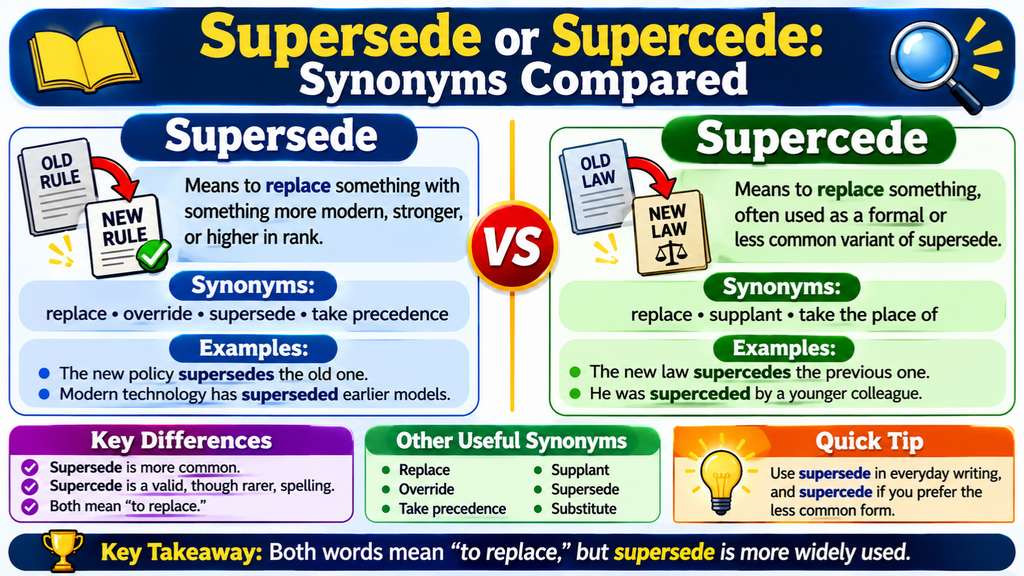
Supersede has close synonyms, but they are not identical.
| Word | Meaning | Example |
| supersede | replace something outdated or inferior, or outrank it | The new rule supersedes the old one. |
| replace | put something in the place of another | I replaced the battery. |
| override | set aside by greater authority | The manager overrode the decision. |
| supplant | take the place of, often by force or skill | He supplanted his rival. |
| displace | move something out of its place | Rising prices displaced many buyers. |
The synonym question matters too. Merriam-Webster lists replace, displace, and supplant as synonyms, and says supersede specifically implies replacing something obsolete or inferior. Use supersede when the new thing officially or clearly takes the place of the old.
The -Cede Family: What Each Word Means Next to Supersede
Because supersede is the exception, it helps to see the regular -cede words next to it. Most are common verbs, so you probably know them already.
| Word | Meaning | Example |
| accede | agree to a demand | The union acceded to the request. |
| cede | give up | The country ceded the land. |
| concede | admit something is true | She conceded the point. |
| intercede | step in to help or plead | He interceded on her behalf. |
| precede | come before | Silence preceded the speech. |
| recede | move back | The tide receded. |
| secede | withdraw from a group | The region voted to secede. |
Seeing the list in one place makes the exception clearer. All of these end in -cede, while supersede stands alone with -sede, and exceed, proceed, and succeed use -ceed.
Supersede or Supercede in Business Emails and Notices
Short notices are where this word appears most often. Here are ready-to-use patterns with the correct spelling:
| Situation | Sentence |
| Revised price list | Please note this price list supersedes the one dated 1 March. |
| Updated schedule | The attached timetable supersedes all earlier timetables. |
| New instruction | This instruction supersedes my previous email. |
| Policy update | Effective today, this policy supersedes the 2024 policy. |
| Corrected invoice | This invoice supersedes invoice 1042, which should be disregarded. |
| Document control | Version 3 supersedes version 2. |
A simple rule for notices: say what is being replaced, which document replaces it, and when. Then double-check that every form of the verb is spelled supersede, supersedes, superseded, or superseding.
Supersede vs Precede vs Proceed vs Succeed
Because of the -cede, -ceed, and -sede pattern, supersede is often mixed up with several look-alike verbs.
| Word | Meaning | Example |
| supersede | replace or take the place of | The new rules supersede the old ones. |
| precede | come before | A short film preceded the main feature. |
| proceed | go forward or continue | Please proceed to gate 12. |
| exceed | go beyond a limit | The speed exceeded the limit. |
| succeed | achieve a goal, or follow after | She succeeded in her plan. |
| recede | move back or away | The floodwaters began to recede. |
| concede | admit or give up | He conceded the point. |
The quick test: if you mean replace, spell it -sede. For every other verb in this table, the other endings apply.
Common Mistakes With Supersede or Supercede
| Incorrect | Correct | Why |
| The new rule supercedes the old one. | The new rule supersedes the old one. | The standard spelling is -sede. |
| The old model was superceded. | The old model was superseded. | The past tense keeps -sede. |
| The superceding document is attached. | The superseding document is attached. | Every form keeps -sede. |
| The speed superseded the limit. | The speed exceeded the limit. | The meaning is “go beyond,” not “replace.” |
| The film superseded the main feature. | The film preceded the main feature. | The meaning is “come before.” |
| Please supersede to the next room. | Please proceed to the next room. | The meaning is “go forward.” |
Other slips to avoid:
- Spelling supersede with -ceed, as in superceed. No standard word ends this way.
- Spelling the noun as supercession. The standard noun is supersession.
- Mixing spellings in one document. Pick supersede and keep it throughout.
Supersede or Supercede: Tips for Editors and Proofreaders
If you edit other people’s writing, Supersede or Supercede is a common find-and-replace job.
- Search for every form. Check supercede, supercedes, superceded, and superceding, not just the base form.
- Check the noun. Look for supercession and change it to supersession.
- Check the meaning. If a sentence says “supersede” but means “come before” or “go beyond,” the right word may be precede or exceed.
- Watch quoted text. If you are quoting a source word for word, keep the original spelling and note it instead of changing it.
- Stay consistent. Use one spelling throughout a document, contract, or website.
These five checks catch most problems in a single pass.
Memory Tricks and Quick Self-Test
These tricks settle Supersede or Supercede quickly.
Trick 1: Supersede is the only one. It is the only common English verb that ends in -sede. If you remember “the only one,” you remember the spelling.
Trick 2: Think of the S for “sit.” Supersede comes from Latin words meaning “to sit above.” The S is the S of sit.
Trick 3: Super special. Supersede is a super-special word, the one with the S.
Trick 4: Count the exceptions. Three -ceed words (exceed, proceed, succeed), one -sede word (supersede), and all others -cede.
Trick 5: Check the ending. If you are writing “replace,” the word ends in -sede. For the other verbs, use the table above.
Quick practice test. Choose the correct spelling for each blank.
- The new policy will ___ the old one. (supersede / supercede)
- The update ___ all earlier versions. (supersedes / supercedes)
- The paper map was ___ by GPS. (superseded / superceded)
- A short speech ___ the main event. (preceded / superseded)
- Please ___ to the front desk. (proceed / supersede)
- The new rules ___ the old ones. (supersede / supercede)
- His speed will ___ the limit. (exceed / supersede)
- The ___ version is attached. (superseding / superceding)
- She hopes to ___ in her new job. (succeed / supersede)
- Floodwater began to ___ after the storm. (recede / supersede)
Answers:
| # | Answer | Why |
| 1 | supersede | Standard spelling, meaning replace. |
| 2 | supersedes | Third person keeps -sede. |
| 3 | superseded | Past participle keeps -sede. |
| 4 | preceded | The meaning is “came before.” |
| 5 | proceed | The meaning is “go forward.” |
| 6 | supersede | Standard spelling. |
| 7 | exceed | The meaning is “go beyond.” |
| 8 | superseding | The participle keeps -sed. |
| 9 | succeed | The meaning is “achieve a goal.” |
| 10 | recede | The meaning is “move back.” |
If you got all ten right, you have mastered Supersede or Supercede.
Keep Learning: More Word Guides
Good spelling comes from reading many examples. These guides on Clear Pen Press build the same skills:
- Penality vs Penalty shows how a small spelling slip changes a word.
- Entail vs Intail covers another common misspelling.
- Within vs Withing separates a real word from a typo.
- Marveled or Marvelled explains an American and British spelling split.
- Characterize vs Characterise compares -ize and -ise endings.
- Criteria vs Criterion clears up a tricky singular and plural pair.
- Meter vs Metre shows another spelling difference between varieties of English.
- Browse all Spelling guides, all Vs comparisons, or the full grammar blog.
Frequently Asked Questions About Supersede or Supercede
Is it supersede or supercede?
The standard spelling is supersede. Supercede is a disputed variant that many readers regard as an error, so use supersede.
Is supercede ever correct?
It has been used as a variant since the 17th century, and Merriam-Webster notes that it is common in current published writing. But it is still widely regarded as an error, so it is not a safe choice.
What does supersede mean?
It means to replace something older, weaker, or less important, or to take its place. The new law supersedes the old one.
Why is supersede spelled with -sede?
It comes from Latin supersedēre, from super- (“over”) and sedēre (“to sit”). The -sede ending comes from that Latin root.
Is supersede the only English word ending in -sede?
According to Proofed’s spelling guide, yes. It is the only one of the common -cede, -ceed and -sede verbs spelled with -sede.
Which words end in -ceed?
Three verbs: exceed, proceed, and succeed.
Which words end in -cede?
Most of the rest, such as accede, concede, intercede, precede, recede, secede, and cede.
What is the past tense of supersede?
Superseded, as in The old rule was superseded.
What is the noun form of supersede?
Supersession and supersedure are the noun forms, and superseder names the person or thing that supersedes.
Is supersede transitive?
Yes. It takes an object: The new rule supersedes the old rule.
What is the difference between supersede and precede?
Supersede means to replace. Precede means to come before. A film can precede the main feature without replacing it.
What is the difference between supersede and exceed?
Exceed means to go beyond a limit. Supersede means to replace. They are not interchangeable.
Can I use supersede in legal writing?
Yes. It is common in contracts and laws, where it means that a newer document or rule replaces or outranks an older one.
What are synonyms for supersede?
Replace, displace, supplant, and override, though each has a slightly different shade of meaning.
How can I remember the spelling of supersede?
Remember that it is the only common verb that ends in -sede, and that the S stands for “sit,” from its Latin root.
Is supersedable a real word?
Yes. Merriam-Webster lists it as an adjective meaning “capable of being superseded.” It is rare, so in formal writing a phrase like “can be replaced” is usually clearer.
What is the noun for supersede?
The standard noun is supersession, which Merriam-Webster defines as the act of superseding or the state of being superseded.
Is superseder a word?
Yes, it is a listed noun for one who supersedes, but it is used very rarely.
Do dictionaries list supercede?
Merriam-Webster lists it as a disputed variant. Other dictionaries may simply point you to the standard spelling, so check the entry, and when in doubt, use supersede.
Final Thoughts
The Supersede or Supercede question has a short answer. Use supersede. It is the standard spelling, it matches the Latin root sedēre, and it is the only common English verb that ends in -sede. Supercede is a disputed variant that many readers still treat as a mistake, so avoid it in professional writing.
Memory tip: Three words end in -ceed, one word ends in -sede (supersede), and the rest end in -cede.
Sources checked: Merriam-Webster: supersede, Merriam-Webster: supercede, Dictionary.com: supersede, Proofed: cede, ceed and sede.